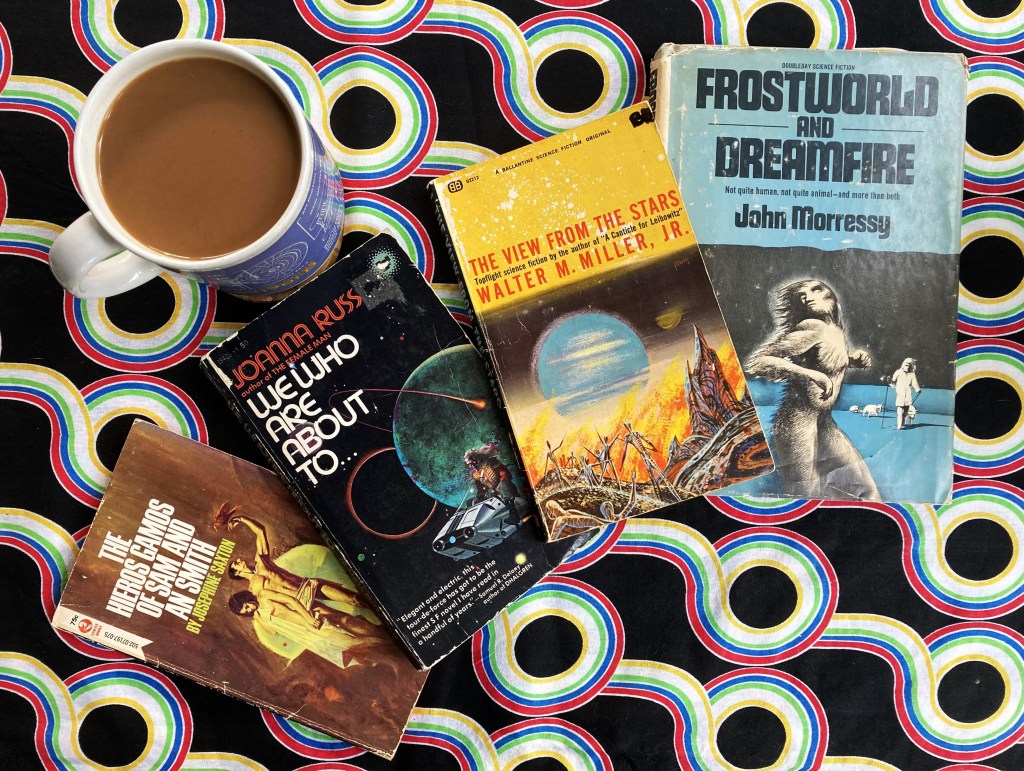
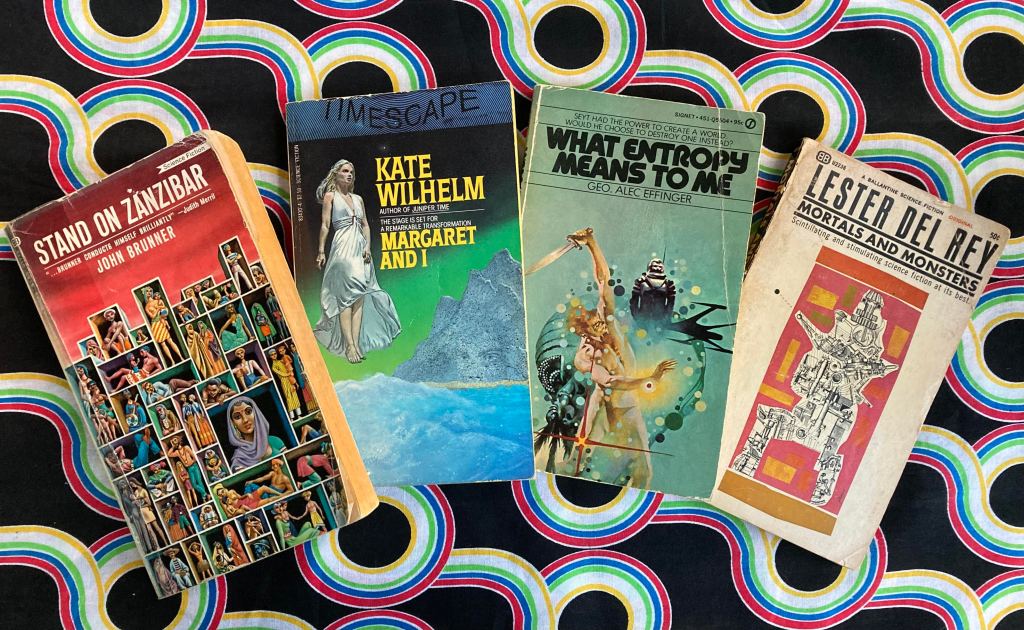
What pre-1985 science fiction are you reading this weekend?
Thank you all for making this fanzine column a success! I’ve thoroughly enjoyed the conversations and connections you all have made in the comments. Make sure to check out the previous installment if you haven’t already. As before, I’ve included a bit about the books in the photograph, birthdays from the last two weeks, and brief ruminations on what I’ve been reading and writing.
Robert Foster’s cover for the 1st paperback edition
5/5 (Masterpiece)
Nominated for the 1965 Hugo Award for Best Novel [1]
Edgar Pangborn’s Davy (1964) takes place in a future devastated by a partially abortive nuclear war and the depravations of subsequent plagues (50). A powerful theocracy and perpetually warring microstates in the American Northeast emerged from the Years of Confusion. The novel takes the form of an autobiography. We follow a young orphan in love with life and desperate to escape his unfortunate circumstances.
What pre-1985 science fiction are you reading this weekend?
After the success of the previous installment, I’ve decided to make this a bimonthly post (“column”) for my site (“fanzine”). As before, I’ve included a bit about the books in the photograph, birthdays from the last two weeks, and brief ruminations on what I’ve been reading and writing.
Which books/covers/authors intrigue you? Which have you read? Disliked? Enjoyed?
1. The Saliva Tree and Other Strange Growths, Brian W. Aldiss (1966)
Les Edwards’ cover for the 1979 edition
Contents: “The Saliva Tree” (1965), “Danger: Religion!” (1962), “The Source” (1965), “The Lonely Habit” (1962), “One Role with Relish” (1966), “Legends of Smith’s Burst” (1959), “Day of the Doomed King” (1965), “Paternal Care” (1966), “Girl and Robot with Flowers” (1965)
Today I’ve reviewed the 28th story in my series on the science fictional media landscape of the future. In Henry Kuttner’s masterpiece “Year Day” (1953), a couple attempts to rekindle their relationship in the midst of a sonic deluge of advertising that threatens to blot out their thoughts.
Richard Powers’ cover for the 1st paperback edition
5/5 (Masterpiece)
Henry Kuttner’s “Year Day” first appeared in his collection Ahead of Time (1953). Some of the other stories in the collection were co-written with his wife C. L. Moore. You can read the story online here.
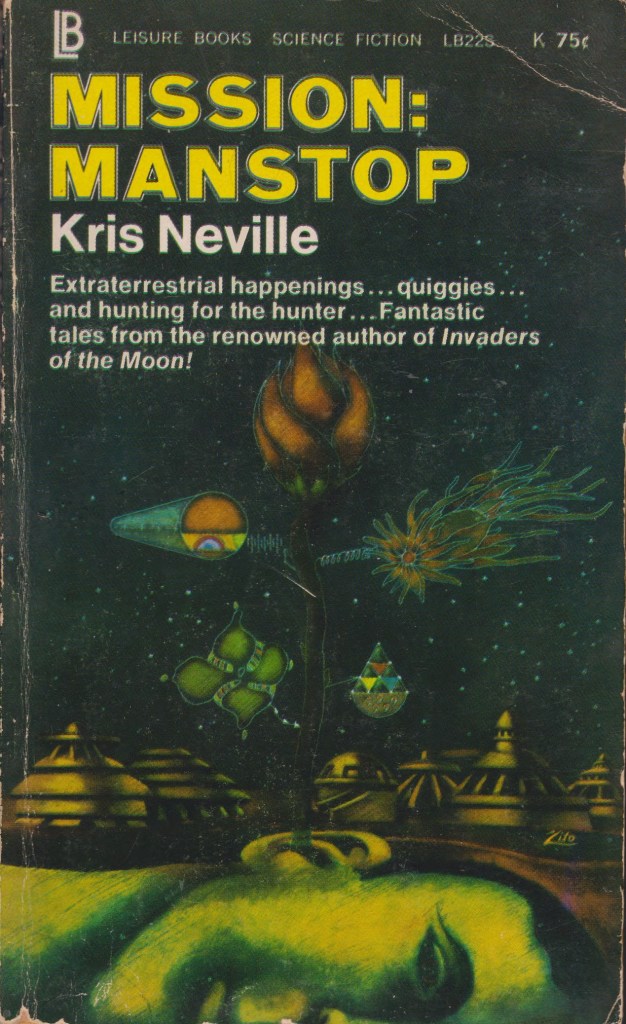
The career of Kris Neville (1925-1980) can be divided broadly into two parts. In his most productive period (1949-1957), Neville’s SF appeared in all the major magazines of the day, The Magazine of Fantasy and Science Fiction in particular. Afterwards, while he continued to publish short stories at a far reduced clip until his death, he wrote a handful of fix-up novels between 1964-1970. This trajectory neatly maps onto the restriction of magazine markets in the late 50s and the growing importance of the SF novel.
I’ve returned from my expedition abroad. It’s time to get back to writing about science fiction! But first, there are always new books that have accumulated at my doorstep…
Which books/covers/authors intrigue you? Which have you read? Disliked? Enjoyed?
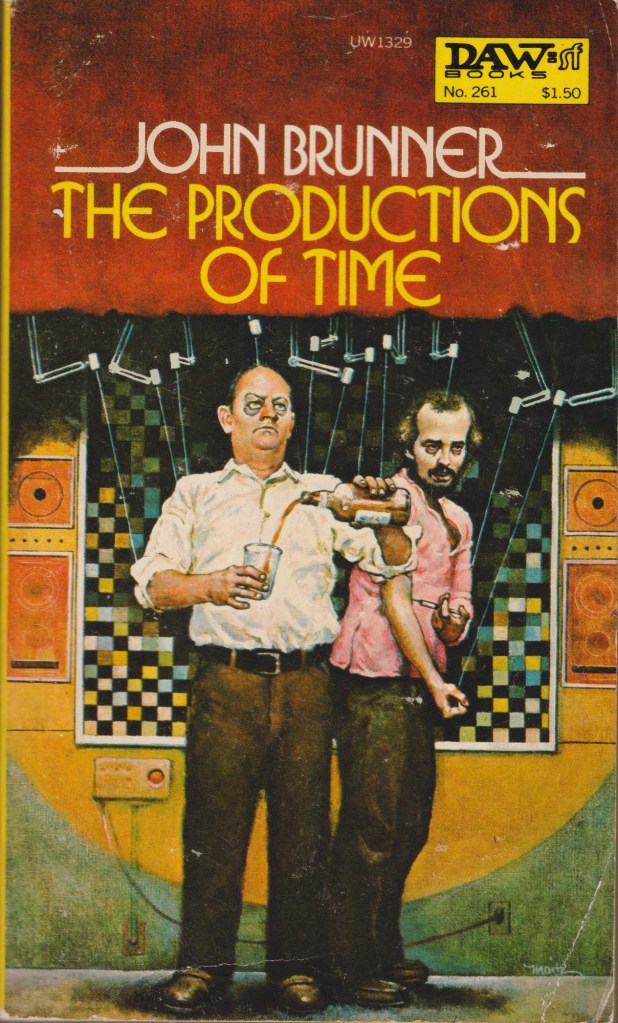
1. The Productions of Time, John Brunner (serialized 1966)
Don Maitz’s cover for the 1977 edition
From the back cover: “Murray Douglas had been a theatrical star until he’d hit the bottle once too often. But now he had broken the habit, and, handsome and fit, was ready for a comeback. The most challenging opening available was an avant-garde play where the actors themselves would make up the drama as they went along.
But out at an isolated country estate where the rehearsals were going on, Murray found himself trapped on a real-life day-and-night stage in which nothing was as it seemed, in which inexplicable devices monitored everything and eerie lures attracted each actor’s psychological weakness.
Who then was the real sponsor of this terrifying play–and to what alien audience was it to be presented?
By the Hugo-winning author of STAND ON ZANZIBAR, this is the first unabridged American edition of this John Brunner classic.”
This is Part I of II in a series covering the short fiction of Russell Bates (1941-2018), one of a handful of Native American science fiction authors active in the 1970s [1]. I first came across his name while investigating all the authors featured in Craig Strete’s Native American fanzine Red Planet Earth (6 issues in 1974) [2]. I’ve managed to piece together the following information about his SF career.
Born in Lawton, Oklahoma (I’ve also seen Anadarko, OK implied as a birthplace), Bates was an enrolled member of the Kiowa tribe. After he finished high school, he entered the U.S. Air Force. While injured after an explosion at a missile assembly building, he was encouraged to take up a hobby. He began writing science fiction stories–including Star Trek fanfiction (discussed in more detail below) [4].
Interested in honing his craft, Bates attended the famous Clarion workshop in 1969, and his first story, “Legion” (1971), hit print two years later [4]. He published six science fiction short stories between 1971-1977. A seventh–“Search Cycle: Beginning and Ending 1. The Last Quest; 2. Fifth and Last Horseman”–was scheduled to appear in Harlan Ellison’s infamous Last Dangerous Visions, originally slated for 1973. It hasn’t been published elsewhere.
Bates decided to try his luck in Hollywood. He joined a Writer’s Guild program for minorities with the assistance of D. C. Fontana. Initially unsuccessful, his rejected Star Trek story attempt later appeared in The New Voyages 2(1978). He kept the American Indian crew member Walking Bear that later appeared in his only co-written Star Trek credit ST: The Animated Series’ “How Sharper Than a Serpent’s Tooth” (1974). It is for this episode that Bates is probably best known as it is the only episode of the two original Star Trek series that won an Emmy Award. Unfortunately, despite quite a few sales to the motion picture industry, few of his stories saw the screen after his early Star Trek credit [5].
Without further tangents, lets turn to his first three science fiction short stories–each a rumination on violence and trauma–to hit print.
Jim Steranko’s cover for Infinity Two, ed. Robert Hoskins (1971)
Today I’ve reviewed the twenty-sixth and twenty-seventh story in my series on the science fictional media landscape of the future. In Kate Wilhelm’s masterpiece of blue-collar drama “Ladies and Gentlemen, This Is Your Crisis” (1976), reality TV serves both as domestic irritant and therapy. Langdon Jones, in “The Empathy Machine” (1965), also speculates on the therapeutic aspects of “viewing” the crisis of another in a media-drenched future.
As always, if you know of other stories connected to this series that I haven’t reviewed, then let me know in the comments!
David Plourde’s cover art detail for the 1978 edition of Best Science Fiction Stories of the Year: Sixth Annual Collection, ed. Gardner Dozois (1977)
5/5 (Masterpiece)
Kate Wilhelm’s “Ladies and Gentlemen, This Is Your Crisis” first appeared in Orbit 18, ed. Damon Knight (1976). You can read it online here if you have an Internet Archive account. I read it in her collection Somerset Dreams and Other Fictions (1979).
Lottie comes home from the factory Friday afternoon with “frozen dinners, bread, sandwich meats, beer” to prepare for the weekend watching reality TV with her husband Butcher (121). As predicted, Butcher comes home mad, “mad at his boss because the warehouse didn’t close down early, mad at traffic, mad at everything” (123). He pulls up his recliner–they’ll sleep in front of the softly flickering screens–Lottie microwaves the dinners and brings her husband beer. The ritual commences.