Short Story Reviews: Lisa Tuttle’s “Stone Circle” (1976) and Grania Davis’ “New-Way-Groovers Stew” (1976)

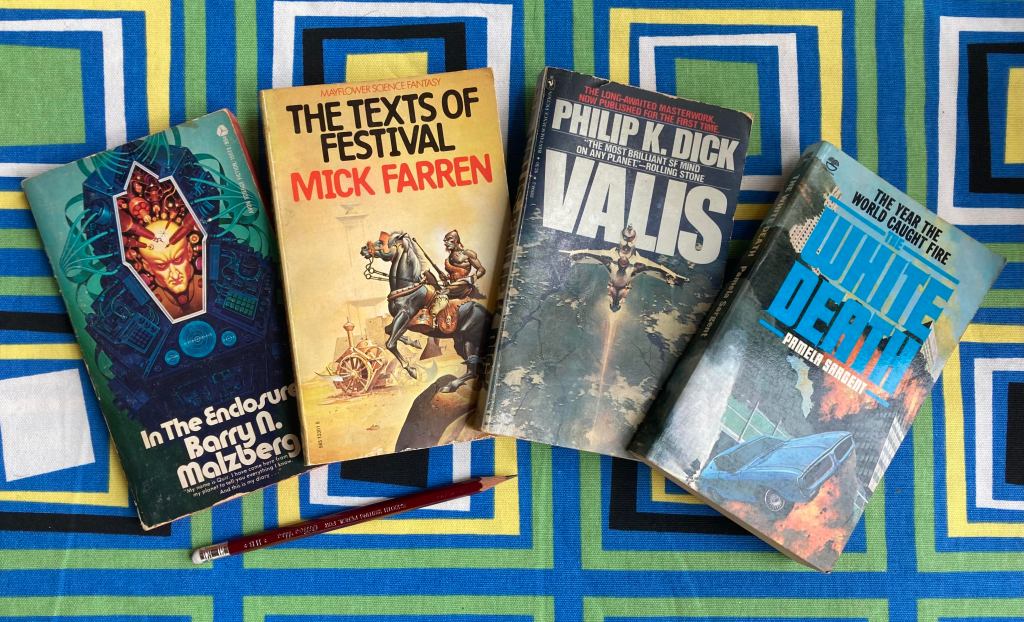
While perusing Eric Garber and Lyn Paleo’s indispensable resource Uranian Worlds: A Reader’s Guide to Alternative Sexuality in Science Fiction and Fantasy (1983, second ed. 1990), my eyes fell on stories by Lisa Tuttle and Grania Davis.1 I’ve never read the work of Lisa Tuttle and I know little to nothing about Grania Davis beyond “My Head’s in a Different Place, Now” (1972), which I tersely dismissed as “zany and forgettable.” I’m glad I decided to pair the stories. Both tackle the inability of 60s radicalism to create a lasting ideological movement. Both stories come with caveats.

Preliminary Note: In the future, I might cover problematic stories on this theme or others with a strong heterosexual bias. They too reveal how people thought about queer topics through the lens of science-fictional extrapolation at different points in history.

Let’s get to the stories!


4.25/5 (Very Good)

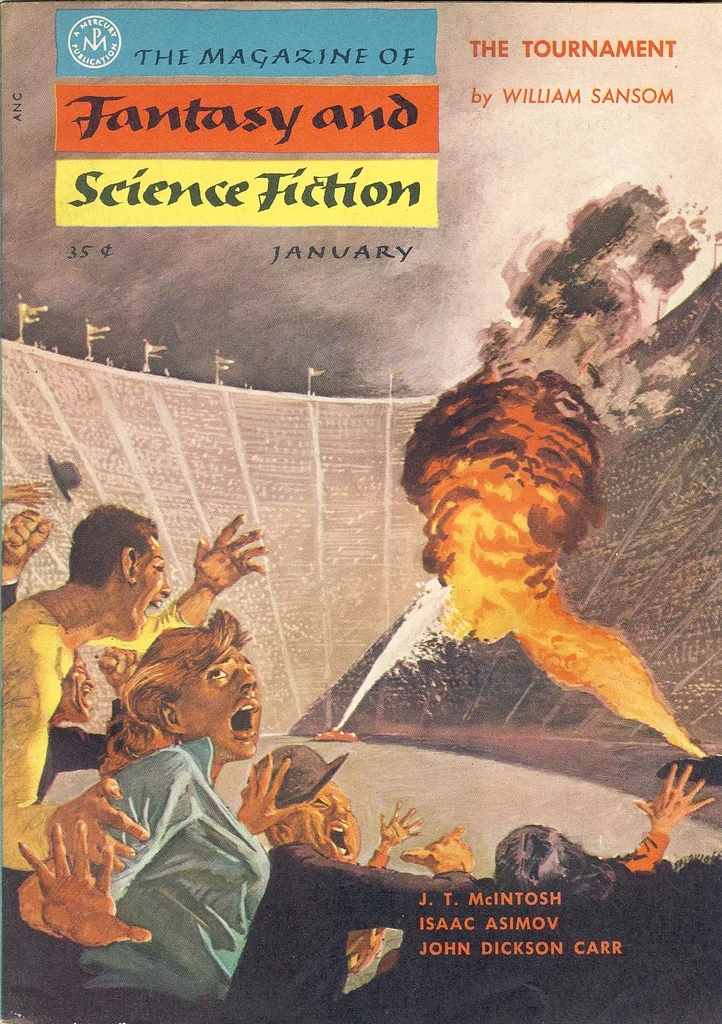
Lisa Tuttle’s “Stone Circle” first appeared in Amazing Stories, ed. Ted White (March 1976). You can read it online here. It was nominated for the 1977 Nebula Award for Best Short Story.

Continue reading

Book Review: The Shadow Hunter, Pat Murphy (1982)

3.75/5 (Good)

Pat Murphy’s first novel The Shadow Hunter (1982) is an achingly beautiful tale of displacement. In the distant past, a young Neanderthal boy embarks on a hunt to claim his name and to learn the nature of the world. In the near future, a mogul named Roy Morgan wants to create a Pleistocene oasis (The Project) ensconced in a valley in an increasingly urban world. Morgan employs two damaged souls, Amanda and Cynthia, to aim his machines–that reach backward and forward into time.

Continue reading

What pre-1985 science fiction are you reading? + Update No. XV

What pre-1985 science fiction are you reading or planning to read this month? Here’s July’s installment of this column.

Last month I waxed rhapsodic about a powerful interaction with a professor in graduate school… this month I’ll show you a recent obsessive territory I’ve been reading and ruminating about: 1940s and 1950s (and a few from the 60s) social commentary on American affluence, technology, and media. It all started with my media landscapes of the future series–I could not write on the topic unless I read some Marshall McLuhan. And then I had to read about C. Wright Mills to write about Clifford D. Simak and organized labor. And then I needed to track down other popular authors of social commentary published in era. It should not be surprising so much 50s SF revolved around social commentary — it was in the air. You get the idea. This pile represents some of what I now own:

Continue reading

Updates: Recent Science Fiction Purchases No. CCCXXXVI (Clare Winger Harris, Frederik Pohl, Barrington J. Bayley, and Robert Asprin)

Which books/covers/authors in the post intrigue you? Which have you read? Disliked? Enjoyed?

1. Away From the Here and Now, Clare Winger Harris (1947)

From the inside flap: “In this age of atomic bombs and radar to the moon, Mrs. Harris’ stories may prove closer to the “here and now” than the title would indicate. Mrs. Harris Proudly claims the distinction of being the first woman science-fiction writer in the country. Each of her stories is based upon a sound scientific fact, carried so plausibly to the nth degree that at no time does it overstain credulity. The stories possess the qualities of dealing with ideas of big importance to the human race, of presenting those ideas in a plausible form, and of appealing to emotions that exist deep within the heart of every human being whether he be scientific or not.

Continue reading

What pre-1985 science fiction are you reading? + Update No. XIV

What pre-1985 science fiction are you reading or planning to read this month?

Here’s June’s installment of this column.

I’m periodically plagued by the virulent Esoterica virus, the relentless desire to catalogue and write about the less known, and even better, the completely unknown. While attending a Medieval English literature graduate class, I remember a conversation I had with the professor, Robert D. Fulk, during office hours about the sheer quantity of scholarship on Beowulf (here’s his edition of the iconic text). I pointed out the panic I experience if I’m unable to read ALL the scholarship on a popular text.

Continue reading

Short Story Reviews: Hugo Correa’s “Alter Ego” (1967) and “Meccano” (1968)

Today I’m joined again by Rachel S. Cordasco, the creator of the indispensable website and resource Speculative Fiction in Translation, for the third installment of our series exploring non-English language SF worlds. Last time we covered Vladimir Colin’s Lem-esque story of an unusual alien encounter “The Contact” (1966, trans. 1970). We have stories from the Netherlands, Austria, Poland, and France in the queue.

This time we shift continents from Europe to South America with two stories by Hugo Correa (1926-2008). According to SF Encyclopedia, Correa was the “leading Chilean sf author of his generation.” Unfortunately, his best-known work, the novel Los altímos (The Superior Ones) (1951, rev. 1959) remains untranslated. Correa’s brief appearance in the American market–three short stories–came courtesy of Ray Bradbury. In 1961, the young Chilean author received a grant to participate in the writers’ workshops at the University of Iowa. He translated a handful of his own stories from Spanish to English and sent them to Ray Bradbury, who responded “with enthusiasm and encouragement.” Bradbury met with Correa when he visited Los Angeles, and the famous SF author sent a few of the translated stories to various magazine editors. Four stories eventually appeared in the North American market. It’s a shame that more of his work hasn’t been translated — yet alone a complete bibliography compiled at The Internet Speculative Fiction Database. The SF Encyclopedia entry mentions works that aren’t listed in the database. And this Spanish-language website contains a far more extensive bibliography.

We’ve selected two of his four translated stories for this post:

  1. “Alter Ego” first appeared in The Magazine of Fantasy and Science Fiction, ed. Edward L. Ferman (July 1967). You can read it online here.
  2. “Meccano” first appeared in International Science-Fiction, ed. Frederik Pohl (June 1968). You can read it online here.

Both are super short and worth the read.

Now let’s get to our reviews!

Rachel S. Cordasco’s Reviews

Continue reading

Short Story Review: Robert Abernathy’s “Single Combat” (1955)

In January, I inaugurated a new review series on the urban landscape in science fiction. I finally present the second post! And it’s a good one. I am joined by Anthony Hayes, a frequent contributor and creator of wonderful conversations over the last few years on the site (as antyphayes). I recommend you check out his website The Sinister Science. In addition to ruminations on science fiction–often through the lens of his academic PhD research in the Situationist International, “as well as other related left-communist and post-situationist writings,” he creates fascinating collages that interweave comic books, textual play, and historical images.

We chose Robert Abernathy’s deceptively complex parable of urban alienation “Single Combat” (1955) as our inaugural story. It first appeared in The Magazine of Fantasy and Science Fiction, ed. Anthony Boucher (January 1955). You can read it online here.

Previously: Michael Bishop’s “The Windows in Dante’s Hell” (1973), Barrington J. Bayley’s “Exit from City 5” (1971), and A. J. Deutsch’s “A Subway Named Mobius” (1950).

Up Next: TBD


Anthony Paul Hayes’ Rumination

Urban alienation writ large: Robert Abernathy’s “Single Combat”’ (1955)

Having planted an explosive device in a forgotten corner of an unnamed, North American city, the similarly unnamed protagonist flees. However, in fleeing the protagonist comes to realise what they had hitherto only suspected: that the city has become a living, conscious thing, and like all such things is willing to fight for its survival.my

Continue reading

Short Book Reviews: Clifford D. Simak’s They Walked Like Men (1962) and Jacques Sternberg’s Sexualis ’95 (1965, trans. 1967)

Note: My read but “waiting to be reviewed pile” is growing. Short rumination/tangents are a way to get through the stack before my memory and will fades. My website partially serves as a record of what I have read and a memory apparatus for future projects. Stay tuned for more detailed and analytical reviews.


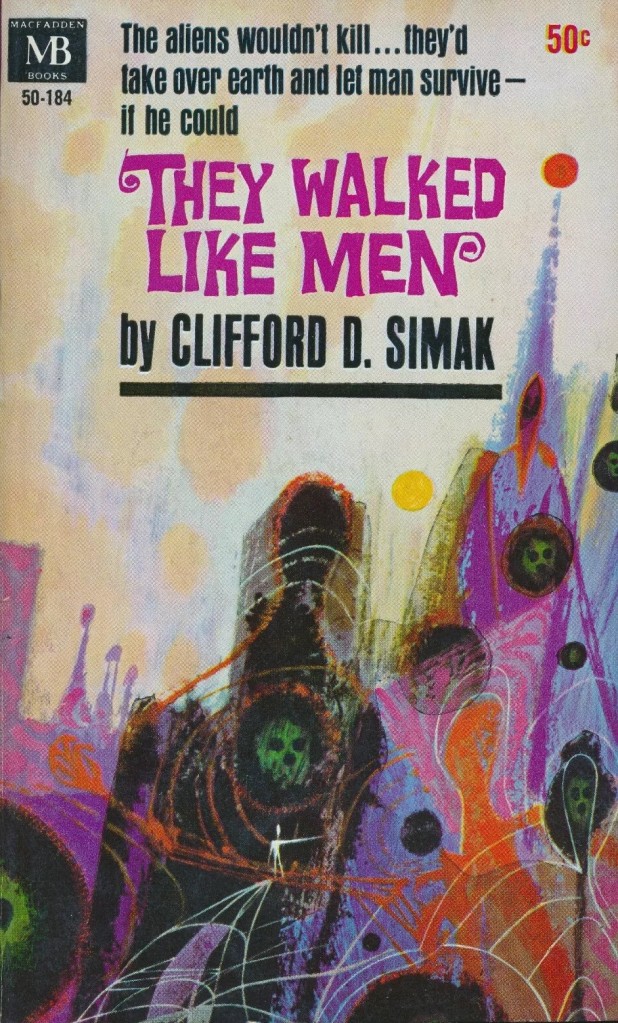
1. They Walked Like Men, Clifford D. Simak (1962)

3/5 (Average)

In a confrontation with maleficent alien land prospectors in Clifford D. Simak’s They Walked Like Men (1962), the main character ruminates that “it was almost if [we] were acting out an old morality play, with the basic sins of mankind enlarged a millionfold to prove a point by exaggeration” (113). Simak’s moment of meta-commentary on his own narrative and tonal choices gives shape to odd conjuration of juvenile comedy and apocalyptic extrapolation of capitalism unleased.

Continue reading

What pre-1985 science fiction are you reading? + Update No. XII

What pre-1985 science fiction are you reading or planning to read this month?

Here’s April’s installment of this column.

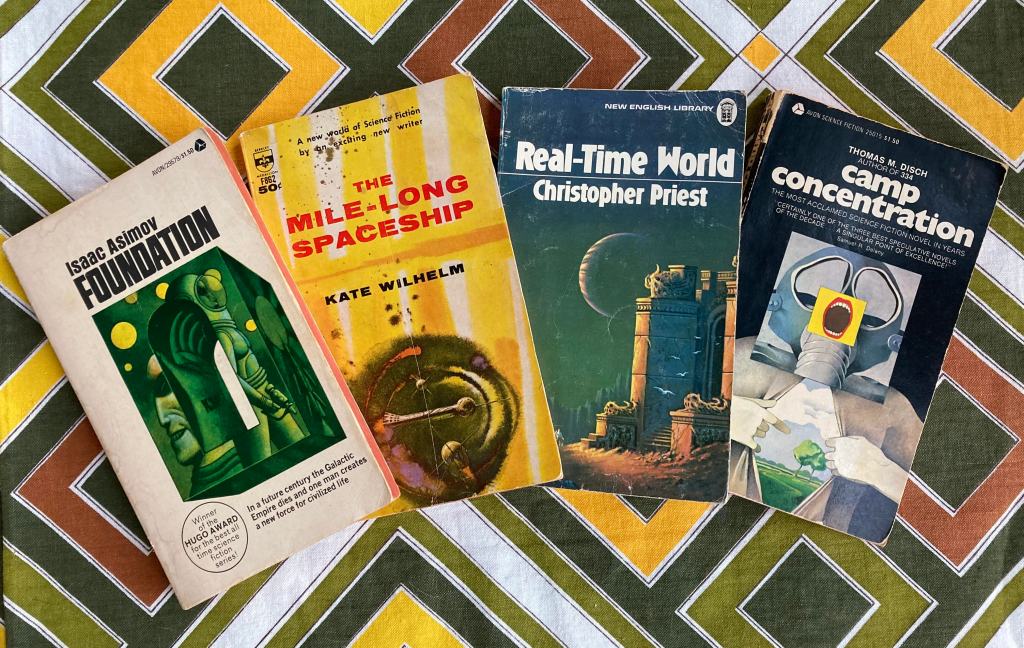
First, a bit about Isaac Asimov’s Foundation (1951) from M. Keith Booker’s Monsters, Mushroom Clouds, and the Cold War: American Science Fiction and the Roots of Postmodernism, 1946-1964 (2001), my current history of science fiction read:

Continue reading