Book Review: Godling, Go Home!, Robert Silverberg (1964)

(Uncredited cover for the 1964 edition)

3.25/5 (Average)

Before Robert Silverberg wrote his late 60s and early 70s New Wave masterpieces (A Time of Changes, Dying Inside, The World Inside, etc), he produced a vast quantity of pulp science fiction novels and short stories.  Godling, Go Home! (1964) is a surprisingly solid collection of 50s shorts that can, at times, be surprisingly meditative (on death, exploration, civilization).  That said, expect rather naive messages — à la “we travel in space because we can!” or “Alien contact requires out-of-the-box thinking” — grafted onto a by the numbers pulp plot.

A fun collection — recommended for fans of slightly more intelligent than normal pulp SF, Silverberg completes, and 50s SF.  “Godling, Go Home!” (1957), “Why?” (1957), and Continue reading

Book Review: Chronocules (variant title: Hot Wireless Sets, Aspirin Tablets, the Sandpaper Sides of Used Matchboxes, and Something that Might have been Castor Oil), D. G. Compton (1970)

(Diane and Leo Dillon’s cover for the 1970 edition)

3/5 (Average)

D. G. Compton has long been one of my favorite SF authors.  Regrettably, his readership remains small and he has ceased publishing SF.  Novels like The Continuous Katherine Mortenhoe (variant title: The Unsleeping Eye) (1973) and Synthajoy (1968) are first rate masterworks with Farewell, Earth’s Bliss (1966) and The Steel Crocodile (1970) close behind.  All of his works have a distinctly English feel with solid, and occasionally beautiful, prose.

Chronocules (1970), with its outrageous variant title Hot Wireless Sets, Aspirin Tablets, the Sandpaper Sides of Used Matchboxes, and Something that Continue reading

Book Review: As on a Darkling Plain, Ben Bova (1972)

(Chris Moore’s cover for the 1981 edition)

2.75/5 (Average)

Unfortunate title aside (“darkling” sound like a small evil creature in a work of fantasy), Ben Bova’s As on a Darkling Plain (1972) is a middling fix-up novel in every respect.  It is worth noting that Chapters 5 (‘The Jupiter Mission’) and 6 (‘The Sirius Mission’), which comprise a great majority of the novel, appeared earlier in If February 1970 and Galaxy January 1969 as “Pressure Vessel” and “Foeman, Where Do You Flee?” respectively.  I’m not sure how much was expanded or subtracted.  If anyone knows please leave a comment — I find that the act of revising earlier work interesting in itself.

Bova’s novel inspired my recent cover art post on Future Archeology and Mysterious Artifacts.  The premise is a standard one: A mysterious artifact Continue reading

Updates: Recent Science Fiction Acquisitions No. LXVIII (Varley + Cherryh + Cummings + et. al)

Some fun finds!  Perhaps surprisingly, I still haven’t read Clarke’s “The Sentinel” (1951) so I was happy to find it in a collection collated by Kingsley Amis and Robert Conquest — Spectrum 3 (1963).  Even more appealing are the famous Poul Anderson, J. G. Ballard, and Murray Leinster tales in the same volume…  The entire Spectrum collection (I-V) brings together some fantastic works.

John Varley is one of the important 70s writers that I still haven’t read. Thus, despite the egregious cover, I snatched his collection of 70s stories, The Persistence of Vision (1978)…  I look forward to diving into this one.

Also, C. J. Cherryh was one of my favorite authors as a teen so it’s always nice to come across one of her works I hadn’t devoured yet — in this case, her second novel Brothers of Earth (1976).

1. The Persistence of Vision, John Varley (1978)

(Jim Burns’ cover for Continue reading

Book Review: Approaching Oblivion, Harlan Ellison (1974)

(Leo and Diane Dillon’s cover for the 1974 edition)

4.25/5 (collated rating: Good)

Ellison’s stories punch where it hurts.  Approaching Oblivion (1974) is filled with transfixing tales about violent future racism (“Knox”), humanity’s last moments (“Kiss of Fire”), the desperate desire to change one’s own past (“One Life, Furnished in Early Poverty”), a last rebel against the militarizing system (“Silent in Gehanna”), and familial rivalry within a vast arcology (“Catman”), etc…

They are terrifying and vicious, immersive and gut-wrenching, and span from baroque far future speculations to near future warnings.  Above all, they are well-written and intelligent.  Many are infused with (pseudo) autobiographical content and lament the societal ills Continue reading

Adventures in Science Fiction Cover Art: Future Archaeology and Mysterious Artifacts (Alien + Human)

SPCSCNCFCC1953

(Hannes Bok’s cover for the  Space Science Fiction [UK], Volume 1 No. 4 (1953), ed. unlisted)

A spaceship arrives on Mars…  After a cursory initial exploration, the human astronauts conclude that the planet has always been barren and uninhabited.  But in some chasm or scattered in desolate plain, a column is found, and rows of mysterious buildings, and a pulsating crystal…  An abandoned outpost of an alien society?  Or, Earth’s mysterious forebearers…  Summaries such as this one proliferate the dusty SF paperbacks on back shelves of used book stores and the closets of SF fans — the variations are countless.

Queue my cover art theme: The future discovery of mysterious ruins/artifacts Continue reading

Book Review: Why Call Them Back From Heaven?, Clifford D. Simak (1967)

(Leo and Diane Dillon’s cover for the 1970 edition)

4.5/5 (Very Good)

I have found that the most successful science fiction novels on the theme of immortality are not about the immortals themselves or the state of “being immortal.”  Novels like Raymond Z. Gallun’s The Eden Cycle (1974) might attempt to convey, at moments effectively, the ennui of an endless existence with endless possibilities but, as with mind of the immortal in question, the reader too feels the effects of endless, repetitive inundation.  Rather, the most successful and evocative novels — for example James Gunn’s The Immortals (1962) — explore the social space that is created by the presence of immortals although they might be only peripheral characters.  Simak’s Why Call Them Back From Heaven? (1967) takes Gunn’s premise a step further: What would happen to our society if almost everyone bought into the idea that immortality would be a real possibility sometime in the future? Continue reading

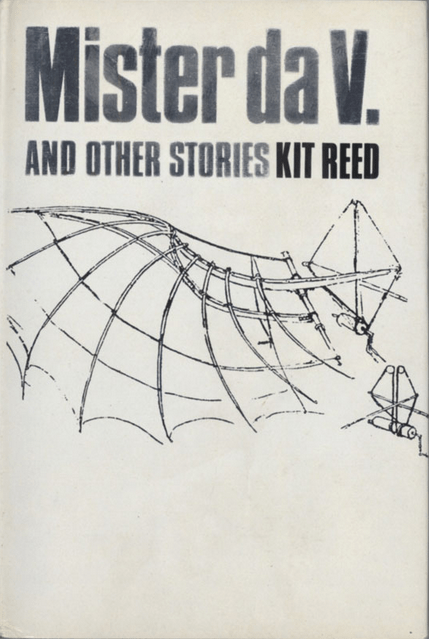
Book Review: Mister Da V. and Other Stories, Kit Reed (1967)

Screen shot 2013-07-16 at 10.06.04 AM

(Uncredited cover for the 1967 edition)

4.25/5 (collated rating: Good)

Kit Reed has been publishing literary, thought-provoking, and darkly satirical sci-fi + speculative fiction + non-genre fiction since the late 50s… And she is still going strong — her most recent novel Son of Destruction (2012) came out last year.  Reed’s collection Mister Da V. and Other Stories (1967) contains three stories from the late 50s including her first published work, ‘The Wait’ (variant title: ‘To be Taken to a Strange Country’) (1958) and ten others from the 60s.  A few of the stories in the collection are not overtly science fiction — regardless, one could argue that all but ‘I am Through with Bus Trips’ (1967) contain speculative and/or sci-fi elements.

There are superficial differences between the 1967 Faber and Faber edition and the 1973 Berkley Medallion edition.  Because I own the Berkley paperback I’ve gone ahead and followed its chronological story order and page numbers.

A few of the themes/topics of the volume:  Paranoia.  Post-apocalyptic Landscapes.  Youth  Continue reading

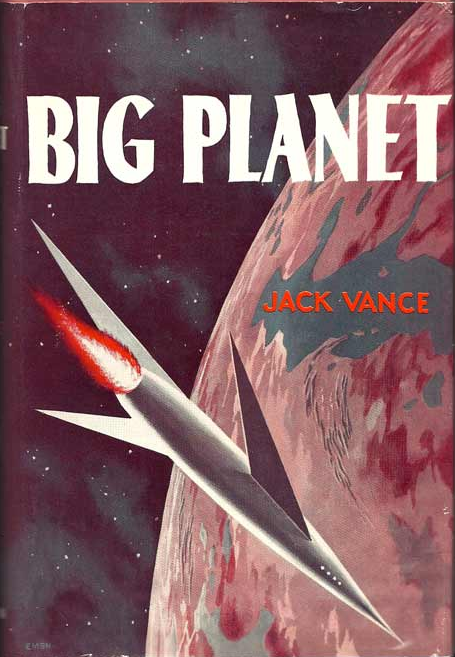
Book Review: Big Planet, Jack Vance (magazine publication 1952)

Screen shot 2013-06-01 at 6.18.27 PM

(Ed Emshwiller’s cover for the 1952 edition)

3.25/5 (Good)

After Jack Vance’s recent passing I decided that as an informal remembrance I’d review one of his novels.  However Big Planet (1952), the only unread novel of his I had on my shelf, is from early in his career and far from the level of his best works.  Of his novels I’ve read, Wyst: Alastor, 1716 (1978) and the loose sequel to Big Planet, Showboard World (1975) were the most satisfying.  The Blue World (1966), Marune: Alastor, 933 (1975), and City of the Chasch (1968) were all enjoyable adventure tales set in fantastic worlds.  I recommend those — along with his more famous novels — before picking up a copy of Big Planet.

Over the course of its publication history Big Planet was cut and modified multiple times from its original magazine form.  A restored text was published in 1978…  Unfortunately, I read the 1957 Ace Continue reading