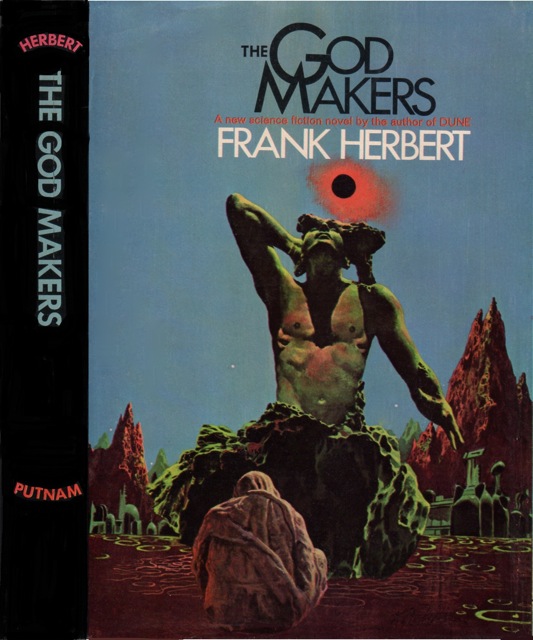
Book Review: The God Makers (variant title: The Godmakers), Frank Herbert (1972)

the god makers

(Vincent Di Fate’s cover for the 1972 edition)

3.25/5 (Average)

As of late I’ve been returning to the extensive catalogue of Frank Herbert’s non-Dune novels on my shelf — The Eyes of Heisenberg (1966) was an engaging read with adept world building which created an intriguing/harrowing dystopic future.  The God Makers (1972) lacks not only Herbert’s trademark dense prose (for example, constantly shifting perspective over the course of a conversation) but also features one of his more poorly conceived future worlds.  This might be due to the fact that the novel was cobbled together from four short stories Continue reading


Book Review: The Mile-Long Spaceship (variant title: Andover and the Android), Kate Wilhelm (1963)

(Richard Powers’ cover for the 1963 edition)

3/5 (collated rating: Average)

Kate Wilhelm, famous for her Hugo-winning masterwork Where Late the Sweet Birds Sang (1976), started her writing career with more modest works.  The Mile-Long Spaceship (1963) collects some of her earliest short stories from the late 50s and a few written for the collection in the early 60s — Clone, her first novel, co-written with Theodore L. Thomas would come out in 1965.  However, her best sci-fi was published in the late 60s to the mid-70s.  Before then her work tended to be straight-forward with an occasional interesting idea or poignant scene but generally unremarkable….

Three stories are worth reading in this collection: an early work of feminist science  Continue reading

Adventures in Science Fiction Cover Art: The City on the Horizon

u273

(Karel Thole’s cover for the 1962 edition of Starman’s Quest (1958), Robert Silverberg)

Some of my favorite cover art posts over the last two years were on the theme of cities — Elevated Cities (Part I, Part II), Domed Cities (Part I, Part II, Part III), Doomed Cities (Part I, Part II, Part III), and Ice-Covered Cities.  I’m starting a new series on science fiction cities  — The City on the Horizon — I already have two additional posts lined up on the theme.

The City on the Horizon — a glimmer of hope for beleaguered travelers, an beacon of habitation of an unknown civilization on an alien world, an organic mass rising from the desert sands, or a refuge of the ultra wealthy rising majestic from a slum… The possibilities are Continue reading

Updates: Recent Science Fiction Acquisitions No. LVIV (Laumer + del Rey + Stableford + Dickson)

An overpopulation themed novel (at least for part) by Gordon R. Dickson….

A supposedly underrated/dark novel by Brian M. Stableford (according to some, one of his best)…

An early novel in Keith Laumer’s famous Retief sequence…

And a fun juvenile by Lester del Rey….

1. The Outposter, Gordon R. Dickson (1971)

(Bruce Pennington’s cover for the 1976 edition)

From the back cover: “Destination: Oblivion.  The Lottery played no favorites — if a person’s number came up, he joined the rest of the losers marked for exile from the overcrowded Continue reading

Book Review: Pebble in the Sky, Isaac Asimov (1950)

Screen shot 2012-12-24 at 9.50.07 AM

(Uncredited (Powers?) cover for the 1957 edition)

3.5/5 (Good)

Pebble in the Sky (1950), Isaac Asimov’s first published novel, is a revision of the earlier short story ‘Grow Old With Me’ published in the late 1940s.  The novel itself takes place in the vast Galactic Empire based at Trantor that features in so many of Asimov’s short stories and novels — most famously, Foundation.  Although I am generally unimpressed with Asimov’s science fiction, Pebble in the Sky contains intriguing world building and an elderly man as the main character which is rather rare in sci-fi (albeit, this does not prevent a silly romance between the other younger main characters from providing the novel’s emotional core). But, most appealing to me, Asimov moves away from the all too simplistic dichotomy of good vs. bad Continue reading

Book Review: Store of Infinity, Robert Sheckley (1960)

(Uncredited cover for the 1960 edition)

4.5/5 (collated rating: Very Good)

Robert Sheckley’s collection Store of Infinity (1960) contains eight remarkable short stories — three of which are near masterpieces.  Sheckley’s visions are satirical, mordant, and replete with vivid imagery conveyed in solid prose.  A few selections remind me of the lighthearted (yet thought-provoking in content) robot fairy tales by  Stanislaw Lem — for example, those collected in The Cyberiad (1965) — although Sheckley’s visions are less whimsical.

‘The Prize of Peril’ (1958), ‘Triplication’ (1959), ‘The Store of the Worlds’ (1959), and ‘If the Red Slayer’ (1959) are must reads for any Continue reading

Book Review: Costigan’s Needle, Jerry Sohl (1953)

(Richard Powers’ cover for the 1954 edition)

2/5 (Bad)

In countless Star Trek episodes a shattered piece of technology is miraculously resurrected (or a non-related piece of technology is transformed into an inter-dimensional portal) rescuing stranded one-time antagonists who learn, through their shared struggles, to finally get along.  Jerry Sohl’s Costigan’s Needle (1953) takes this classic scenario to an even more preposterous level.

Related Tangent

As a kid I adored Jules Verne’s Mysterious Island (1874), disliked Robinson Crusoe (1719), and despised Perseverance Island; or, The Robinson Crusoe Continue reading

Book Review: The Second Trip, Robert Silverberg (serialized: 1971)

(Uncredited cover for the 1973 edition)

4.5/5 (Very Good)

Robert Silverberg’s late 60s and early 70s science fiction novels were often well-wrought ruminations on acute social alienation.   For example, in Dying Inside (1972) a man slowly loses his telepathic abilities and thus, a core component of his identity.  In  The Man in the Maze (1969), a man rendered incapable of interacting with other humans, goes into self-imposed exile.  In Thorns (1967), two manipulated/modified souls (a man surgically altered by aliens and a young girl who’s the virgin mother of hundreds of children), find strange solace in each other’s company.  In The World Inside (1971), our heroes feel disconnected from the unusual world they’ve grown up in — and rebel in their own ways.

The Second Trip (1971) subverts this theme.  Instead, our hero desperately attempts to re-integrate himself into society (as his persona has been designed to do), to come to grips with his laboratory Continue reading

Updates: An Incomplete List of Worthwhile Classic Science Fiction Blogs/Resources

I love the idea of a community of science fiction reviewers — so I’ve put together a list of a handful of book review blogs focused on classic/slightly more esoteric science fiction.  Obviously there are plenty of great blogs I’ve omitted that have reviews of new releases or only occasional vintage science fiction….  Or, blogs that refrain from reviews of vintage science fiction unless participating in certain reading challenges….

Please visit them, comment on their reviews, and browse through their back catalogues.

1] Speculiction….: An under visited /commented on blog with quality book reviews of classic science fiction — however, the reviewer, Jesse, is limited by the lack of older science fiction available to him in Poland.  I especially enjoyed his reviews of Ballard’s “beautifully strange enigma” that is The Crystal World (1966) and of course, my favorite science fiction novel of all time, John Brunner’s magisterial Stand on Zanzibar (1968).  An index of his reviews can be found here.  He also has a good mix of newer science fiction reviews as well.

2] The PorPor Books Blog: SF and Fantasy Books 1968-1988: I find this blog Continue reading