Updates: Recent Science Fiction Acquisitions N. XL (Miller, Jr + Cogswell + Pohl/del Rey + Kornbluth/Merril)

A couple from my father + a few left over Marx Book purchases….

Three delightfully gorgeous Powers covers.  And one stunning John Schoenherr cover despite the unknown quality of the short stories within….

A short story collection and a three novella collection by Walter M. Miller, Jr., the author of A Canticle for Leibowitz (1959)…  A scathing, and hilarious satire by Frederik Pohl and Lester del Rey…  Among others.

1.  The View from the Stars, Walter M. Miller, Jr. (1965) (MY REVIEW)

(Richard Powers’ cover for the 1965 edition) Continue reading

Book Review: Total Eclipse, John Brunner (1974)

(John Cayea’s cover for the 1974 edition)

3/5 (Average)

Over the years I’ve deluded myself into becoming a John Brunner completest — around twenty-five of his novels line my shelves and I’ve read most of them over the years.  At his best he’s without question one of the great masters of the genre — Stand on Zanzibar (1968), The Sheep Look Up (1972), etc. are evidence of this.  However, in-between his social science fiction masterpieces are a plethora of unsatisfying attempts at traditionalist space opera.  In these works Brunner never fully leaves his pulp roots although he occasionally tries to inject a dose of hard science, (pseudo) intellectualism, and social commentary.

Total Eclipse (1974) fits this mold.  A group of scientists attempt to figure out the mystery of a highly advanced race which has apparently, died out. Character interactions are painfully silly along the “Oh heroic main character, you’re a genius let me jump into your bed” sort of Continue reading

Updates: Recent Science Fiction Acquisitions N. XXXIX (Priest + Brunner + Crowley + Wallace + Duncan)

Ah, what a delightful group! A few from my father, a few from Marx books which I hadn’t posted yet….  Priest and Crowley’s novels involve fascinating worldscapes — a world winched across the horizon, a world at the top of a pillar…  Both are considered among the better stylists in science fiction and fantasy.

And, my 22nd (?) Brunner novel!  The Stone That Never Came Down (1973) — from his glory period of the late 60s-early 70s (this period produced Stand on Zanzibar, The Sheep Look Up, Shockwave Rider, The Jagged Orbit).

And two more impulsive finds — Ian Wallace’s Croyd (1967) — a reader claimed it was one of the best sci-fi novels of the 60s, and thus due to my intense curiosity, I had to find a copy.  And Dark Dominion (1954), I know little about David Duncan — he wrote only three sci-fi novels in the 50s.  His work is described by SF encyclopedia as “quietly eloquent, inherently memorable, worth remarking upon.”

And the covers!

1. The Inverted World, Christopher Priest (1974)

(Jack Fargasso’s cover for the 1975 edition) Continue reading

Book Review: The Joy Makers, James Gunn (1961, magazine publication 1955)

(William Hofmann’s cover for the 1961 edition)

4.25/5 (collated rating: Good)

The three parts of James Gunn’s fix-up novel The Joy Makers (1961) were originally published in magazine form in 1955 as ‘Name Your Pleasure,’ ‘The Naked Sky’, and ‘The Unhappy Man.’  I have not read the originals so I’m unsure of how much was added or subtracted or completely re-conceptualized.  Largely a satire — Gunn pushes his point to the logical, and terrifying extreme — each part is a further chronological progression of a society whose chief aim is to make people happy.  It is hard not to read Part I as a satirical take on some aspects of Scientology,  a movement that was gaining force in the early 1950s.

Because each part is only linked thematically to the others

Continue reading

Book Review: The Eden Cycle, Raymond Z. Gallun (1974)

(Kelly Freas’ cover for the 1974 edition)

4/5 (Good)

Raymond Z. Gallun is best known for his pulp sci-fi from the 1930s-50s.  From the 50s onward he wrote a handful of novels of varying quality.  The Eden Cycle (1974), probably his single best science fiction work, is a successful integration of pulp ideas and lush environments with a poignant and often haunting depiction of the social ramifications of a future world where everyone, “blessed” with immortality, can “live” in any virtual reality of their choice, shift  from simulation to simulation at will, and spontaneously conjure new ones.

Brief Plot Summary/Analysis

In the near future mankind receives mysterious signals from space.  Gallun is careful to slowly reveal the main backstory over the course of the first third of the novel.  After Continue reading

Updates: Recent Science Fiction Acquisitions N. XXXVIII (Spinrad + Harrison + Kavan + Effinger)

Ah, when I have access to a massive inexpensive catalogue (Marx Books) the quality of my finds goes up and up…..  Finally a copy of Norman Spinrad’s metafictional The Iron Dream (1972) (if Hitler lived in America and wrote a sci-fi novel AND a commentary on said piece of science fiction).  Unfortunately, I own a later edition (with a hideous cover) than the one below.  Geo. Alec Effinger’s bizarre What Entropy Means to Me (1972) — again, about writing, and interpreting writing, and inventing interpretation…  Anna Kavan’s drug inspired underrated and underread sci-fi parable Ice (1976).  AND, a futuristic fantasy of the highest caliber, M. John Harrison’s The Pastel City (1971) — yes, I could have purchased the multi-novel sequence (and related short stories) in one volume but I like having the original paperbacks.

1. The Iron Dream, Norman Spinrad (1972)

(Uncredited cover for the 1972 edition) Continue reading

Book Review: Farewell, Earth’s Bliss, D. G. Compton (1966)

(Karel Thole’s cover for the 1971 edition)

4.5/5 (Very Good)

(*some spoilers due to the limited nature of the plot*)

Another D. G. Compton novel, another wonderful (and terrifying) experience…  The only one of his novels so far that has failed to hold my interest was The Missionaries (1971), a lackluster satire on religion.  The Continuous Katherine Mortenhoe (variant title: The Unsleeping Eye) (1973) is a masterpiece and Farewell, Earth’s Bliss (1966) and Synthajoy (1968) are close behind.

Farewell, Earth’s Bliss is best described as a character study of a group of convicts sent to Mars and their attempts to integrate into an incredibly repressive and conservative society (derived in part to to the extreme dangers of the Martian environment) — in short, a piece of race and religion themed social science fiction.  Be warned, there  is little to no action.  As with most of Compton’s works, near future environments are the perfect vehicle for societal ruminations Continue reading

Updates: Recent Acquisitions N. XXXVII (del Rey + Geston + Saxton + Gunn)

A wonderful selection of Marx Book purchases….  All of them are high on my to read list!  I hadn’t heard of Josephine Saxton — she’s considered an inventive sf fabulist — until I read a review of her novel Vector for Seven (1970) on SF Mistressworks, a review collating blog which I highly recommend for any fan of science fiction.  There are so many great works by female sci-fi authors out there waiting to be rediscovered on dusty used bookstore shelves….

I enjoyed James Gunn’s Station in Space (1958), a thematically linked short story collection depicting mankind’s first steps into space, so I picked up a copy of one of his better known fix-up novels, The Joy Makers (1961).

I adore sci-fi novels on overpopulation so Lester del Rey’s The Eleventh Commandment (1962) was a given…

And, well, the incredibly alluring description on the back cover of Mark S. Geston’s Lords of the Starship (1967) speaks for itself…

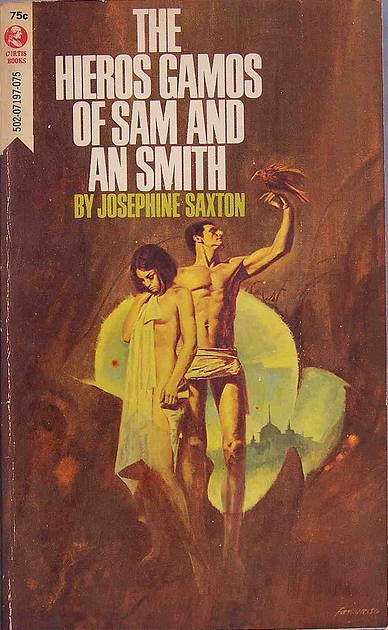
1. The Hieros Gamos of Sam And An Smith, Josephine Saxton (1969) (MY REVIEW)

(Jack Fargasso’s cover for the 1969 edition) Continue reading

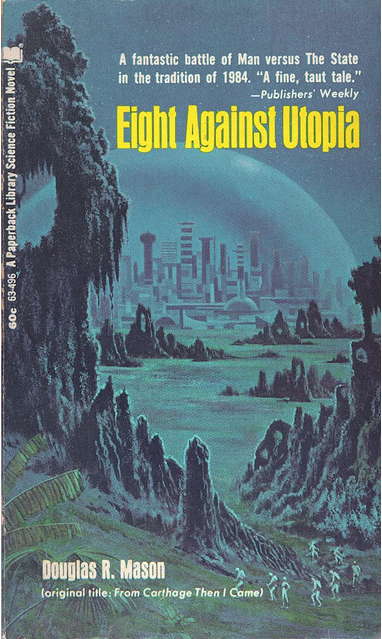
Book Review: Eight Against Utopia (variant title: From Carthage Then I Came), Douglas R. Mason (1966)

(Dean Ellis’ cover for the 1970 edition)

2.25/5 (Bad) 

Eight Against Utopia (1966) is the second escape from a domed city novel published by Paperback Library I’ve read — the first, Rena Vale’s Beyond the Sealed World (1965) was a truly dismal “adventure.”  Mason’s take on the theme is only marginally better.  The first half, life and escape from the domed city of Carthage, is more intriguing and engaging than the second half, an endless unexciting chase sequence along the coast of North Africa.  Mason’s novel is painfully flawed in its social theory and mechanics of delivery.  Even on the level of a future adventure tale, most of Eight Against Continue reading