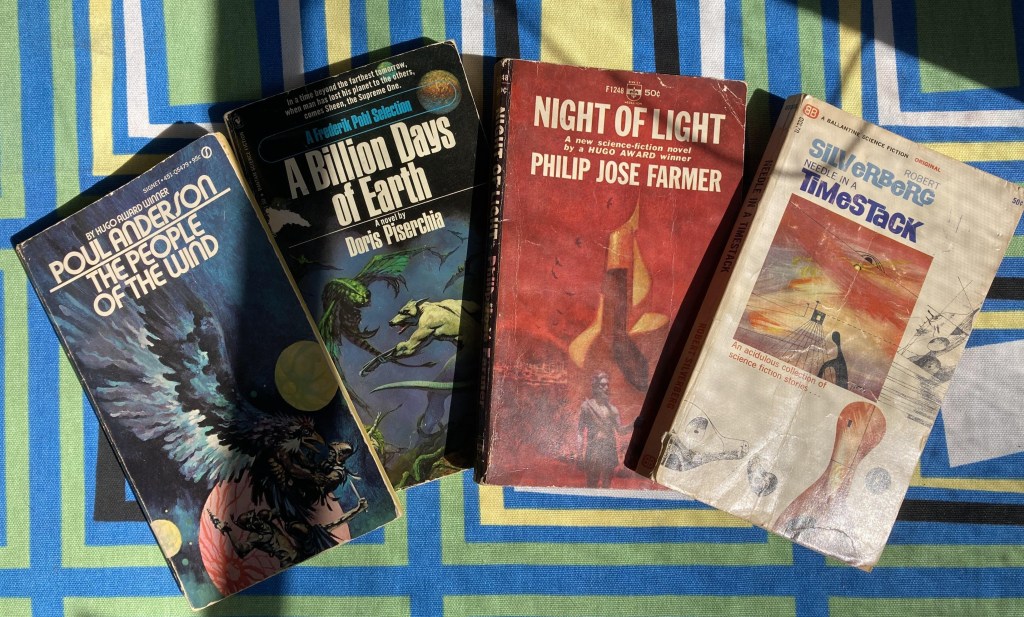
What pre-1985 science fiction are you reading? + Update No. XX

What pre-1985 science fiction are you reading or planning to read this month? Here’s the January installment of this column (sorry I missed a month).

Before John W. Campbell, Jr. (1910-1971) attempted to raise the “standards and thinking in magazine SF,” David Lasser (1902-1996) attempted his own brief (1929-1933) program to improve science fiction as managing editor of Hugo Gernsback’s Science Wonder Stories, Wonder Stories, and Wonder Stories Quarterly. According to Mike Ashley’s The Time Machine: The Story of the Science-Fiction Pulp Magazine from the Beginning to 1950 (2000), Lasser is a “much neglected revolutionary in science fiction” and through his efforts the genre “started to mature” (66).

Ashley highlights Lasser’s letter of instruction mailed to his regular contributors on the 11th of May, 1931, in which he “exhorted them to bring some realism to their fiction” (72). He also outlawed common tropes like the giant insect story and space opera (73). He emphasized the need to focus on characters that “should really be human” — not everything needs to be a “world-sweeping epic” (73). Stories in this vein, according to Ashley, include Clifford D. Simak’s religiously themed “The Voice in the Void” (1932), P. Schuyler Miller and Walter Dennis’ “The Red Spot on Jupiter” (1931) and “The Duel on the Asteroid” (1974), which featured a grim realism and character development (74).

Continue reading

Updates: Recent Science Fiction Purchases No. CCCXXVII (Thomas M. Disch, Doris Piserchia, Ian Watson, and an anthology)

Which books/covers/authors intrigue you? Which have you read? Disliked? Enjoyed?

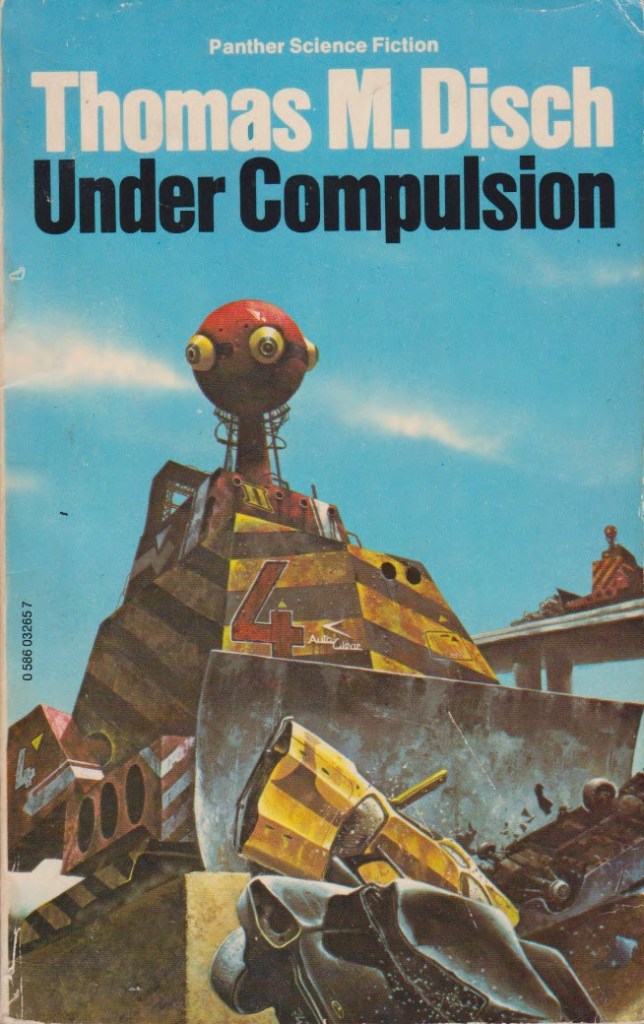
1. Under Compulsion (variant title: Fun with Your New Head), Thomas M. Disch (1968)

From the back cover: “A BLACK BANQUET OF PURE DISCH

A part-human, part-electronic brain going slowly mad in the Venus jungle.

The last man on earth rejecting the last woman.

A Russian astronaut looking for a good reason to die on the moon.

A chilling glimpse of a 21st century America where war is peace, freedom is slavery and ignorance is strength–and they like it like that.

Continue reading

Short Story Reviews: Robert Silverberg’s “The Seed of Earth” (1958) and Doris Piserchia’s “Pale Hands” (1974)

I’ve decided to reframe my series on 50s sex and sexuality to include my entire area of SF interest (1945-1985). Thus, I’ve paired Robert Silverberg’s “The Seed of Earth” (1958), a rumination on colonization and human/alien sex, with Doris Piserchia’s “Pale Hands” (1974), a distressing dissection of a future society designed to fixate all sexual desire on masturbation stalls.

Here are the earlier installments in the series:

  1. Philip José Farmer’s “The Lovers” (1952)
  2. Sherwood Springer’s “No Land of Nod” (1952)
  3. Wallace West’s “Eddie For Short” (1953)
  4. Fritz Leiber’s “The Ship Sails at Midnight” (1950)
  5. Theodore Sturgeon’s “The Sex Opposite” (1952)
  6. Ward Moore’s “Lot” (1953)
  7. Langdon Jones’ “I Remember, Anita…” (1964)
  8. Damon Knight’s “Not With a Bang” (1950)

If any short stories published between 1945-1985 on sex and sexuality come to mind that I haven’t reviewed yet, let me know in the comments. I have a substantial list waiting to be covered but it’s far from comprehensive.


3.5/5 (Good)

Robert Silverberg’s “The Seed of Earth” (variant title: “Journey’s End”) first appeared in Super-Science Fiction, ed. W. W. Scott (April 1958). You can read it online here. It is also available in his collection Dimension Thirteen (1969) that I plan on reviewing in the near future.

A preliminary note about publication: Silverberg reused the title “The Seed of Earth”–chosen by W. W. Scott over “Journey’s End”–for a later unrelated novella and a novel.

Continue reading

Updates: Recent Science Fiction Acquisitions No. CLIX (Gerrold + Reed + Lewin + Anthology of European Non-English Language SF)

Digression: I have been thinking about “best of” lists and why I seldom approach an author by reading their “best known” work first.  Caveat: I compulsively read the Hugo list as a kid and was exposed to many wonderful authors.

Reading “the acknowledged best” reinforces our notions of what is canon or not canon.  And I am all about puncturing holes in our self-perpetuating notions of canon and SF grand narratives of what is “classic” SF and what is not.  The following dialogue often plays out:

A) “Have you read the best SF novels of the 1970s?”

B) “Yes, I have, from this great top 15 novels list!”

A) “What would you say are the best novels from the 1970s?”

B) “Oh, here you go!” Regurgitates original list.

A) “Have you read other SF novels from the 1970s?”

B) “Umm.”

I am guilty of this as well!  My top 1960s novels list undergoes regular revisions.  The original list was a product of my lack of knowledge.  Regardless, it remains to this day the most popular and commented upon post on my site!  Alas!

Sometimes “the less known” novels are a way to get a feel for what an author is capable of and seeing an author through their body of work leads (at least for me) to greater appreciation for their best (which might not be the ones anointed by the majority).  Barry N. Malzberg: I read In the Enclosure (1973) before  Beyond Apollo (1972).  Doris Piserchia:  Doomtime (1981) before A Billion Days of Earth (1976). Robert Silverberg: Thorns (1967) before Downward to the Earth  (1970).  Christopher Priest:  Indoctrinaire (1970) before The Affirmation (1981).

Third, I put great value on individual exploration. It is humorous and ironic that I have run this review site for six or so years but am reluctant to immediately follow-up on the reading suggestions of others.  I am sorry frequent readers!  I devour the reviews of others for sure (see Part I and Part II for worthwhile resources).  Well-argued reviews with evidence and an understanding of the work’s time and place and reflections on interactions with/or within genre, are more likely to remain with me.  And then, when I am in the book store, I remember what others have said.

The questions I have been pondering: Do I put together a best 20 novels of the 1970s list?  When do I decide whether I have read enough?  Or, do I play the “caveat” game and state that this is bound to change (which it is as I read more)?

Post proper:  My mapping of the contours of Kit Reed’s early oeuvre continues.  Her first SF novel Armed Camps (1969) and her stories in Mister Da V. and Other Stories (1967) demonstrate a knack for humanistic exploration of characters trapped in manifestations of cyclicality—be it social constructions or the forces of history.

David Gerrold’s novels do not inspire…..  At least so far: Space Skimmer (1972) + Yesterday’s Children (variant title: Starhunt) (1972).  Which means, time for short stories!  And yes, his acknowledged best The Man  Who Folded Himself (1973) waits in the wings [From Couch to Moon’s review —> here].

Non-English language SF other than Stanislaw Lem and Arkady and Boris Strugatsky: the biggest hole in my SF knowledge.

And perhaps the find/risk of the bunch, a satirical pseudo-governmental pamphlet that generated endless debate about its authenticity.

As always, thoughts and comments are welcome.

1. With a Finger in My I, David Gerrold (1972)

wthfngrnmc1972

(Mati Klarwein’s cover for the 1972 edition) Continue reading

Update: Recent Science Fiction Acquisitions N. I

Oh the joys of amazon gift cards… And perusing dusty corners of local bookstores.

Here are my latest acquisitions.

1. Robert Silverberg’s World Inside (1971) (MY REVIEW HERE)

I’ve always enjoyed semi-dystopic works about the social ramifications of overpopulation (John Brunner’s Stand on Zanzibar is my all time favorite sci-fi novel).  I wonder if Silverberg was inspired by Brunner’s work.  I’ve yet to read a Silverberg novel and I’ve read that this is a pretty good effort.  So, those factors contributed to my purchase.

2. Doris Piserchia’s Continue reading