Which books/covers/authors intrigue you? Which have you read? Disliked? Enjoyed?
The first purchases of 2026!
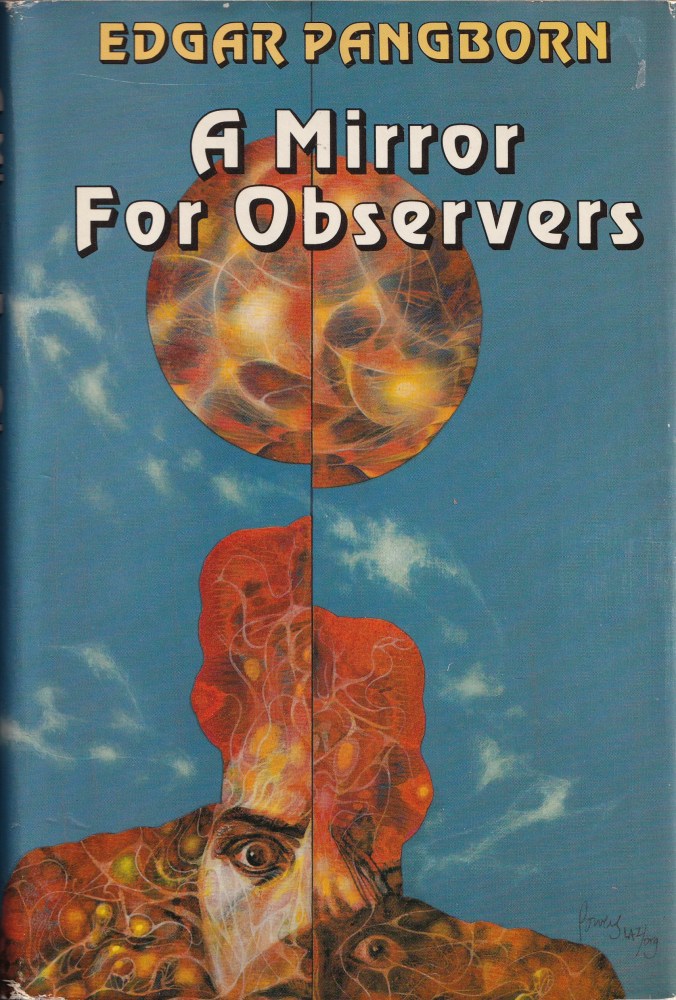
1. A Mirror For Observers, Edgar Pangborn (1954)
Richard Powers’ cover for the 1985 edition
From the back cover: “We would call them Martians, though they refer to themselves as Salvayans. Refugees from their dying planet, they arrived on our world almost 30,000 years ago to make new lives for themselves. From their vast underground cities, hidden from discovery, the Salvayans have ben observing us with care and concern, waiting for the day when humans will be ready to meet them. The Salvayans are not many, but they are long-lived and patient….
Here’s to happy reading in 2026! I hope you had a successful reading year. Whether you are a lurker, occasional visitor, a regular commenter, a follower on Bluesky or Mastodon, thank you for your continued support. As I say year after year, It’s hard to express how important (and encouraging) the discussions that occur in the comments, social media, and via email are to me. I’m so thankful for the lovely and supportive community of readers, writers, and discussion partners that stop by.
What were your favorite vintage SF reads–published pre-1985–of 2025? Let me know in the comments.
Throughout the later part of the year I’ve dropped hints about a research project. Perceptive readers might have parsed together the contours of the research: late 19th/early 20th century, utopian, African American, the American South, radical politics… It’s taking longer than expected. I’ve read a good ten monographs, five dissertations, countless articles. I’ve written twenty pages. I hoped to have it posted by early in this year. Alas. It’s coming together–slowly. Stay tuned.
Without further ado, here are my favorite novels (I only read a few) and short stories (I read a ton of those) I read in 2025 with bonus categories. I made sure to link my longer reviews where applicable if you want a deeper dive.
Check out my 2024, 2023, 2022, and 2021 rundowns if you haven’t already. I have archived all my annual rundowns on my article index page if you wanted to peruse earlier years.
My Top 5 Science Fiction Novels of 2025
Alan Gutierrez’s cover for the 1985 edition
1. Octavia E. Butler’s Clay’s Ark (1984), 4.5/5 (Very Good). Full review.
Which books/covers/authors intrigue you? Which have you read? Disliked? Enjoyed?
It’s the summer Joachim Boaz. Where are the reviews? I’m currently on a much needed vacation (Iceland). I will be back soon! In the meantime here are four recent purchases.
1. The Dancers of Noyo, Margaret St. Clair (1973)
Davis Meltzer’s cover for the 1st edition
From the back cover: “Like so many others before him, reluctant Sam MacGregor was sent on a pilgrimage for the Frail Vision by the Dancers: androids grown from the cells of one man, with the powers of hypnotism and illusion–androids who held the tribes of the Republic of California in thrall.
But soon Sam began to doubt his own identity, for he experienced, in close succession, extra-lives in different corridors of time and space.
Note: My read but “waiting to be reviewed pile” is growing. Short rumination/tangents/impressions are a way to get through the stack before my memory and will fades. My website partially serves as a record of what I have read and a memory palace for future projects. Stay tuned for more detailed and analytical reviews.
1. Edgar Pangborn’s The Company of Glory (1975)
Vincent Di Fate’s cover for the 1st edition
3.5/5 (Good)
Edgar Pangborn is an unsung SF hero in my book. At his best, he’s a deeply humanistic writer interested in moments of effective metafictional play on the nature of narrative. The Company of Glory (serialized 1974, 1975) is the third novel in the Tales of Darkening World sequence. It forms a prequel to Pangborn’s masterpiece Davy(1964). As with Davy, The Company of Glory attempts to create multiple interlocking layers of narrative, stories within the stories, quotations from various diaries, and the interjections of the overarching narrator of the entire collection of texts who remains anonymous until the final pages.
What pre-1985 science fiction are you reading or planning to read this month? Here’s the March installment of this column.
Recently I came across John Boston and Damien Broderick’s three-volume series examining each and every story and non-fiction article in the pre-Michael Moorcock New Worlds and Science Fantasy/SF Impulse magazines in the UK. John Boston is a valued member of my site’s community — frequently stopping by in the comment sections. I thought for this mini-editorial I’d list a handful of active community members with websites, books, and worthwhile SF-related fanzine articles. I, of course, could be missing a few. Community matters more than you might think. I enjoy the discussion. I enjoy reading reviews that others write — even if it’s on science fiction that might not be within my more narrow focus (the historian in me). I always want to learn and share what’s worth reading and/or historically interesting. Thank you one and all.
Here’s to a happy 2024! I hope you had a successful reading year. Maybe you pulled down some dusty tome that you’ve wanted to dive into for a decade. I’d like to imagine you finally picked up a book I raved about in years past that you acquired with great anticipation but never opened. Whether you are a lurker, occasional visitor, or a regular commenter, thank you for your continued support and wonderful conversation.
What were your favorite vintage SF reads–published pre-1985–of 2023? Let me know in the comments.
Continuing a trend, I read only a handful of novels this year. Instead, my obsessions focused on my science short story review initiatives (listed below), collections, and histories of the science fiction genre. Without further ado, here are my favorite novels and short stories I read in 2023 with bonus categories. I made sure to link my longer reviews where applicable if you want a deeper dive into the rich seam of science fictional gems.
Check out last year’s rundown if you haven’t already for more spectacular reads. I have archived all my annual rundowns on my article index page if you wanted to peruse earlier years.
My Top 5 Science Fiction Novels of 2023
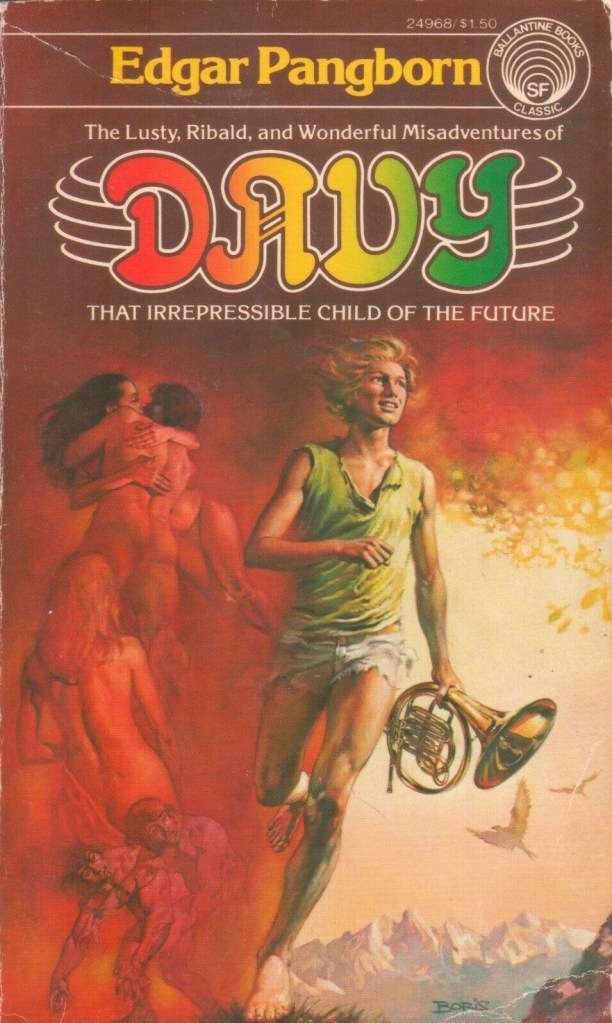
Boris Vallejo’s cover for the 1976 edition
1. Edgar Pangborn’s Davy(1964), 5/5 (Masterpiece): Nominated for the 1965 Hugo Award for Best Novel. Full review.
I can’t escape the post-apocalyptic wasteland. Like a voyeuristic shadow, I follow the denizens of the charred surface as they plod their slow movements toward the end. I observe how they push away the looming violent redness that blots out the sky, and, when everything else seems lost, they turn interior. A final movement that lays bare tattered dreams and ephemeral memories…
Ed Emshwiller’s cover for Galaxy Science Fiction, ed. H. L. Gold (November 1954)
5/5 (Masterpiece)
Edgar Pangborn’s “The Music Master of Babylon” first appeared in Galaxy Science Fiction, ed. H. L. Gold (November 1954). You can read it online here.
Fresh of Edgar Pangborn’s masterpiece Davy (1964), I decided to cover some of his short fiction on the site. He’s shaping up to be my author of the year. “The Music Master of Babylon” (1954), which I suggest should be included as part of his Tales of a Darkening World sequence due to multiple references to events and people present in the world of Davy, contains many of the embryonic concerns that crop up in the later novel. Pangborn is the master of interweaving narrative and personal memory and the ways art–in this instance music–lays bare the topography of self.
Which books/covers/authors intrigue you? Which have you read? Disliked? Enjoyed?
1. The Company of Glory, Edgar Pangborn (serialized 1974, novel 1975)
Vincent Di Fate’s cover for the 1st edition
From the back cover: “BEHOLD DEMETRIOS! With the same rich imagination and dazzling insights that won him the International Fantasy award, Edgar Pangborn weaves a magical tapestry set far in man’s future.
It is a time when man, struggling to rise above the ashes of nuclear holocaust, has returned to the simpler values and lifestyles of medieval times. And in this society, Demetrios the storyteller is revered among men for his captivating tales of the Old Time, with its miraculous Telephones, and Jet Planes, and TV, and Automobiles. But Demetrios is also feared–for one storyteller with a head full of ancient truth can be dangerous.
So Demetrios is forced to flee, with six compatriots, and together they embark on a journey full of unexpected sorrows, and unimagined delights, a journey through realms of fantasy, philosophy, and rich human possibility, which the reader will be delighted and privileged to share.”
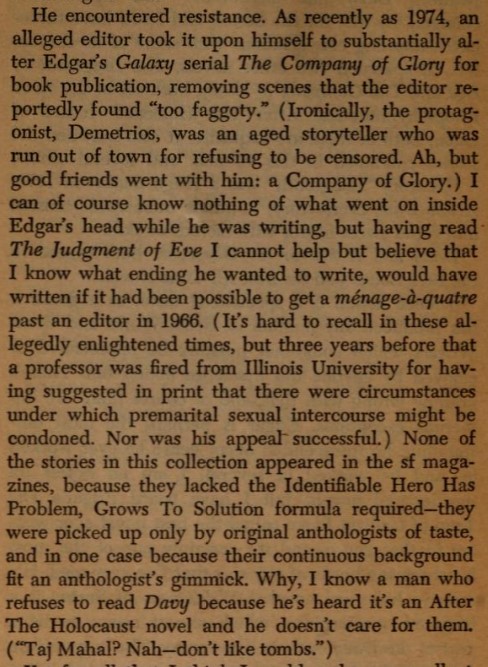
Initial Thoughts: After reveling in Pangborn’s masterpiece Davy (1964), I decided to acquire everything in the Tales of a Darkening World sequence I didn’t own already. According to Spider Robinson, the editor at Pyramid Books cut portions of the novel that was serialized in Galaxy… Inset image is from Robinson’s intro to Still I Persist in Wondering (1978).
Robert Foster’s cover for the 1st paperback edition
5/5 (Masterpiece)
Nominated for the 1965 Hugo Award for Best Novel [1]
Edgar Pangborn’s Davy (1964) takes place in a future devastated by a partially abortive nuclear war and the depravations of subsequent plagues (50). A powerful theocracy and perpetually warring microstates in the American Northeast emerged from the Years of Confusion. The novel takes the form of an autobiography. We follow a young orphan in love with life and desperate to escape his unfortunate circumstances.






 Science Fiction and Other Suspect Ruminations