Updates: Recent Science Fiction Acqusitions No.CLVIII (Tucker + Charnas + Coppel + Sheckley)

September will be a slow month, my apologies in advance.  The review backlog grows and grows–reviews of Poul Anderson’s Tau Zero (1970) and The Best SF Stories from New Worlds #2 (1968) should be appearing soon.  Although, there are many unreviewed volumes less fresh on my memory…

At least I have a massive review INDEX to keep you all busy.

I am diligently posting all the KWG volumes I snagged from a local Half Price Books—this shadowy person had a spectacular collection.

I am rarely interested in SF series, but, I’ll make an exception as Suzy McKee Charnas’ Walk to the End of the World (1974) was so darn amazing!

More Sheckley!

More Tucker! Fresh off the very satisfying The Long Loud Silence (1952)

And finally, a novel from an author I’ve never read before—Alfred Coppel.

As always, thoughts/comments are welcome.

1. Motherlines, Suzy McKee Charnas (1978)
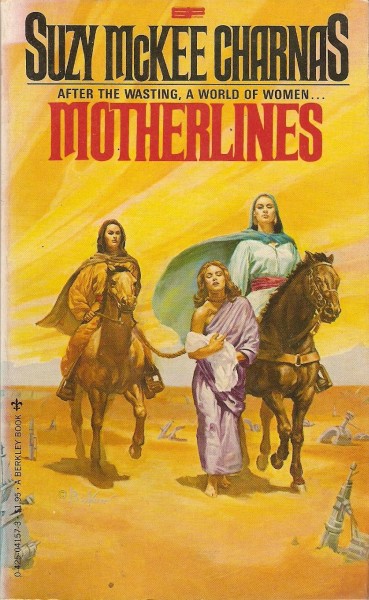
mthl1979

(Doug Beekman’s very bland cover for the 1979 edition) Continue reading

Adventures in Science Fiction Cover Art: The Futuristic Cities of Lima de Freitas, Part I

Argonauta119

(Cover for the 1967 edition of vol. 1 of The Moon is a Harsh Mistress (1965), Robert A. Heinlein)

The Portuguese painter and illustrator Lima de Freitas (1927-1998) created a vast number of covers for the Portuguese press Livros do Brasil.  For more on the range of art he produced in his career consult his wikipedia page [here].

A while back I reviewed Mordecai Roshwald’s Level 7 (1959) and discovered de Freitas’ amazing cover (below).  More than any of the US editions, it evokes the claustrophobic tone of the novel (and even some of the surreal elements).

As the son of two architects, architecturally inclined SF covers always fascinate. Thus, as an introduction to his art (if you do not know it already) I have collected a handful of his cityscapes.  They are surreal masterpieces.  Lima de Freitas’ covers emphasize the city as a canvas, the textures of human Continue reading

Updates: Recent Science Fiction Acquisitions No. CLVII (Sturgeon + Sheckley + Scortia + Mannes)

I can’t pass up a Sheckley collection!

Nor can I pass up a rather unknown “discovered manuscript” type 1960s feminist dystopia by Marya Mannes.  She wrote for Vogue and The New Yorker over her career….

Nor can I pass up a Sturgeon collection (perhaps I will appreciate his more radical SF short stories?)….

And finally, a best of collection by an author who might not be worth exploring, but, sometimes short stories give a better impression of an author’s capabilities than a novel-length work.

As always, thoughts/observations/comments are welcome!

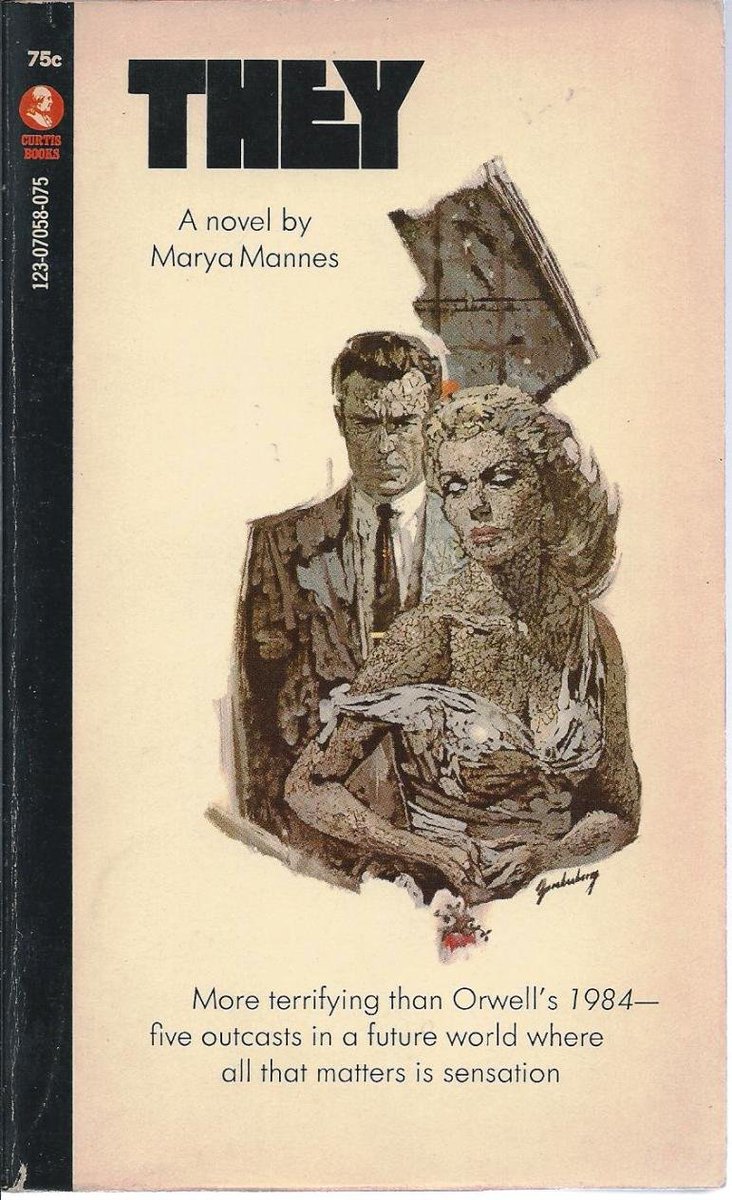
1. They, Marya Mannes (1968)

they

(Stanley Zuckerberg’s cover for the 1970 edition) Continue reading

Updates: Recent Science Fiction Acquisitions No. CLVI (Budrys + New Writings in SF Anthologies)

Another batch of volumes from the mysterious person with the initials KWG who ditched their entire collection at the local Half Price Books.

I have rarely seen the New Writings in SF series edited by John Carnell on used bookstore shelves.  But, as I am a fan of discovering new authors who might not have collected volumes of short stories, it pretty easy to justify snatching them up….  A while back I featured the covers of David Mccall Johnson, and now I have my first physical copy with his art!

More Algis Budrys…  Is it my need to read the major “classics” so I can “rewrite” the canon?  Certainly not out of any love for his SF (or criticism for that matter) —> see my review of The Falling Torch (1959) and my short review of Michaelmas (1976).  I will probably read his short story collection I recently acquired before another one of his novels.

As always, thoughts and comments are welcome/appreciated.

Enjoy!

1. Rogue Moon, Algis Budrys (1960)

ROGMON1960

(Richard Powers’ cover for the 1960 edition) Continue reading

Updates: Recent Science Fiction Acquisitions No. CLV (Herbert + Tucker + Saberhagen + England Swings SF anthology)

A person with the initials K.W.G ditched their entire SF collection at my local Half Price Books.  So many books that the store made a new SF anthology section that did not exist a few months ago and the “vintage” SF books made up more than half the non-vintage SF section.  I spent too much money.  One of many future SF Acquisitions posts featuring books from the mysterious K. W. G….

A famous anthology important for showcasing UK authors in America!  I’ve included the lengthy description of the collection by Ace and their position vis-à-vis New Wave SF.  I find it humorous that the publisher has to defend their position!

An often praised 1950s post-apocalyptical novel by Wilson Tucker….  My 1969 edition was “rewritten” by the author–unfortunately, I have already started reading it (not sure how much it will tell me about  its position in 1950s SF if it were rewritten in the 60s).  Perhaps someone knows how much was changed?  Admiral Ironbombs wrote a worthwhile review here.

Fred Saberhagen’s best known work.

And one of the few Frank Herbert novels I have not read…

Thoughts and comments are always welcome.

1. England Swings SF: Stories of Speculative Fiction, ed. Judith Merril (1968)

NGLNDSWNGS1970

(Ron Walotsky’s cover for the 1970 edition) Continue reading

Adventures in Science Fiction Cover Art: Interview with Emanuel Schongut and a selection of his 1970s SF covers

Screen Shot 2016-07-13 at 11.08.14 AM

(Cover for the 1972 edition of Recalled to Life (1958), Robert Silverberg)

“I think the 60s and 70s were probably one the most creatively interesting periods for everyone. Art, music, film all pushing the envelope. New York City was affordable and fun, fertile in its influences. Book cover art, book jacket art was fun concept art, a bit more free than other illustration work” — Emanuel Schongut

Back on May 19th, I showcased Emanuel Schongut’s 1960s SF covers [link].  His nephew found my post and put me in touch.   Over the last few weeks I have had a wonderful discussion via email about his time creating covers for Doubleday under the direction of Margo Herr (art director + cover illustrator/artist).  Emanuel graciously agreed to a short interview.  He gives a behind-the-scenes look at SF cover illustrating in the 60s/70s, reflects on his own career, and discusses his artistic process.  If you have any questions, I will be more than happy to relay them to the artist.

Also included after the interview is a delightful selection of his 1970s covers–a double post!  I also recommend visiting his online portfolio for his more recent non-SF work.

As always, thoughts and comments are welcome.

Enjoy!

Note: I have made only minor edits for clarity and inserted publication dates where necessary.

Interview

Thank you so much for agreeing to do an interview on your 60s/70s science fiction covers.  Over more than two decades  of producing SF covers for Doubleday, you put together an impressive body of work. They graced novels by some of the most esteemed authors of the genre, including Kate Wilhelm, John Brunner, Clifford D. Simak, Robert Silverberg, Keith Laumer, among others.

1) First, can you say a little about yourself.

Thank you for your interest Joachim.

Continue reading

Adventures in Science Fiction Cover Art: Women SF Illustrators of the 1960s/70s, Part III: The Galassia Covers of Allison, A.K.A. Mariella Anderlini

Screen Shot 2016-07-23 at 4.01.50 PM

(Cover for Galassia #97, January 1969)

Two of my recent Adventures in Science Fiction Cover Art posts fit (retroactively) into a linked post series on women SF illustrators from the 1960s/70s—which includes The Diagrammatic Minimalism of Ann Jonas and Donald Crews and Haunting Landscapes and Cityscapes: The 1970s Italian SF Art of Allison A.K.A. Mariella Anderlini.  This post is a continuation of the latter and explores the twelve covers Alison created for Galassia in 1969 that showcase her vivid creativity.

Galassia was one of the primary Italian SF publications for most of the 1960s (consult Michael Ashley’s Transformations: The Story of the Science-fiction Magazines from 1950-1970, 311) and introduced translations of English-language Continue reading

Adventures in Science Fiction Art: Haunting Landscapes and Cityscapes: The 1970s Italian SF Art of Allison A.K.A. Mariella Anderlini

Screen Shot 2016-07-21 at 1.34.27 PM

(Cover for the 1973 edition of The City in the Sea (1951), Wilson Tucker)

Mariella Anderlini, under the pseudonym Allison, produced a vast number of surreal and masterful SF covers (between 1969-1988) primarily for the Italian SF publisher Libra Editrice.  Apparently, she went under the pseudonym to avoid damaging her professional painting career.  She was the wife of Ugo Malaguti, editor and author, who founded Libra Editrice and edited Galassia.

As I celebrate the birthdays of a range of SF authors/illustrators/editors from multiple language traditions on twitter (@SFRuminations), I came across Allison’s work while researching her husband’s untranslated SF output.  However, only through the diligent research of a twitter follower, whose Italian is far better than mine, were we able to come across her real name.

A reader on twitter sent me two Italian articles for more details (they are scanty) about her life and SF art: “Libra Editrice: ascess e caduta di un impero”  and  “Nova SF.”

And her art is absolutely gorgeous…. Her work enters the pantheon of my favorite SF cover Continue reading

Adventures in Science Fiction Cover Art: The Diagrammatic Minimalism of Donald Crews and Ann Jonas

Screen Shot 2016-07-12 at 6.03.04 PM

(Cover for the 1967 edition of Extrapolasis (1967), Alexander Malec)

Between 1965 and 1971, the husband-and-wife team Donald Crews and Ann Jonas created a handful of fascinating minimalistic and diagrammatic covers for Doubleday.   I should note that their cover for the 1966 edition of Nebula Award Stories 1965 (1966), ed. Damon Knight was reused in different colors for multiple Nebula anthologies (1967, 1971, 1971).  Thus, their new covers for Doubleday appeared only (to the best of my knowledge) in a two-year span from 1965 and 1967.

A while back I explored the idea of the diagram (maps, brain/skull size, molecules, orbits) in SF art.  Donald and Ann Crews take the diagram in more minimalistic Continue reading