Short Book Reviews: Margot Bennett’s The Long Way Back (1954) and Mack Reynolds’ The Earth War (1964)

Note: My read but “waiting to be reviewed pile” is growing. Short rumination/tangents/impressions are a way to get through the stack before my memory and will fades. My website partially serves as a record of what I have read and a memory apparatus for future projects. Stay tuned for more detailed and analytical reviews.

1. Margo Bennett’s The Long Way Back (1954)

3.25/5 (Above Average)

I’m always on the lookout for lesser-known SF works by female authors. And Margot Bennett’s The Long Way Back (1954) certainly fits the bill. Bennett (1912-1980), a Scottish-born screenwriter and author of primarily crime and thriller novels, lead a fascinating life before her writing career. During the Spanish Civil War, she volunteered for Spanish Medical Aid, and was shot in both legs. Afterwards, she continued to participate in various left-wing political causes such as the Campaign for Nuclear Disarmament.

The Long Way Back manifests, with satirical strokes, her critical stance on nuclear war and British colonialism. In a future collectivized Africa ruled by a calculating machine that grades the population, Grame, a “mechanical-repetitive worker” (7), dreams of a career in physics. Instead, the machine shuffles him off on an ill-fated expedition to the ruined remains of Britain post “Big Bang” (nuclear blast). On the way he falls in love with the leader of the expedition, Valya, who serves as a virginal Bride of the State (24). After their sea plane lands, they are beset by a bizarre range of mutations–ferocious dogs, micro-horses, etc. Eventually they discover a tribe of hairless white survivors holed up in primitive caves. Grame teaches the brightest arithmetic. Valya sets about measuring and applying pseudo-scientific theories to understand white society, religion, and conception of the world i.e. parroting all the pseudo-science and racist theories posed by British explorers of Africa. As they attempt to find a lost city, Hep, the third surviving member of the expedition, imagines the potential exploitation and colonization Africa might implement—“Yellow America” is on the rise and resources will be needed. History threatens to re-cycle through the horrors of the past in more ways than one.

Continue reading

[short] Diaristic Fragments on Japanese New Wave Film: Nagisa Ôshima’s Empire of Passion (1978), Masahiro Shinoda’s Double Suicide (1969), Shûji Terayama’s Pastoral Hide and Seek (1974), and Shôhei Imamura’s The Pornographers (1966)

screen-shot-2016-11-10-at-9-22-55-pm

(Still from The Pornographers (1966), dir. Shôhei Imamura)

In the beginning the “Other Suspect Ruminations” part of my site’s title referred to my filmic obsessions. It’s been five years since I’ve posted along those lines. As diligent readers might be able to tell, I am fascinated by the general historical context (and earlier) of the SF decades I enjoy the most—from the Czech New Wave to the Japanese New Wave, from 60s/70s political jazz to the surrealists.

Until a few months ago my experience with Japanese New Wave film was limited to Hiroshi Teshigahara’s collaborations with the Japanese author (of SF and literature) Kôbô Abe—The Woman in the Dunes (1964), The Face of Another (1966) and Pitfall (1962)—and a few surreal Seijun Suzuki yakuza flics including Branded to Kill (1967) and Tokyo Drifter (1966) and Masahiro Shinoda’s hyper-stylized Pale Flower (1964). I highly recommend all of the above, especially The Face of Another (1966) if you’re interested in Japanese New Wave’s take on science fiction.

face-of-another

(A tantalizing scene from The Face of Another)

Recently my horizons have expanded. I am in no way a scholar of Japan or claim to be knowledgeable about Japanese culture, however, the narrative experimentation Continue reading

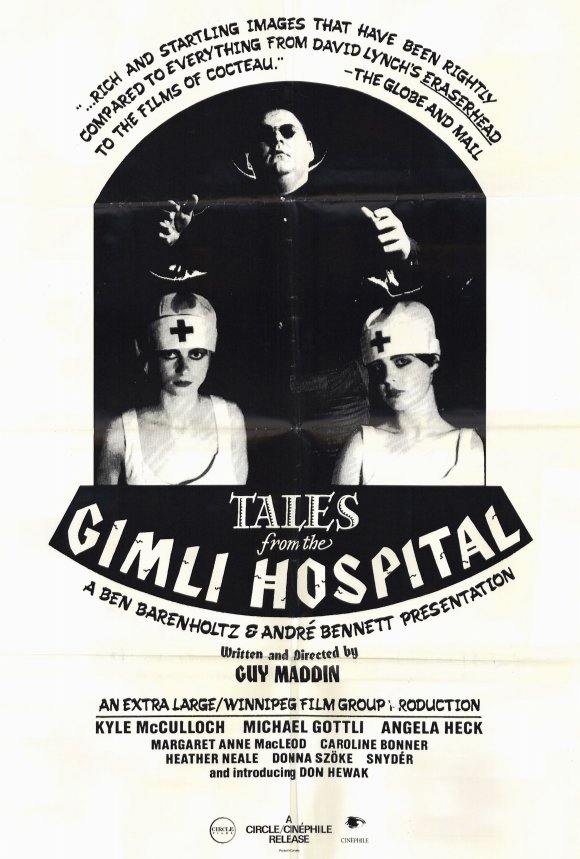
A Film Rumination: Tales from the Gimli Hospital, Guy Maddin (1988)

8/10 (Very Good)

Guy Maddin’s first feature film is a spectacle to behold.  A classic sort of frame story devolves (positively) into a dreamlike wandering in an alternative Iceland, with strange preachers, bark fish, a woman discovered on the shore wrapped in nets, young girls floating down rivers in coffins…  Maddin manipulates silent black-and Continue reading

A Film (documentary) Rumination: The Atomic Cafe, Jayne Loader, Kevin Rafferty (1982)

8/10 (Very Good)

Atomic Cafe (1982) is a scathing documentary on the atomic age created from archival film from the 40s-early 60s.  The scope of the material is extensive: military training films (often the most morbidly hilarious and poorly acted of the bunch), television news, various other government-produced propaganda films Continue reading

A Film Rumination: The Bitter Tears of Petra von Kant, Fassbinder (1972)

8/10 (Very Good)

The Bitter Tears of Petra von Kant (1972) is by far my favorite Rainer Werner Fassbinder film I’ve seen and like all of his films, an acquired taste.  I’ve not always appreciated his works — I barely tolerated The Merchant of Four Seasons and managed to watch only half of The Marriage of Maria Braun (I did enjoy Veronika Voss). However, Continue reading