What pre-1985 science fiction are you reading? + Update No. XIII

What pre-1985 science fiction are you reading or planning to read this month?

Here’s May’s installment of this column.

As I am currently exploring the north-of-the-Arctic Circle reaches of Norway, why not segue way into this post by re-ruminating on the only Norwegian SF novel I’ve read: Knut Faldbakken’s spectacular Twilight Country (1974, trans. Joan Tate, 1993). I wish I’d thought to bring the sequel — Sweetwater (1976, trans. Joan Tate, 1994). Twilight Country, my second favorite SF novel read of 2021, contains one of the great depictions of a decaying metropolis. It is a densely metaphoric story of survival within its crumbling edifices. The masterstroke of Faldbakken’s novel is the portrayal of the Dump, a border zone containing the cast off fragments of human existence, as a place of recreation. Our characters run to the Dump to escape, to make their lives anew. They’re deeply flawed figures. There’s a tangible sense of organic transformation within the transients who inhabit this liminal zone. Sweetwater and The Dump act as a closed system. One decays into the other. One creates the other. Not recommended unless you like your SF dark and moody like me!

Continue reading
What pre-1985 science fiction are you reading? + Update No. XI

What pre-1985 science fiction are you reading or planning to read this month. Here’s March’s installment of this column.

Before we get to books and birthdays and writing plans…

Continue reading

Updates: Recent Science Fiction and Fantasy Purchases No. CCCXII (J. G. Ballard, Roger Zelazny, John Wyndham, and Joel Zoss)

Which books/covers/authors intrigue you? Which have you read? Disliked? Enjoyed?

1. The Impossible Man and Other Stories, J. G. Ballard (1966)

From the back cover: “THE IMPOSSIBLE MAN is the eighth book by J. G. Ballard to be published in the United States. Since the publication of his famous first two novels in 1962, The Wind from Nowhere and The Drowned World, no writer in modern science fiction has received higher acclaim from the critics:

“…the freshest new talent in science fiction since Brian Aldiss.— DAMON KNIGHT

“Ballard is one of the brightest new stars in post-war fiction… he may turn out to be one of the most imaginative of Wells’s successors.” — KINGSLEY AMIS

THE IMPOSSIBLE MAN gathers together nine of Ballard’s most recent stories. A few samples:

In “The Drowned Giant” an enigmatic visitor is subjected to the various kindnesses of man…”

Continue reading

Updates: My 2021 in Review (Best SF Novels, Best SF Short Fiction, and Bonus Categories)

2021 was the best year in the history of my site for visits and unique viewers! I suspect this increasingly has to do with my twitter account where I actively promote my site vs. a growing interest in vintage SF. I also hit my 1000th post–on Melisa Michaels’ first three published SF short stories–in December.

As I mention year after year, I find reading and writing for the site—and participating in all the SF discussions it’s generated over the year—a necessary and greatly appreciated salve. Thank you everyone!

I read very few novels this year. Instead, I devoted my attention to various science short story reviews series and anthologies. Without further ado, here are my favorite novels and short stories I read in 2021 (with bonus categories).

Tempted to track any of them down?

And feel free to list your favorite vintage (or non-vintage) SF reads of the year. I look forward to reading your comments.


My Top 7 Science Fiction Novels of 2021 (click titles for my review)

1. Where Time Winds Blow (1981), Robert Holdstock, 5/5 (Masterpiece): Holdstock’s vision is a well-wrought cavalcade of my favorite SF themes–the shifting sands of time, the pernicious maw of trauma that threatens to bite down, unreliable narrators trying to trek their own paths, a profoundly alien planet that compels humanity to construct an entirely distinct society… It’s a slow novel that initially masquerades as something entirely different. Just like the planet itself.

Continue reading

Short Story Review: J. G. Ballard’s “The Cage of Sand” (1962)

The following review is the 12th installment of my series searching for “SF short stories that are critical in some capacity of space agencies, astronauts, and the culture which produced them.” Some stories I’ll review in this series might not fit. And that is okay. I relish the act of literary archaeology.

As always, feel free to join the conversation.

Previously: Charles W. Runyon’s “First Man in a Satellite” (1958)

Up Next: Anthony Boucher’s “Star Bride” (1951)

4.5/5 (Very Good)

J. G. Ballard’s “The Cage of Sand” (1962) first appeared in New Worlds Science Fiction (June 1962), ed. John Carnell. You can read it online here.

Amidst the wreckage of Cape Canaveral, with its “old launch-gantries and landing ramps [..] like derelict pieces of giant sculpture” (140), three souls attempt to find meaning in the buried hotels and relics of a rapidly disappearing past.

Adrift, We Cast About

Continue reading

Updates: Recent Science Fiction Purchases No. CCLXXI (Jack McDevitt, Clifford D. Simak, New Worlds Quarterly, and New Voices)

As always, which books/covers/authors intrigue you? Which have you read? Disliked? Enjoyed?

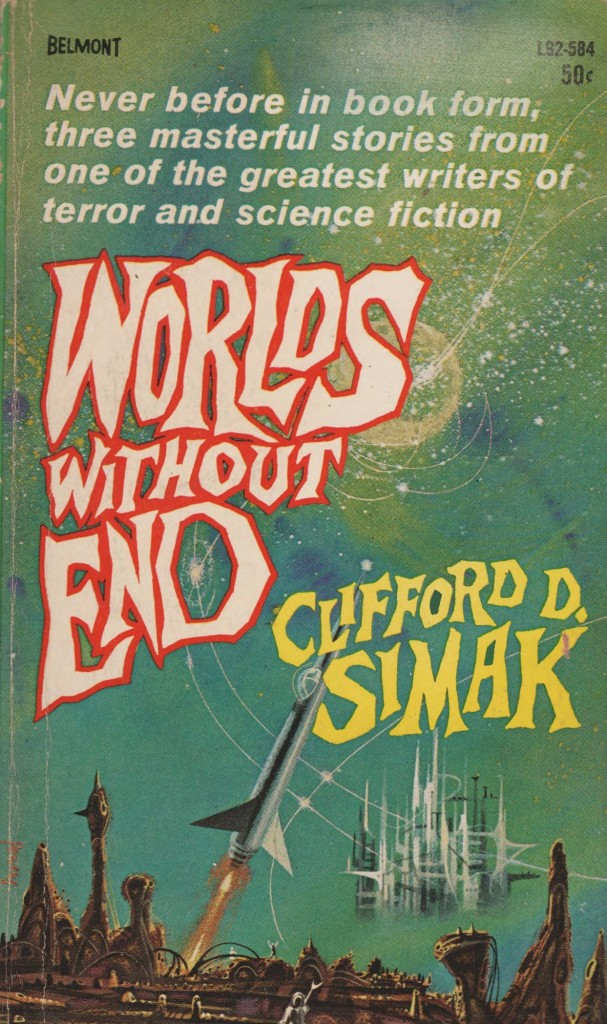
1. Worlds Without End, Clifford D. Simak (1964)

From the back cover: “A link between yesterday and the tomorrow that was here already…. Dreams constructed and maintained by society…. A world-to-world search for an elusive secret…. The bizarre, weird, strange creations of things and worlds only Clifford D. Simak could have written… and make believable.”

Contents: “Worlds Without End” (1956), “The Spaceman’s Van Gogh” (1956), “Full Cycle” (1955)

Continue reading

Updates: Recent Science Fiction Acquisitions No. CCLXVIII (Norman Spinrad, J. G. Ballard, Jacquetta Hawkes, and Frederik Pohl)

As always, which books/covers/authors intrigue you? Which have you read? Disliked? Enjoyed?

1. Low-Flying Aircraft and Other Stories, J. G. Ballard (1976)

There’s not a back cover or inside cover blurb on my edition

Contents: “The Ultimate City” (1976), “Low-Flying Aircraft” (1975), “The Dead Astronaut” (1968), “My Dream of Flying to Wake Island” (1974), “The Life and Death of God” (1976), “The Greatest Television Show on Earth” (1972), “A Place and a Time to Die” (1969), “The Comsat Angels” (1968), “The Beach Murders” (1966)

Initial Thoughts: I’ve been on a weird (for me) music kick as of late. I’ve been listening to a lot of 80s post-punk/new wave/goth music (Bauhaus, The Cure, Echo & the Bunnymen, The Psychedelic Furs, The Sisters of Mercy, Siouxsie and the Banshees, etc.) and I came across the British band The Comsat Angels. And they’re named after a J. G. Ballard story! If you don’t know of the band but enjoy any of the bands in the above list, check out Sleep No More (1981) (cold, paranoid, hypnotic). This led me back to Ballard’s catalog to track down the remaining anthologies of his I don’t own.

Continue reading

Book Review: The Wind From Nowhere, J. G. Ballard (1962)

Richard Powers’ cover for the 1st edition

3/5 (Average)

In J. G. Ballard’s The Wind From Nowhere (1962), cosmic radiation creates an immense natural disaster. Ever-increasing winds threaten to tear buildings out by their foundations and force the survivors into subterranean caverns. With the winds comes dust, a manifestation of erasure, that lacerates skin and engulfs all.

John Carnell serialized Ballard’s first novel in New Worlds in 1961 (issues 110 and 111). Continue reading

Book Review: The Best SF Stories from New Worlds 6, ed. Michael Moorcock (1970) (stories by J. G. Ballard, Hilary Bailey, Carol Emshwiller, M. John Harrison, et al.)

Paul Lehr’s cover for the 1971 edition

3.75/5 (collated rating: Good)

Welcome to a postmodern museum of disordered landscapes. J. G. Ballard paints a cratered England as a new Vietnam. Langdon Jones reduces the operation of the world to a series of sculptural machines. Hilary Bailey weaves a dystopic England changed beyond recognition in mere years. M. John Harrison’s characters interact with cardboard cutouts on an imaginary set. And Michael Moorcock’s Jerry Cornelius flits between India and Pakistan’s present and past.

While there are a few duds, the cream Continue reading