Which books/covers/authors intrigue you? Which have you read? Disliked? Enjoyed?
1. When Gravity Fails, George Alec Effinger (1986)
Jim Burns’ cover for the 1988 edition
From the back cover: “In a decadent world of cheap pleasures and easy death, Marîd Audran has kept his independence and his identity the hard way. Still, like everything else in the Budayeen, he is available …for a price.
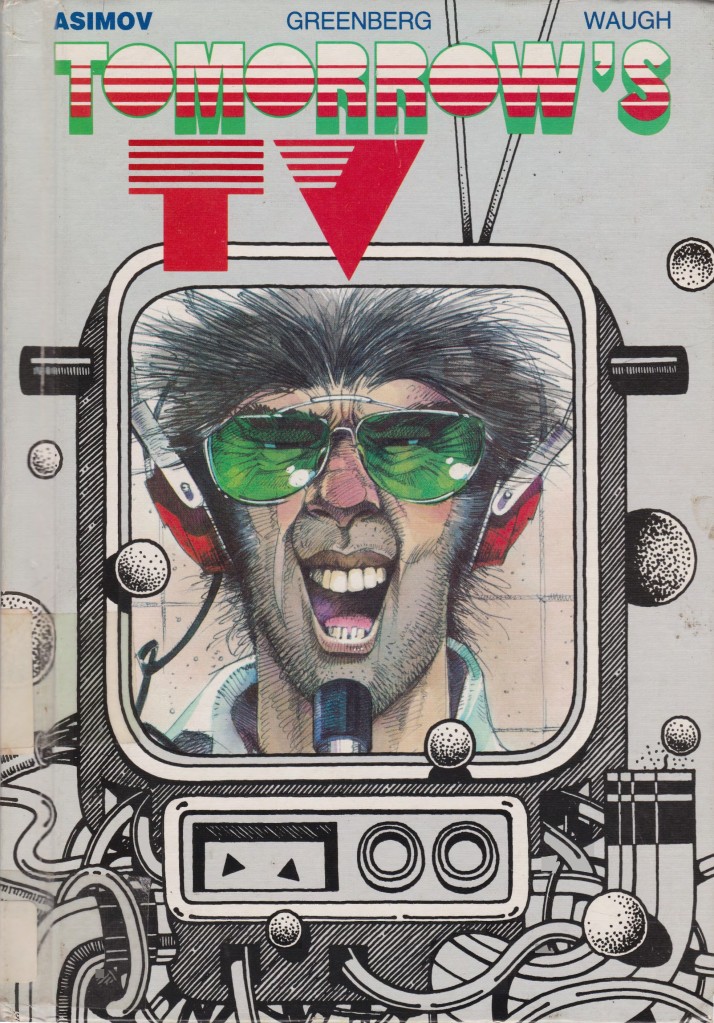
The seventh, eighth, ninth, and tenth stories in my series on the science fictional media landscape of the future appear in the anthology Tomorrow’s TV, ed. Isaac Asimov, Martin Harry Greenberg, and Charles Waugh (1982).
Tomorrow’s TV (1982) gathers together five short stories published between 1951 and 1979 on future speculations and disturbing manifestations of the tube of the future. The extensive number of TV-related science fiction from these decades (especially the 50s and early 60s) should not come as a surprise. According to Gary R. Edgerton’s magisterial monograph The Columbia History of American Television (2007), no “technology before TV every integrated faster into American life” (xi). Isaac Asimov speculates on the nature of education and the role of the “teacher” if every kid goes to school on their TV. Ray Bradbury imagines a frosty world where everyone turns inward towards the hypnotic glow of their TV sets. Robert Bloch explores the intersection of programming as escape and its collision with the real world. Ray Nelson narrates a hyperviolent expose of the alien entities behind subliminal messaging. And Jack Haldeman II imagines what will happen when the human mind reaches a moment of information overload.
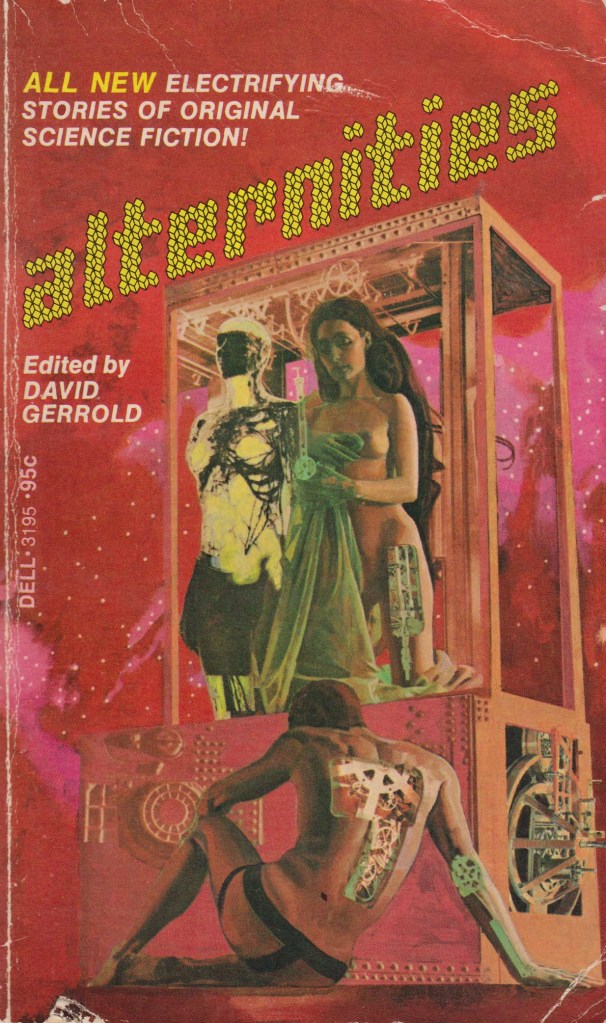
David Gerrold and his associate editor Stephen Goldin collect a bizarre range of SF oddities including an epistolary nightmare from Vonda N. McIntyre’s pen and a one-sentence “sign” by Duane Ackerman. Gerrold argues that he wants “science fiction to be fun again” without “literary inbreeding and incestuous navel-studying” (8). With a more than pungent hint of hypocrisy, he spouts “I’m tired of the kind of bullshitting that creates false images in the readers’ minds” (8). Alternities (1974) reads like the cast off stories from a New Wave (i.e. deliberately literary) Judith Merril or Harlan Ellison anthology with heavy dose of erotic comedy and shock value. A few–including E. Michael Blake’s “The Legend of Lonnie and the Seven-Ten Split,” Vonda N. McIntyre’s “Recourse, Inc.,” and Edward Bryant’s “Cowboys, Indians”–rise above the dross.
To be clear, I enjoy devouring anthologies like Alternities. The stories are originals and few are anthologized elsewhere. I adore reading authors I wouldn’t otherwise encounter (Robert Wissner, E. Michael Blake, et al.). Gerrold’s nonsense of an introduction aside, the anthology with its deliberate attempts at the “literary” (Greg Bear’s “Webster” and James Sallis’ “The First Few Kinds of Truth”) and “edgy” (Steven Utley’s “Womb, with a View”) firmly fit in the passing mid-70s foam of the New Wave movement.

 Science Fiction and Other Suspect Ruminations