What pre-1985 science fiction are you reading? + Update No. XXII

What pre-1985 science fiction are you reading or planning to read next month? Here’s the April installment of this column.

As readers of the site know, I am obsessed with the machinations of Cold War nuclear logic—historical and science fictional. In Ira Chernus’ brilliant Apocalypse Management: Eisenhower and the Discourse of National Insecurity (2008), he dives into the Manichean ideoscape that dominated Eisenhower’s thinking. In short, he posits that Eisenhower interpreted the Soviet threat as an apocalyptic struggle in which the traditional outcome, eliminating the treat, is impossible. Instead the best hope is “to contain and manage it forever” (2)–hence “apocalypse management.” This “new linguistic paradigm” profoundly influenced their policymaking process and dominated American public discourse.

According to Chernus, Eisenhower was obsessed with Americans practicing voluntary self-control in their consumption in order shoulder the taxes needed to fund the perpetual struggle. With this paradigm, Eisenhower’s gestures towards peace–for example his “The Chance for Peace” (April 16th, 1953) speech–were acts of calibrated psychological warfare designed to put the burden of action on the Soviets and score points with the American public and American allies. The United States, on the other hand, could wage the conflict with perpetual, safe, and managed inaction in which peace is never the ultimate objective.

Continue reading
Updates: Recent Science Fiction Purchases No. CCLXXXVIII (Sakyo Komatsu, Women of Wonder anthology, Arsen Darnay, and interviews with SF authors)

Which books/covers/authors intrigue you? Which have you read? Disliked? Enjoyed?

1. Japan Sinks!, Sakyo Komatsu (1973; trans. by Michael Gallagher, 1976)

From the back cover: “WORST DISASTER IN THE HISTORY OF THE WORLD!

A FISSURE in a wall–a land survey mysteriously out of true–a small island disappearing overnight–and one of the worst disaster in the history of the world is born. Only one man suspects the truth, but his theory is so unprecedented, his predications so horrifying that even his fellow scientists ignore him.

Earthquakes

Then a series of devastating earthquakes strikes, and suddenly the authorities are prepared to listen. But time is short and as they frantically try to ward off the disaster the crust of the earth begins to shift…”

Continue reading

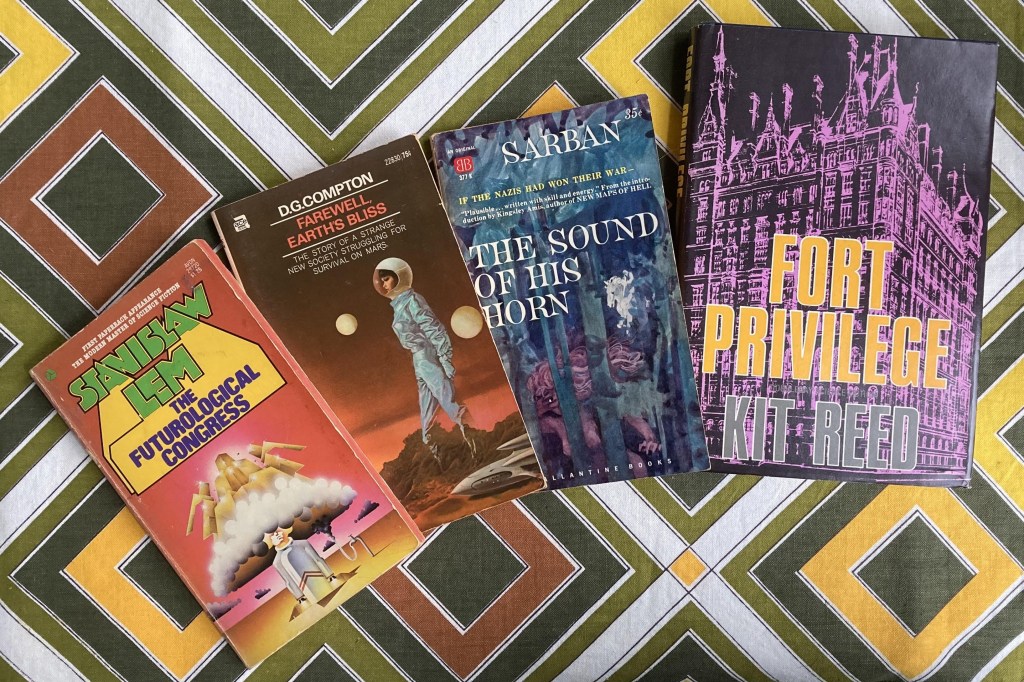
Short Book Reviews: Jack Vance’s The Languages of Pao (1958), Kit Reed’s Fort Privilege (1985), and John Shirley’s Transmaniacon (1979)

Note: My read but “waiting to be reviewed pile” is growing. Short rumination/tangents are a way to get through the stack before my memory and will fades. Stay tuned for more detailed and analytical reviews.


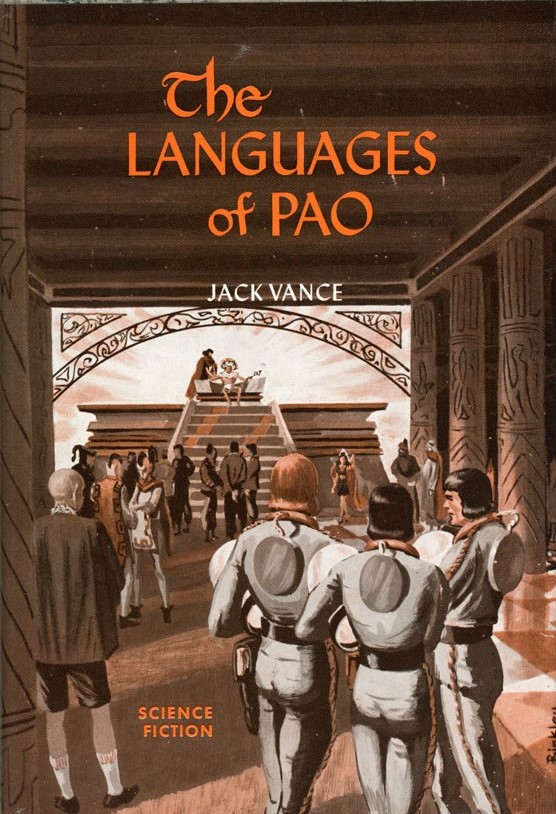
1. The Languages of Pao, Jack Vance (1958)

3.25/5 (Vaguely Good)

Since I started my site in 2011, I’ve soured a bit on Jack Vance’s brand of planetary adventure in richly realized and exotic worlds. I doubt I’d currently rate novels like Showboat World (1975) or The Blue World (1966) as highly as I did back then. One of more appealing elements of having a single project for so long is my ability to track my evolving views on genre. That said, I’d classify Wyst: Alastor 1716 (1978) and The Languages of Pao (1958) amongst his most conceptually ambitious novels I’ve read so far and worth tracking down. For a full list consult my index. Note: I read but never reviewed Dying Earth (1950).

Continue reading

Updates: Recent Science Fiction Acquisitions No. CCLVIII (Philip K. Dick, Kit Reed, Kenneth F. Gantz, and a Themed Anthology)

As always which books/covers/authors intrigue you? Which have you read? Disliked? Enjoyed?

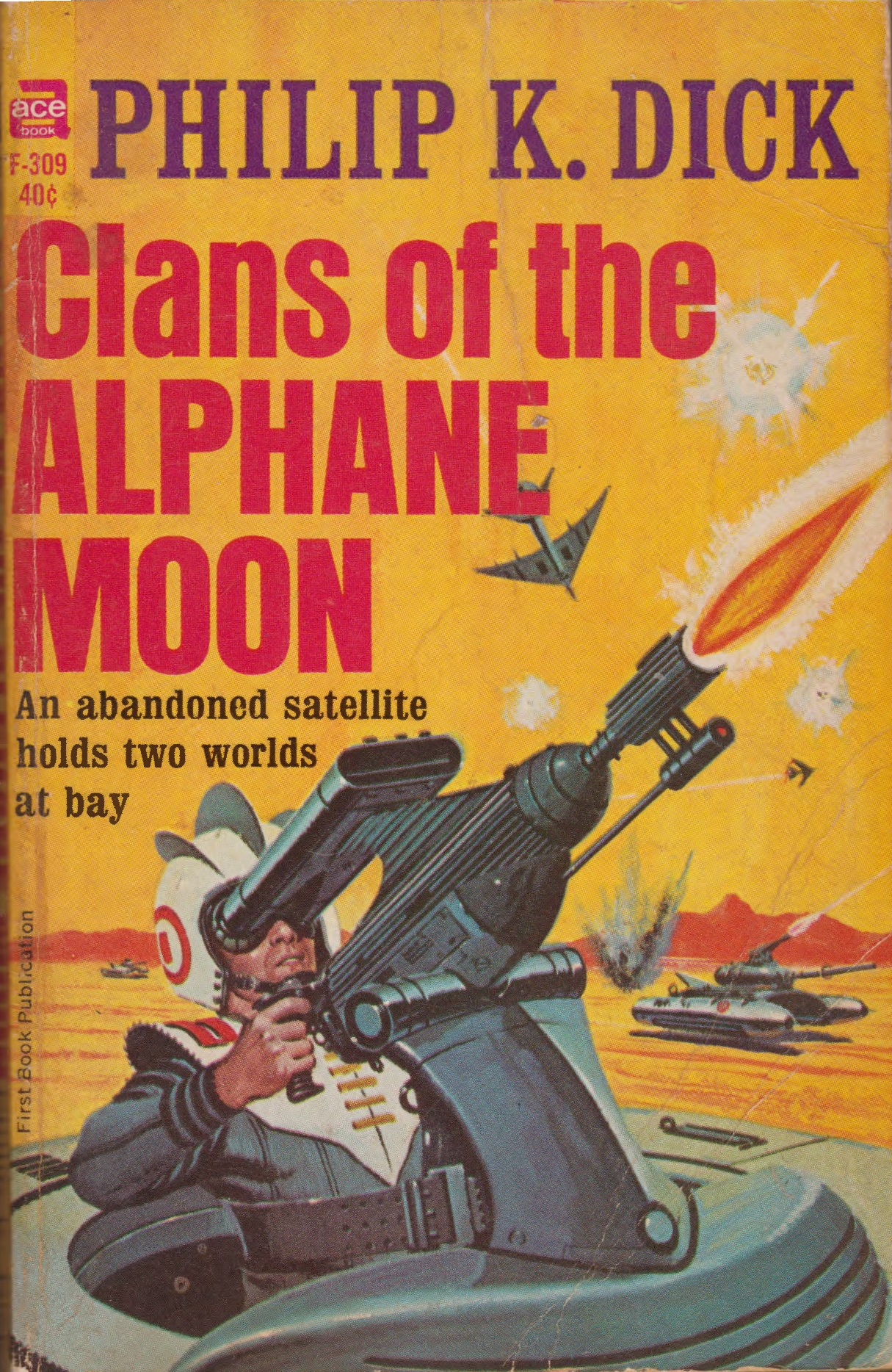
1. Clans of the Alphane Moon, Philip K. Dick (1964)

Ed Valigursky’s cover for the 1st edition

From the back cover: “Holding a precarious liberty as the result of an interstellar stalemate, the human survivors of Alpha Centauri’s hospital moon readied themselves for their war of independence.

Naturally, the Pares, always suspicious and sunning, assumed the leadership, leaving it to the Manses to provide the super weapons out of their sheer love of violence. Propaganda and other details would have been left to the Skitzes, the Heebs, and Polys, and the Ob-Coms.

Continue reading

Updates: My 2018 in Review (Best SF Novels, Best SF Short Fiction, and Bonus Catagories)

Post-academia depression hits hard…. While completing my PhD (defended in the summer of 2017), reading SF and writing about SF was the way I kept sane. After multiple mostly unsuccessful years on the academic market, I have changed gears career-wise (although I’m still affiliated with a university and teaching college-level history courses but without the research component) and it has been a liberating experience. My history obsessions remain, even stronger in many ways, and academic monographs on all the topics that I wanted to read about but never could—Hellenistic successor states to Alexander, Early Islam, Late Antique and Medieval Persia, etc.–have dominated my time and pocketbook 2018 (don’t ask how much I’ve spent). I have included a “Best Academic History Reads of 2018” section for the curious.

At the beginning of November, I was moments from announcing that I was on hiatus for the foreseeable future. However, I have fallen back in love with SF and writing about SF and the new year beckons!

All of this is to say, I read little SF this year–until last month. However, there were a handful of stand-out SF novels and short stories that I managed to squeeze in.

And please list your favorite vintage (or non-vintage) SF reads of the year. I look forward to reading your comments.

Enjoy!

…and read lots of good books in 2019. I will.

Best SF Novels Continue reading

Updates: Kit Reed (June 7, 1932-September 24, 2017)

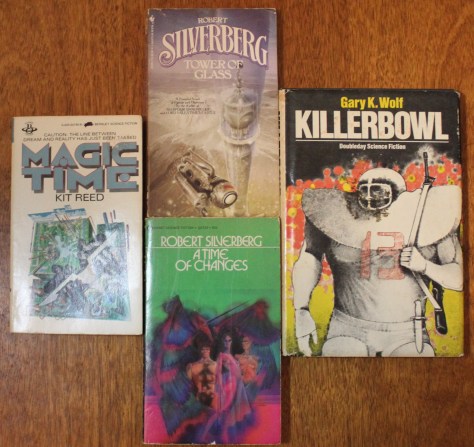
(A selection of my Kit Reed collection. Left and Right cover info below. Center cover: Peter Andrew Jones, 1978)

Today I learned on twitter that Kit Reed (1932-2017), one of my favorite SF authors, passed away back in September. Although I only had infrequent conversations with her via twitter, her charm and intelligence always showed through. Her most recent novels included Where (2015) and Mormama (2017) for Tor. I, of course, know her best for her 50s-70s short fiction and Armed Camps (1969), her single SF novel published before the 1980s. Continue reading

Guest Post: Pioneer Spaceships, Robot Therapists, and Oppressive Small Towns: “Survival Ship” (1951), Judith Merril, “Short in the Chest” (1954), Margaret St. Clair, “The Wait” (1958), Kit Reed

Megan (twitter) over at From Couch to Moon—who, with boundless wit and intelligence, enjoys exploring the turbulent seas of lesser known SF both vintage and contemporary—provides the sixth guest post in my SF Short Stories by Women Writers pre-1969 series (original announcement and list of earlier posts). Head over to her blog—do not miss her review of Brunner’s Stand on Zanzibar (1968) written in his style and more recent rundowns of various award slates, the 2015 Kitschies for example.

Here are three reviews of 1950s short fiction by Judith Merril, Margaret St. Clair, and Kit Reed.

As always, the required exhortation, find copies!

_________________________________________________________________

newwrmay55

(“Survival Ship” appeared in the May 1955 issue of New Worlds Science Fiction, ed. John Carnell, cover: Gerard Quinn)

Reviews of “Survival Ship” (1951) by Judith Merril, “Short in the Chest” (1954) by Margaret St. Clair, and “The Wait” (1958) by Kit Reed

By Megan

Not being much of a short fiction reader, these were all new-to-me stories that I thought I might appreciate. A selection of fifties SF, all of which are dark and strange and rebellious, and examine the social and political pressures that are often Continue reading

Guest Post Series Announcement: SF Short Stories by Women Writers pre-1969

146532

(Richard Powers’ cover for the 1963 edition of A Handful of Time (1963), Rosel George Brown)

The time has come for a new Guest Post series on SF Short Stories by Women Writers pre-1969. My reasons are two-fold: 1) to showcase a deserving and fascinating topic in line with my goal to feature lesser known SF from a range of viewpoints and traditions 2) to feature posts from reviewers in the vintage SF blogsphere and beyond (in any combination of the following) that attempt to move past standard lists and grand narratives of canon, tackle fiction from evidence-based analytical and academic perspectives, or are simply darn good writers whose sites I cannot help but return to compulsively.

Why pre-1969? Although most endpoints are arbitrary in nature, 1969 saw the publication of Ursula Le Guin’s magisterial The Left Hand of Darkness. Considered a watershed moment in the history of women writers as it was the first to win a Hugo Award for best novel, Le Guin among many others were part of a rich (albeit oft suppressed and ignored) genealogy of women SF authors reaching back to Mary Shelly. My focus on short stories will allow exploration of many authors who did not write novels, whose novels overshadow their short fiction, and those whose rich body of early work focused predominately on the short form.

Thus I have rounded up my normal suspects along with new voices. The first guest post series covered the work of Michael Bishop and the second Kate Wilhelm.

Topics in the queue: Robot therapists, French and Soviet SF, a range of speculative fictions from the 19th Continue reading

Updates: Recent Science Fiction Acquisitions No. CLXV (Leiber + Haiblum + Scholz and Harcourt + Orbit Anthology)

Recently reminded of Fritz Leiber’s beautiful story “A Pail of Air” (1951) which I reviewed a few years ago in the eponymous collection, I was delighted to come across another one of his short story collections.  Thankfully, no Fafhrd and the Gray Mouser stories are in sight.  And of course, another Richard Powers cover…

On twitter I mentioned my ignorance regarding the work of Isidore Haiblum, the author of the “the first Yiddish SF novel” according to the blurb on The Tsaddik of the Seven Wonders (1971).  I have not come across a copy of that particular novel yet, but, another even lesser known quantity joins the books arrayed in piles across my library.

My dalliance with the 1980s continues in fits and starts: I wrote a short review of Christopher Priest’s masterpiece The Affirmation (1981) and recently reviewed Terry Carr’s edited volume Universe 10 (1980)…  As Carter Scholz’s short story “The Johann Sebastian Bach Memorial Barbecue and Nervous Breakdown” (1980) made such a positive impression on me, I decided to find a copy of his collaborative novel.

And I love Damon Knight’s Orbit series of original anthologies.  For reviews: Orbit 1 (1966), Orbit 3 (1968), and Orbit 8 (1970).

As always, thoughts/comments are welcome!

1. Fritz Leiber, The Night of the Wolf (1966)

thnghwlf111966

(Richard Powers’ cover for the 1966 edition)  Continue reading