Updates: Recent Science Fiction Acquisitions No. CLIX (Gerrold + Reed + Lewin + Anthology of European Non-English Language SF)

Digression: I have been thinking about “best of” lists and why I seldom approach an author by reading their “best known” work first.  Caveat: I compulsively read the Hugo list as a kid and was exposed to many wonderful authors.

Reading “the acknowledged best” reinforces our notions of what is canon or not canon.  And I am all about puncturing holes in our self-perpetuating notions of canon and SF grand narratives of what is “classic” SF and what is not.  The following dialogue often plays out:

A) “Have you read the best SF novels of the 1970s?”

B) “Yes, I have, from this great top 15 novels list!”

A) “What would you say are the best novels from the 1970s?”

B) “Oh, here you go!” Regurgitates original list.

A) “Have you read other SF novels from the 1970s?”

B) “Umm.”

I am guilty of this as well!  My top 1960s novels list undergoes regular revisions.  The original list was a product of my lack of knowledge.  Regardless, it remains to this day the most popular and commented upon post on my site!  Alas!

Sometimes “the less known” novels are a way to get a feel for what an author is capable of and seeing an author through their body of work leads (at least for me) to greater appreciation for their best (which might not be the ones anointed by the majority).  Barry N. Malzberg: I read In the Enclosure (1973) before  Beyond Apollo (1972).  Doris Piserchia:  Doomtime (1981) before A Billion Days of Earth (1976). Robert Silverberg: Thorns (1967) before Downward to the Earth  (1970).  Christopher Priest:  Indoctrinaire (1970) before The Affirmation (1981).

Third, I put great value on individual exploration. It is humorous and ironic that I have run this review site for six or so years but am reluctant to immediately follow-up on the reading suggestions of others.  I am sorry frequent readers!  I devour the reviews of others for sure (see Part I and Part II for worthwhile resources).  Well-argued reviews with evidence and an understanding of the work’s time and place and reflections on interactions with/or within genre, are more likely to remain with me.  And then, when I am in the book store, I remember what others have said.

The questions I have been pondering: Do I put together a best 20 novels of the 1970s list?  When do I decide whether I have read enough?  Or, do I play the “caveat” game and state that this is bound to change (which it is as I read more)?

Post proper:  My mapping of the contours of Kit Reed’s early oeuvre continues.  Her first SF novel Armed Camps (1969) and her stories in Mister Da V. and Other Stories (1967) demonstrate a knack for humanistic exploration of characters trapped in manifestations of cyclicality—be it social constructions or the forces of history.

David Gerrold’s novels do not inspire…..  At least so far: Space Skimmer (1972) + Yesterday’s Children (variant title: Starhunt) (1972).  Which means, time for short stories!  And yes, his acknowledged best The Man  Who Folded Himself (1973) waits in the wings [From Couch to Moon’s review —> here].

Non-English language SF other than Stanislaw Lem and Arkady and Boris Strugatsky: the biggest hole in my SF knowledge.

And perhaps the find/risk of the bunch, a satirical pseudo-governmental pamphlet that generated endless debate about its authenticity.

As always, thoughts and comments are welcome.

1. With a Finger in My I, David Gerrold (1972)

wthfngrnmc1972

(Mati Klarwein’s cover for the 1972 edition) Continue reading

Book Review: The Best SF Stories from New Worlds 2, ed. Michael Moorcock (1968)

THBSTSFSTR1969

(Paul Lehr’s cover for the 1969 edition)

3.75/5 (Collated rating: Good)

As New Worlds issues tend to be expensive and hard to find (especially in the US), Michael Moorcock’s anthology series provides satiating morsels from the magazine’s best period.  New Worlds was instrumental in the so-called New Wave movement.  I am at home in  eclectic and genre-challenging/subversive madness.

New Worlds combined SF stories/poems with experimental art and layout that is, unfortunately, lost in the anthologies.  One of my favorite examples is Vivienne Young’s collage (below) illustrating James Sallis’ “Kazoo” (1967) Continue reading

Updates: Recent Science Fiction Acquisitions No. CLII (Silverberg + Reed + Robinson + Reamy)

More Kit Reed! I enjoyed both her first short story collection Mister Da Vi (1967) and first SF novel Armed Camps (1969).  I was impressed enough to track down another—and as she has informed me via twitter “rare”—collection.  Rare enough that she does not even own a copy!

Fresh off Tom Reamy’s dark and wonderful Blind Voices (1978), I thought it would be best to explore some of his early short fiction.

There’s nothing wrong with another Robert Silverberg collection from his heyday (late 60s-70s), although, I have read at least two of the thirteen stories in the collection already.

Frank M. Robinson in the early 90s jumped back on the SF scene with the well-received generation ship novel The Dark Beyond the Stars (1991).  More involved with editing over the decades, he published in the 70s a series of famous thrillers with Thomas N. Scortia.  I found a copy of his first novel, The Power (1956), although, the presence of telepathy (my least favorite SF theme?) makes me less than enthused.

Three of the four following books came via Mike at Potpourri of Science Fiction Literature and Tongues of Speculation—he visited Uncle Hugo’s in Minneapolis and sent me 10 (!!) books I had on my “to acquire” list.

Thoughts and comments are welcome (as always!).

1. Unfamiliar Territory, Robert Silverberg (1973)

NFMLRTRRTR1978

(Paul Alexander’s cover for the 1978 edition) Continue reading

Updates: Recent Science Fiction Acquisitions No. CXLVII (Women of Wonder Anthology + Eklund + Watson + Franke)

IMG_0799

(Inside illustration by Vincent Di Fate for the 1973 edition of The Orchid Cage (1961), Herbert W. Franke)

Part II of my SF acquisitions from Dawn Treader Books in Ann Arbor, MI– Part I.  In my attempt to acquire more foreign SF (still haven’t managed to read that much of it—but the mood will strike eventually), I found a nice copy with a wonderful interior illustration and cover by Vincent Di Fate of one of Herbert W. Franke’s novels.

Also, another Ian Watson novel—I’ve read the Jonah Kit (1975) but never got around to reviewing it as well as his collection (must read for fans of 70s SF) The Very Slow Time Machine (1979).  Jesse over at Speculiction raves about his other Continue reading

Updates: Recent Science Fiction Acquisitions No. CXXX (Anthologies 2x + Bishop + Green)

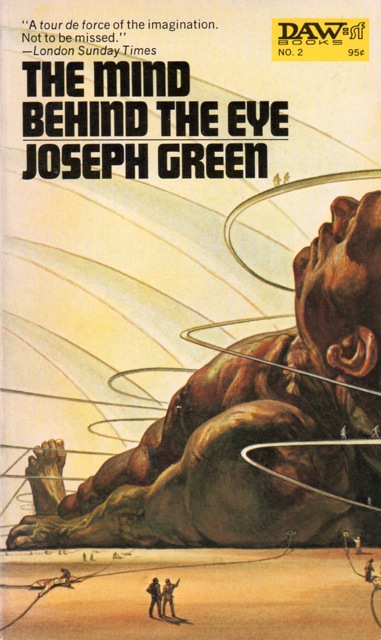
I’m continuing my anthology kick (my review of one of them is already up)—a fascinating way to explore the work of lesser known authors who might have produced some quality SF but never had solo collections or novels published.  Also, an unknown quantity in Joseph Green…  Has anyone read his work?  I do think that the Josh Kirby cover is quite evocative although the premise seems ridiculously silly.

Joachim Boaz trembles with excitement as he picked up another work by one of my all time favorite SF authors, Michael Bishop!  If only I could convince myself to finally review Catacomb Years (1979) which was downright fantastic…

Thoughts?

1. The Mind Behind the Eye (variant title: Gold the Man), Joseph Green (1972)

MNDBHND1972

(Josh Kirby’s cover for the 1972 edition) Continue reading

Updates: Year in Review (Top Ten SF Novels + Top Ten Short Stories/Novelettes/Novellas + other categories)

Everyone likes lists!  And I do too….  This is an opportunity to collate some of my favorite (and least favorite) novels and shorter SF works I read this year.  Last year I discovered Barry N. Malzberg and this year I was seduced by…. Well, read and find out.


Top Ten Novels

1. We Who Are About To…, Joanna Russ (1976): A scathing, and underread, literary SF novel by one of the more important feminist SF writers of the 70s (of The Female Man fame).

2. A Funeral for the Eyes of Fire, Michael Bishop (1975): A well-written anthropological clash of cultures novel.  Slow, gorgeous, emotionally engaging….

3. Level 7, Mordecai Roshwald (1959): A strange satire of the bomb shelter…  Everyday surrealism. Continue reading

Book Review: Armed Camps, Kit Reed (1969)

Screen shot 2013-08-29 at 9.24.15 AM(Bob Haberfield’s cover for the 1969 edition)

4.5/5 (Very Good)

“[…] and the men were on the way to the bar, they were talking about the performance, they had to compare it to every other performance, they had to link them all and form them into something continuous, something to keep away the dark” (19).

Kit Reed’s first SF novel Armed Camps (1969) is all about characters constructing narratives and conjuring visions in order to keep the aphotic tides of societal disintegration at bay.  The two paralleled narratives — a woman (Anne) running from her past and a man (Danny March) slowly recounting what led to his own downfall — are two different ways of fighting off what is bound to come.  An oppressive melancholy that never lifts soaks the passages, presaging the motions of the characters as if they are trapped in some Thucydidean manifestation of the cyclicality Continue reading

Updates: Recent Science Fiction Acquisitions N. XLVI (Reed + Pratt + Brown + anthology)

Finally getting near the end of the pile of science fiction novels procured during my latest journey to Texas (a few were in clearance dollar bins) + gifts from 2theD.  I know very little about any of the authors (any info would be read with relish) — and I even bought a book from the early 1980s!  I know, shocker, but it has to do with drowned cities…. one of my favorite themes…. although it’ll never equal the uterine joys of Ballard’s magisterial The Drowned World (1962).

1. Under the City of Angels, Jerry Earl Brown (1981)

(Lou Feck’s cover for the 1981 edition) Continue reading