What pre-1985 science fiction are you reading? + Update No. VIII

I hope you’ve gotten off to a great reading start to 2024! What pre-1985 science fiction are you reading this month?

If you’re new and curious about my rationale for the perimeters of my site, check out this recent interview and podcast. And follow me on Mastodon if you don’t already as I no longer post on my Twitter account. Also make sure to check out the previous installment of this monthly column

And, most importantly, let me know what pre-1985 SF you’ve been reading!

The Photograph (with links to reviews and brief thoughts)

  1. Adrian Mitchell’s The Bodyguard (1970) might be one of the oddest dystopias ever written.
  2. Kate Wilhelm’s Where Late the Sweet Birds Sang (1976) is a fascinating peek into her vast oeuvre of disquieting visions. While I read it before I started my site, a friend reviewed it for my guest post series on Wilhelm’s fiction. As I recently covered Wilhelm’s far lesser known anti-Vietnam War novel The Killing Thing (1967), her work was on my mind.
  3. M. John Harrison is rightly famous for his Viriconium Nights sequence: The Pastel City (1971), A Storm of Wings (1980), and In Viriconium (1982). If you enjoyed them, I highly recommend tracking down his first novel — The Committed Men (1971). From my review: “Possessed by destructive melancholy, the inhabitants of a post-apocalyptical UK–where political powers have sunk into oblivion–attempt to recreate a semblance of normalcy.  Clement St John Wendover, teeth long since rotted, still administers to the skin diseases and ailments of his one-time patients although he cannot cure them. […] Gathering together a troop of “committed men” (and a woman!), Wendover sets off across the corroded landscape with a newborn mutant child: a new species for an altered Earth or an accidental abnormality….”
  4. I recently covered a Barrington J. Bayley short story in my cities of the future series and it reminded me of his most extreme moments of off-the-wall invention — The Garments of Caean (1976) immediately came to mind.

What am I writing about?

Continue reading
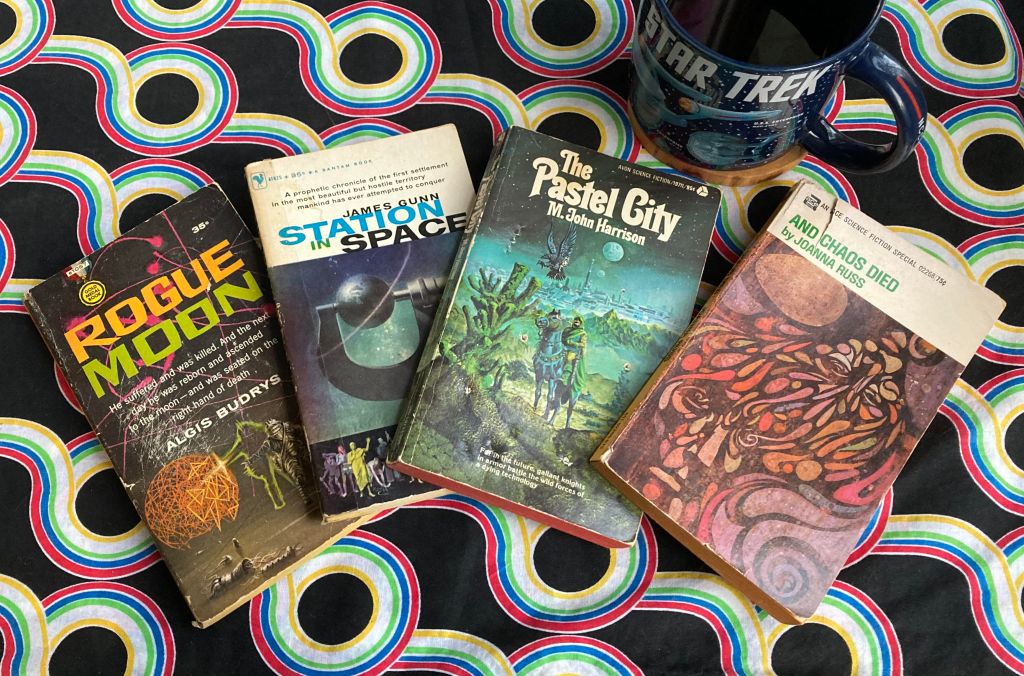
What pre-1985 science fiction are you reading? + Bimonthly Update No. IV

What pre-1985 science fiction are you reading this week?

I’ve thoroughly enjoyed the conversations and connections you all have made in the comments over the last two months of this column. Make sure to check out the previous installment if you haven’t already. As before, I’ve included a bit about the books in the photograph, birthdays from the last two weeks, and brief ruminations on what I’ve been reading and writing.

Let me know what pre-1985 SF you’ve been reading!

Continue reading

Updates: Recent Science Fiction Purchases No. CCLXXI (Jack McDevitt, Clifford D. Simak, New Worlds Quarterly, and New Voices)

As always, which books/covers/authors intrigue you? Which have you read? Disliked? Enjoyed?

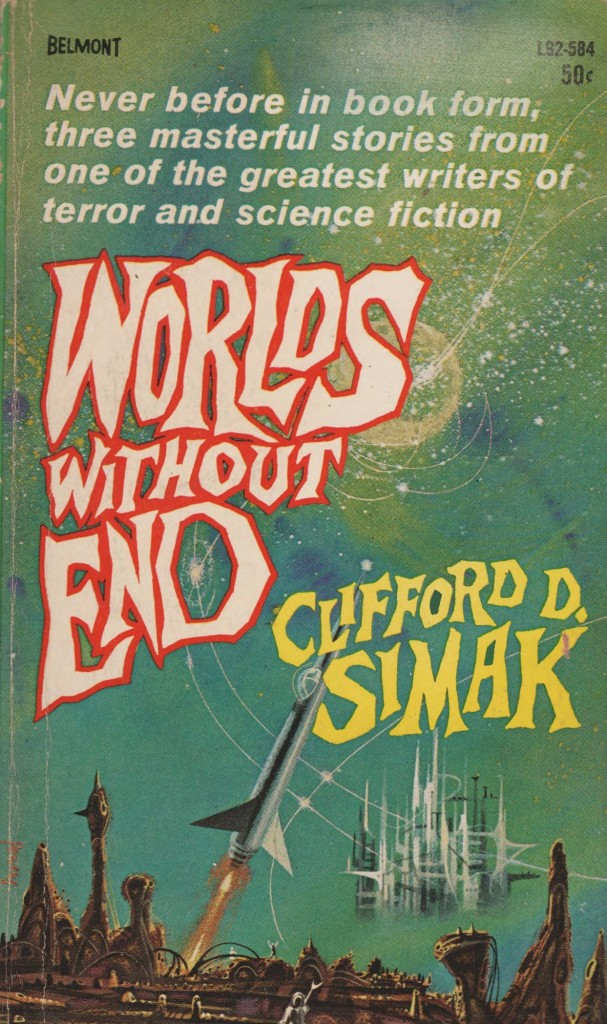
1. Worlds Without End, Clifford D. Simak (1964)

From the back cover: “A link between yesterday and the tomorrow that was here already…. Dreams constructed and maintained by society…. A world-to-world search for an elusive secret…. The bizarre, weird, strange creations of things and worlds only Clifford D. Simak could have written… and make believable.”

Contents: “Worlds Without End” (1956), “The Spaceman’s Van Gogh” (1956), “Full Cycle” (1955)

Continue reading

Updates: My 2020 in Review (Best SF Novels, Best SF Short Fiction, and Bonus Categories)

I’m not sure what I can add about the general sentiment of 2020. It was awful in every way. Here’s to a better 2021.

Reading and writing for the site—and participating in all the SF discussions it’s generated over the year—was a necessary and greatly appreciated salve. Thank you everyone!

I also have one (hopefully more) review coming out in The Magazine of Fantasy and Science Fiction (the Curiosities column) in the spring. I’ve not included my reviews of those esoteric SF novels in this particular post.

Without further ado, here are my favorite novels and short stories I read in 2020 (with bonus categories). Tempted to track any of them down?

And feel free to list your favorite vintage (or non-vintage) SF reads of the year. As always, I look forward to reading your comments.


My Top 10 Science Fiction Novels (click titles for my review)

Tim White’s cover for the 1983 edition

1. Electric Forest, Tanith Lee (1979), 5/5 (Masterpiece): Tanith Lee spins a gauzy, sinister, and terrifying tale of manipulative resurrection. A brilliant inventor projects the mind of a grotesque social outcast into a new transcendent Continue reading

Short Book Reviews: M. John Harrison’s A Storm of Wings (1980), Algis Budrys’ Some Will Not Die (1961, rev. 1978), and William Greenleaf’s The Tartarus Incident (1983)

James Gurney’s cover art detail for the 1st edition of William Greanleef’s The Tartarus Incident (1983)

Note: My read but “waiting to be reviewed pile” is growing. Short rumination/tangents are a way to get through the stack. Stay tuned for more detailed and analytical reviews.

1. A Storm of Wings, M. John Harrison (1980)

Michael Whelan’s cover for the 1982 edition

4.5/5 (Very Good)

A Storm of Wings (1980) is the second volume, after The Pastel City (1971), of the Viriconium sequence. Far more dense and oblique than its predecessor, A Storm of Wings revels in the creation of a surreal urban tapestry–redolent with decay and decadent excess. Two Reborn Men (Fay Glass and Alstath Fulthor) attempt to animate the somnolent city of Viriconium Continue reading

Book Review: The Best SF Stories from New Worlds 6, ed. Michael Moorcock (1970) (stories by J. G. Ballard, Hilary Bailey, Carol Emshwiller, M. John Harrison, et al.)

Paul Lehr’s cover for the 1971 edition

3.75/5 (collated rating: Good)

Welcome to a postmodern museum of disordered landscapes. J. G. Ballard paints a cratered England as a new Vietnam. Langdon Jones reduces the operation of the world to a series of sculptural machines. Hilary Bailey weaves a dystopic England changed beyond recognition in mere years. M. John Harrison’s characters interact with cardboard cutouts on an imaginary set. And Michael Moorcock’s Jerry Cornelius flits between India and Pakistan’s present and past.

While there are a few duds, the cream Continue reading

Updates: Recent Science Fiction Acquisitions No. CCXX (M. John Harrison + John Christopher + Ian Watson)

1 and 2. As a kid, I read and adored John Christopher’s Tripod Trilogy (1967-1968). Little did I know at the time the quantity of other SF novels—mostly of the post-apocalyptical sort—published over his long career. In 2012 I read,  reviewed, and enjoyed his post-apocalyptical satire The Long Winter (1962). And now, I have both his single most famous “cozy catastrophe” and a lesser known one… with a fantastic cover by Steve Crisp.

3. I now own three of the four volumes in M. John Harrison’s Viriconium sequence (1971-1984)! Here’s volume two. I reviewed and adored The Pastel City (1971).

My other M. John Harrison reviews (he’s a Joachim Boaz favorite):

The Committed Men (1971)

The Centauri Device (1974)

The Machine in Shaft Ten (1975)

4. Ian Watson is a fascinating author. The stories in The Very Slow Time Machine (1979) should be tracked down. I also recommend The Jonah Kit (1975), which I never got around to reviewing…. this acquisition is a lesser known novel in his extensive oeuvre.

Let me know what books/covers intrigue you. Which have you read? Enjoyed? Hated?

~

1. A Wrinkle in the Skin (variant title: The Ragged Edge), John Christopher (1965)

(Steve Crisp’s cover for the 1985 edition) Continue reading

Book Review: New Writings in SF 9, ed. John Carnell (1972) (Harrison + Coney + Sellings + King + et al.)

nwwrsnsf651972

(Gene Szafran’s cover for the 1972 edition)

3/5 (collated rating: Average)

An imaginary question I received: “Why do you read anthologies cover to cover?” I love discovering new authors and those I was aware existed but haven’t read—with New Writings in SF 9 (1972) the following fall into this bipartite category: Joseph Green, Paul Corey, Arthur Sellings, Vincent King, R. W. Mackelworth, and Eddy C. Bertin.

Of the bunch, I will probably only remember Vincent King’s vision of the angst as the exploration of the entire galaxy nears completion… Both authors whom I know far better produce the best of the collection.  Michael G. Coney’s haunting tale of evolutionary dependency and M. John Harrison account of paranoia and guilt over the massacre of mysterious aliens are worth the read. Too bad the three above were never anthologized outside of John Carnell’s New Writings series!

Overall New Writings in SF 9 is superior to New Writings in SF 4 (1965) but probably only satisfying for Coney and Harrison completists….

Note: this title refers to the 1972 US publication which was a best of earlier volumes. Another volume by the same name was published in 1966 in the Continue reading

Adventures in SF Cover Art: Collage and Mechanism: Anita Siegel’s Art for Doubleday Science Fiction

149193

(Cover for the 1975 edition of The Hellhound (1975), Ron Goulart)

Over the past year or so I’ve explored the artists behind Doubleday Science Fiction—from the early art of The Brothers Quay, who later became well-known directors of experimental short film, to an interview with artist Emanuel Schongut. I’ve included the links to other posts in the loose series below.

Anita Siegel (1939-2011) was a Brooklyn based artist best known for her “sardonic collages seamlessly combining pictures into biting satires” (from her obituary). Her work also featured in the New York Times Op-Ed page (especially during Continue reading