Today I’ve reviewed the eighteenth and nineteenth stories in my series on the science fictional media landscape of the future. Alice Eleanor Jones and C. M. Kornbluth conjure a media-saturated world and cartoon characters that generate cultish adoration. Both authors respond to the rapid growth of television in the United States over the 1950s and multimedia conglomerates like Disney.
Previously: John Brunner’s “Fair” (March 1956) under the pseudonym Keith Woodcott.
C. M. Kornbluth’s “The Advent on Channel Twelve” first appeared in Star Science Fiction Stories No. 4, ed. Frederik Pohl (1958). You can read it online here if you have an Internet Archive account. Nominated for the 1959 Hugo for Best Short Story. Lost to Robert Bloch’s “That Hell-Bound Train” (1958).
In the short intro to the story in The Best of C. M. Kornbluth (1976), Frederik Pohl explains that Kornbluth’s two young sons (and their father) never missed an episode of theThe Mikey Mouse Club(1955-1958). The iconic Disney TV show generated a “national mania” with kids everywhere singing the Mouseketeer song and wearing mouse-ear hats. In 1955, the wider Disney craze would see the creation of their first theme park–Disneyland. Expanding on earlier ruminations on media and the masses in The Space Merchants (1953), “The Advent on Channel Twelve” imagines the dystopic elevation of cartoon character to an altogether new pedestal in the American consciousness.
Uncredited cover art detail for the 1975 New English Library edition of Barry N. Malzberg’s The Destruction of the Temple (1974)
In the history of my website, I’ve reviewed and adored countless fictions that tackled future formations of the media landscape. Spurned in part by the explosion of television ownership in the 50s, pop art’s obsession with filmic iconography, and popular studies on advertising, science fiction compulsively explored futuristic formulations of media performance and manipulation, exploitation and paranoia (SF Encyclopedia). I’ve decided to put together a review series of short fiction that will continue my exploration of the theme.
It is devilishly difficult to organize all that I’ve reviewed so far but here are a few of the highlights that suggest different routes I might traverse. As I do not plan on rereading stories I’ve covered in the past, feel free to track down some of the gems below.
Kate Wilhelm’s “Baby, You Were Great” (1967), Carol Emshwiller’s “This Thing Called Love” (1955), and James Tiptree, Jr.’s “The Girl Who Was Plugged In” (1973) scrutinize the emotional bifurcation between the audience and their love of the starlet or influencer as presented and constructed. And the ways in which the audience controls the construction…. and by extension the performer.
Lloyd Biggle, Jr.’s “Well of the Deep Wish” (1961), Keith Roberts’ “Sub-Lim” (1965), and Kit Reed’s “At Central” (1967) speculate on the methods media can be used as social control. Of course, in the both the Biggle and Reed, the real world outside has utterly transformed since the audience has slipped into new worlds.
And, of course, I have to include Barry N. Malzberg’s extensive oeuvre–such as Revelations(1972) and Screen(1968). His work often demonstrates the pernicious addiction and desperation audiences and participants project into the media landscape hoping for truth and real experience. The media landscape is yet another mechanized artifice pandering to our obsession with dark spectacle.
I hope you enjoy this series. Feel free to join in (I include a link to the first story below)!
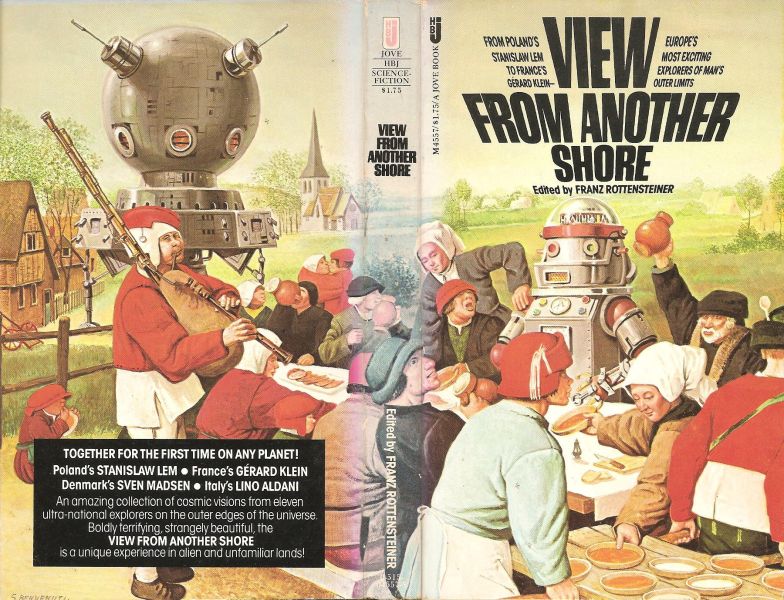
Gianni Benvenuti’s cover for the 1978 edition ofView from Another Shore (1973), ed. Franz Rottensteiner
4.75/5 (Near Masterpiece)
Lino Aldani’s short story “Good Night, Sophie” first appeared under the pseudonym N. L. Janda in Futuro, no. 1 (March/April 1963). Futuro, edited by Aldani along with Giulio Raiola and Massimo Lo Jacono, was the first entirely Italian science fiction magazine (it contained some translations of Polish SF) (contents). I read it in Franz Rottensteiner’s anthology of European science fiction in translation View from Another Shore (1973). You can read it online here.


 Science Fiction and Other Suspect Ruminations