What pre-1985 science fiction are you reading? + Update No. XXI

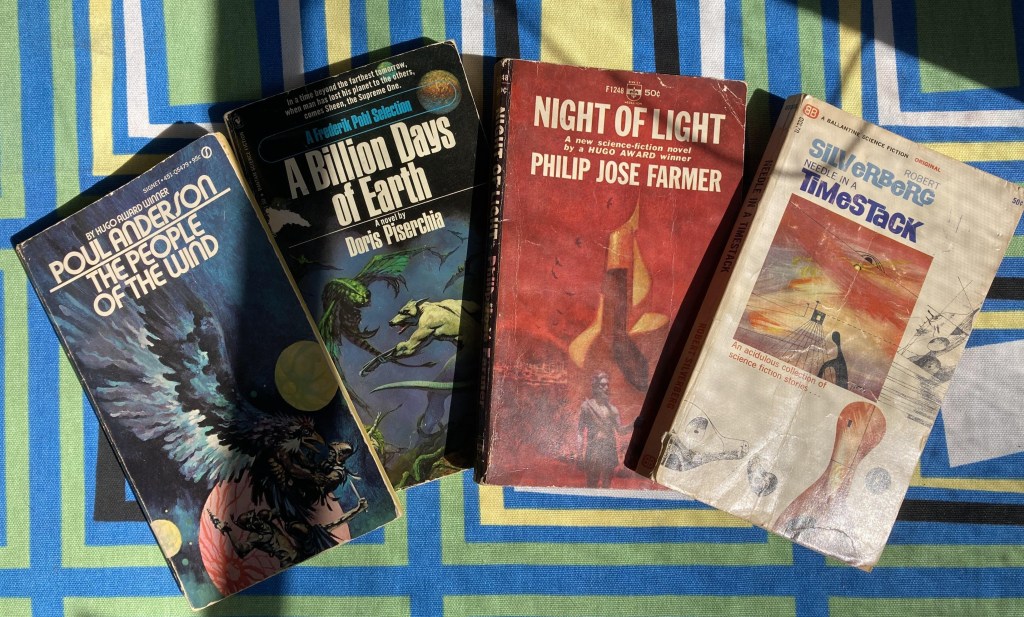
What pre-1985 science fiction are you reading or planning to read this month? Here’s the March installment of this column.

Recently I came across John Boston and Damien Broderick’s three-volume series examining each and every story and non-fiction article in the pre-Michael Moorcock New Worlds and Science Fantasy/SF Impulse magazines in the UK. John Boston is a valued member of my site’s community — frequently stopping by in the comment sections. I thought for this mini-editorial I’d list a handful of active community members with websites, books, and worthwhile SF-related fanzine articles. I, of course, could be missing a few. Community matters more than you might think. I enjoy the discussion. I enjoy reading reviews that others write — even if it’s on science fiction that might not be within my more narrow focus (the historian in me). I always want to learn and share what’s worth reading and/or historically interesting. Thank you one and all.

Continue reading

What pre-1985 science fiction are you reading? + Update No. XX

What pre-1985 science fiction are you reading or planning to read this month? Here’s the January installment of this column (sorry I missed a month).

Before John W. Campbell, Jr. (1910-1971) attempted to raise the “standards and thinking in magazine SF,” David Lasser (1902-1996) attempted his own brief (1929-1933) program to improve science fiction as managing editor of Hugo Gernsback’s Science Wonder Stories, Wonder Stories, and Wonder Stories Quarterly. According to Mike Ashley’s The Time Machine: The Story of the Science-Fiction Pulp Magazine from the Beginning to 1950 (2000), Lasser is a “much neglected revolutionary in science fiction” and through his efforts the genre “started to mature” (66).

Ashley highlights Lasser’s letter of instruction mailed to his regular contributors on the 11th of May, 1931, in which he “exhorted them to bring some realism to their fiction” (72). He also outlawed common tropes like the giant insect story and space opera (73). He emphasized the need to focus on characters that “should really be human” — not everything needs to be a “world-sweeping epic” (73). Stories in this vein, according to Ashley, include Clifford D. Simak’s religiously themed “The Voice in the Void” (1932), P. Schuyler Miller and Walter Dennis’ “The Red Spot on Jupiter” (1931) and “The Duel on the Asteroid” (1974), which featured a grim realism and character development (74).

Continue reading

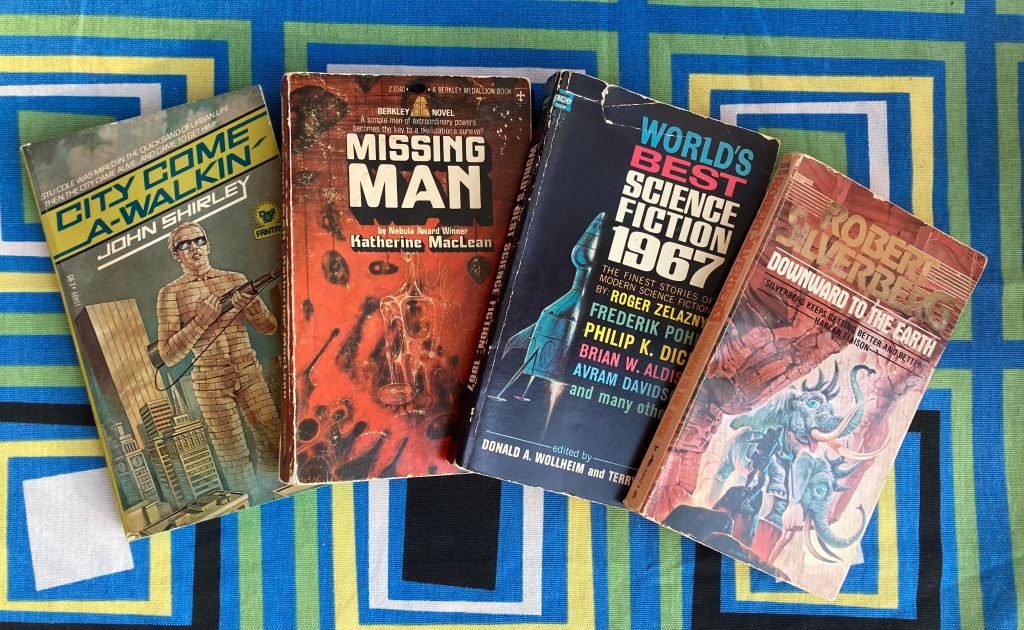
Updates: Recent Science Fiction Purchases No. CCCXLI (Pamela Sargent, Lan Wright, Burt Cole, and an Anthology on Post-Apocalyptic Fiction)

Which books/covers/authors intrigue you? Which have you read? Disliked? Enjoyed?

1. Subi: The Volcano, Burt Cole (1957)

From the inside flap: “This is a forceful war story with a different. There is the Far Eastern background, the convincing solders’ talk, the military politics, the sex, disablement, disease, death, violence, stoicism, sadism, and so on, which combine to stress once again war’s futility and stupidity and man’s inhumanity to man: but there are also deeper implications which make this novel so strikingly unusual.

Judson, a persistent deserter from an army camp, has made a rough shelter for his native girl in the nearby ramshackle, bombed city, when he hears of a guerrilla attack on the camp. He goes to the base of the volcano (where the mob has gathered) to persuade them that if they kill Americans they will only die of disease for want of medical treatment. For his pains he is set upon and torn to pieces.

Continue reading

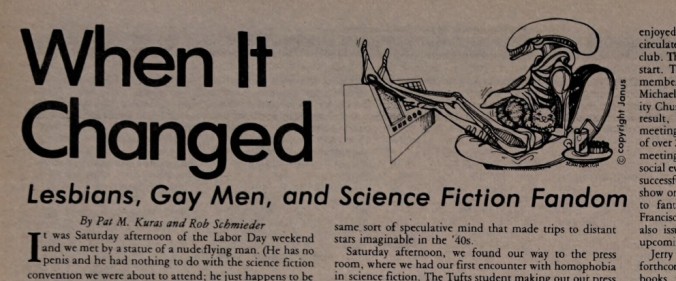
Exploration Log 8: Pat M. Kuras and Rob Schmieder’s “When It Changed: Lesbians, Gay Men, and Science Fiction Fandom” (1980)

“We also encountered many gay people, feminists and progressives of every stripe. These people were at the convention because present day science fiction has much to offer them. Science fiction is the fiction of ideas, and the ideas coming from the minds of the new writers more and more concern progressive analyses of social issues.”

— Pat M. Kuras and Rob Schmieder (1980)

At the 38th World Science Fiction Convention (29th August–1st September, 1980) held in Boston, MA, organizers scheduled the first Worldcon panel with an openly LGBTQ topic: “The Closed Open Mind: Homophobia in Science Fiction Fantasy Stories” moderated by Jerry Jacks, one of the “early openly gay fans.”1 Around 200 fans attended to hear Elizabeth A. Lynn (SFF author), Samuel R. Delany (SFF author), Frank M. Robinson (SF author and activist), and Norman Spinrad (SFWA President and SF author) (“the token straight”) discuss issues of representation.

Continue reading

What pre-1985 science fiction are you reading? + Update No. XIX

What pre-1985 science fiction are you reading or planning to read this month? Here’s the December installment of this column.

Lost texts, and the act of reconstructing the fragments, fascinates. The questions pile up. Would the contents reveal a pattern in an author’s work? Intriguing personal details? A startling modus operandi? At the 11th World Science Fiction Convention (Philcon 2), Philadelphia (September 1953), Philip José Farmer gave a speech titled “SF and the Kinsey Report.” Considering Farmer’s recent publication of “The Lovers” (1952), this is not surprising. Alfred Kinsey, the famous sexologist and founder of the Kinsey Institute for Research in Sex, Gender, and Reproduction on Indiana University’s campus, published his controversial Sexual Behavior in the Human Male in 1948. Sexual Behavior in the Human Female appeared in 1953. Like many of Farmer’s earliest speeches, he did not keep copies.

Deeply intrigued by what the speech might have contained, Sanstone and I (on Bluesky) managed to piece together a few general responses from fanzines and magazine con reports.

Continue reading

Updates: Recent Science Fiction Purchases No. CCCXL (Philip José Farmer, L. Sprague de Camp, George Alec Effinger, and an Anthology of SF by Women)

A selection of SF volumes acquired over winter break!

Which books/covers/authors intrigue you? Which have you read? Disliked? Enjoyed?

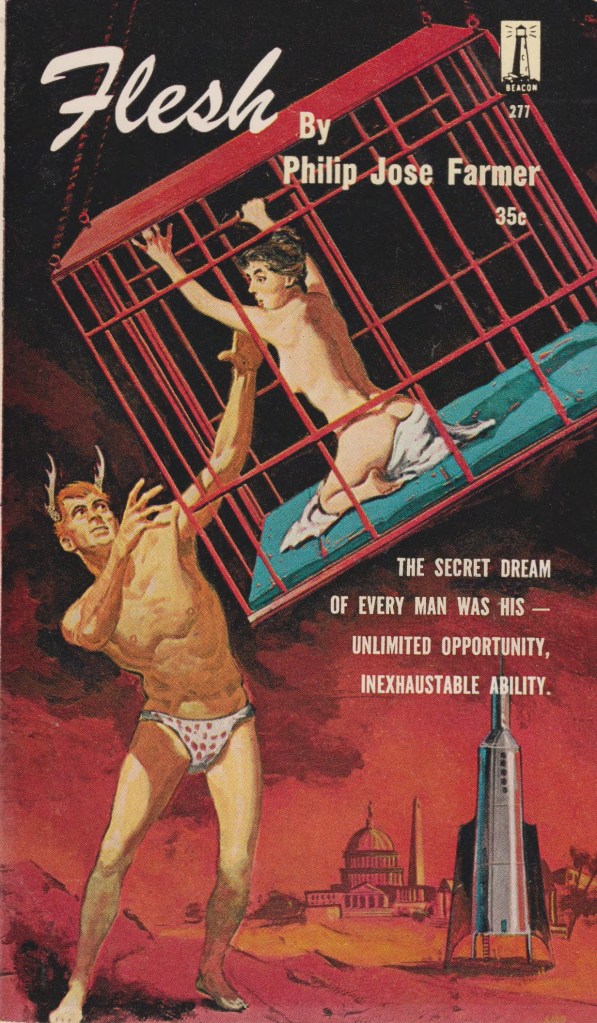
1. Flesh, Philip José Farmer (1960)

From the back cover: “Spaceman by DAY… MONSTER by night!

Peter Stagg was caught in the vilest trap ever devised–his own lust-driven body! For FLESH is the pulse-stirring story of a space explorer’s return from the strangest voyage man had ever made–to the strangest world the universe had ever seen–his own Earth!

Continue reading

Book Review: In the Drift, Michael Swanwick (1985)

3.25/5 (Above Average)

In The Drift (1985), a fix-up novel comprised of two Nebula-nominated short works–“Mummer Kiss” (1981) and “Marrow Death” (1984), maps a new way forward in an ecologically and genetically ravaged post-apocalyptic age. The entire concoction decays with a sense of grim unease and cavorts around piles of dead that would make a triumvir from the Late Roman Republic proud. It’s a violent, erotic, and disquieting experience that can’t entirely hide its flaws behind the decadent panache.

Continue reading

What pre-1985 science fiction are you reading? + Update No. XVIII

What pre-1985 science fiction are you reading or planning to read this month? Here’s the November installment of this column.

Last week I wrote a post about Clifford D. Simak’s delightfully inclusive 1971 speech at the height of the New Wave in which he celebrated science fiction as a “forum of ideas” open to all voices. While reviewing the various snarky comments leveled at the movement by “classic authors” like Asimov, a faint memory of James Blish’s own anti-New Wave sentiments tickled my memory. I randomly opened up a book on my desk to figure out a fascinating SF tidbit to start this post, and voilà, the James Blish story.

Jacqueline Foertsch’s Reckoning Day: Race, Place, and the Atom Bomb in Postwar America (2013) contains a sustained analysis of Samuel R. Delany’s various post-apocalyptic novels. She includes a discussion of the response to Delany’s Nebula-winning The Einstein Intersection (1967). At the 1968 Nebula Awards Banquet, moments after Delany received his prize for Einstein (and where moments later he’d collected another award for “Aye, and Gomorrah”), Blish lambasted the New Wave. Blish complained about the “loosening of the genre’s parameters” and the “re-christening of the genre” as “speculative fiction” (98). I find all of this hilarious as Blish himself wrote fantasy novels like Black Easter (1968) (that would also nab a 1969 Nebula nomination) and far earlier oblique proto-New Wave speculative fictions like “Testament of Andros” (1953). I wonder if Blish aimed such vitriol at a figure like Simak, who took the loosening of the genre’s parameters to extremes during the New Wave–i.e. novels like The Goblin Reservation (1968), Destiny Doll (1971), and Out of Their Minds (1970). Unfortunately, I don’t think it’s surprising that Blish took especial issue with one of the few black SFF authors of the day.

And let me know what pre-1985 science fiction you’ve been reading!

Continue reading

Exploration Log 6: Clifford D. Simak’s 1971 Worldcon Guest of Honor Speech

In an August 1967 editorial in Galaxy titled “S.F. as a Stepping Stone”, Isaac Asimov (1920-1992) voiced his extreme disapproval of the New Wave movement as “‘mainstream’ with just enough of a tang of the not-quite-now and the not-quite-here to qualify it for inclusion in the genre” (4). He concludes: “I hope that when the New Wave has deposited its forth and receded, the vast and solid shore of science fiction will appear once more and continue to serve the good of humanity” (6). The implication is clear: there is an Platonic science fiction form that exists (and that he writes) that must be rediscovered.

Fellow “classic” author Clifford D. Simak (1904-1988) offered a different, and far more inclusive, take at his Guest of Honor speech at Norescon 1 (Worldcon 1971). In an environment of “shrill” disagreement between various New Wave and anti-New Wave camps, Simak celebrated science fiction as a “forum of ideas” open to all voices (148).

Preliminary note: I read the speech in Worldcon Guest of Honor Speeches, ed. Mike Resnick and Joe Siclari (2006). You can listen to the speech (at the 28:00 min. mark) here. For a wonderful range of photographs of Simak at the convention, check out this indispensable photo archive.

As I did with six Simak interviews earlier this year, I will paraphrase his main points and offer a few thoughts of my own.

Let’s get to the speech!

Continue reading