In The Drift (1985), a fix-up novel comprised of two Nebula-nominated short works–“Mummer Kiss” (1981) and “Marrow Death” (1984), maps a new way forward in an ecologically and genetically ravaged post-apocalyptic age. The entire concoction decays with a sense of grim unease and cavorts around piles of dead that would make a triumvir from the Late Roman Republic proud. It’s a violent, erotic, and disquieting experience that can’t entirely hide its flaws behind the decadent panache.
What pre-1985 science fiction are you reading or planning to read this month? Here’s the November installment of this column.
Last week I wrote a post about Clifford D. Simak’s delightfully inclusive 1971 speech at the height of the New Wave in which he celebrated science fiction as a “forum of ideas” open to all voices. While reviewing the various snarky comments leveled at the movement by “classic authors” like Asimov, a faint memory of James Blish’s own anti-New Wave sentiments tickled my memory. I randomly opened up a book on my desk to figure out a fascinating SF tidbit to start this post, and voilà, the James Blish story.
Jacqueline Foertsch’s Reckoning Day: Race, Place, and the Atom Bomb in Postwar America (2013) contains a sustained analysis of Samuel R. Delany’s various post-apocalyptic novels. She includes a discussion of the response to Delany’s Nebula-winning The Einstein Intersection (1967). At the 1968 Nebula Awards Banquet, moments after Delany received his prize for Einstein (and where moments later he’d collected another award for “Aye, and Gomorrah”), Blish lambasted the New Wave. Blish complained about the “loosening of the genre’s parameters” and the “re-christening of the genre” as “speculative fiction” (98). I find all of this hilarious as Blish himself wrote fantasy novels like Black Easter (1968) (that would also nab a 1969 Nebula nomination) and far earlier oblique proto-New Wave speculative fictions like “Testament of Andros” (1953). I wonder if Blish aimed such vitriol at a figure like Simak, who took the loosening of the genre’s parameters to extremes during the New Wave–i.e. novels like The Goblin Reservation (1968), Destiny Doll (1971), and Out of Their Minds (1970). Unfortunately, I don’t think it’s surprising that Blish took especial issue with one of the few black SFF authors of the day.
And let me know what pre-1985 science fiction you’ve been reading!
In an August 1967 editorial in Galaxy titled “S.F. as a Stepping Stone”, Isaac Asimov (1920-1992) voiced his extreme disapproval of the New Wave movement as “‘mainstream’ with just enough of a tang of the not-quite-now and the not-quite-here to qualify it for inclusion in the genre” (4). He concludes: “I hope that when the New Wave has deposited its forth and receded, the vast and solid shore of science fiction will appear once more and continue to serve the good of humanity” (6). The implication is clear: there is an Platonic science fiction form that exists (and that he writes) that must be rediscovered.
Fellow “classic” author Clifford D. Simak (1904-1988) offered a different, and far more inclusive, take at his Guest of Honor speech at Norescon 1 (Worldcon 1971). In an environment of “shrill” disagreement between various New Wave and anti-New Wave camps, Simak celebrated science fiction as a “forum of ideas” open to all voices (148).
Preliminary note: I read the speech in Worldcon Guest of Honor Speeches, ed. Mike Resnick and Joe Siclari (2006). You can listen to the speech (at the 28:00 min. mark) here. For a wonderful range of photographs of Simak at the convention, check out this indispensable photo archive.
As I did with six Simak interviews earlier this year, I will paraphrase his main points and offer a few thoughts of my own.
Let’s get to the speech!
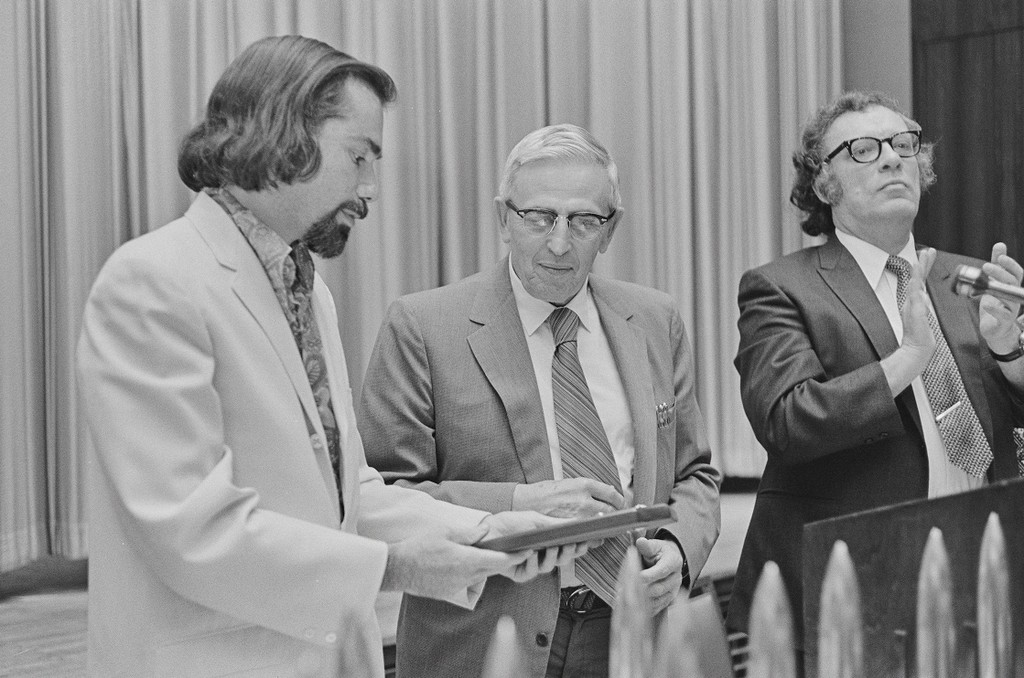
Jay Kay Klein’s photograph of Robert Silverberg, Clifford D. Simak, and Isaac Asimov at the 1971 Worldcon
Which books/covers/authors in the post intrigue you? Which have you read? Disliked? Enjoyed?
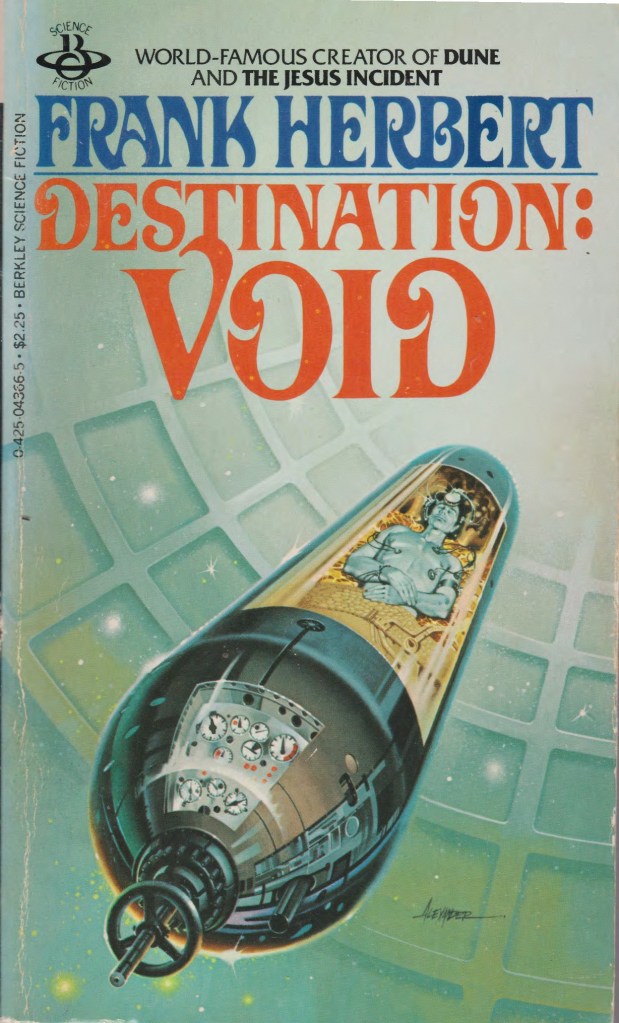
1. Frank Herbert’s Destination: Void (1966, rev. 1978)
Paul Alexander’s cover for the 1978 edition
From the back cover: “DESTINATION: VOID
THE COMPLETELY REVISED AUTHOR’S EDITION OF THE CLASSIC DEEP-SPACE ADVENTURE!
‘When the publishers announced that they were going to bring out a new edition of DESTINATION: VOID, they offered me the opportunity to make any changes I felt were necessary. Because of the tightly interwoven scientific premises behind this story and rapid development in the fields related to these premises, it would be extraordinary if discoveries across thirteen years did not dictate certain revisions.
Pat Murphy’s first novel The Shadow Hunter (1982) is an achingly beautiful tale of displacement. In the distant past, a young Neanderthal boy embarks on a hunt to claim his name and to learn the nature of the world. In the near future, a mogul named Roy Morgan wants to create a Pleistocene oasis (The Project) ensconced in a valley in an increasingly urban world. Morgan employs two damaged souls, Amanda and Cynthia, to aim his machines–that reach backward and forward into time.
A selection of previously read novels from my shelf
What pre-1985 science fiction are you reading or planning to read this month? Here’s July’s installment of this column.
Last month I waxed rhapsodic about a powerful interaction with a professor in graduate school… this month I’ll show you a recent obsessive territory I’ve been reading and ruminating about: 1940s and 1950s (and a few from the 60s) social commentary on American affluence, technology, and media. It all started with my media landscapes of the future series–I could not write on the topic unless I read some Marshall McLuhan. And then I had to read about C. Wright Mills to write about Clifford D. Simak and organized labor. And then I needed to track down other popular authors of social commentary published in era. It should not be surprising so much 50s SF revolved around social commentary — it was in the air. You get the idea. This pile represents some of what I now own:
Uncredited cover for the 1960 edition of Pat Frank’s Alas, Babylon (1959)
4/5 (Good)
Pat Frank (1907-1964) began his writing career working for local papers in northeastern Florida before a stint in The Office of Wartime Information (OWI) during WWII. The popular success of Frank’s three nuclear war-themed novels, that culminated with Alas, Babylon (1959), led him to take on the role as a speechwriter for the 1960 Kennedy campaign and beyond.1 As Frank was a lifelong Democrat, Alas, Babylon contains a range of 50s political views that manifest anti-communism and align with the small minority within the party interested in Civil Rights. The novel advocates for vigorous anti-Communist ideology at home and abroad and, in case deterrence fails, survival is possible for those who embody American virtues.
The Narrative Vantage Point Amidst the Mushroom Clouds
Bizarre alien civilizations. Homesickness as psychiatric treatment. The dangers of space travel. Capitalism unleashed. Utopian possibilities? Welcome to the strange wonders of Clifford D. Simak.
Today I’ve gathered together three more fascinating Simak tales that chart his deeply critical views of American business ethic. As in my previous post on the theme, the Grandmaster creates a future in which colonization goes hand-in-hand with the exploitation of resources, workers, and threatens the often bizarre alien intelligences they encounter.1
Two of the three rank among my best reads of the year. And now, to the stories!
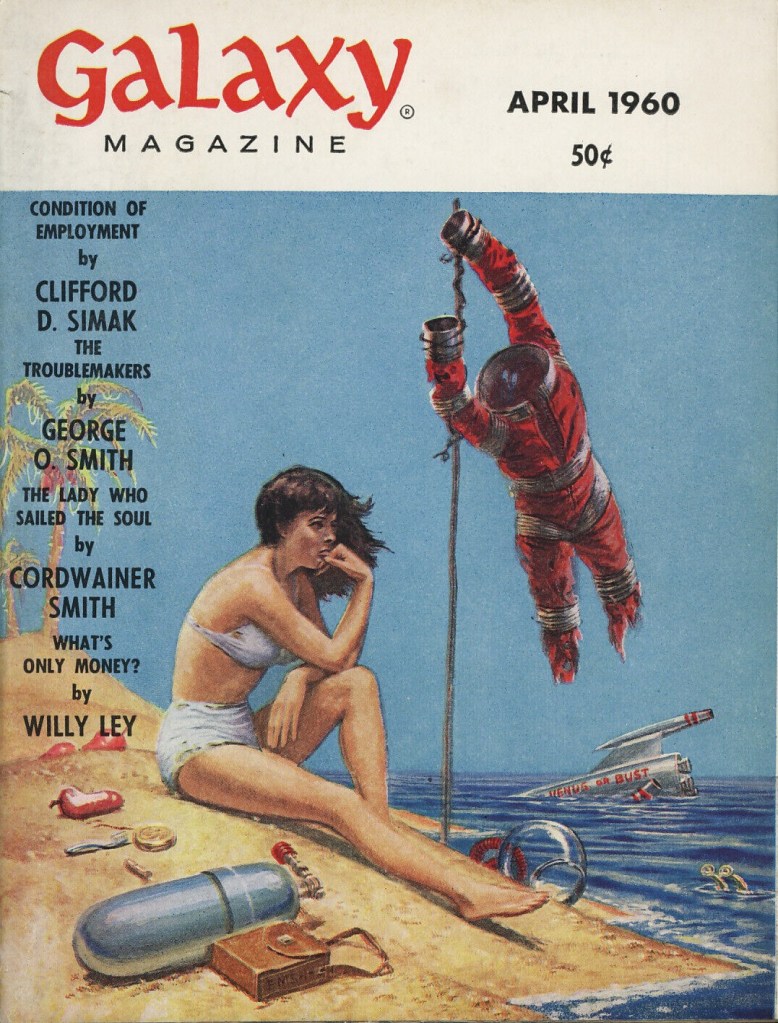
Ed Emshwiller’s cover for Galaxy Magazine (April 1960)
4.75/5 (Near Masterpiece)
“Conditions of Employment” first appeared in Galaxy, ed. H. L. Gold (April 1960). You can read it online here.




 Science Fiction and Other Suspect Ruminations