Book Review: Yesterday’s Children (variant title: Starhunt*), David Gerrold (1972)

(Paul Lehr’s cover for the 1972 edition)

3/5 (Average)

*The 1980 edition, still under the title Yesterday’s Children, was substantially rewritten.  In 1985 David Gerrold released it under a new title, Starhunt.  This is a review for the original 1972 edition.  I have not read the later rewrite so I am unsure how much was modified.

David Gerrold, best known for writing the famous Star Trek: The Original Series episode “The Trouble With Tribbles” (1967), has continuously produced SF novels since the early 70s.  I had previously read the disappointing Space Skimmer (1972) which combined a fascinating premise with puff-puppies, annoying princes, and bad poetry.  Yesterday’s Children (1972) (variant title: Starhunt) likewise combines a fascinating premise with a less than satisfactory delivery, numerous narrative hiccups, and uneven tone and characterization.  I am not surprised that the novel was rewritten due to the slightly rough Continue reading

Updates: Year in Review (Top Ten SF Novels + Top Ten Short Stories/Novelettes/Novellas + other categories)

Everyone likes lists!  And I do too….  This is an opportunity to collate some of my favorite (and least favorite) novels and shorter SF works I read this year.  Last year I discovered Barry N. Malzberg and this year I was seduced by…. Well, read and find out.


Top Ten Novels

1. We Who Are About To…, Joanna Russ (1976): A scathing, and underread, literary SF novel by one of the more important feminist SF writers of the 70s (of The Female Man fame).

2. A Funeral for the Eyes of Fire, Michael Bishop (1975): A well-written anthropological clash of cultures novel.  Slow, gorgeous, emotionally engaging….

3. Level 7, Mordecai Roshwald (1959): A strange satire of the bomb shelter…  Everyday surrealism. Continue reading

Updates: Recent Science Fiction Acquisitions No. LXXXIII (Randall + Brunner + Shaw + Jones)

Dallas Half Price Book Store Part III (Part I, Part II)!

A short story collection by an author I have termed Mr. Perpetually Average But Readable, Bob Shaw.  I am interested in whether or not his visions are more concise/poignant in short story form.  I suspect a book like One Million Tomorrows (1971) would have been amazing in short form, especially the disturbing portions that take place in Africa (the UN forcefully administering immortality treatment on people who do not want them)….

A Nebula award nominated novel by Marta Randall, Islands (1976)—immortality themed, seems (at first glance) to be on the allegorical side = I have high hopes.

More Brunner! (Despite his warning, I was influenced by a review over at Speculiction…. here)  But then again, I am a Brunner completest…. And finally, a relatively unknown British SF novel, Implosion (1967) about a decreasing population.  Despite words of warning from reviews like Ian Sales’ (here) I couldn’t resist the Vincent Di Fate cover.

Thoughts?

1. Tomorrow Lies in Ambush, Bob Shaw (1973)

(Uncredited cover for the 1975 edition) Continue reading

Book Review: The Men Inside, Barry N. Malzberg (1973)

(Ron Walotsky’s cover for the 1973 edition)

4.5/5 (Very Good)

Caveat: If a perverse (and Freudian) metafictional (and literary) retelling of Otto Klement and Jerome Bixby’s Fantastic Voyage replete with filmic flashbacks does not intrigue you then stay away….

There are few SF authors who utilize metafictional elements as gleefully and effectively as Barry N. Malzberg.  Beyond Apollo (1972), his masterpiece, is a labyrinthine sequence of 67 short chapters of a novel written by the main character who may or may not be recounting real (imagined?) events.  While in In the Enclosure (1973) the excruciating paranoia that permeates the pages and the impossible escapes that transpire, recounted as if they were entries in a diary, could indeed be generated by an external force—the exact nature of which is unknowable—implanting memories.  Revelations (1972) was entirely comprised of a sequence of documents (interview transcripts, diary fragments, epistolary fragments) Continue reading

Book Review: Fireship (variant title: Fireship / Mother and Child), Joan D. Vinge (1978)

(Stephen Hickman’s cover for the 1978 edition)

3.5/5 (collated rating: Good)

Like so many SF fans, my first exposure to Joan D. Vinge’s work was via her wonderful Hugo-winning novel The Snow Queen (1980).  Eventually I found a copy of her first published novel, The Outcasts of Heaven Belt (1978), which had an intriguing premise but a less than satisfactory delivery (poor characterizations, pacing, etc).  The collection Fireship (1978) is comprised of two novellas: the Hugo- and Nebula-nominated “Fireship” (1978) and one of her earlier works, “Mother and Child” (1975).

The title story is the lesser of the two despite its (dare I say dubious) award nominations.  It’s a light-hearted and unchallenging proto-cyperpunk Continue reading

Updates: Recent Science Fiction Acquisitions No. LXXXI (Vinge + Gerrold + Zelazny + White)

Part 1 of many: Half Price Books in Dallas, TX (the second best bookstore, after Dawn Treader Books in Ann Arbor, MI for SF I have ever come across).  Gift card courtesy of fiancé’s mother = LOTS OF SCIENCE FICTION.  There could not be a better gift….

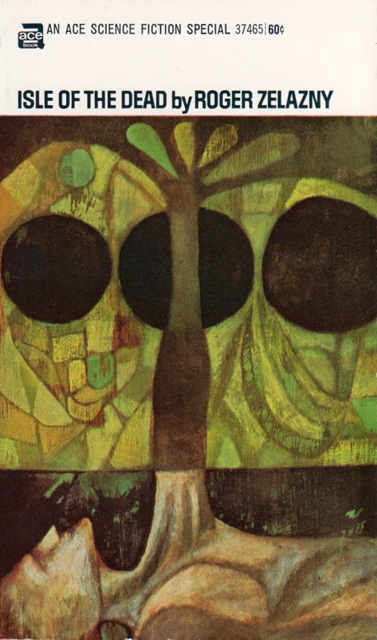
Everyone reads Robert Zelazny’s This Immortal (1966) and Lord of Light (1967), but who has read Isle of the Dead (1969)?  Thematically it seems similar to Lord of Light…  I have high hopes.  James White’s SF is always above average — and a fund cover from Dean Ellis makes that an auto-buy.  Although I disliked David Gerrold’s Space Skimmer (1972) my father swears Yesterday’s Children (1972) is somewhat readable.

I enjoyed Joan D. Vinge’s The Summer Queen (1980), tolerated her first novel The Outcasts of Heaven Belt (1978), so I suspect her two novella collection Fireship (1978) will be worthwhile…

Thoughts?

1. Isle of the Dead, Robert Zelazny (1969)

(Leo and Dianne Dillon’s cover for the 1969 edition) Continue reading

Updates: Recent Science Fiction Acquisitions N. LXXX (Bishop + Herbert + Malzberg + Offutt)

Stopped briefly in St. Louis to peruse a used book store and came across these…  Another work by one of my new favorite SF authors, Michael Bishop.  Short stories by Frank Herbert, and an intriguing post-apocalyptical vision by Andrew J. Offutt (with a fantastic Powers cover).

Unfortunately, Malzberg’s lesser novel Tactics of Conquest (1974) — according to later admission expanded from a short story in only four days! — tempted me, but it was only one dollar…

Thoughts?

1. Stolen Faces, Michael Bishop (1977)

(Steve Hickman’s cover for the 1978 edition) Continue reading

Book Review: The Shores of Another Sea, Chad Oliver (1971)

(Michael Booth’s cover for the 1984 edition)

3.25/5 (Vaguely Good)

Suppose that one day man landed on some distant planet.  Why would he have come, what impulse would have driven him across the darkness and the light-years?  Could he explain, and would he even try?  If he set out to explore that fearful world, if he trapped some specimens, what would he do if he were attacked by monstrous beings he could not understand? (135)

Chad Oliver is a well-known proponent of anthropological science fiction.  John Clute (of SF encyclopedia) proclaims him “pioneer in the application of competent anthropological thought to sf themes.”  Despite being relatively prolific between the 50s-70s (a handful of short stories appeared in the 80s), The Shores of Another Sea (1971) retains a distinctly 50s tone, Continue reading

Book Review: Immortality, Inc. (variant title: Time Killer), Robert Sheckley (1958)

(Uncredited cover for the 1959 edition)

3.75/5 (Good)

Nominated for the 1959 Hugo Award for Best Novel

Robert Sheckley’s first novel Immortality, Inc. (variant title: Time Killer) (1958) has a somewhat checkered publication history.  It was originally published by Avalon books under the title Immortality Delivered (1958) where it was abridged against Sheckley’s wishes.  Unless you are a collector of the Avalon publication series I recommend procuring the complete 1959 Bantam Book edition with its gorgeous (and alas, uncredited) cover.  Later editions were decked with rather unfortunate covers linking the book to the atrocious film Freejack (1992) (replete with Mick Jagger) which was supposedly influenced by Sheckley’s novel.

Thematically, Immortality, Inc concerns the societal ramifications of the important discovery that death is not the end of existence and nor does the Christian conception of the afterlife Continue reading