Updates: Recent Science Fiction Purchases No. CCC (James Blish, Norman Spinrad, R. M. Meluch, Kurt Vonnegut, Jr.)

My 300th purchase post!

Which books/covers/authors intrigue you? Which have you read? Disliked? Enjoyed?

Preliminary Note: As I’m currently on vacation, the images in this post are photographs of my volumes rather than my normal hi-res scans. I’ll replace them when I get home.

1. Slaughterhouse-Five or The Children’s Crusade: A Duty-Dance with Death, Kurt Vonnegut, Jr. (1969)

From the inside page: “TAKE A TRIP WITH BILLY PILGRIM

-To the cellar of a slaughterhouse in Dresden, a city about to be destroyed by the greatest man-made catastrophe of all time.

-To happy marriage and mating with the sweet and willing daughter of one of the finest citizens of Illium, New York.

-To a luxurious zoo on the planet Tralfamadore for the public exhibition of lovemaking with the famous Earthling blue-moviestar, Montana Wildhack.

All in an amazing novel that could only have been written by Kurt Vonnegut, Jr., a writer whose wildest flights take you straight to the hear and now.

Continue reading

Book Review: Mockingbird, Walter Tevis (1980)

4.5/5 (Very Good)

William Tevis’ Mockingbird (1980) is a paean to the power of reading. Possessed by an encyclopedic adoration for silent films and books of all genres, Tevis creates a rich textual substate in which his characters pin together the true nature of their world. For more on the situation in Tevis’ life that prompted him to write Mockingbird–his experiences teaching and his own attempts to defeat alcoholism–and his relationship to science fiction, check out James Sallis’ review in The Magazine of Science Fiction and Fantasy.

The World

In a rapidly depopulating world, the last humans live a medicated life. Successful indoctrination programs of privacy and individuality with catch phrases like “Don’t ask-relax” (24) and “Alone is best” (26), have deprived the masses from the desire to learn or interact with each other. Paul and Mary Lou might be the “last generation of children, ever” (32). Tevis lays out the reasons for depopulation as follows: “1. Fears of overpopulation 2. The perfection of sterilization techniques 3. The disappearance of the family 4. The widespread concern with “inner” experiences 5. A loss of interest in children 6. A widespread desire to avoid responsibilities” (145).

Continue reading

Updates: Recent Science Fiction Purchases No. CCXCV (Andre Norton, Alfred Bester, Kendell Foster Crossen, Mark Clifton, Frank Riley)

Which books/covers/authors intrigue you? Which have you read? Disliked? Enjoyed?

1. They’d Rather Be Right, Mark Clifton and Frank Riley (1954)

Inside page blurb: “They’d rather be right!

They tried to smash ‘Bossy’ the super-computer. Joe Carter and his strange friends saved the machine–but that really wasn’t necessary. You can’t smash an idea–and the idea was bound to grow again anyway. But people can hate an idea….

They’d rather be right!

Continue reading

Book Review: Universe 12, ed. Terry Carr (1982) (Kim Stanley Robinson, Howard Waldrop, Nancy Kress, R. A. Lafferty, et al.)

3.5/5 (collated rating: Good)

My fifth sojourn to Terry Carr’s Universe series of original anthologies (17 volumes published between 1971-1987) embodies the reasons I gravitate towards the medium: I discover new authors, I reassess old opinions, and deepen my understanding of my favorites. Recommended for Nancy Kress’ rumination on a childhood wrecked by insanity; Kim Stanley Robinson’s character piece on Mars transforming; Howard Waldrop’s account of obsession in an apocalyptic past; and Bruce McAllister’s tale of an astronaut returning home and the lies we tell.

Recommended for fans of more introspective early 80s SF.

Brief Plot Summary/Analysis

“A Pursuit of Miracles” (1982), George Turner, 3/5 (Average): The Australian author and SF critic George Turner (1916-1997) published his first science fiction at 62! It’s never too late to start. A few years ago I read Turner’s first novel Beloved Son (1978) in the Ethical Culture trilogy. While the details have faded from memory as I never got around to writing a review, I remember how fascinated I was by the exploration of a post-Holocaust world by a returning expedition in the first half of the novel. The second half faded and grew increasingly ponderous and I’m not sure I finished….

Continue reading

Adventures in Science Fiction Cover Art: The Pop Collage of Atelier Heinrichs & Bachmann, Part II

In 2021, I posted Part I of my Adventures in Science Fiction Cover Art series on the Atelier Heinrichs & Bachmann. Between 1966 and 1971, they created a kaleidoscopic array of psychedelic visions for the German press Heyne Bücher. I described their art as follows: “Pop surrealism? Lowbrow art? The Andy Warhol effect? However you classify Atelier Heinrichs & Bachmann’s covers […] they’re gleeful and sarcastic.” And despite a few readers who disliked their exuberant/chaotic hilarity (someone described them as the “very nadir in SF cover art”), I stand by my positive assessment. And I bring you Part II of my series!

Continue reading

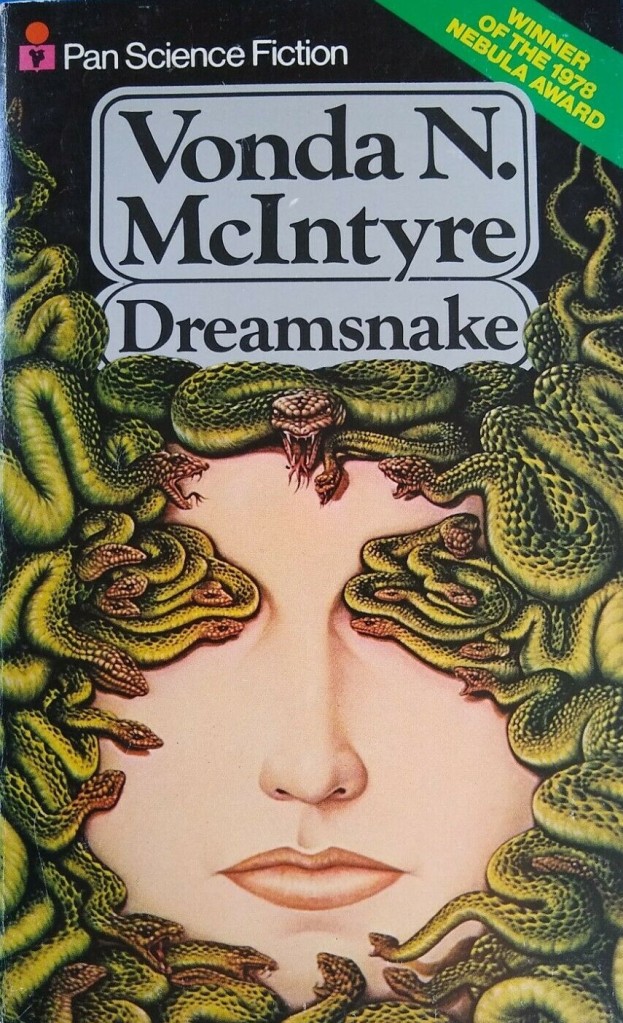
Book Review: Dreamsnake, Vonda N. McIntyre (1978)

4.5/5 (Very Good)

Won the 1979 Hugo, Locus, and Nebula Award for Best Novel.

I’ve now tackled the only pre-1990 Hugo Award-winning novel I had yet to read. And I was not disappointed. Fresh off Vonda N. McIntyre’s ingenious generation ship short story “The Mountains of Sunset, The Mountains of Dawn” (1974) with its winged-alien voyagers, I savored Dreamsnake‘s original blend of feminist science fiction and post-apocalyptic quest tale.

Continue reading

Update: Recent Science Fiction Purchases No. CCLXXXIX (Nevil Shute, Nancy Kress, Hilbert Schenck, and a themed-anthology on future sex)

Which books/covers/authors intrigue you? Which have you read? Disliked? Enjoyed?

1. The Shape of Sex to Come, ed. Douglas Hill (1978)

From the back cover: “Eight stories from SF names as highly-respected as Aldiss, Moorcock and Silverberg explore the strange and bizarre possibilities for sexuality in the furthest reaches of tomorrow.”

Contents: Robert Silverberg’s “In the Group” (1973), Thomas M. Disch’s “Planet of the Rapes” (1977), A. K. Jorgensson’s “Coming-of-Age Day” (1965), Anne McCaffrey’s “The Thorns of Barevi” (1970), Brian W. Aldiss’ “A One-Man Expedition Through Life” (1974), Brian W. Aldiss’ “The Taste of Shrapnel” (1974), Brian W. Aldiss’ “Forty Million Miles from the Nearest Blonde” (1974), Hilary Bailey’s “Sisters” (1976), John Sladek’s “Machine Screw” (1975), and Michael Moorcock’s “Pale Roses” (1974).

Continue reading

Short Book Reviews: Octavia E. Butler’s Dawn (1987), Robert Holdstock’s Where Time Winds Blow (1981), and Philippe Curval’s Brave Old World (1976, trans. 1981)

Note: My read but “waiting to be reviewed pile” is growing. Short rumination/tangents are a way to get through the stack before the new year and my memory/will fades. Unfortunately, I left two of my favorite reads of the year for last. Stay tuned for more detailed and analytical reviews.

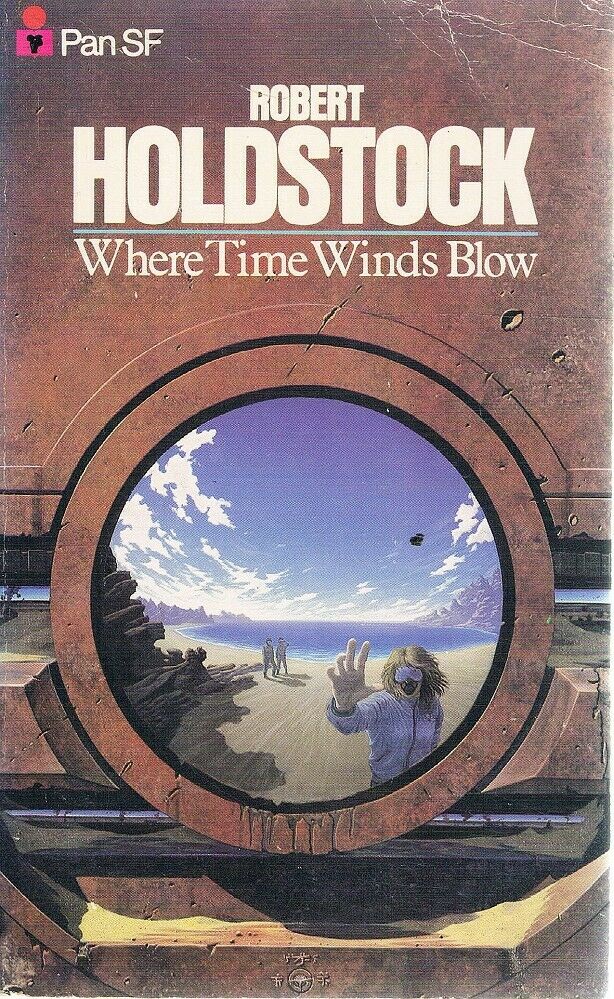
1. Where Time Winds Blow, Robert Holdstock (1981)

5/5 (Masterpiece)

I cannot properly review Where Time Winds Blow (1981). Sometimes, while perambulating the interwebs, I encounter a singular encapsulation of a text’s brilliance that defeats all my own attempts to write constructively about a book. I blame Andrew Darlington’s brilliant review/article on Robert Holdstock contextualizing the novel within his early oeuvre. The short paragraph below–an attempt to convince you to procure a copy–is indebted to his review. Please read his review! There are fan writers and then there are fan writers. Darlington should receive a Hugo nod.

Continue reading

Updates: Recent Science Fiction Purchases No. CCLXXXV (Arkady and Boris Strugatsky, Lester Del Rey, Peter George, and Adrien Stoutenburg)

1. Nerves, Lester Del Rey (1956)

From the back cover: “THIS IS NO STORY OF SPACE SHIPS AND MARTIANS. THIS IS A STORY ABOUT OUR WORLD RIGHT NOW.

‘In 1942, three years before the general public had ever heard of nuclear fission. Lester del Rey wrote a brilliantly detailed novella of disaster in an atomics plant, which now appears, skillfully expanded to book length, as NERVES. A wholly admirable blend of prophetic thinking (in medicine as well as atomics), warm human values and powerful narrative suspense, this novel is strongly recommended…’ –N.Y. Herald Tribune.”

Continue reading