Adventures in Science Fiction Cover Art: An Assortment of Mysterious Spheres, Part II

(David Bergen’s cover for the 1978 edition of Sea-Horse in the Sky (1969), Edmund Cooper)

Here’s Part II of my cover art series on the delightfully nebulous theme of mysterious spheres (Part I).  I’ve selected a variety of spheres: including spheres elevated in the air (balloon representations of the sun? planets? large scale planetary orbit models?), spherical eggs hatching men?, alien warships, alien (and human) transportation devices, strange atomic technology, obvious Death Star ripoffs, fields littered with the perplexing shapes….

… and even the simple unadorned sphere held aloft to indicate the pure delight of Continue reading

Updates: Recent Science Fiction Acquisitions, Magazine Edition No. I (Galaxy 2x, Worlds of If 3x, The Magazine of Fantasy and Science Fiction 1x)

My first science fiction magazines!

Although I’m not sure that I want to collect the entire catalogues of either Worlds of If or The Magazine of Fantasy and Science Fiction, I wouldn’t mind starting a collection of Galaxy (one of the more famous magazines).  I’ve been tentative in the past about purchasing magazines for one simple reason: a large percentage of their contents, especially if by well-known authors, are rewritten/expanded/re-conceptualized for later short story collections or novel publication form.  Thus, what version you read in the magazine is rarely the more polished version found in later editions.  For example, in the August 1965 issue of Galaxy Frank Herbert’s Do I Wake or Dream? was expanded for the 1966 novel publication under the title Destination: Void (which was revised again for the much later 1978 edition).  Novels like Dune (1965) are themselves fix-up novels from shorter novels previously serialized in magazines — Dune World (1963) and The Prophet of Dune (1965).  However, six magazines for one dollar each was too good of a deal to pass up….

The only magazine I desperately want to collect is New Worlds due to the quantity of experimental New Wave material which was published during Moorcock’s editorship.

(Gray Morrow’s cover for the August 1965 issue) Continue reading

Adventures in Science Fiction Cover Art: Pyramids (spaceships + future earthscapes + alien temples)

THPRMDSFRM1971

(Jack Faragasso’s cover for the 1971 edition of The Pyramids from Space (1970), Jack Bertin and Peter B. Germano)

This post is in a series on the interaction between television/film and science fiction cover art (The Statue of Liberty on Pre-1968 Magazine and Novel Covers and Cosmic Fetuses + Other Uterine Spaces).  In the former, the scene at the end of Planet of the Apes (1968) drew directly on pre-existing pulp science fiction art tropes.  In the later, Kubrick’s baby in a balloon scene in 2001: A Space Odyssey (1968) inspired many artists to reproduce the image of the cosmic fetus.  There isn’t a direct line of influence in this post between these covers and Stargate (1994) and its sequels.  I simply seek to illustrate that there has always been an obsession, verging into the sci-fi genre, with re-interpreting Continue reading

Adventures in Science Fiction Cover Art: Easter Island Heads

(Ray Kalfus’ cover for the May 1963 issue of Amazing Stories)

The Easter Island heads have long been explained away by conspiracy theorists as the work of aliens!  Apparently there are a few short stories and novels that derive not only their cover art but entire stories from such hilariously awful material…. Regardless, the covers are giggle inducing, and in the case of the uncredited cover for William Tenn’s Of All Possible Worlds (1955) rather striking.  I’ve included one cover from the 40s, an Arkham house novel that might be more “horror” than “sci-fi.”  Regardless, the idea that the Easter Island heads evoke dread, is well, laughable.

If you know of any others please let me know — I could only round up these five Continue reading

Adventures in Science Fiction Cover Art: Nuclear Explosions + Mushroom Clouds, Part II

(Pattee’s cover for the November 1950 issue of Astounding Science Fiction)

In case you missed Part I.

Pattee’s cover for the Astounding Science Fiction November 1950 issue is visually stunning.  A transparent man (his arteries + brain showing) holds the atomic symbol aloft.  On the horizon a gigantic mushroom cloud is transposed with a spaceship.  Does man use atomic power for science and the good of mankind or evil and the destruction of mankind?  The message is made even more abundantly clear by the title of the piece of art — “Choice.”  Although this rhetoric might seem somewhat ham-fisted to modern post-Cold War readers, it produced some remarkable works of science fiction and science fiction art.  (If anyone knows the full name of the artist, I’d be grateful).

As with Part I, I’ve included some covers from the notorious hackwork spewing conveyor belt publisher Badger Books for giggles and Continue reading

Adventures in Science Fiction Cover Art: Visualizing Time

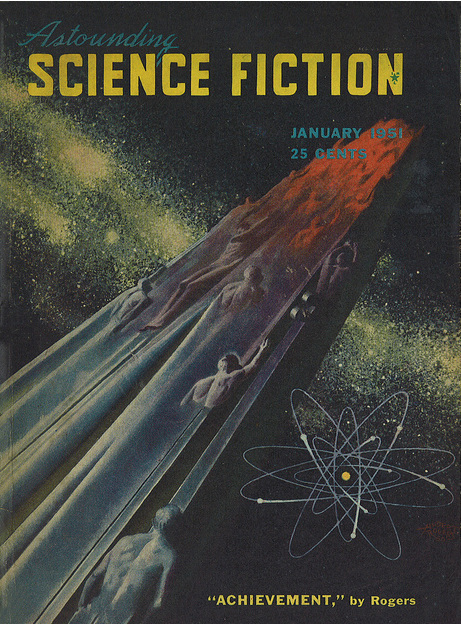
(Hubert Rogers’ cover for the January 1951 issue of Astounding Science Fiction)

In Hubert Rogers’ fascinating cover (titled ‘Achievement’) for the January 1951 issue of Astounding Science Fiction, mankind appears pulled upward, as if against their will, towards an undefined future goal.  Rogers’ cover encapsulates David Hume’s notion of historical time relentlessly moving towards improvement — improvement as something measurable and observable by the historian, and anyone who studies history.  Obviously, this historiographical framework has long been debunked (although it crops up in virtually all of my undergraduate students’ work in intro level courses) — it favors Western conceptions of progress, dismisses the achievements of non-European Continue reading

Book Review: Galaxies Like Grains of Sand, Brian Aldiss (1960)

(Paul Lehr’s cover for the 1960 edition)

3/5 (collated rating: Average)

The concept behind Brian Aldiss’ short story collection Galaxies Like Grains of Sand (1960) is intriguing.  Take previously published stories (in this case from magazines in the late 50s), graft them together by means of mini-introductions, and arrange them so they fit into a future history framework à la Olaf Stapledon’s Last and First Men (1930) or Isaac Asimov’s Foundation Trilogy (1951-1953).

The quality of the stories makes the format less than successful.   Only three stories are worth reading — ‘Secret of a Mighty City’ (1958), ‘Out of Reach’ (1957), and ‘All Continue reading

Updates: Recent Science Fiction Acquisitions N. XL (Miller, Jr + Cogswell + Pohl/del Rey + Kornbluth/Merril)

A couple from my father + a few left over Marx Book purchases….

Three delightfully gorgeous Powers covers.  And one stunning John Schoenherr cover despite the unknown quality of the short stories within….

A short story collection and a three novella collection by Walter M. Miller, Jr., the author of A Canticle for Leibowitz (1959)…  A scathing, and hilarious satire by Frederik Pohl and Lester del Rey…  Among others.

1.  The View from the Stars, Walter M. Miller, Jr. (1965) (MY REVIEW)

(Richard Powers’ cover for the 1965 edition) Continue reading

Adventures in Science Fiction Cover Art: The Statue of Liberty on Pre-1968 Magazine and Novel Covers

pota-statue-of-liberty-2.jpeg

(Still from the 1968 film Planet of the Apes, dir. Franklin J. Schaffner)

For more covers on the same theme see Part II

I suspect that virtually all science fiction fans and film cineastes recall the vivid sequence near the end of the 1968 film Planet of the Apes where the Statue of Liberty lies half-buried in the sands.  Franklin J. Schaffner’s film draws on a rich tradition in pulp science fiction cover art.  I’ve included six cover from 1941-1965, all before the film was released, that depict the Statue of Liberty submerged by apocalyptical floods and excavated by future spacemen.  I have a large catalogue of covers that show various landmarks destroyed by mechanical monsters, ogled at by aliens, and wrecked by a variety of world ending disasters.  The Hollywood penchant for destroying as many national landmarks as possible in movies is deeply rooted in existing visual traditions.

My favorite is by far Blanchard’s (does anyone know his full name) cover for the 1959 edition of John Bowen’s After The Rain (1958).  The dark skies, the stormy waters reaching up to her nose, the survivors of the flood perched near the flame, the boats and roofs of houses floating about, perfectly evoke the extent of the disaster — and, “elements gone wild!”

Enjoy!

(if I’ve missed any pre-1968 covers please let me know.  I know that there are multiple later covers but they might be purposefully referencing Planet of the Apes)
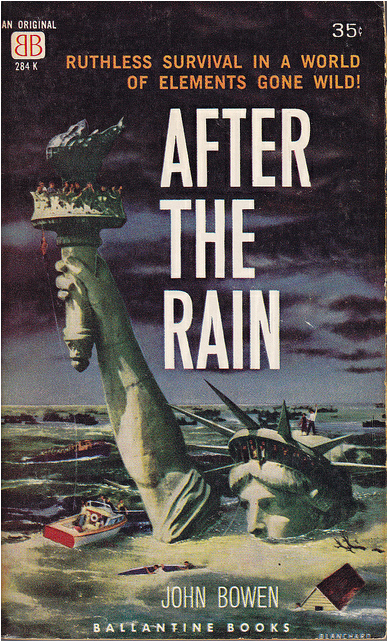
(Blanchard’s cover for the 1959 edition of After The Rain (1958), John Bowen) Continue reading