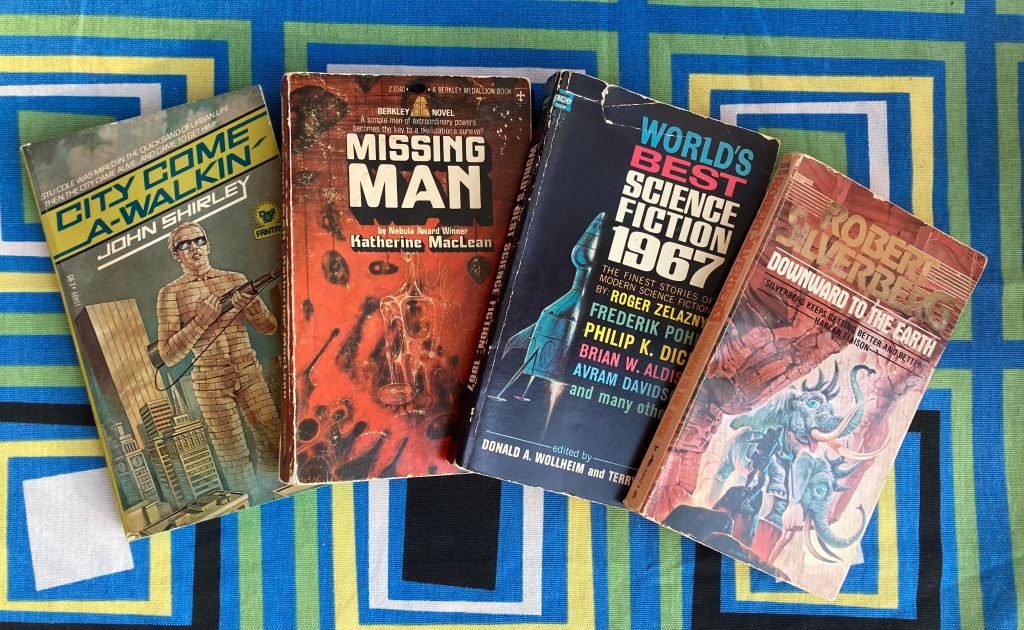
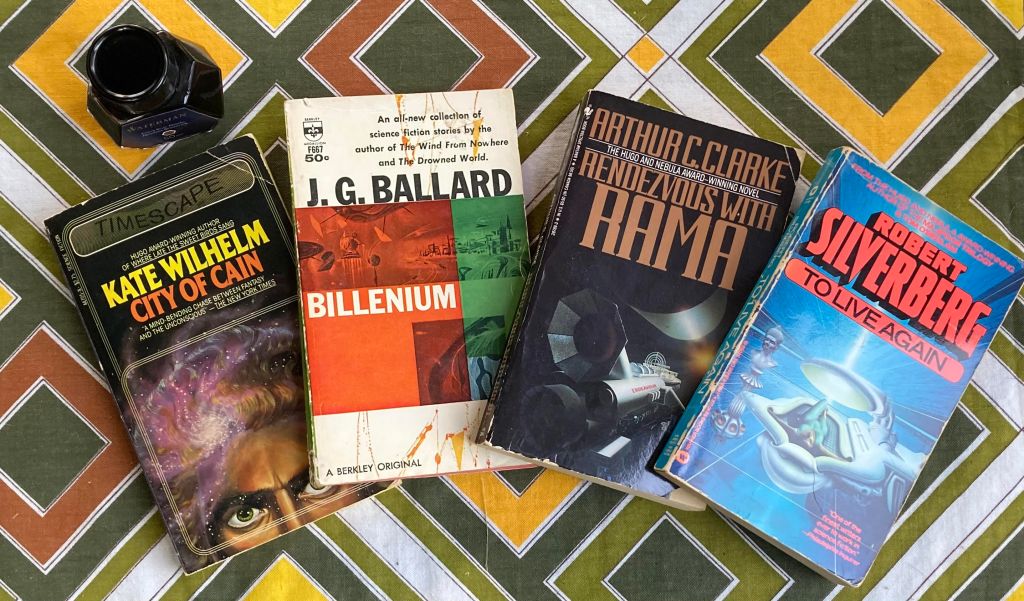
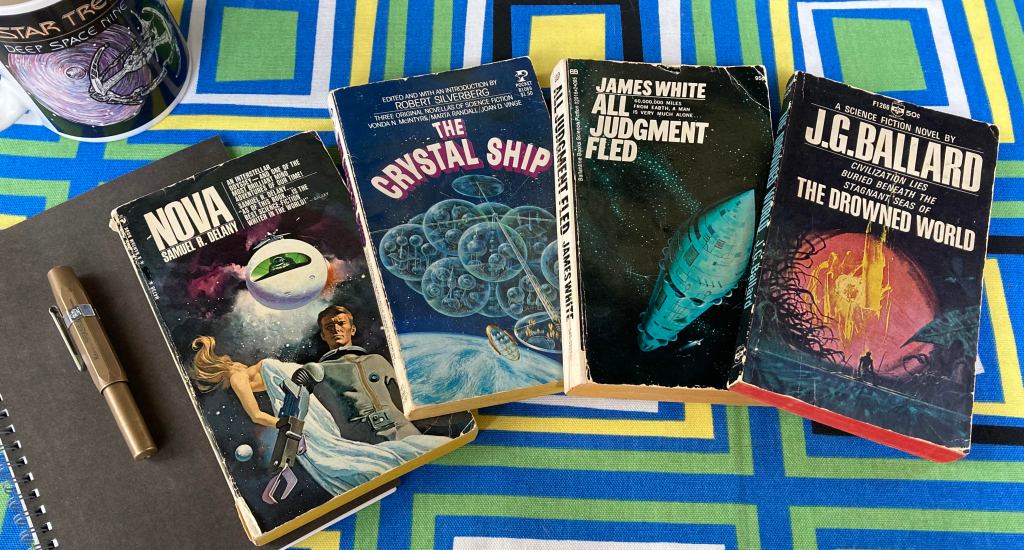
What pre-1985 science fiction are you reading? + Update No. XXV

What pre-1985 science fiction are you reading or planning to read next month? Here’s the July installment of this column.

One of my favorite forms of SF scholarship is careful identification of a intellectual genealogy–tracing what an author read and engaged in dialogue with. Authors are readers. They also can’t escape references and textual traces of what they’ve consumed (or, of course, engagement with the world in which they lived).

I’ve read two interesting examples recently. The first, Carol McGuirk’s “J. G. Ballard and American Science Fiction” in Science Fiction Studies, vol. 49 (2022), is the perfect example of this type of scholarship. She traces Ballard’s engagement with SF, his earliest stories, and the various parallels an interactions between his work and American SF that he read (Galaxy Magazine, Theodore Sturgeon, Fritz Leiber, Robert Heinlein, Frederik Pohl, C. M. Kornbluth, Ray Bradbury, Judith Merril, Federic Brown, Henry Kuttner, C. L. Moore, etc.). She argues that Ballard engaged in “retelling with a twist” (476). She writes that “early Ballard stories rework prior sf in moods ranging from measured homage to barbed repose to parodic photo-bomb” (483).

Continue reading
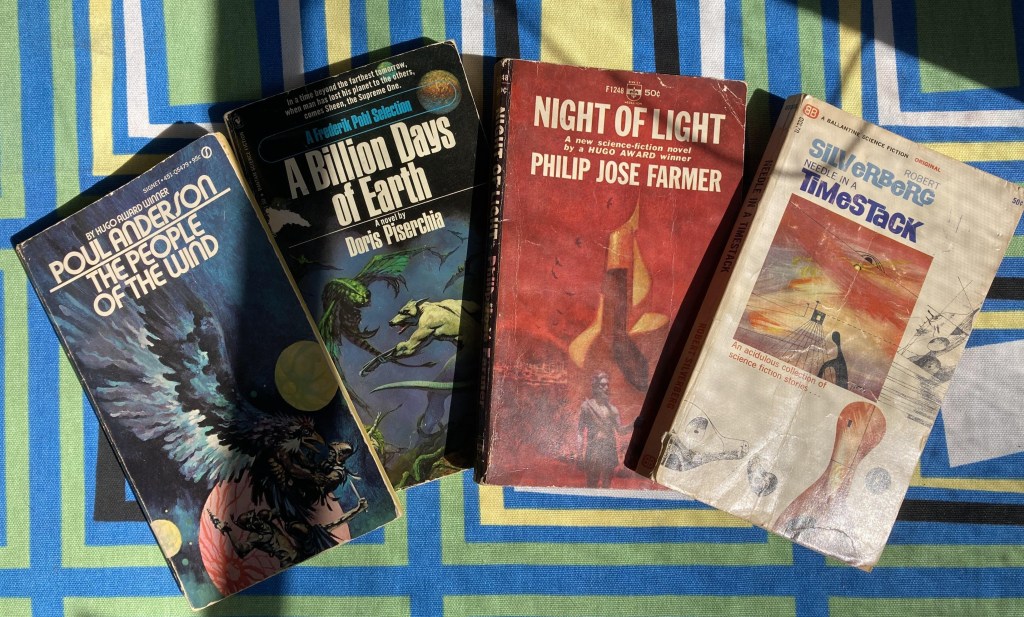
Updates: Recent Science Fiction Purchases No. CCCXLII (Robert Silverberg, C. L. Moore, Henry Kuttner, Peter Tate, and Thomas Burnett Swann)

Which books/covers/authors intrigue you? Which have you read? Disliked? Enjoyed?

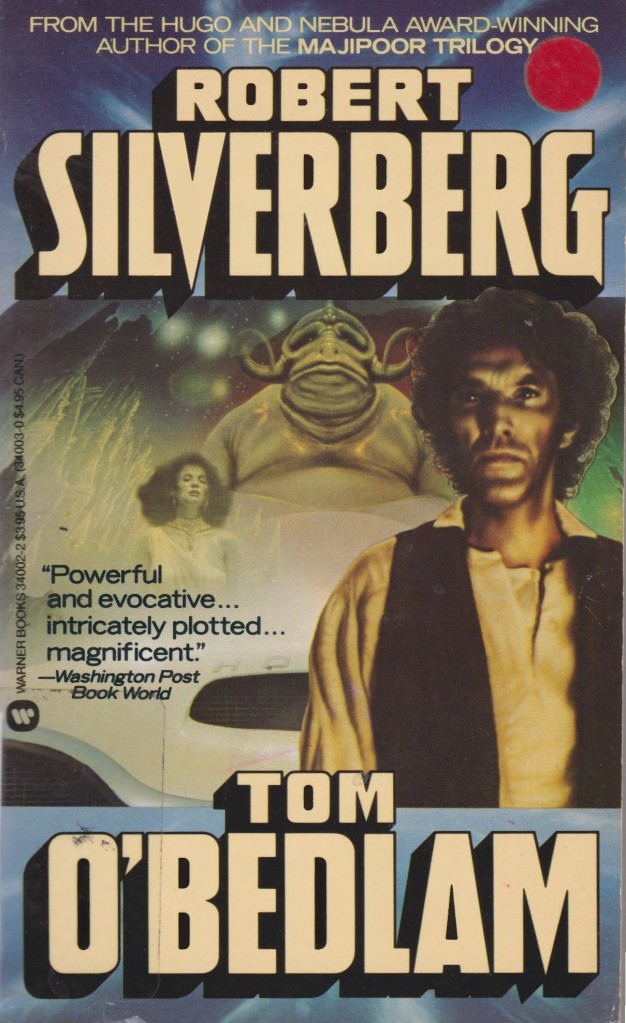
1. Tom O’Bedlam, Robert Silverberg (1985)

From the back cover: “MESSIAH OR MADMAN? It is 2103 and Tom O’Bedlam, madman, prophet, and visionary, wanders through California, dwelling place of the last humans on a continent decimated by radioactive dust. Tom, caught up in a living vision of distant worlds ruled by godlike beings, is the herald of a new age, a herald no one wants to hear until others too begin to dream of salvation beyond the stars. Yet while many dream, only tom has the power to make the wondrous visions real, to give people the ultimate escape they desire. Across the universe they must go… if Tom is humanity’s last hope–and not its final destroyer.”

Continue reading

What pre-1985 science fiction are you reading? + Update No. XX

What pre-1985 science fiction are you reading or planning to read this month? Here’s the January installment of this column (sorry I missed a month).

Before John W. Campbell, Jr. (1910-1971) attempted to raise the “standards and thinking in magazine SF,” David Lasser (1902-1996) attempted his own brief (1929-1933) program to improve science fiction as managing editor of Hugo Gernsback’s Science Wonder Stories, Wonder Stories, and Wonder Stories Quarterly. According to Mike Ashley’s The Time Machine: The Story of the Science-Fiction Pulp Magazine from the Beginning to 1950 (2000), Lasser is a “much neglected revolutionary in science fiction” and through his efforts the genre “started to mature” (66).

Ashley highlights Lasser’s letter of instruction mailed to his regular contributors on the 11th of May, 1931, in which he “exhorted them to bring some realism to their fiction” (72). He also outlawed common tropes like the giant insect story and space opera (73). He emphasized the need to focus on characters that “should really be human” — not everything needs to be a “world-sweeping epic” (73). Stories in this vein, according to Ashley, include Clifford D. Simak’s religiously themed “The Voice in the Void” (1932), P. Schuyler Miller and Walter Dennis’ “The Red Spot on Jupiter” (1931) and “The Duel on the Asteroid” (1974), which featured a grim realism and character development (74).

Continue reading

What pre-1985 science fiction are you reading? + Update No. XIX

What pre-1985 science fiction are you reading or planning to read this month? Here’s the December installment of this column.

Lost texts, and the act of reconstructing the fragments, fascinates. The questions pile up. Would the contents reveal a pattern in an author’s work? Intriguing personal details? A startling modus operandi? At the 11th World Science Fiction Convention (Philcon 2), Philadelphia (September 1953), Philip José Farmer gave a speech titled “SF and the Kinsey Report.” Considering Farmer’s recent publication of “The Lovers” (1952), this is not surprising. Alfred Kinsey, the famous sexologist and founder of the Kinsey Institute for Research in Sex, Gender, and Reproduction on Indiana University’s campus, published his controversial Sexual Behavior in the Human Male in 1948. Sexual Behavior in the Human Female appeared in 1953. Like many of Farmer’s earliest speeches, he did not keep copies.

Deeply intrigued by what the speech might have contained, Sanstone and I (on Bluesky) managed to piece together a few general responses from fanzines and magazine con reports.

Continue reading

What pre-1985 science fiction are you reading? + Update No. XVI

What pre-1985 science fiction are you reading or planning to read this month? Here’s the August installment of this column.

I often think back to how I got hooked on science fiction. As I have mentioned many times before, I primarily read fantasy–in particular every bloated Tolkein ripoff I could get my hands on–before I moved to science fiction in my late teens. Tad Williams’ fantasy trilogy Memory, Sorrow & Thorn (1988-1998) holds special significance. While looking for other fantasy titles by Williams at the local used book store, I stumbled across his equally bloated four-volume SF sequence Otherland (1996-2001). And so the slow shift began… I had read other science fiction but nothing hooked me quite like Otherland. It’s one of those works that I plan on never rereading—the spell would break.

Continue reading

Book Review: Those Who Watch, Robert Silverberg (1967)

3.25/5 (Above Average)

A preliminary note: I’m something of a Robert Silverberg completionist, especially work from his glory years of 1967-1975. I’ve reviewed forty-seven of Silverberg’s short stories and thirteen of his novels–I’ve also read but never reviewed A Time of Changes (1971), The Masks of Time (1968), Tower of Glass (1970), and the stories in Capricorn Games (1976).

While a middling Silverberg novel at best, Those Who Watch (1967) almost succeeds as a revisionist take on UFO panic. The aliens do not seek to experiment on, exterminate, or manipulate humans. Instead, this is a book about the lost and lonely, and how their love and care for the injured interstellar visitors that appear on their doorsteps transform their lives. It’s a problematic work that simultaneously pulses with kindness.

Continue reading

What pre-1985 science fiction are you reading? + Update No. XIII

What pre-1985 science fiction are you reading or planning to read this month?

Here’s May’s installment of this column.

As I am currently exploring the north-of-the-Arctic Circle reaches of Norway, why not segue way into this post by re-ruminating on the only Norwegian SF novel I’ve read: Knut Faldbakken’s spectacular Twilight Country (1974, trans. Joan Tate, 1993). I wish I’d thought to bring the sequel — Sweetwater (1976, trans. Joan Tate, 1994). Twilight Country, my second favorite SF novel read of 2021, contains one of the great depictions of a decaying metropolis. It is a densely metaphoric story of survival within its crumbling edifices. The masterstroke of Faldbakken’s novel is the portrayal of the Dump, a border zone containing the cast off fragments of human existence, as a place of recreation. Our characters run to the Dump to escape, to make their lives anew. They’re deeply flawed figures. There’s a tangible sense of organic transformation within the transients who inhabit this liminal zone. Sweetwater and The Dump act as a closed system. One decays into the other. One creates the other. Not recommended unless you like your SF dark and moody like me!

Continue reading

Updates: Recent Science Fiction Purchases No. CCCXXXIV (Robert Silverberg, Best SF of 1979, C. L. Moore, George Hay)

Spring semester in the books! It’s now time to read (and go on vacation).

Which books/covers/authors in the post intrigue you? Which have you read? Disliked? Enjoyed?

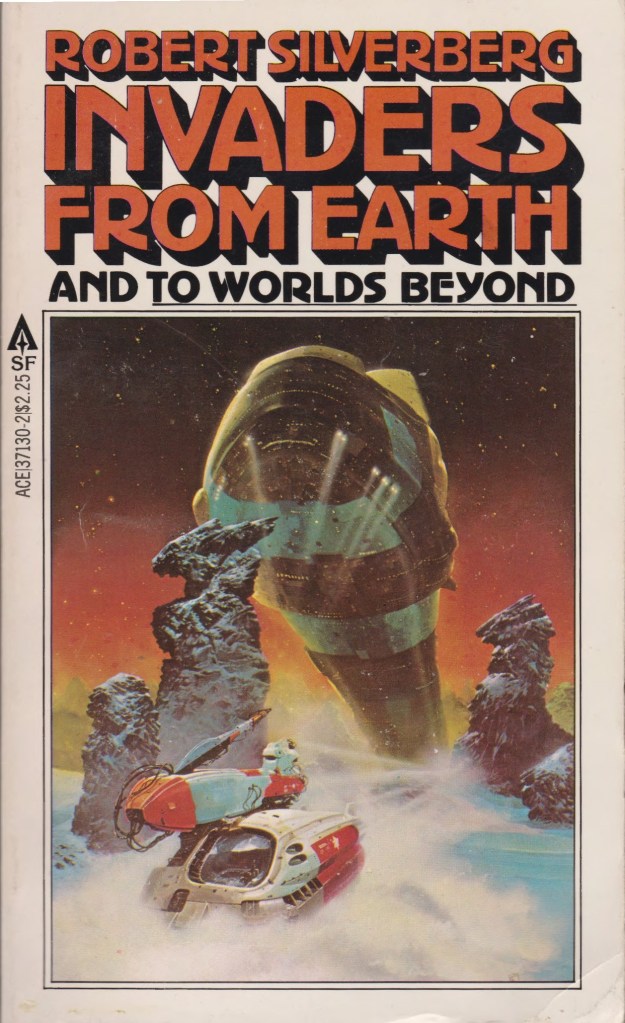
1. Invaders from Earth and To Worlds Beyond, Robert Silverberg (1980)

From the back cover: “The Ganymedians had a rich, peace culture, peaceful culture extending back hundreds of thousands of years in human time. But the soil of their Jovian moon held uncountable riches in the form of the nuclear fuels Earth so desperately needed. It was a pattern that had been repeated many times in humanity’s bloody history; in Asia, in Africa, in the American West–but the nations of mankind were not ready to make the same mistake again. So when the Corporation decided it wanted those fissionables whether the Ganymedians wanted to give them up or not, they knew they had a job of selling of their hands, to swing the weight of public opinion behind them. And that was a job for Ted Kennedy, ad-man supreme. Kennedy’s record showed he could sell the public on just about anything. Even genocide.”

Continue reading

What pre-1985 science fiction are you reading? + Update No. XI

What pre-1985 science fiction are you reading or planning to read this month. Here’s March’s installment of this column.

Before we get to books and birthdays and writing plans…

Continue reading