Updates: Recent Science Fiction Acquisitions No. CXXI (Zelazny + White + Daventry + Gerrold)

A nice grab bag of used book store finds…  I’m nearing completion of my collection of Zelazny’s pre-1980 novels (I do not own nor really want to read any of his purely fantasy works).  Also, I couldn’t help but pick up David Gerrold’s 1974 Hugo and Nebula Award nominated novel The Man Who Folded Himself (1973) although I have been utterly underwhelmed with his work in the past—for example, Space Skimmer (1972) and Yesterday’s Children (1972).

I also found the first volume of a trilogy by Leonard Daventry—owned only the third one for some reason.  And, who can resist another James White novel.  I desperately want to recreate the joy that was White’s The Watch Below (1966).

Thoughts?

1. Damnation Alley, Roger Zelazny (1969) (MY REVIEW)

(Alan Gutierrez’s cover for the 1984 edition) Continue reading

Book Review: The Dream Master, Roger Zelazny (1966)

THDRMMSTR1966

(Kelly Freas’ cover for the 1966 edition)

4/5 (Good)

Roger Zelazny’s The Dream Master (1966)—expanded from the Nebula Award winning novella “He Who Shapes” (1965)—revolves around the Freudian notion of the centrality of dreams and importance of decoding dreams for psychoanalytical treatment.  Susan Parman, in Dream and Culture (1990), points out that Freud was initially focused on “treating ‘abnormal’ patients” but soon “expanded his theory of psychoanalysis to explain puzzling events in ‘normal’ behavior” including dreams.  Freud’s influential work The Interpretation of Dreams (1899) argued that the “dream expresses the secret wishes of the soul” where the dreamscape is the “arena” in which good and bad forces are engaged in a struggle.  Thus, the dream is a message that must be deciphered by an “allegorical Continue reading

Updates: New Type of Post (grouped reviews of uncollected short stories published in magazines)


I do not own many SF magazines from the 40s-70s.  The reasons are as follows: 1) Novels tended to be serialized which means I have to track down multiple magazines to read an entire novel.  2) The novels were often radically altered for their first book form publication (think, Herbert’s “Dune World” (1963) that later became Dune (1965).  Thus, I rather own the later novel form that wasn’t as constrained by the strictures of magazine form. 3) I love short story collections and would rather own the entire collection than read a singleton story.

Continue reading

Updates: Recent Science Fiction Acquisitions No. LXXXI (Vinge + Gerrold + Zelazny + White)

Part 1 of many: Half Price Books in Dallas, TX (the second best bookstore, after Dawn Treader Books in Ann Arbor, MI for SF I have ever come across).  Gift card courtesy of fiancé’s mother = LOTS OF SCIENCE FICTION.  There could not be a better gift….

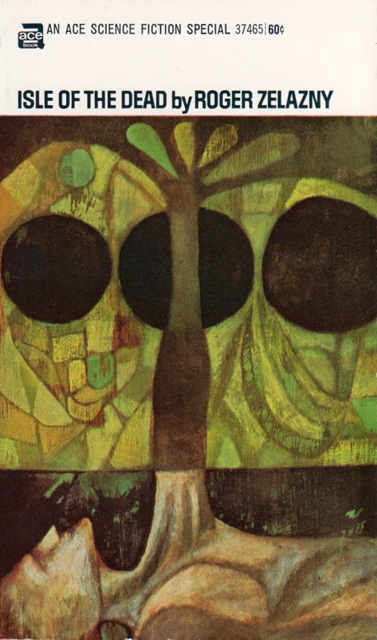
Everyone reads Robert Zelazny’s This Immortal (1966) and Lord of Light (1967), but who has read Isle of the Dead (1969)?  Thematically it seems similar to Lord of Light…  I have high hopes.  James White’s SF is always above average — and a fund cover from Dean Ellis makes that an auto-buy.  Although I disliked David Gerrold’s Space Skimmer (1972) my father swears Yesterday’s Children (1972) is somewhat readable.

I enjoyed Joan D. Vinge’s The Summer Queen (1980), tolerated her first novel The Outcasts of Heaven Belt (1978), so I suspect her two novella collection Fireship (1978) will be worthwhile…

Thoughts?

1. Isle of the Dead, Robert Zelazny (1969)

(Leo and Dianne Dillon’s cover for the 1969 edition) Continue reading

Book Review: Three for Tomorrow, novellas by Robert Silverberg, Roger Zelazny, and James Blish, (1969)

(Uncredited cover for the 1970 edition)

3.5/5 (collated rating: Good)

Three for Tomorrow (1969) contains three novellas written specially for the volume on the following theme selected by Arthur C. Clarke: “with increasing technology goes increasing vulnerability: the more man conquers Nature, the more prone he becomes to artificial catastrophe” (foreword, 8).  In my continuing quest for Robert Silverberg’s work from his Glory Period (proclaimed by me) 1967-1976, I was delighted to come across one of his shorter works paired with two other great authors, James Blish and Roger Zelazny.  If you want to read Silverberg’s novella but not the others, it appeared in many of his later collections — Earth’s Other Shadow (1973) for example.

As with most collections, Three for Tomorrow is uneven.  Silverberg’s installment is the best due to its intriguing social analysis of a city suddenly whose inhabitants are suddenly missing Continue reading