Adventures in Science Fiction Cover Art: Mariella Anderlini’s Covers for Roger Zelazny’s Chronicles of Amber (Corwin) sequence

On twitter, I recently learned from Jay O’Connell (cover artist and author) that all of Roger Zelazny’s work will be back in print. What exactly “everything back in print” means in reality I’m not entirely sure–will it include only the best known novels? All the short stories? Are works Zelazny wanted to “kill off” like To Die in Italbar (1973) really going to get reprints? Regardless, I was inspired to look back at the non-English language covers his work has received over the years. Naturally, as I moved to the fantastic Italian presses, I re-encountered and fell in love (again) with Allison’s evocative take on Zelazny’s Chronicles of Amber (Corwin) five-novel sequence.

What are your favorites?

Continue reading

Updates: Podcast Interview and Vintage Science Fiction Discussion Extravaganza

I appeared in my first ever podcast–Postcards from a Dying World with David Agranoff–last week. Organized around a series of interview questions, David and I ended up discussing vintage SF for a good hour. I cover how studying history has inspired my project, reasons for my focus on SF from post-WWII to the mid-1980s, favorite authors and themes, etc. Please check out his twitter and website as well. I have gathered together a list of the SF works I mention in the interview with links to my reviews when applicable.

I hate listening to myself as I am far too excited about vintage SF! (but is that a surprise?)

Continue reading

Updates: Recent Science Fiction and Fantasy Purchases No. CCCII (C. L. Moore, Marc Laidlaw, Fredric Brown, Mack Reynolds)

Which books/covers/authors intrigue you? Which have you read? Disliked? Enjoyed?

1. Dad’s Nuke, Marc Laidlaw (1986)

From the back cover: “BARBECUE THE NEIGHBOURS. In post-collapse suburban America, keeping up with the Joneses has got a little out of hand. Fallout shelters used to be the ultimate status symbol–until Mr. Johnson had his baby daughter’s digestive system adapted to consume radioactive waste.

Now Jock Smith has the edge on his neighbours–he has installed his very own tactical nuclear missile in the back yard.

After all, these are dangerous times..”

Continue reading

Book Review: I Am Legend, Richard Matheson (1954)

4/5 (Good)

Richard Matheson’s I Am Legend (1954) is an influential SF vampire/zombie novel that spawned three film adaptations (I’ve watched the first two) and inspired directors such as George A. Romero and Danny Boyle, game designers such as Tim Cain (Fallout), and countless authors. The subject of the novel–man attempts to survive an onslaught of vampires, caused by bacterial infection, that act like smart(er) zombies in a post-apocalyptic wasteland–normally isn’t my cup of tea. I’m the first to admit that I picked up the novel entirely due to its historical importance. And I’m somewhat glad I did! While the physical onslaught of vampiric zombies didn’t interest me, the main thrust of the narrative concerns the mechanisms of grief and sexual frustration in the burning wreckage of one-time domestic bliss.

Continue reading

Updates: Recent Science Fiction Acquisitions No. CCCI (Angela Carter, Keith Roberts, J. L. Hensley, and a Leo Margulies Anthology)

Which books/covers/authors intrigue you? Which have you read? Disliked? Enjoyed?

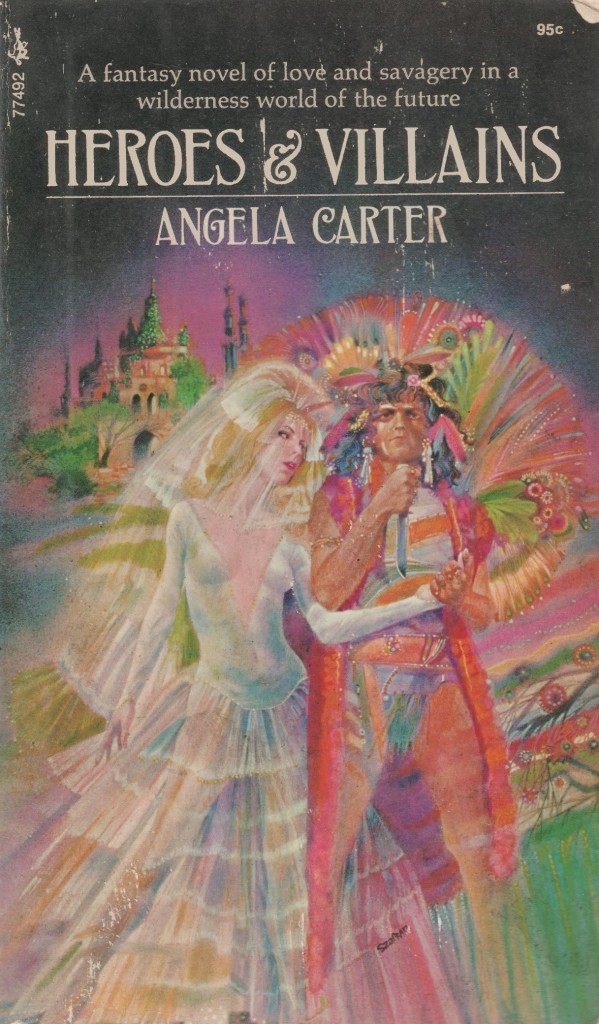
1. Heroes & Villains, Angela Carter (1969)

From the back cover: “The Barbarians had attacked the village, looting and burning. And when they left, Marianne, a daughter of the scientists, went with them. Now she followed Jewel, leader of the barbarians, and lived with him as his captured bride…”

Initial Thoughts: A few years ago I read, and was blown away, by Angela Carter’s The Infernal Desire Machines of Doctor Hoffman (1972). I placed it on my best reads of 2016 list but never managed to write a review. Inspired by the novel, I wrote an article derived from a fascinating 1979 interview on Angela Carter’s views on science fiction–including her inspirations and the state of the British SF scene, Michael Moorcock’s prodigious production and New Worlds editorship, and the unescapable influence of J. G. Ballard.

Continue reading

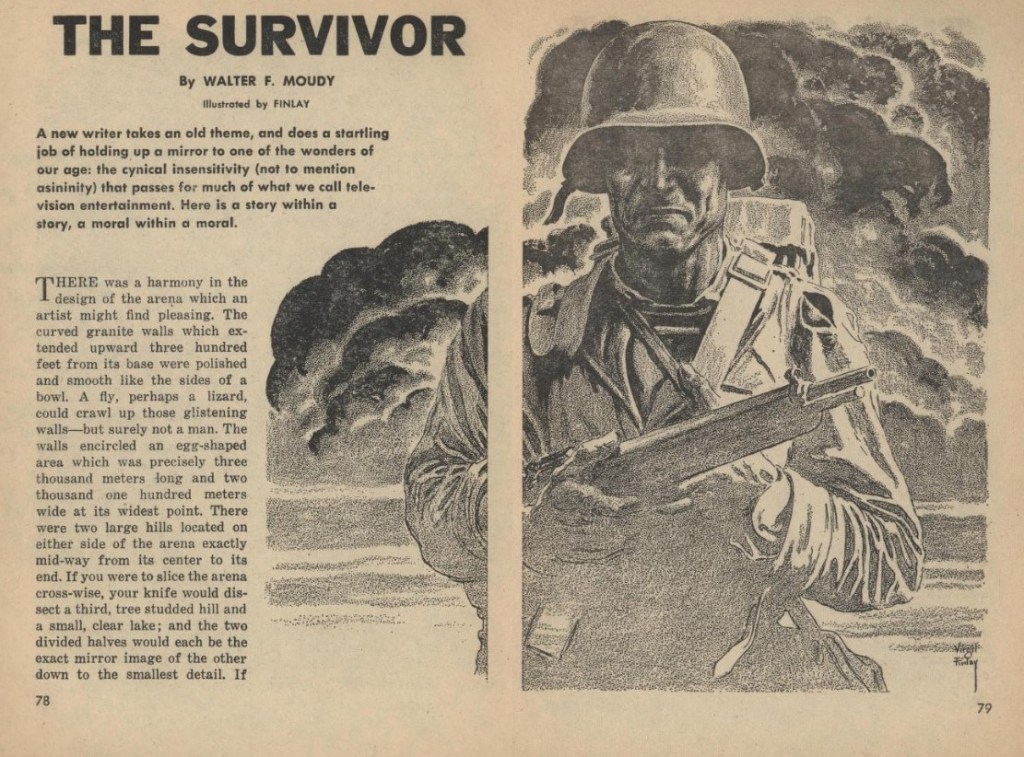
Future Media Short Story Review: Walter F. Moudy’s “The Survivor” (1965)

Today I’ve reviewed the fourteenth story in my series on the science fictional media landscape of the future. Walter F. Moudy relays the coverage of the 2050 Olympic War Games between the United States and Russia with harrowing effect.

Previously: Barry N. Malzberg’s “The Idea” (1971) (as K. M. O’Donnell).

Up Next: Theodore Sturgeon’s “And Now the News…” (December 1956).

3.5/5 (Good)

Walter F. Moudy’s “The Survivor” first appeared in the May 1965 issue of Amazing Stories, ed. Cele Lalli (Goldsmith). You can read it online here.

Recently James Harris highlighted the truncated writing career of Walter F. Moudy (1929-1973) with a focus on No Man on Earth (1964), his only science fiction novel. Inspired by his comments on “The Survivor” (1965) and relentlessly intrigued by authors who have fallen from contemporary memory, I placed the slick future televised Cold War conflict tale at the top of my media landscapes of the future review list. For those expecting a masterful Henry Kuttner tale, stay tuned! In the meantime, let’s plunge into Moudy’s coverage of the 2050 Olympic War Games between the US and Russia.

Continue reading

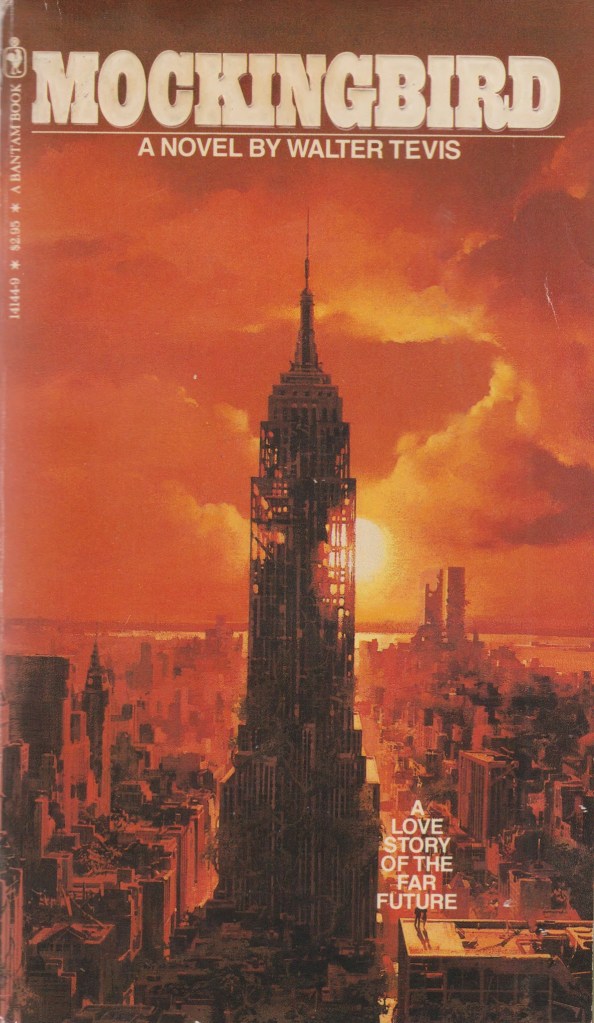
Book Review: Mockingbird, Walter Tevis (1980)

4.5/5 (Very Good)

William Tevis’ Mockingbird (1980) is a paean to the power of reading. Possessed by an encyclopedic adoration for silent films and books of all genres, Tevis creates a rich textual substate in which his characters pin together the true nature of their world. For more on the situation in Tevis’ life that prompted him to write Mockingbird–his experiences teaching and his own attempts to defeat alcoholism–and his relationship to science fiction, check out James Sallis’ review in The Magazine of Science Fiction and Fantasy.

The World

In a rapidly depopulating world, the last humans live a medicated life. Successful indoctrination programs of privacy and individuality with catch phrases like “Don’t ask-relax” (24) and “Alone is best” (26), have deprived the masses from the desire to learn or interact with each other. Paul and Mary Lou might be the “last generation of children, ever” (32). Tevis lays out the reasons for depopulation as follows: “1. Fears of overpopulation 2. The perfection of sterilization techniques 3. The disappearance of the family 4. The widespread concern with “inner” experiences 5. A loss of interest in children 6. A widespread desire to avoid responsibilities” (145).

Continue reading

Recent Science Fiction Purchases No. CCXCIX (Henry Kuttner, C. L. Moore, Jack Williamson, Jacob Transure, Star Anthology)

Which books/covers/authors intrigue you? Which have you read? Disliked? Enjoyed?

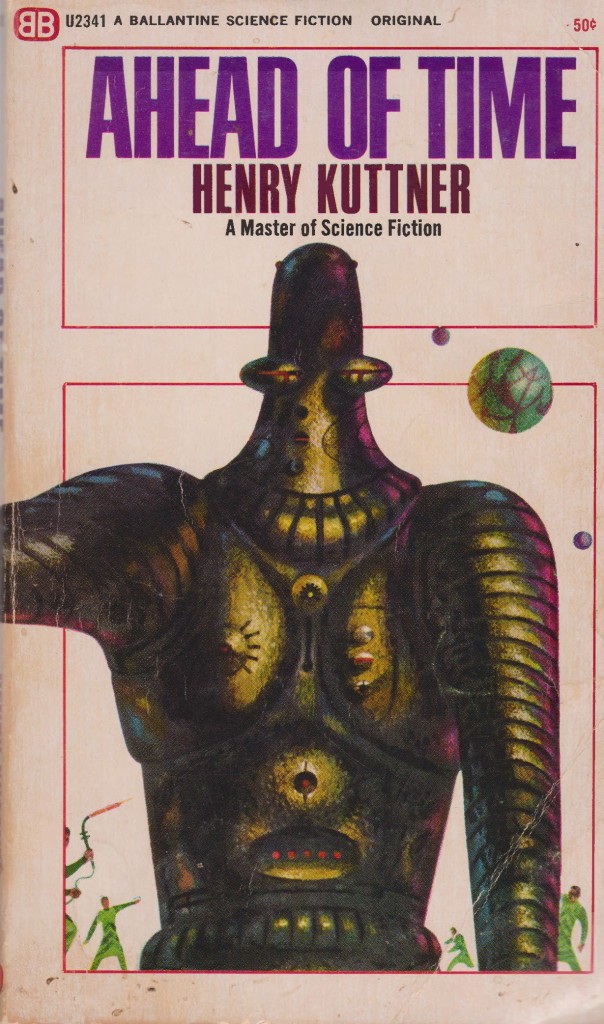
1. Ahead of Time, Henry Kuttner and C. L. Moore (1953)

From the inside page: “A brain in a box fights a criminal plot

A visitor from the future turns out to be peculiar even for his society

An eternal hillbilly family survives the centuries and gets into political trouble

A sick electronic calculator catches a psychosis from its operator

…these are some of the highly original and vividly written stories you will find in this selection of a master’s work.

Science fiction and fantasy grow constantly in popularity. Writing of this quality and imagination is the reason. Henry Kuttner demonstrates again in his book why more and more readers are becoming devotees of that intriguing fiction which is not content to stay in the world as we see it and know it, which takes us to the farthest reaches of space and time, to the farthest reaches of the human mind.”

Continue reading

Book Review: Moon-Flash, Patricia A. McKillip (1984)

3.5/5 (Good)

As Patricia A. McKillip (1948-2022) recently passed away (obituary), I decided to pick up one of her few science fiction novels. And I’m glad I did! Channeling (and reworking) the conceptual breakthrough-style premise of Clarke’s Against the Fall of Night (serialized 1948) and countless generation ship novels, Moon-Flash (1984) is an achingly beautiful coming-of-age story of a young woman who sets out to map the geography of her restrictive world.

Continue reading