Book Review: The Eden Cycle, Raymond Z. Gallun (1974)

(Kelly Freas’ cover for the 1974 edition)

4/5 (Good)

Raymond Z. Gallun is best known for his pulp sci-fi from the 1930s-50s.  From the 50s onward he wrote a handful of novels of varying quality.  The Eden Cycle (1974), probably his single best science fiction work, is a successful integration of pulp ideas and lush environments with a poignant and often haunting depiction of the social ramifications of a future world where everyone, “blessed” with immortality, can “live” in any virtual reality of their choice, shift  from simulation to simulation at will, and spontaneously conjure new ones.

Brief Plot Summary/Analysis

In the near future mankind receives mysterious signals from space.  Gallun is careful to slowly reveal the main backstory over the course of the first third of the novel.  After Continue reading

Adventures in Science Fiction Cover Art: Spacewomen of the Future (fixing spaceships + fighting aliens + charging across barren landscapes)

(Don Sibley’s cover for the November 1950 issue of Galaxy)

When we conjure the image of a 40s/50s science fiction pulp heroine we often imagine a character who has to be rescued by men from aliens, shrieks and clings to any man nearby, and is always in a state of undress.  I’ve included one cover, for the sake of comparison, that I find to be an exemplar of this type of sexist (and racist) depiction below (Alex Schomburg’s cover for the January 1954 issue of Future Science Fiction): white woman wrapped in only a towel stalked by an evil alien obviously painted with African-American facial characteristics (heavy on the sexual predation vibe) — the reader is supposed to buy into the racial stereotypes and thus be titillated by the fear she must feel.

I’ve selected a wide range of mostly pulp magazine covers depicting spacewomen of the future (I’ve loosely decided that this means women in space, in spacesuits) that tend to buck the trend Continue reading

Updates: Recent Acquisitions XXXVI (Malzberg + Gallun + Harrison + Silverberg)

More Marx Book purchases along with some random 99 cent thrift store finds (Raymond Z. Gallun + M. John Harrison)  that seemed intriguing enough.  I will eventually get to M. John Harrison’s magnum opus series of novels, Virconium– beginning with The Pastel City (1971) — but, as always, I approach an author’s masterpieces through an often circuitous manner.  I suspect my Malzberg find will be of a lesser quality than either Beyond Apollo (1972) or Revelations (1972).

I reviews I’ve found online of Gallun’s The Eden Cycle (1974) proclaim it an underrated masterpiece — with layers of virtual reality, etc.  I’ll read it soon…

As always, have you read any of these?  If so, what did you think?

1. The Day of the Burning, Barry N. Malzberg (1974)

(Don Ivan Punchatz’s cover Continue reading

Updates: Recent Science Fiction Acquisitions XXXV (Malzberg + Compton + Silverberg)

Books and short story collections from three of my favorite science fiction authors — Barry N. Malzberg, D. G. Compton, and Robert Silverberg…  A review of Malzberg’s masterpiece Revelations (1972) — almost as good as Beyond Apollo (1972) — is forthcoming.

I’ve recently discovered Marx Books — an online bookstore run by a retired professor (at Texas Tech University) and avid science fiction collector.  His collection is substantial and most importantly, he only bills you for the exact shipping (not sure if he ships internationally).  So, no $3.99 a book as Amazon does!  Instead, $3 shipping total for seven books!  Because Malzberg novels, and his short story collections, are so hard to find in used book stores it’s always nice to know I can pick up a copy quite cheaply online.

Another Richard Powers cover for my collection….

1. Revelations, Barry N. Malzberg (1972) (MY REVIEW)

(Uncredited cover for the 1972 edition)

From the back cover of the 1977 edition: “REVELATIONS is Continue reading

Book Review: Seed of Light, Edmund Cooper (1959)

(Uncredited cover for the 1959 edition — I suspect it might be David Davies)

3.25/5 (Average)

Edmund Cooper’s Seed of Light (1959) is less of a traditional narrative of the voyage of a generation ship as are its fellow generation ship novels of the 40s/50s. The best examples are Brian Aldiss’ Non-Stop (1958) and Robert Heinlein’s Orphans of the Sky (1941).  Seed of Light is more like a piece of pseudo-history interlaced with fragments of narrative of varying effectiveness.  The work is best described as a thematically-linked series of novellas tracking the future development of man in broad strokes à la Brian Aldiss’ Galaxies Like Grains of Sand (1960).  Unfortunately, Cooper’s original splicing of the generation ship theme onto a Future History template (made popular but Olaf Stapleton and Isaac Asimov among others) is extremely uneven.  Some portions are involving while others are plagued by laborious epoch-spanning pseudo-historical lectures.

Because each part is a separate novella (the last two are more closely Continue reading

Book Review: Wyst: Alastor 1716, Jack Vance (1978)

(Eric Ladd’s cover for the 1978 edition)

4.25/5 (Good)

Wyst: Alastor 1716 (1978), the second book of the Alastor Trilogy I’ve read, is more involving, satirical, and thought-provoking than Marune: Alastor 933 (1975).  Each book takes place in the same star cluster so there’s no need to read them in order.  As with every Vance book I’ve had the pleasure to read, the world is vibrant, detailed, and believable.  And also with every Vance book I’ve had the pleasure to read, an unoriginal political intrigue-driven plot is grafted with varying degrees of success onto the world.

A Description of Wyst

The Alastor trilogy takes place in the Alastor cluster, a dense collection of stars ruled by the Connatic (who makes a brief appearance in this novel) from his palace on Numenes. Wyst, Alastor 1716, is comprised of the urban center Uncibal in Arrabus where the egalist utopian society resides, large rural regions with small Continue reading

Book Review: Marune: Alastor 933, Jack Vance (1975)

(Darrell Sweet’s cover for the 1975 edition)

3.75/5 (Good)

Even though I’ve previously read only three of Jack Vance’s lesser known works, The Showboat World (1975), The Blue World (1966) and City of the Chasch (1968) I’ve come to appreciate his world building and solid story telling abilities.  Marune: Alastor 933 (1975), although not the best of his Alastor trilogy, is no exception.  I recommend the work for all fans of space opera, “fantasy in space,” and fans of Vance’s more famous works who haven’t yet tracked down other works of his substantial catalogue.

Brief Plot Summary (limited spoilers)

This work of space opera takes place in the Alastor Cluster, a node Continue reading

Updates: Recent Science Fiction Acquisitions No. XXXII (Cowper + Vance + Williamson + MacTyre)

As always Half Price Bookstore in Northern Austin, TX yielded a wonderful collection of sci-fi paperbacks…  I bought Doomsday, 1999 (1962) solely on the cover art — cool looking city exploding…  Richard Cowper’s Profundis (1979) on recommendation of my friend 2theD at Potpourri of Science Fiction Literature who waxed prophetic (hopefully)/intellectually about to joys of this seldom read author (well, his fantasy at least).  I personally, do not have high hopes considering the questionable nature of the back flap blurb.  My previous Williamson experiment, Trial of Terra (1962), had promise so I picked up one of his supposedly best works, Bright New Universe (1967).  And well, Vance is Vance and thus almost always worth reading….

1. Doomsday, 1999 (variant title: Midge),  Paul MacTyre (1962)

(Uncredited cover for the 1963 Continue reading

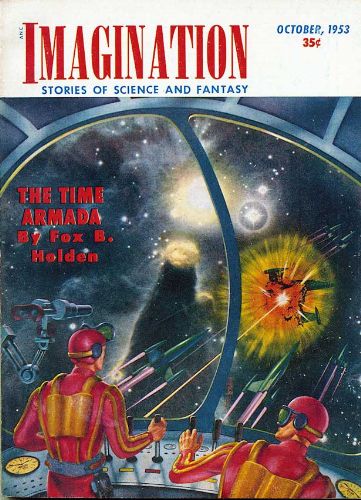
Adventures in Science Fiction Cover Art: Scenes from the Control Room

(Malcolm Smith’s cover for the October 1953 issue of Imagination)

Inspired by some of the cover art I found for my earlier post Through the View Screen, Through the Window, I decided to focus on the image of gazing from within the control room of a spaceship (either at objects within or scenes outside the view screens).  The trope is extraordinarily effective at conveying the action of a story: the unfolding canvas of an epic battle, the tension of charting a course through the stars and nefarious nebulae, the destruction of cities, the last glance at a beautiful astronaut adrift, or even, Earth within grasp!

I’ve tried not to be redundant in the covers I use — with this Continue reading