Book Review: Octavia E. Butler’s Clay’s Ark (1984)

4.5/5 (Very Good)

Octavia E. Butler’s Clay’s Ark (1984) is the final published volume of her Patternist sequence (1976-1984).1 It is the third novel according to the internal chronology of the series. Clay’s Ark is, without doubt, the most horrifyingly bleak science fiction novel I have ever read.2 It’s stark. It’s sinister. It’s at turns deeply affective before descending into extreme violence and displaced morality. The moral conundrum that underpins the central problem, the spread of an extraterrestrial disease, unfurls with an unnerving alien logic. Butler’s characters are trapped by the demands of the alien microbes, scarred by the pervasive sense that their humanity is slipping away, and consumed by the fear of starting an epidemic. A true confrontation of the moment cannot lead to anything other than suicide or the first steps towards an apocalyptic transformation.

Continue reading

Book Review: George Hay’s Flight of the “Hesper” (1952)

This is the 21st post in my series of vintage generation ship short fiction reviews. While not technically a short story, George Hay’s novel clocks in at a mere 112 pages. I’ve decided to include it in my series. While I have dabbled in the more esoteric as of late, thanks go out to all who have joined some part of my read-through already. I’ve also compiled an extensive index of generation ship SF–expanded from a monograph by Simone Caroti–if you wish to track down my earlier reviews on the topic and any that you might want to read on your own.1

Previously: Poul Anderson’s “The Troublemakers” (1953)

Next Up: TBD

2/5 (Bad)

In 2019, I made the resolution to read all the pre-1985 science fiction on the theme of generation ships available in English. I’ve made substantial progress, especially on the short story front! Last year I posted the 20th installment of my short story read-through.2 I’ve covered authors from John Brunner to Judith Merril. As I mentioned above, I’ve decided to include George Hay’s short novel Flight of the “Hesper” (1952) in my series. Unfortunately, no online copies exist to link.

Continue reading

Recent Science Fiction Purchases No. CCCXLIII (Philip K. Dick, Roger Zelazny, Chuck Rothman, Philip José Farmer, and an anthology on Future Love)

Which books/covers/authors intrigue you? Which have you read? Disliked? Enjoyed?

1. Deus Irae, Philip K. Dick and Roger Zelazny (1976)

From the back cover: “One their own, they have written landmarks works that have added whole new dimensions of wonder to the field of science fiction. Now, in Deus Irae, they have created what ALA Booklist calls “the most successful collaboration in years!”–set in in bizarre world where you will encounter…

A bunch of backwoods farmers who happen to be lizards…

Continue reading

My 2024 in Review (Best Science Fiction Novels and Short Fiction, Articles/Podcasts, Reading Initiatives, and Bonus Categories)

Here’s to a happy reading in 2025! I hope you had a successful reading year. Whether you are a lurker, occasional visitor, a regular commenter, a follower on Bluesky or Mastodon, thank you for your continued support. It’s hard to express how important (and encouraging) the discussions that occur in the comments, social media, and via email are to me. This was the third year running of record-breaking numbers of viewers and views in the 13-year history of my site. What were your favorite vintage SF reads–published pre-1985–of 2024? Let me know in the comments.

Clifford D. Simak defined my 2024. Starting with a February review of his collection Worlds Without End (1964), I embarked on a fiction and non-fiction reading extravaganza that culminated in my article for Journey Planet, which I spent most of the summer writing, titled “‘We Must Start Over Again and Find Some Other Way of Life’”’: The Role of Organized Labor in the 1940s and ’50s Science Fiction of Clifford D. Simak.” Despite his Grand Master status, there’s little scholarship on Simak’s work and so much more to be done. As expected, there was little response to the article outside of my website. I also wrote two Exploration Logs on six of his interviews and his 1971 Worldcon speech and contributed to a podcast on “The Huddling Place” (1944) (the second City story). Sometimes you find a little niche that you never expected to inhabit which you feel there’s so much more to explore and say. I hope my Simak focus continues into 2025.

Continue reading

Short Story Review: Poul Anderson’s “The Troublemakers” (1953)

This is the 20th post in my series of vintage generation ship short fiction reviews. You are welcome to read and discuss along with me as I explore humanity’s visions of generational voyage. And thanks go out to all who have joined already. I also have compiled an extensive index of generation ship SF if you wish to track down my earlier reviews on the topic and any that you might want to read on your own.

Previously: Fred Saberhagen’s “Birthdays” (1976)

Next Up: George Hay’s Flight of the “Hesper” (1952)

3.25/5 (Above Average)

Poul Anderson’s “The Troublemakers” (1953) first appeared in Cosmos Science Fiction and Fantasy Magazine, ed. L. B. Cole (September 1953). You can read it online here.

Anderson’s tale is a fascinating collision of two of my recurring interests in post-WWII science fiction: generation ships and organized labor. Due to my love of Ursula K. Le Guin’s “Paradises Lost” (2002) and Brian W. Aldiss’ Non-Stop (variant title: Starship) (1959), I started a review series on generation ship short fiction in 2019. The series has languished recently as I am running out of pre-1985 depictions of the theme available in English to read. I read Anderson’s vision last year but could not muster a review. However, my recent focus on organized labor caused me to reread Anderson’s account of generational conflict, the working class experience, and the contours of power and government.

Continue reading

Updates: Recent Science Fiction Purchases No. CCCXXXIX (Frank Herbert, Alan E. Nourse, Ann Maxwell, Craig Harrison)

Which books/covers/authors in the post intrigue you? Which have you read? Disliked? Enjoyed?

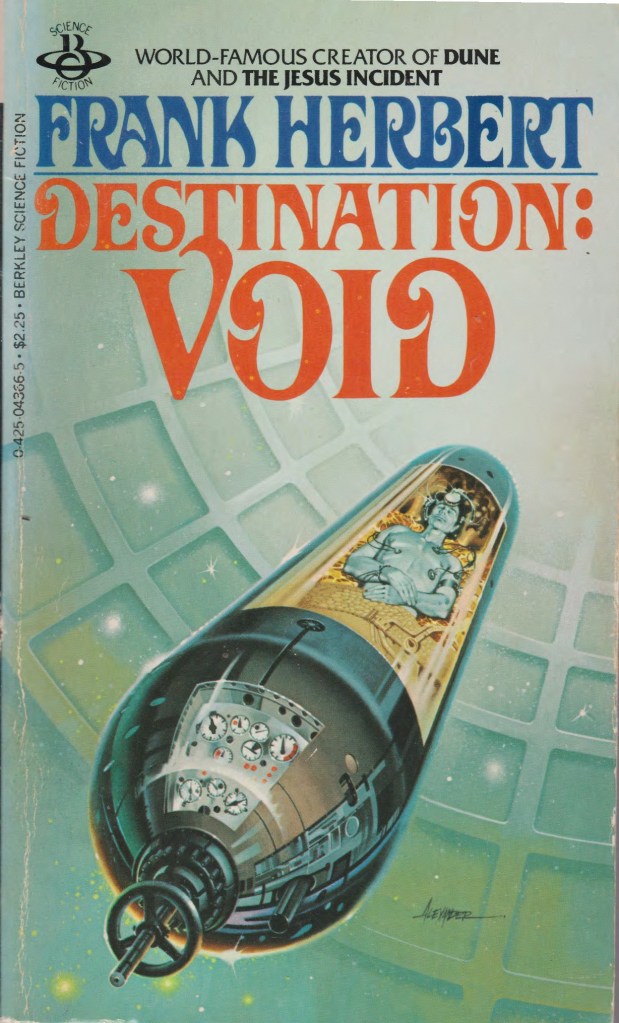
1. Frank Herbert’s Destination: Void (1966, rev. 1978)

From the back cover: “DESTINATION: VOID

THE COMPLETELY REVISED AUTHOR’S EDITION OF THE CLASSIC DEEP-SPACE ADVENTURE!

‘When the publishers announced that they were going to bring out a new edition of DESTINATION: VOID, they offered me the opportunity to make any changes I felt were necessary. Because of the tightly interwoven scientific premises behind this story and rapid development in the fields related to these premises, it would be extraordinary if discoveries across thirteen years did not dictate certain revisions.

Continue reading

Updates: Recent Science Fiction Purchases No. CCCXXXVIII (Gregory Benford, Dean McLaughlin, Warren Norwood, and Aileen La Tourette)

Which books/covers/authors in the post intrigue you? Which have you read? Disliked? Enjoyed?

1. In Alien Flesh, Gregory Benford (1986)

From the back cover: “A journey into the depts of space and time by Gregory Benford, winner of the Nebula Award.”

Contents: “In Alien Flesh” (1978), “Time Shards” (1979), “Redeemer” (1979), “Snatching the Bot” (1977), “Relativistic Effects” (1982), “Nooncoming” (1978), “To the Storming Gulf” (1985), “White Creatures” (1975), “Me/Days” (1984), “Of Space/Time and the River” (1985), “Exposures” (1981), “Time’s Rub” (1984), “Doing Lennon” (1975).

Continue reading

What pre-1985 science fiction are you reading? + Update No. XV

What pre-1985 science fiction are you reading or planning to read this month? Here’s July’s installment of this column.

Last month I waxed rhapsodic about a powerful interaction with a professor in graduate school… this month I’ll show you a recent obsessive territory I’ve been reading and ruminating about: 1940s and 1950s (and a few from the 60s) social commentary on American affluence, technology, and media. It all started with my media landscapes of the future series–I could not write on the topic unless I read some Marshall McLuhan. And then I had to read about C. Wright Mills to write about Clifford D. Simak and organized labor. And then I needed to track down other popular authors of social commentary published in era. It should not be surprising so much 50s SF revolved around social commentary — it was in the air. You get the idea. This pile represents some of what I now own:

Continue reading

Book Review: Those Who Watch, Robert Silverberg (1967)

3.25/5 (Above Average)

A preliminary note: I’m something of a Robert Silverberg completionist, especially work from his glory years of 1967-1975. I’ve reviewed forty-seven of Silverberg’s short stories and thirteen of his novels–I’ve also read but never reviewed A Time of Changes (1971), The Masks of Time (1968), Tower of Glass (1970), and the stories in Capricorn Games (1976).

While a middling Silverberg novel at best, Those Who Watch (1967) almost succeeds as a revisionist take on UFO panic. The aliens do not seek to experiment on, exterminate, or manipulate humans. Instead, this is a book about the lost and lonely, and how their love and care for the injured interstellar visitors that appear on their doorsteps transform their lives. It’s a problematic work that simultaneously pulses with kindness.

Continue reading