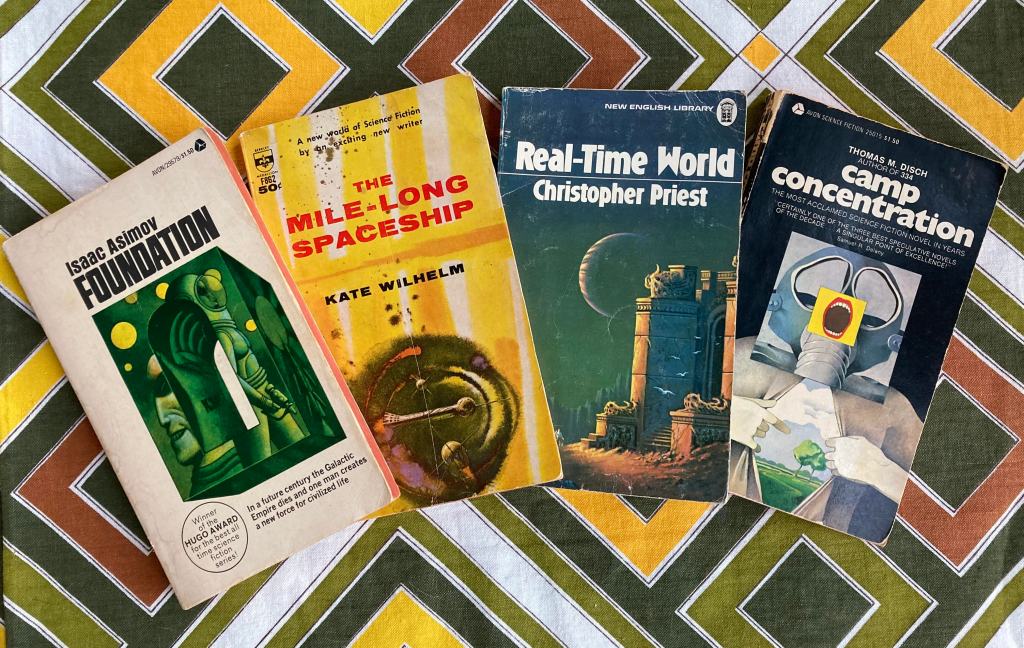
What pre-1985 science fiction are you reading? + Update No. XV

What pre-1985 science fiction are you reading or planning to read this month? Here’s July’s installment of this column.

Last month I waxed rhapsodic about a powerful interaction with a professor in graduate school… this month I’ll show you a recent obsessive territory I’ve been reading and ruminating about: 1940s and 1950s (and a few from the 60s) social commentary on American affluence, technology, and media. It all started with my media landscapes of the future series–I could not write on the topic unless I read some Marshall McLuhan. And then I had to read about C. Wright Mills to write about Clifford D. Simak and organized labor. And then I needed to track down other popular authors of social commentary published in era. It should not be surprising so much 50s SF revolved around social commentary — it was in the air. You get the idea. This pile represents some of what I now own:

Continue reading
Book Review: Those Who Watch, Robert Silverberg (1967)

3.25/5 (Above Average)

A preliminary note: I’m something of a Robert Silverberg completionist, especially work from his glory years of 1967-1975. I’ve reviewed forty-seven of Silverberg’s short stories and thirteen of his novels–I’ve also read but never reviewed A Time of Changes (1971), The Masks of Time (1968), Tower of Glass (1970), and the stories in Capricorn Games (1976).

While a middling Silverberg novel at best, Those Who Watch (1967) almost succeeds as a revisionist take on UFO panic. The aliens do not seek to experiment on, exterminate, or manipulate humans. Instead, this is a book about the lost and lonely, and how their love and care for the injured interstellar visitors that appear on their doorsteps transform their lives. It’s a problematic work that simultaneously pulses with kindness.

Continue reading

What pre-1985 science fiction are you reading? + Update No. XII

What pre-1985 science fiction are you reading or planning to read this month?

Here’s April’s installment of this column.

First, a bit about Isaac Asimov’s Foundation (1951) from M. Keith Booker’s Monsters, Mushroom Clouds, and the Cold War: American Science Fiction and the Roots of Postmodernism, 1946-1964 (2001), my current history of science fiction read:

Continue reading

Generation Ship Short Story Review: Fred Saberhagen’s “Birthdays” (1976)

This is the 19th post in my series of vintage generation ship short fiction reviews. I am not entirely sure Fred Saberhagen’s vision exactly fits the definition of a generation ship but it’s so fascinating that I had to share it with you all!

As a reminder for anyone stopping by, all of the stories I’ll review in the series are available online via the link below in the review. And, if you want to work through the reviews from the series from the beginning, here’s my first post from 2019 on Chad Oliver’s “The Wind Blows Free” (1957).

You are welcome to read and discuss along with me as I explore humanity’s visions of generational voyage. And thanks go out to all who have joined already. I also have compiled an extensive index of generation ship SF if you wish to track down my earlier reviews on the topic and any that you might want to read on your own.

Previously: Barrington J. Bayley’s “Exit from City 5” (1971).

Next Up: Poul Anderson’s “The Troublemakers” (1953)

4.25/5 (Very Good)

Continue reading

Updates: Recent Science Fiction Purchases No. CCCXXXII (Vernor Vinge, Brian Stableford, Joan Cox, and Pierre Boulle)

Which books/covers/authors in the post intrigue you? Which have you read? Disliked? Enjoyed?

1. The Witling, Vernor Vinge (1976)

From the back cover: “Witling: A pretender to wit. (Webster’s Dictionary)

In the eyes of the inhabitants of Giri the scientific explorers from outer space were witlings. In the context of that primitive-seeming planet, they were.

Because on Giri a peculiarity of evolution had given a special talent to all living things–and this talent had made unnecessary most of the inventions associated with intelligent life elsewhere. Roads and planes, engines and doors… these were the products of witlings, not of ‘normal’ people.

So when the little band from Earth’s exploration team fell into Giri hands, their problem was unprecedented. How to demonstrate that science is worthwhile and how to keep the medieval masters of Giri from realizing their potential for cosmic mischief.”

Continue reading

Updates: Recent Science Fiction Purchases No. CCCXXXI (Iain M. Banks, Mike Resnick, Sydney J. Van Scyoc, and David J. Skal)

Which books/covers/authors in the post intrigue you? Which have you read? Disliked? Enjoyed?

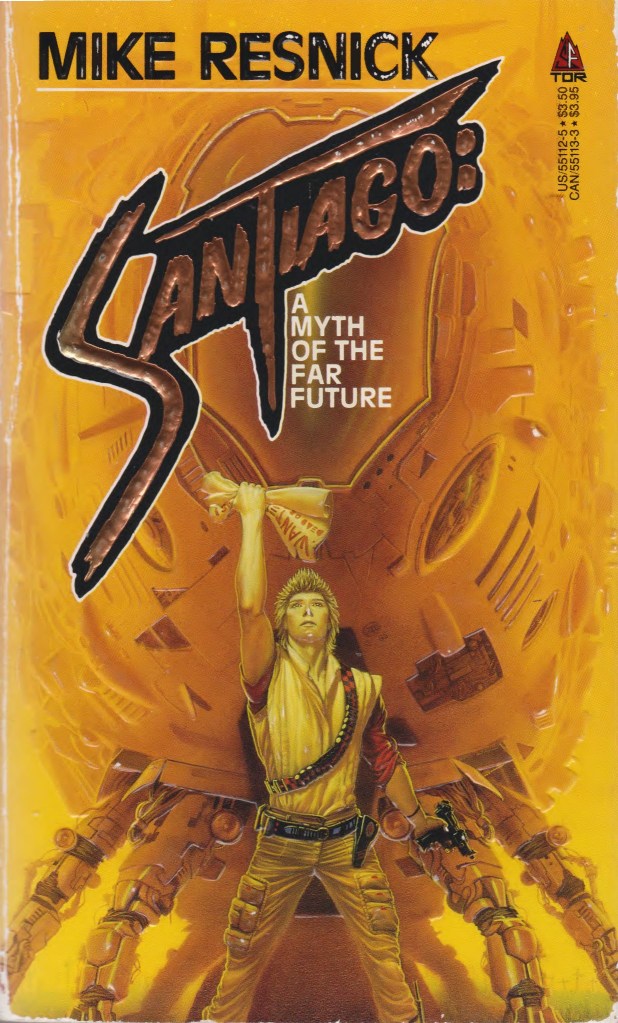
1. Santiago: A Myth of the Far Future, Mike Resnick (1986)

From the back cover: “SEBASTIAN NIGHTINGALE CAIN: County hunter. You can call him Songbird–but only once. He’s after Santiago.

VIRTUE MECKENZIE: Freelance reporter. She never give up. She wants an interview… with Santiago.

THE SWAGMAN: He collects art–at gun point. He wants a few pieces currently in the hands of Santiago.

Continue reading

Updates: Holiday Purchases! No. CCCXXVIII (Robert Silverberg, S. P. Somtow, Janet Asimov, and a World’s Best Anthology)

Happy holidays. I hope you’ve been able to squeeze in a bit of science fiction reading.

Which books/covers/authors intrigue you? Which have you read? Disliked? Enjoyed?

1. Those Who Watch, Robert Silverberg (1967)

From the back cover: “CRASH LANDING FROM THE STARS.

Only three humans would ever know that the blinding flash in the sky on that night in 1982 was an exploding flying saucer. Only they would learn the truth about THOSE WHO WATCH–about the alien beings who came into this world in a crash landing from the stars. THOSE WHO WATCH is the strange, seductive novel of three accidental colonists from outer space whose chance encounter with Earth triggers interplanetary conflict. It is also the most unusual love story ever written.”

Continue reading

What pre-1985 science fiction are you reading? + Bimonthly Update No. V

What pre-1985 science fiction are you reading this week?

Thanks again for all the great conversation. Make sure to check out the previous installment if you haven’t already. As before, I’ve included a bit about the books in the photograph, birthdays from the last two weeks, and brief ruminations on what I’ve been reading and writing.

Let me know what pre-1985 SF you’ve been reading!

Continue reading

Book Review: The Gold at the Starbow’s End, Frederik Pohl (1972)

3.75/5 (Collated rating: Good)

After Frederik Pohl (1919-2013) left his editorial position at Galaxy and If in 1969, he set his pen towards a productive vein of form in the 70s that would culminate in his Hugo and Nebula-winning Gateway (1977). The Gold at the Starbow’s End contains five short stories–including the first of his Heechee sequence–from this period. Two of the best stories, the titular “The Gold at the Starbow’s End” (1972) and “The Merchant of Venus” (1972), demonstrate Pohl’s characteristic blend of hyperbolic satire and delirious energy. There are no duds in this collection.

Continue reading