Updates: Recent Science Fiction Acquisitions N. XLIV (Anderson + Brunner + Bova + Budrys)

My Austin, TX haul….

Two classics I’ve yet to read: Budrys’ Who? (1958) and Poul Anderson’s Tau Zero (1970)…  The second in a trilogy by John Brunner, The Avengers of Carrig (1969) — the first, Polymath (first published in 1963 but expanded in 1974) was a readable Brunner pulp.

I’ve never enjoyed Bova’s novels, but I impulsively picked up As on a Darkling Plain (1972), perhaps influenced by the Ellis’ cover.

1. Who?, Algis Budrys (1958)

(Robert V. Engel’s cover for the 1958 edition) Continue reading

Book Review: The Wall Around the World, Theodore R. Cogswell (1962)

(John Schoenherr’s cover for the 1962 edition)

collated rating: 2.25/5 (Bad)

In my quest to bring to light the esoteric, the worthwhile yet forgotten, and to re-examine unjustly maligned works of science fiction I’m unfortunately more likely find incredibly average works than if I were to stick to the more well-trod path.  Theodore Cogswell’s short stories attempt unsuccessfully to wed clichéd fantasy + horror elements — à la vampires, werewolves, broomsticks and all that drek — with science fiction staples, including alien invasions and alien visitations.  I suspect there was, and still is, a market for such hybridity.  I don’t have to mention the conveyor belt chunking out vampire/zombie excreta all over our modern bookstore shelves… (I apologize to anyone who’s offended or implicated by that statement).  Almost all of Cogswell’s stories are lighthearted (besides ‘The Burning’), replete with heavy doses of whimsy, and in the few readable stories, some vibrancy.

Not my type of science fiction or fantasy.

Continue reading

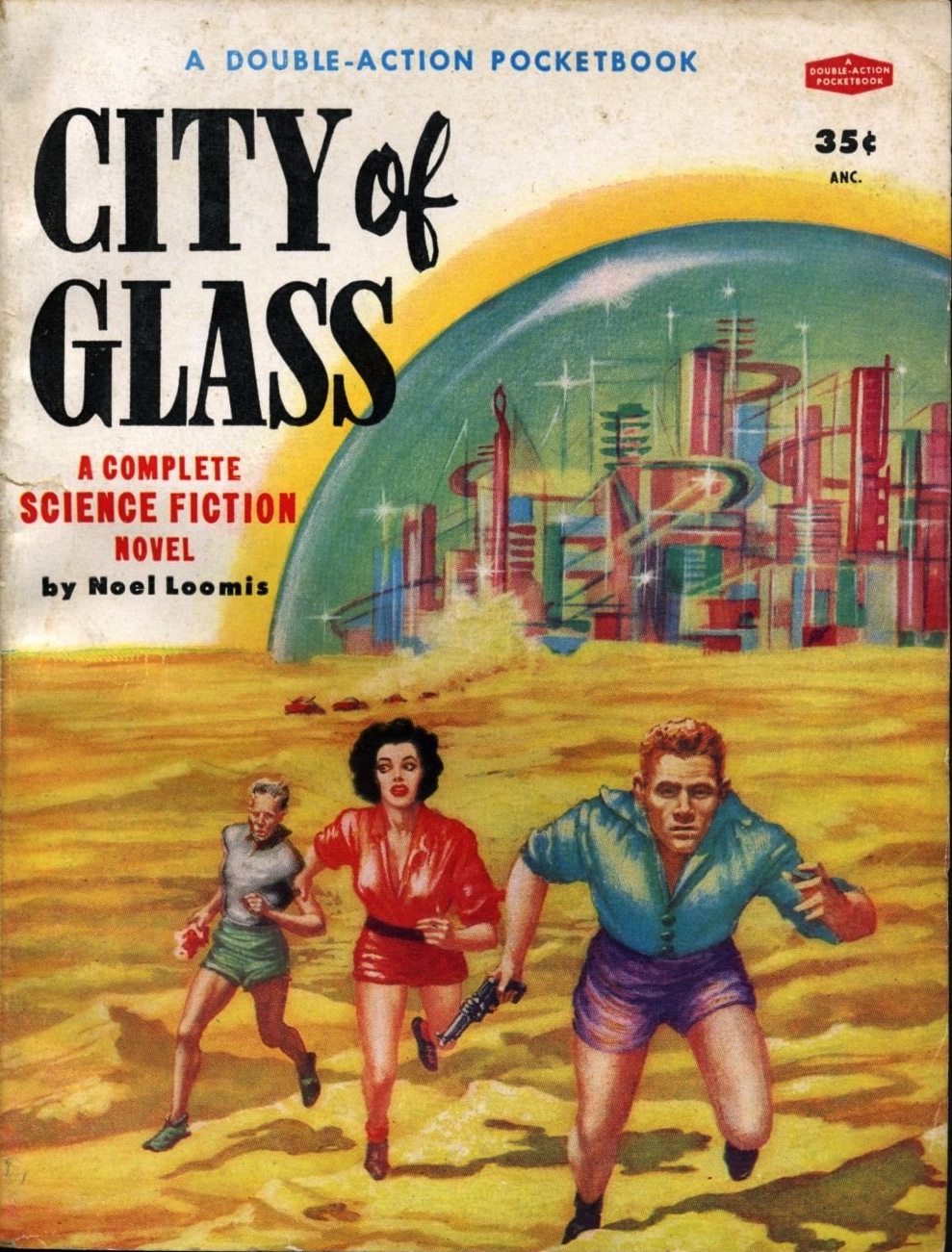
Adventures in Science Fiction Cover Art: Domed Cities of the Future, Part III

(Kelly Freas’ cover for the 1955 edition of City of Glass (1942 magazine), Noel Loomis)

Part I, Part II of my series on domed cities of the future.

Bob Watkin’s cover for the 1955 issue of If Magazine depicts an old man regaling stories of futuristic domed cities.  His fantastic visions are reduced to their key elements in sketch form — a translucent dome, buildings.  I’ve selected a variety of images from pulp 50s works until the late 70s depicting more fantastic/futuristic domed cities than the old man’s imagination conjures.  Ed Emshwiller’s cover for the  1953 edition of City at World’s End (1950) depicts two futuristic metropoli — a trend in future city development?  The first is a planned circular city spreading horizontally across the plain.  The other, an incredibly stylized “futuristic complex” Continue reading

Adventures in Science Fiction Cover Art: Nuclear Explosions + Mushroom Clouds, Part II

(Pattee’s cover for the November 1950 issue of Astounding Science Fiction)

In case you missed Part I.

Pattee’s cover for the Astounding Science Fiction November 1950 issue is visually stunning.  A transparent man (his arteries + brain showing) holds the atomic symbol aloft.  On the horizon a gigantic mushroom cloud is transposed with a spaceship.  Does man use atomic power for science and the good of mankind or evil and the destruction of mankind?  The message is made even more abundantly clear by the title of the piece of art — “Choice.”  Although this rhetoric might seem somewhat ham-fisted to modern post-Cold War readers, it produced some remarkable works of science fiction and science fiction art.  (If anyone knows the full name of the artist, I’d be grateful).

As with Part I, I’ve included some covers from the notorious hackwork spewing conveyor belt publisher Badger Books for giggles and Continue reading

Book Review: Galaxies Like Grains of Sand, Brian Aldiss (1960)

(Paul Lehr’s cover for the 1960 edition)

3/5 (collated rating: Average)

The concept behind Brian Aldiss’ short story collection Galaxies Like Grains of Sand (1960) is intriguing.  Take previously published stories (in this case from magazines in the late 50s), graft them together by means of mini-introductions, and arrange them so they fit into a future history framework à la Olaf Stapledon’s Last and First Men (1930) or Isaac Asimov’s Foundation Trilogy (1951-1953).

The quality of the stories makes the format less than successful.   Only three stories are worth reading — ‘Secret of a Mighty City’ (1958), ‘Out of Reach’ (1957), and ‘All Continue reading

Updates: Recent Science Fiction Acquisitions N. XL (Miller, Jr + Cogswell + Pohl/del Rey + Kornbluth/Merril)

A couple from my father + a few left over Marx Book purchases….

Three delightfully gorgeous Powers covers.  And one stunning John Schoenherr cover despite the unknown quality of the short stories within….

A short story collection and a three novella collection by Walter M. Miller, Jr., the author of A Canticle for Leibowitz (1959)…  A scathing, and hilarious satire by Frederik Pohl and Lester del Rey…  Among others.

1.  The View from the Stars, Walter M. Miller, Jr. (1965) (MY REVIEW)

(Richard Powers’ cover for the 1965 edition) Continue reading

Book Review: Total Eclipse, John Brunner (1974)

(John Cayea’s cover for the 1974 edition)

3/5 (Average)

Over the years I’ve deluded myself into becoming a John Brunner completest — around twenty-five of his novels line my shelves and I’ve read most of them over the years.  At his best he’s without question one of the great masters of the genre — Stand on Zanzibar (1968), The Sheep Look Up (1972), etc. are evidence of this.  However, in-between his social science fiction masterpieces are a plethora of unsatisfying attempts at traditionalist space opera.  In these works Brunner never fully leaves his pulp roots although he occasionally tries to inject a dose of hard science, (pseudo) intellectualism, and social commentary.

Total Eclipse (1974) fits this mold.  A group of scientists attempt to figure out the mystery of a highly advanced race which has apparently, died out. Character interactions are painfully silly along the “Oh heroic main character, you’re a genius let me jump into your bed” sort of Continue reading

Book Review: The Eden Cycle, Raymond Z. Gallun (1974)

(Kelly Freas’ cover for the 1974 edition)

4/5 (Good)

Raymond Z. Gallun is best known for his pulp sci-fi from the 1930s-50s.  From the 50s onward he wrote a handful of novels of varying quality.  The Eden Cycle (1974), probably his single best science fiction work, is a successful integration of pulp ideas and lush environments with a poignant and often haunting depiction of the social ramifications of a future world where everyone, “blessed” with immortality, can “live” in any virtual reality of their choice, shift  from simulation to simulation at will, and spontaneously conjure new ones.

Brief Plot Summary/Analysis

In the near future mankind receives mysterious signals from space.  Gallun is careful to slowly reveal the main backstory over the course of the first third of the novel.  After Continue reading

Updates: Recent Science Fiction Acquisitions N. XXXVIII (Spinrad + Harrison + Kavan + Effinger)

Ah, when I have access to a massive inexpensive catalogue (Marx Books) the quality of my finds goes up and up…..  Finally a copy of Norman Spinrad’s metafictional The Iron Dream (1972) (if Hitler lived in America and wrote a sci-fi novel AND a commentary on said piece of science fiction).  Unfortunately, I own a later edition (with a hideous cover) than the one below.  Geo. Alec Effinger’s bizarre What Entropy Means to Me (1972) — again, about writing, and interpreting writing, and inventing interpretation…  Anna Kavan’s drug inspired underrated and underread sci-fi parable Ice (1976).  AND, a futuristic fantasy of the highest caliber, M. John Harrison’s The Pastel City (1971) — yes, I could have purchased the multi-novel sequence (and related short stories) in one volume but I like having the original paperbacks.

1. The Iron Dream, Norman Spinrad (1972)

(Uncredited cover for the 1972 edition) Continue reading