Book Review: The Light That Never Was, Lloyd Biggle, Jr. (1972)

3.25/5 (Average)

The Light That Never Was (1972) is an unusual take on space opera — there are no epic battles, voyages on spaceships, weird technology, or heroic figures.  Instead, the swirling eddies of interstellar change descend on a tourist planet replete with legions of rather atrocious, silly, and easily maleable “artists.”  The island of Zrilund on the plant of Donev is afflicted by a general artistic malaise — artists paint for the swarms of tourists which descend on the fountains and beaches of the island snatching Continue reading

Book Review: The Alien Way, Gordon Dickson (1965)

3.75/5 (Good)

I was pleasantly surprised by Gordon R. Dickson’s intelligent and occasionally thought-provoking The Alien Way (1965).  Considering he’s famous for his military sf Dorsai! saga, the lack of epic space battles — i.e. inter-species conflict in the traditional manner — came as a shock.  There are a few instances of violence but they’re few and far between.

The ultimate message is a cautionary one — only when the pattern of human nature (its instincts, reactions, ets) is understood can non-violent contact be made with an alien species.   We react to protect our species just as animals react to protect their young.  Of course the aliens have to come to this realization Continue reading

Book Review: Beyond the Barrier, Damon Knight (1964)

1/5 (Bad)

Damon Knight’s dismal Beyond the Barrier (1964) is all plot, lacks even the most cursory world development, makes no attempt to construct a “character”, and contains one of the single most ludicrous scenes I’ve encountered.  Knight is considered somewhat of a “master” of sci-fi but his supposed skills are not on show here (short stories?).  Yes, there’s adventure, intrigue, action, bizarre technology, green frog aliens, time travel, Earth core traversing oscillating field machines, and time  Continue reading

Adventures in Science Fiction Cover Art: Assorted 1970s Surrealistic Faces by Richard Powers

This is the second post in a potential series of posts showcasing the science fiction cover art by Richard Powers (1921-1996). My first post discussed a few surrealist cityscape covers from the 1950s.  Here I’ve selected a variety of surrealistic, composite, conglomerated, and masked faces from his 1970s covers.

A delightful green human shape — mouthless — replete with translucent hollows?  emerging occupants or surfacing memories?

(Cover for the 1973 edition of All Flesh is Grass (1965), Clifford D. Simak)

The Eternal Frontiers utilizes another Continue reading

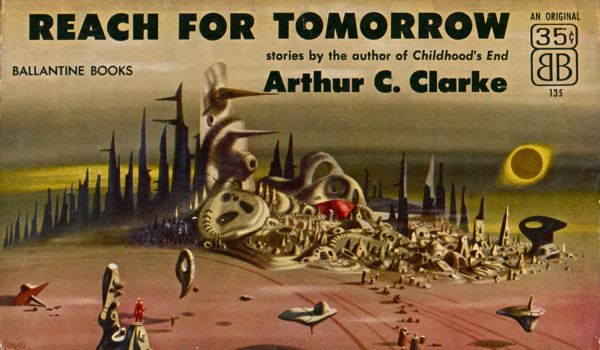
Adventures in Science Fiction Cover Art: The 1950s Surrealist Cityscapes of Richard Powers

Richard Powers (1921-1996) is one of my favorite science fiction cover artists.  Heavily influenced by the likes of Yves Tanguey and Picasso, his delightful vein of surrealism graced the covers of multiple classics of the genre (for example, Simak’s City, Clarke’s Earthlight and The City and the Stars, Norton’s Sky Gate, Vonnegut’s The Sirens of Titan, Sturgeon’s More Than Human).  His covers are unmistakable and extremely easy to identify.  I’ve decided to showcase a few of his surrealist cityscapes.

(cover for 1956 edition of Reach for Tomorrow (1956), Arthur C. Clarke)

The cover for Reach for Tomorrow achieves a wonderful Continue reading

Update: Recent Science Fiction Acquisitions N. VIII

My month of infrequent posts is over — I’ve returned to Austin after a month long sojourn across Colorado, New Mexico, France and Italy….  So, what do I do in my jet lagged state?  Head to the Half Price Books.  Not the best haul this time but a few potentially interesting reads.

1. Witch World (1963), Andre Norton

I’ve yet to read any of Andre Norton’s immense number of novels.  Not knowing exactly where to start I picked up what is generally considered among her best works — Witch World (1963).  It was nominated for the 1964 Hugo award for Best novel and often places in best Fantasy/Sci-fi lists.  And the cover is Continue reading

Book Review: Star Ways (variant title: The Peregrine), Poul Anderson (1956)

2.75/5 (Average)

Poul Anderson’s third novel contains a few glimmers of his later slick storytelling but lacks developed ideas and convincing characters.  This is not entirely Anderson’s fault, as he points out in the introduction to a later edition, because the original manuscript was heavily edited without his knowledge in order to achieve a specific page Continue reading