Which books/covers/authors intrigue you? Which have you read? Disliked? Enjoyed?
I planned to have a review up today. Unfortunately, August is always my least productive month writing as it marks the return to work after a much needed summer break. It’s been a rough few weeks! Stay tuned.
1. The Squares of the City, John Brunner (1965)
Murray Tinkelman’s cover for the 1978 edition
From the back cover: CHECHMATE IN PARADISE. Ciudad de Vados was a Latin-American showplace, a paradise…a flourishing supercity designed and run nearly to perfection.
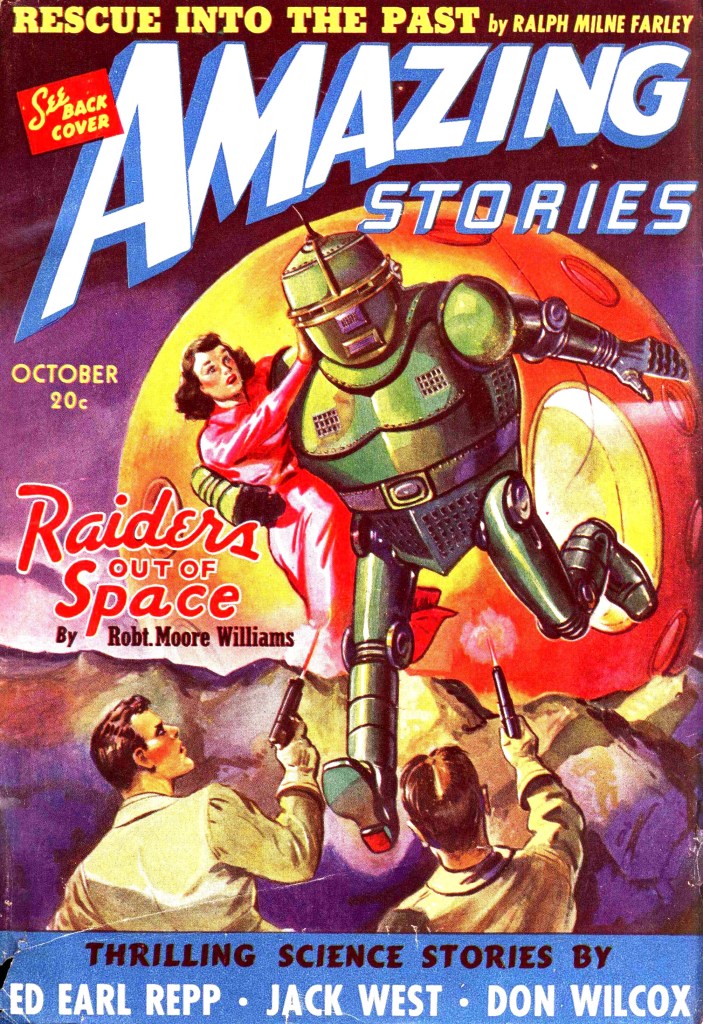
This is the 14th post in my series of vintage generation ship short fiction reviews. Today I return to the 1940s with a story that feels like the progenitor of so many later visions of the generation ship. Along with Robert A. Heinlein’s “Universe” (1941) and “Common Sense” (1941) (novelized in 1963 as Orphans of the Sky), Don Wilcox’s “The Voyage That Laster 600 Years” (1940) maps out a commonly followed path for the subgenre.
Leo Morey’s cover for the October 1940 issue of Amazing Stories, ed. Raymond A. Palmer
3.5/5 (Good)
Don Wilcox’s “The Voyage That Lasted 600 Years” first appeared in the October 1940 issue of Amazing Stories, ed. Raymond A. Palmer. You can read it online here.
According to SF Encyclopedia, Don Wilcox (1905-2000) taught creative writing at Northwestern University and started writing pulp science fiction for Ray Palmer’s Amazing Stories and Fantastic Adventures in July 1939. He remains best known for his pioneering generation ship story “The Voyage that Lasted 600 Years” (1940).
The following review is the 15th installment of my series searching for “SF short stories that are critical in some capacity of space agencies, astronauts, and the culture which produced them.” Some stories I’ll review in this series might not fit. And that is okay. I relish the act of literary archaeology.
I read this story in celebration of Walter M. Miller, Jr.’s birthday (1/23). While best known for his masterfulA Canticle for Leibowitz (fixup 1959)novellas, I’ve thoroughly enjoyed his other short fictions, including his previous appearance in this series “Death of a Spaceman” (variant title: “Memento Homo”) (1954).
As always, feel free to join the conversation and read along with me on the search for the depressed astronaut.
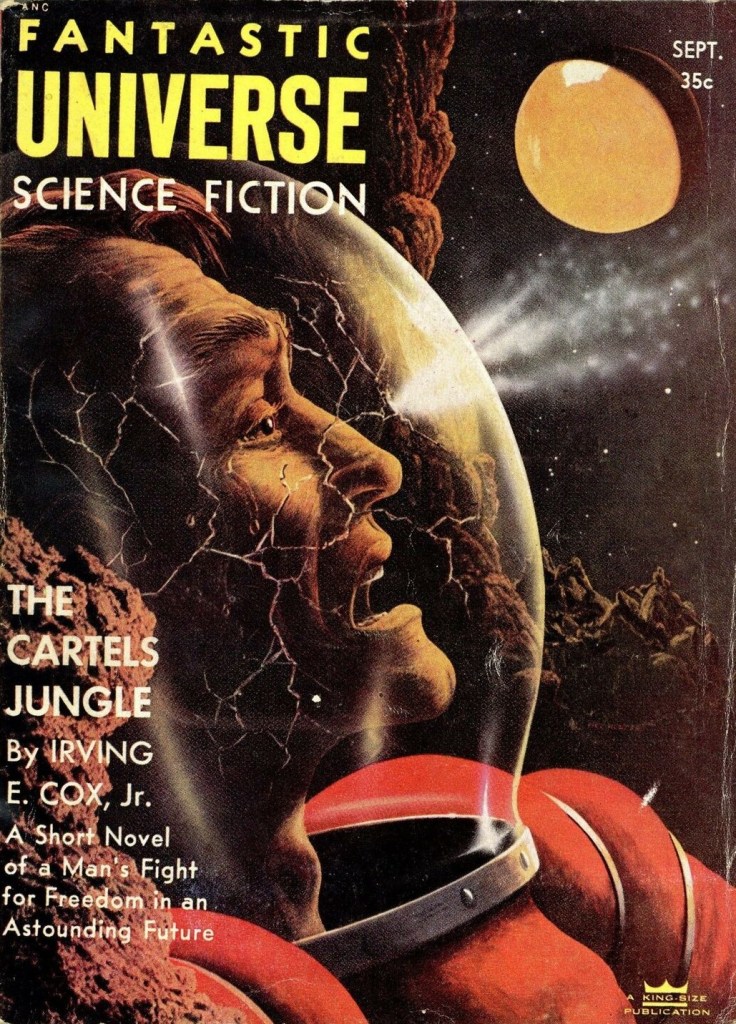
Mel Hunter’s cover for the September 1955 issue of Fantastic Universe
4.5/5 (Very Good)
Walter M. Miller, Jr.’s “The Hoofer” first appeared in the September 1955 issue of Fantastic Universe, ed. Leo Margulies. You can read it online here. I read it in S-F: The Year’s Greatest Science-Fiction and Fantasy, ed. Judith Merril (1956).
“The Hoofer” inhabits a similar future as “Death of a Spaceman” (1954) where space travel is a dangerous blue-collar occupation and coming home from the “Big Bottomless” parallels the traumas of a wartime veteran. With deceptive and powerful simplicity, “The Hoofer” follows Big Hogey Parker, with bottle of gin in hand that aggravates the physical symptoms of space travel–“glare-blindness, gravity-legs, and agoraphobia” (77), on his bus journey home a “week late” (79). He has a secret he fears to share with his wife. And the effects of space travel only explain some of his deep sadness within.
2021 was the best year in the history of my site for visits and unique viewers! I suspect this increasingly has to do with my twitter account where I actively promote my site vs. a growing interest in vintage SF. I also hit my 1000th post–on Melisa Michaels’ first three published SF short stories–in December.
As I mention year after year, I find reading and writing for the site—and participating in all the SF discussions it’s generated over the year—a necessary and greatly appreciated salve. Thank you everyone!
I read very few novels this year. Instead, I devoted my attention to various science short story reviews series and anthologies. Without further ado, here are my favorite novels and short stories I read in 2021 (with bonus categories).
Tempted to track any of them down?
And feel free to list your favorite vintage (or non-vintage) SF reads of the year. I look forward to reading your comments.
My Top 7 Science Fiction Novels of 2021 (click titles for my review)
Uncredited cover for the 1988 edition
1. Where Time Winds Blow (1981), Robert Holdstock, 5/5 (Masterpiece): Holdstock’s vision is a well-wrought cavalcade of my favorite SF themes–the shifting sands of time, the pernicious maw of trauma that threatens to bite down, unreliable narrators trying to trek their own paths, a profoundly alien planet that compels humanity to construct an entirely distinct society… It’s a slow novel that initially masquerades as something entirely different. Just like the planet itself.
Every morning for the last few years, I post on Twitter the birthdays (pre-1955) of artists, authors, and editors involved in some way with science fiction. In the last year, a singular compulsion has hit and I’ve started to include even more obscure figures like Gabriel Jan (1946-) and Daniel Drode (1932-1984). On May 31st, while perusing the indispensable list on The Internet Speculative Fiction Database, I came across an author unknown to me–Melisa Michaels (1946-2019) (bibliography). She’s best known for the five-volume Skyrider sequence (1985-1988) of space operas “depicting the growth into maturity of its eponymous female Starship-pilot protagonist” (SF Encyclopedia).
As I’m always willing to explore the work of authors new to me, I decided to review the first three of her six published SF short stories. Two of the three stories deal with my favorite SF topics–trauma and memory.
Karl Kofoed’s interior art illustrating Melisa Michaels’ “In the Country of Blind, No One Can See” in Isaac Asimov’s Science Fiction Magazine (January 1979)
“In the Country of the Blind, No One Can See” (1979), 3.5/5 (Good): First appeared in Isaac Asimov’s Marvels of Science Fiction (1979). It was reprinted in Isaac Asimov’s Science Fiction Magazine (January 1979). You can read it online here.
On a terraformed Mars, Allyson Hunter and her two clone sisters, Rebecca and Kim, are societal outcasts. They spent their lives trying to be “real people” yet were “reminded, every day in a dozen little ways, that they weren’t real people” (87). Clones retain their first usage as replacement body parts. Permitted to live only due to indications of telepathic potential (needed to guide spaceships), the sisters attempt to live meaningful lives and develop useful skills. The sisters charter two identical twins, Frank and Todd, to convey them across the Martian landscape. A horrific crash kills Kim and forces the survivors to work together and move past the deep resentment and hatred the brothers hold.
This is the 11th post in my newly resurrected series of vintage generation ship short fiction reviews. I’m continuing my exploration of 50s visions.
As a reminder for anyone stopping by, all of the stories I’ll review in the series are available online via the link below in the review.
You are welcome to read and discuss along with me as I explore humanity’s visions of generational voyage. And thanks go out to all who have joined already. I also have compiled an extensive index of generation ship SF if you wish to track down my earlier reviews on the topic and any that you might want to read on your own.
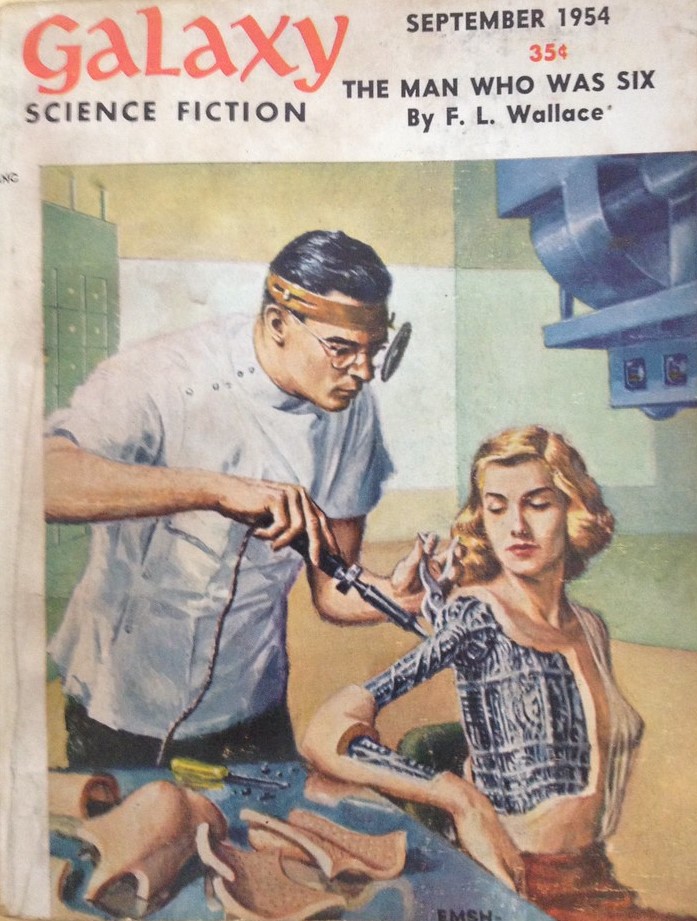
Ed Emshwiller’s cover for Galaxy Science Fiction (September 1954)
Arthur Sellings’ “A Start in Life” first appeared in Galaxy Science Fiction (September 1954), ed. H. L. Gold. 3/5 (Average). You can read it online here.
Which books/covers/authors intrigue you? Which have you read? Disliked? Enjoyed?
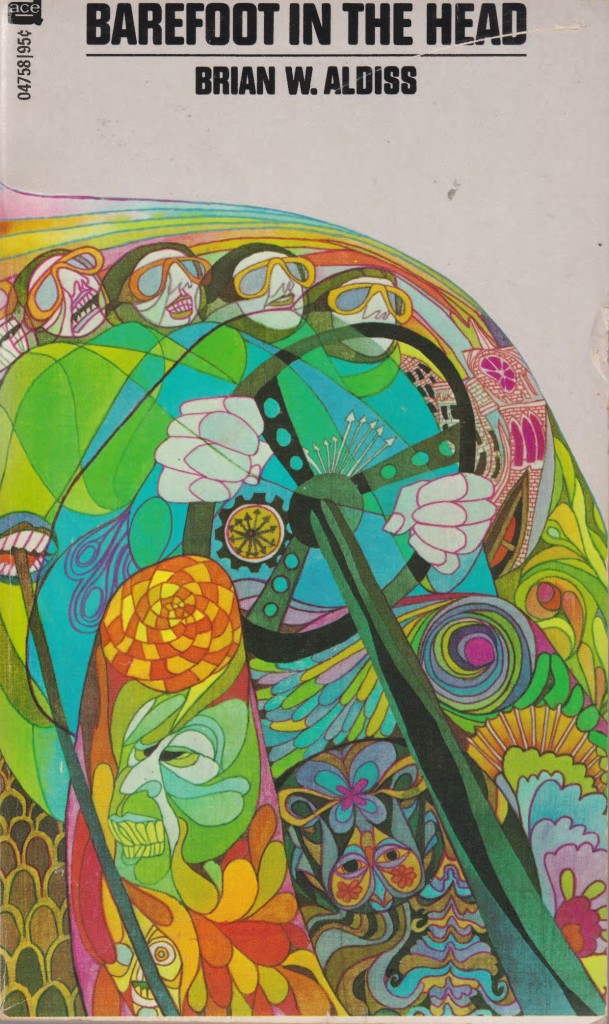
1. Barefoot In the Head, Brian W. Adliss (1969)
Diane and Leo Dillon’s cover for the 1972 edition
From the back cover: “AFTER THE ACID WAR…. Rising from the dust and ashes of a Europe still reeling from the effects of the great Acid War comes Colin Charteris, a futuristic Don Quixote riding the mechanized brontosaurus of the times.
Charteris tries desperately to make sense of the drugged, chaotic world he lives in, and finds himself hailed as the new Messiah. Stranger still, Charteris himself comes to believe this.
His adventures as he tries to save the world from its insanity are brilliantly told, a satiric science fiction comment on the future of mankind.”
This is the 10th post in my newly resurrected series of vintage generation ship short fiction reviews. I’ve returned to an author, Frank M. Robinson (1926-2014), that I promised to read more of after the wonderful “The Wreck of the Ship John B.” (1967).
As a reminder for anyone stopping by, all of the stories I’ll review in the series are available online via the link below in the review.
You are welcome to read and discuss along with me as I explore humanity’s visions of generational voyage. And thanks go out to all who have joined already. I also have compiled an extensive index of generation ship SF if you wish to track down my earlier reviews on the topic and any that you might want to read on your own.
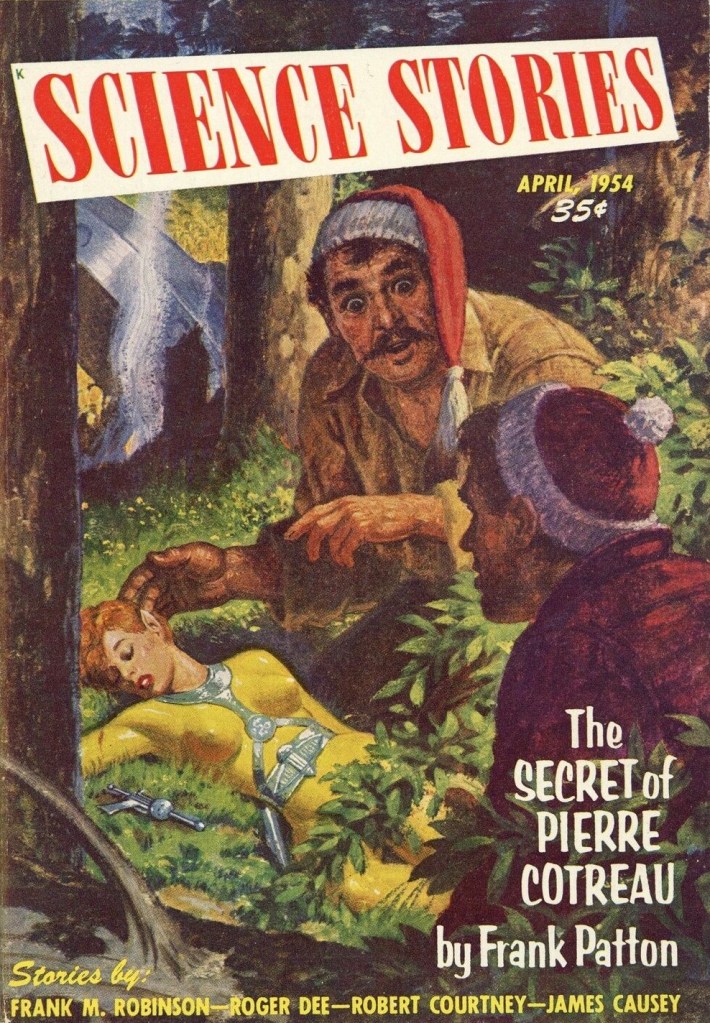
Robert Gibson Jones’ cover art for Science Stories (April 1954)
Frank M. Robinson’s “The Oceans Are Wide” first appeared in Science Stories (April 1954), ed. Bea Mahaffey and Ray Palmer. 3.75/5 (Good). You can read it online here. Note: I read the story in Starships, ed. Isaac Asimov, Martin Harry Greenberg, Charles G. Waugh (1983).
A Boy Comes of Age, or How Do You Make a Machiavellian Tyrant
Comic book author and artist Gene Day (1951-1982) is best known for his SF work on Marvel Comics’ Star Wars series and as an editor and artist for Dark Fantasy (1973-1980). He also created art for Chaosium games including Nomad Gods(1977). My brief bibliographic blurb is based on Wikipedia. Here is a wonderful gallery of his work including images from his various Star Wars publications.
Future Day (1979), a “graphic album,” contains seven “graphic stories” on themes of galactic conflict. It might be worth comparing Day’s rather nihilistic formulations of war and galactic expansion/conquest with the positivist depiction of heroic liberation in Star Wars. I would suggest that Day is deliberately responding to the phenomenon of Star Wars: Episode IV – A New Hope (1977). The art and storylines are filled with indirect correlates to the Star Wars universe (“cute” R2D2-esque robots, hulking spaceships with similar details to imperial cruisers and X-wings, etc.)