What pre-1985 science fiction are you reading? + Update No. XXII

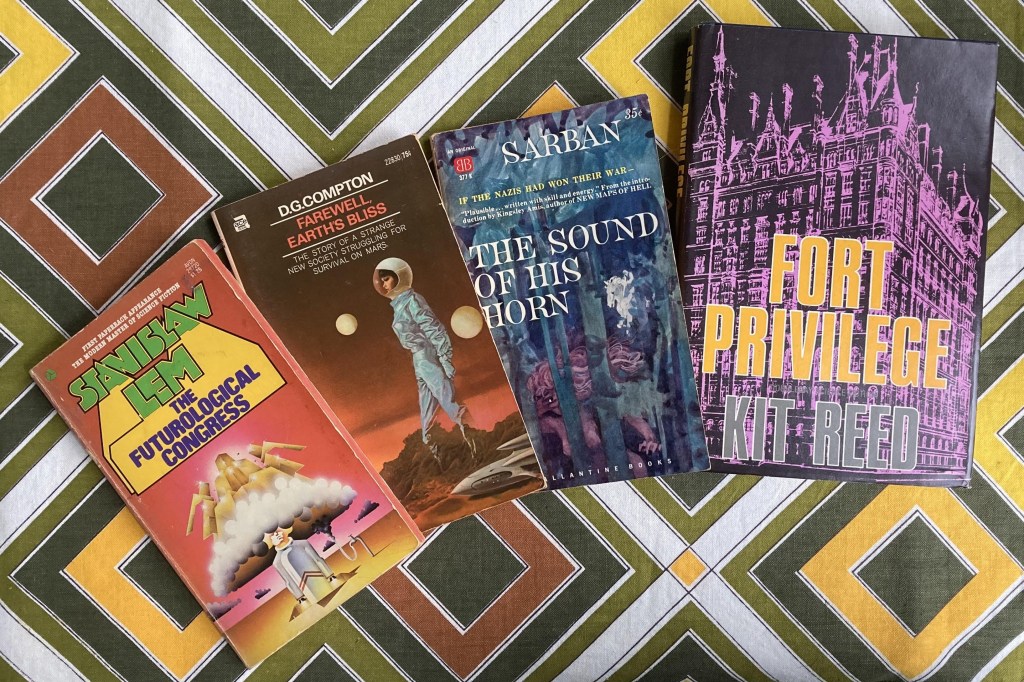
What pre-1985 science fiction are you reading or planning to read next month? Here’s the April installment of this column.

As readers of the site know, I am obsessed with the machinations of Cold War nuclear logic—historical and science fictional. In Ira Chernus’ brilliant Apocalypse Management: Eisenhower and the Discourse of National Insecurity (2008), he dives into the Manichean ideoscape that dominated Eisenhower’s thinking. In short, he posits that Eisenhower interpreted the Soviet threat as an apocalyptic struggle in which the traditional outcome, eliminating the treat, is impossible. Instead the best hope is “to contain and manage it forever” (2)–hence “apocalypse management.” This “new linguistic paradigm” profoundly influenced their policymaking process and dominated American public discourse.

According to Chernus, Eisenhower was obsessed with Americans practicing voluntary self-control in their consumption in order shoulder the taxes needed to fund the perpetual struggle. With this paradigm, Eisenhower’s gestures towards peace–for example his “The Chance for Peace” (April 16th, 1953) speech–were acts of calibrated psychological warfare designed to put the burden of action on the Soviets and score points with the American public and American allies. The United States, on the other hand, could wage the conflict with perpetual, safe, and managed inaction in which peace is never the ultimate objective.

Continue reading

What pre-1985 science fiction are you reading? + Update No. XV

What pre-1985 science fiction are you reading or planning to read this month? Here’s July’s installment of this column.

Last month I waxed rhapsodic about a powerful interaction with a professor in graduate school… this month I’ll show you a recent obsessive territory I’ve been reading and ruminating about: 1940s and 1950s (and a few from the 60s) social commentary on American affluence, technology, and media. It all started with my media landscapes of the future series–I could not write on the topic unless I read some Marshall McLuhan. And then I had to read about C. Wright Mills to write about Clifford D. Simak and organized labor. And then I needed to track down other popular authors of social commentary published in era. It should not be surprising so much 50s SF revolved around social commentary — it was in the air. You get the idea. This pile represents some of what I now own:

Continue reading

Adventures in Science Fiction Cover Art: Max Ernst and his landscapes of decay (on SF/F covers)

barbarians-marching-to-the-west-1937.jpg!Blog

Max Ernst’s Barbarians Marching to the West

Max Ernst (1891-1976) has long been one of my favorite artists.  I had no idea, until browsing through the Penguin SF cover images from the 60s, that his art appeared on a variety of SF/F novels and related literature/nonfiction….  Yes, I had seen the memorable cover for J. G. Ballard’s The Crystal World (1966) [below] but I had not put the two together.

My favorite is without a doubt the use of Ernst’s awe-inspiring Europe After the Rain II (1940-42) for J. G. Ballard’s collection of stories, Memories of the Space Age (1988).  The malaise generated by his landscapes of decay combined with the sheer power of Ballard’s visions evoke are almost palpable shudders of joy…

There are a handful more but I have included most of the 50s to early 80s examples.

And today, April 2nd, is Max Ernst’s birthday!  So, share, if you are so inclined, your favorite of his works of art.  And, feel free to identify any that might appear on the covers below…  Too bad more publishers don’t latch onto the joy that are his collages (do a google search and you will understand).

Enjoy!

MMRSSPCG1988

(Max Ernst, Europe After the Rain, cover for the 1988 edition of J. G. Ballard’s Memories of the Space Age, 1988) Continue reading

Adventures in Science Fiction Cover Art: Jack Gaughan’s covers for Walker & Co. (1969-1970)

At last, inspired to make a cover art post! [list of art posts]

Thanks to my frequent commentator Peter S, I followed up on his suggestion to take a peek at Jack Gaughan’s 1969 cover for the Walker & Co. edition of James White’s All Judgement Fled (1968)—and was blown away by some of the other works in his art sequence for the press.

Jack Gaughan’s covers for Walker & Co. between 1969-1970 showcase some of his more surrealist inclinations.  Beautiful, often minimalistic, evocative…  Some famous novels are graced by his covers: James Blish’s A Case of Conscience (1958), Stanislaw Lem’s Solaris (1961), Silverberg’s Nightwings (1968), Ursula Le Guin’s The Left Hand of Darkness (1969), and Norman Spinrad’s Bug Jack Barron (1969).

Titles in this art sequence without suitable images online: A Gift from Earth (1968), Re-Birth (1955), All Judgement Fled (1968), Trouble with Lichen (1960), The Midwich Cuckoos (1957).  If you have any in your collection I’d love to see them!

Many of these covers have wrap-around illustrations.  If you have one at home I’d love to see a photo of what the back looks like! (post in comments).

Thoughts? Favorites?

THWNDRRCTS1969

(1969 edition of The Wanderer (1964), Fritz Leiber) Continue reading