Updates: Recent Science Fiction Acquisitions No. CLIX (Gerrold + Reed + Lewin + Anthology of European Non-English Language SF)

Digression: I have been thinking about “best of” lists and why I seldom approach an author by reading their “best known” work first.  Caveat: I compulsively read the Hugo list as a kid and was exposed to many wonderful authors.

Reading “the acknowledged best” reinforces our notions of what is canon or not canon.  And I am all about puncturing holes in our self-perpetuating notions of canon and SF grand narratives of what is “classic” SF and what is not.  The following dialogue often plays out:

A) “Have you read the best SF novels of the 1970s?”

B) “Yes, I have, from this great top 15 novels list!”

A) “What would you say are the best novels from the 1970s?”

B) “Oh, here you go!” Regurgitates original list.

A) “Have you read other SF novels from the 1970s?”

B) “Umm.”

I am guilty of this as well!  My top 1960s novels list undergoes regular revisions.  The original list was a product of my lack of knowledge.  Regardless, it remains to this day the most popular and commented upon post on my site!  Alas!

Sometimes “the less known” novels are a way to get a feel for what an author is capable of and seeing an author through their body of work leads (at least for me) to greater appreciation for their best (which might not be the ones anointed by the majority).  Barry N. Malzberg: I read In the Enclosure (1973) before  Beyond Apollo (1972).  Doris Piserchia:  Doomtime (1981) before A Billion Days of Earth (1976). Robert Silverberg: Thorns (1967) before Downward to the Earth  (1970).  Christopher Priest:  Indoctrinaire (1970) before The Affirmation (1981).

Third, I put great value on individual exploration. It is humorous and ironic that I have run this review site for six or so years but am reluctant to immediately follow-up on the reading suggestions of others.  I am sorry frequent readers!  I devour the reviews of others for sure (see Part I and Part II for worthwhile resources).  Well-argued reviews with evidence and an understanding of the work’s time and place and reflections on interactions with/or within genre, are more likely to remain with me.  And then, when I am in the book store, I remember what others have said.

The questions I have been pondering: Do I put together a best 20 novels of the 1970s list?  When do I decide whether I have read enough?  Or, do I play the “caveat” game and state that this is bound to change (which it is as I read more)?

Post proper:  My mapping of the contours of Kit Reed’s early oeuvre continues.  Her first SF novel Armed Camps (1969) and her stories in Mister Da V. and Other Stories (1967) demonstrate a knack for humanistic exploration of characters trapped in manifestations of cyclicality—be it social constructions or the forces of history.

David Gerrold’s novels do not inspire…..  At least so far: Space Skimmer (1972) + Yesterday’s Children (variant title: Starhunt) (1972).  Which means, time for short stories!  And yes, his acknowledged best The Man  Who Folded Himself (1973) waits in the wings [From Couch to Moon’s review —> here].

Non-English language SF other than Stanislaw Lem and Arkady and Boris Strugatsky: the biggest hole in my SF knowledge.

And perhaps the find/risk of the bunch, a satirical pseudo-governmental pamphlet that generated endless debate about its authenticity.

As always, thoughts and comments are welcome.

1. With a Finger in My I, David Gerrold (1972)

wthfngrnmc1972

(Mati Klarwein’s cover for the 1972 edition) Continue reading

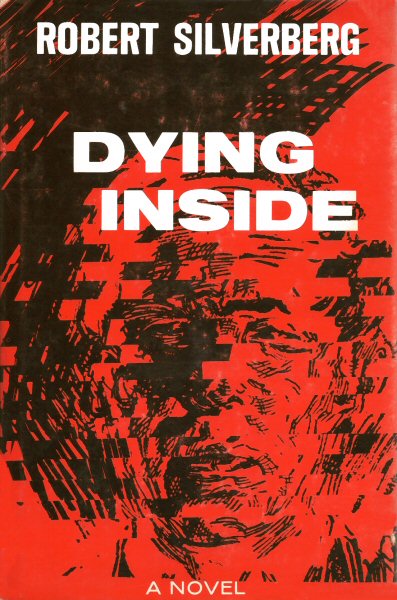
Short Book Reviews: Robert Silverberg’s Dying Inside (1972), Universe 2, ed. Terry Carr (1972), and Avram Davidson’s The Enemy of My Enemy (1966)

Here are three short reviews.  Either I waited too long to review the work or in the case of the short story collection, the handful of poor stories (amongst the many gems) faded from memory and I couldn’t convince myself to reread them…

I apologize for the brevity and lack of analysis.  My longer reviews definitely try to get at the greater morass of things but hopefully these will still whet your palate if you haven’t read the works already.

1. Dying Inside, Richard Silverberg (1972)

DYINGNSD1972

(Jerry Thorp’s cover for the 1972 ediiton)

5/5 (Masterpiece) Continue reading

Adventures in Science Fiction Cover Art: The Futuristic Cities of Lima de Freitas, Part I

Argonauta119

(Cover for the 1967 edition of vol. 1 of The Moon is a Harsh Mistress (1965), Robert A. Heinlein)

The Portuguese painter and illustrator Lima de Freitas (1927-1998) created a vast number of covers for the Portuguese press Livros do Brasil.  For more on the range of art he produced in his career consult his wikipedia page [here].

A while back I reviewed Mordecai Roshwald’s Level 7 (1959) and discovered de Freitas’ amazing cover (below).  More than any of the US editions, it evokes the claustrophobic tone of the novel (and even some of the surreal elements).

As the son of two architects, architecturally inclined SF covers always fascinate. Thus, as an introduction to his art (if you do not know it already) I have collected a handful of his cityscapes.  They are surreal masterpieces.  Lima de Freitas’ covers emphasize the city as a canvas, the textures of human Continue reading

Updates: Recent Science Fiction Acquisitions No. CLVII (Sturgeon + Sheckley + Scortia + Mannes)

I can’t pass up a Sheckley collection!

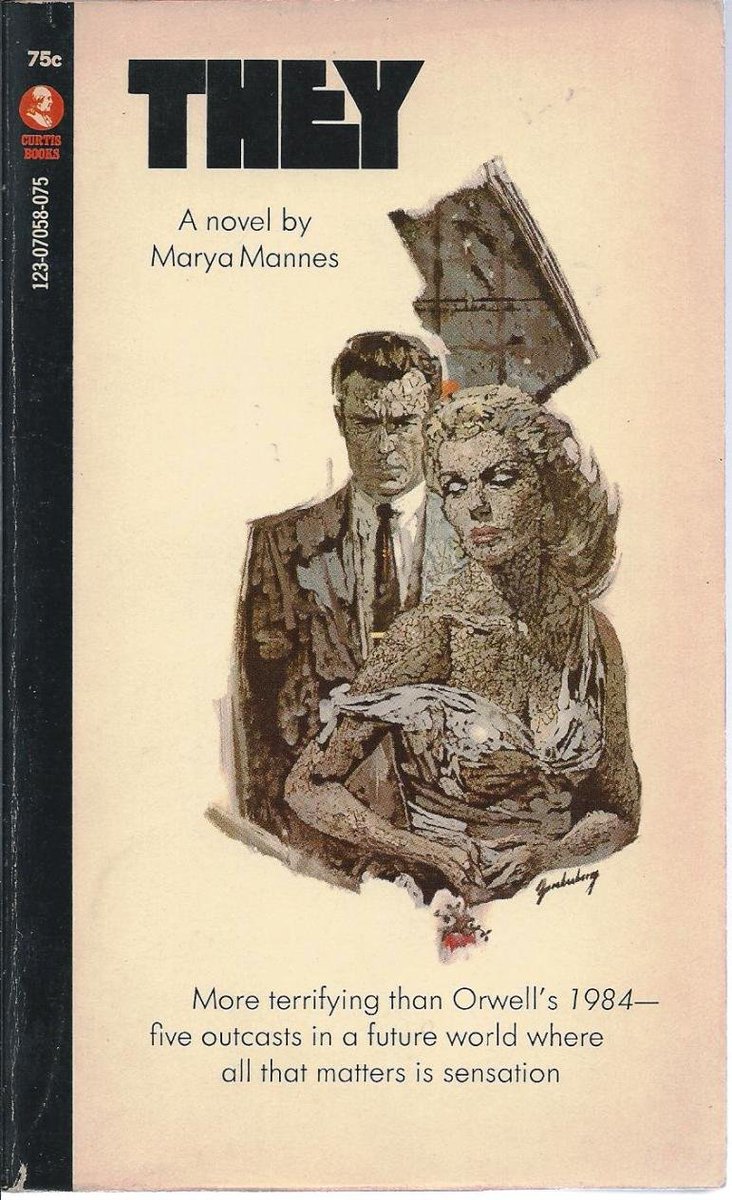
Nor can I pass up a rather unknown “discovered manuscript” type 1960s feminist dystopia by Marya Mannes.  She wrote for Vogue and The New Yorker over her career….

Nor can I pass up a Sturgeon collection (perhaps I will appreciate his more radical SF short stories?)….

And finally, a best of collection by an author who might not be worth exploring, but, sometimes short stories give a better impression of an author’s capabilities than a novel-length work.

As always, thoughts/observations/comments are welcome!

1. They, Marya Mannes (1968)

they

(Stanley Zuckerberg’s cover for the 1970 edition) Continue reading

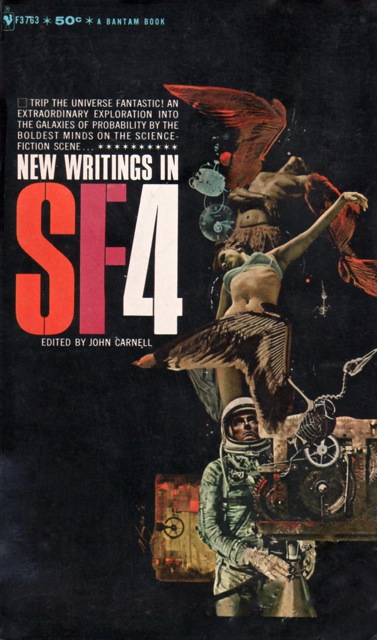
Book Review: New Writings in SF 4, ed. John Carnell (1965) (Asimov + Roberts + Tenn + Kapp + Etchison + Morgan)

NWWRTNGSNF1968

(Robert Foster’s stunning cover for the 1968 edition)

2.75/5 (Collated rating: Vaguely Average)

Despite the presence of one of Robert Foster’s best covers (for more on his art: Part I, Part II), New Writings in SF 4, ed. John Carnell (1965) contains only a few glimmers of brilliance—concentrated in Keith Roberts’ short story “Sub-Lim” (1965), a dark tale of crooked people and subliminal stimuli.  Isaac Asimov regurgitates something about a SF heist he scribbled on a napkin, Dan Morgan mumbles about alternate universes and tricycles, and Colin Kapp lectures on the “unusual methods of cementation of electrolysis” (54) instead of telling a Continue reading

Updates: Recent Science Fiction Acquisitions No. CLVI (Budrys + New Writings in SF Anthologies)

Another batch of volumes from the mysterious person with the initials KWG who ditched their entire collection at the local Half Price Books.

I have rarely seen the New Writings in SF series edited by John Carnell on used bookstore shelves.  But, as I am a fan of discovering new authors who might not have collected volumes of short stories, it pretty easy to justify snatching them up….  A while back I featured the covers of David Mccall Johnson, and now I have my first physical copy with his art!

More Algis Budrys…  Is it my need to read the major “classics” so I can “rewrite” the canon?  Certainly not out of any love for his SF (or criticism for that matter) —> see my review of The Falling Torch (1959) and my short review of Michaelmas (1976).  I will probably read his short story collection I recently acquired before another one of his novels.

As always, thoughts and comments are welcome/appreciated.

Enjoy!

1. Rogue Moon, Algis Budrys (1960)

ROGMON1960

(Richard Powers’ cover for the 1960 edition) Continue reading

Book Review: The Long Loud Silence, Wilson Tucker (1952, revised 1969)

LNGLDS1952

(Richard Powers’ cover for the 1953 edition)

4.25/5 (Very Good)

Preliminary Note: I read the 1969 Lancer edition which was “specially revised and updated by the author.”  Other than many overt references to the Vietnam War which chronologically could not have been in the original 1952 edition, I am uncertain how much was subtracted, added, or re-conceived.  John Clute at SF Encyclopedia indicates that “early editions” deleted references to cannibalism.  Perhaps he means the pre-1969 editions as it is horrifyingly present in this edition.  I wish I read the first edition as comparisons to his contemporaries would be easier to make.  Anyone who has read both versions or knows of a resource which lays out the modifications, please let me know.  The idea of updating a radical 50s novel for a late 60s audience intrigues me!

The Long Loud Silence (1952, revised 1969) is a quiet novel that depends on the emotional impact of loneliness and trauma,  and the desire for intrahuman connection Continue reading

Updates: Recent Science Fiction Acquisitions No. CLV (Herbert + Tucker + Saberhagen + England Swings SF anthology)

A person with the initials K.W.G ditched their entire SF collection at my local Half Price Books.  So many books that the store made a new SF anthology section that did not exist a few months ago and the “vintage” SF books made up more than half the non-vintage SF section.  I spent too much money.  One of many future SF Acquisitions posts featuring books from the mysterious K. W. G….

A famous anthology important for showcasing UK authors in America!  I’ve included the lengthy description of the collection by Ace and their position vis-à-vis New Wave SF.  I find it humorous that the publisher has to defend their position!

An often praised 1950s post-apocalyptical novel by Wilson Tucker….  My 1969 edition was “rewritten” by the author–unfortunately, I have already started reading it (not sure how much it will tell me about  its position in 1950s SF if it were rewritten in the 60s).  Perhaps someone knows how much was changed?  Admiral Ironbombs wrote a worthwhile review here.

Fred Saberhagen’s best known work.

And one of the few Frank Herbert novels I have not read…

Thoughts and comments are always welcome.

1. England Swings SF: Stories of Speculative Fiction, ed. Judith Merril (1968)

NGLNDSWNGS1970

(Ron Walotsky’s cover for the 1970 edition) Continue reading

Book Review: The Eclipse of Dawn, Gordon Eklund (1971)

THCLPSFDWN1971

(Diane and Leo Dillon’s cover for the 1971 edition)

3.25/5 (Vaguely Good)

“I hadn’t even voted in the last election.  I knew nothing about it, except Robert Colonby, how he wanted to make America strong again, how he said we ought to exert ourselves” (15).

Gordon Eklund’s first novel Eclipse of Dawn (1971) tells of a future dystopic America (the year 1988) chaffing under foreign quarantine and suffering from a major race war which results in African-Americans creating an autonomous political entity in the American South.  The effects of limited nuclear war spawns a poisonous urban environment and microclimates across the state of California. A return to “Victorian morality” presents but a facade of “purity laid across a morass of fear and guilt” (94).

Robert F. Colonby sets out from his residence amidst the bombed-out remains of Disneyland, where he dines on exotic cuts of meat and “wines dated back to the glory days” Continue reading