Updates: Recent Science Fiction Purchases No. CCCXXXIX (Frank Herbert, Alan E. Nourse, Ann Maxwell, Craig Harrison)

Which books/covers/authors in the post intrigue you? Which have you read? Disliked? Enjoyed?

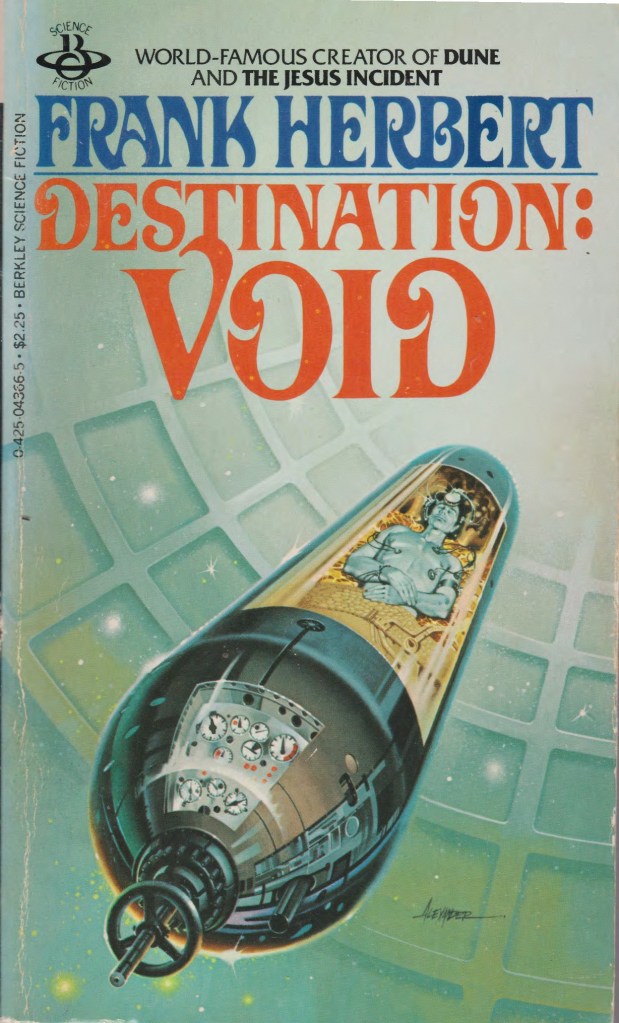
1. Frank Herbert’s Destination: Void (1966, rev. 1978)

From the back cover: “DESTINATION: VOID

THE COMPLETELY REVISED AUTHOR’S EDITION OF THE CLASSIC DEEP-SPACE ADVENTURE!

‘When the publishers announced that they were going to bring out a new edition of DESTINATION: VOID, they offered me the opportunity to make any changes I felt were necessary. Because of the tightly interwoven scientific premises behind this story and rapid development in the fields related to these premises, it would be extraordinary if discoveries across thirteen years did not dictate certain revisions.

Continue reading

Short Story Reviews: Clifford D. Simak’s “City” (1944), “Ogre” (1944), and “Spaceship in a Flask” (1941)

I’ve finally completed my article for Journey Planet on depictions of organized labor in the 40s and 50s science fiction of Clifford D. Simak. I plan on adding to it over the next few months as I read more. After it appears for Journey, I’ll post it on my site in whatever version is current. The project lead me to read a vast range of Simak short fictions, a small slice of which I’ve reviewed on my site, including the first two stories revised for his iconic masterpiece City (1952). I’ll cover “Huddling Place” (1944) soon as well.

Enjoy!


4.25/5 (Very Good)

“City” first appeared in Astounding Science Fiction, ed. John Campbell, Jr. (May 1944). You can read it online here.

This is a good one! I read the 1952 novelized version of the City stories in my late teens. At the time, logically, I was fascinated by the sentient dogs and the slow apocalypse of humanity that unfolds across the generations. For whatever reason, the earliest stories without dogs, for example “City” (1944) and “Huddling Place” (1944), faded from the culminative aura the novel generated all these years later. This project compelled me to break my deep-seated compulsion to read what I haven’t read before.

Continue reading

Generation Ship Short Story Review: Fred Saberhagen’s “Birthdays” (1976)

This is the 19th post in my series of vintage generation ship short fiction reviews. I am not entirely sure Fred Saberhagen’s vision exactly fits the definition of a generation ship but it’s so fascinating that I had to share it with you all!

As a reminder for anyone stopping by, all of the stories I’ll review in the series are available online via the link below in the review. And, if you want to work through the reviews from the series from the beginning, here’s my first post from 2019 on Chad Oliver’s “The Wind Blows Free” (1957).

You are welcome to read and discuss along with me as I explore humanity’s visions of generational voyage. And thanks go out to all who have joined already. I also have compiled an extensive index of generation ship SF if you wish to track down my earlier reviews on the topic and any that you might want to read on your own.

Previously: Barrington J. Bayley’s “Exit from City 5” (1971).

Next Up: Poul Anderson’s “The Troublemakers” (1953)

4.25/5 (Very Good)

Continue reading

What pre-1985 science fiction are you reading? + Update No. XI

What pre-1985 science fiction are you reading or planning to read this month. Here’s March’s installment of this column.

Before we get to books and birthdays and writing plans…

Continue reading

Updates: Recent Science Fiction Purchases No. CCCXXXII (Vernor Vinge, Brian Stableford, Joan Cox, and Pierre Boulle)

Which books/covers/authors in the post intrigue you? Which have you read? Disliked? Enjoyed?

1. The Witling, Vernor Vinge (1976)

From the back cover: “Witling: A pretender to wit. (Webster’s Dictionary)

In the eyes of the inhabitants of Giri the scientific explorers from outer space were witlings. In the context of that primitive-seeming planet, they were.

Because on Giri a peculiarity of evolution had given a special talent to all living things–and this talent had made unnecessary most of the inventions associated with intelligent life elsewhere. Roads and planes, engines and doors… these were the products of witlings, not of ‘normal’ people.

So when the little band from Earth’s exploration team fell into Giri hands, their problem was unprecedented. How to demonstrate that science is worthwhile and how to keep the medieval masters of Giri from realizing their potential for cosmic mischief.”

Continue reading

Book Review: Clash by Night and Other Stories, Henry Kuttner and C. L. Moore (1980)

3.5/5 (collated rating: Good)

From 1937 to 1958, the dynamic writing duo of Henry Kuttner (1915-1958) and his wife C. L. Moore (1911-1987) wrote countless stories together. As SF Encyclopedia puts it, “much of [Kuttner’s] later work is inextricably entwined” with that of Moore–often to the point of being unable to entangle who wrote what. While the cover of Clash by Night and Other Stories (1980) does not mention Moore, all the stories in the collection were co-written with her.1

Continue reading

Book Review: The Squares of the City, John Brunner (1965)

4/5 (Good)

Nominated for the 1966 Hugo Award for Best Novel

John Brunner’s The Squares of the City (1965) transposes the moves of a 1892 chess game between Wilhelm Steinitz (1836-1900) and Mikhail Chigorin (1850-1905) onto a near future landscape of political intrigue. Inspired by Brazil’s planned capital Brasília (founded in 1960), the action takes place in Ciudad de Vados, the capital city of the imaginary Latin American nation of Aguazul.1 Conjured out of a “barren, rocky stretch of land,” Ciudad de Vados contains all the homogenized trappings of an ultra-modern metropolis (170). It’s sterile. Planned. Mechanized. Quickly the monumental urban regularity fades into the background and the intricate game across its squares takes over.

Continue reading

What pre-1985 science fiction are you reading? + Update No. IX

What pre-1985 science fiction are you reading or planning to read this month? Here’s January’s installment of this column.

When I’m not reading science fiction, I’m more often than not devouring history that touches on my decades of focus: 1945-1985. Recently that’s meant lots and lots of monographs on Cold War culture: from fallout shelters, suburbia, to analysis of the drama of morality and terror that characterized nuclear deterrence. And in Guy Oakes’ transfixing The Imaginary War: Civil Defense and American Cold War Culture (1994), I came across a fascinating collision of science fictional thought and public policy.

A few months into Dwight D. Eisenhower’s presidency, the Public Affairs Office of the Federal Civil Defense Administration released a short pamphlet that analyzed the “relation between national will and nuclear terror” under the ridiculous title “Civil Defense Implications of the Psychological Impact and Morale Effect of Attacks on the People of the United States” (April 1953). In this pamphlet, the authors imagine the effects of nuclear war. They suggest that some survivors would “isolate themselves from the terrifying consequences of nuclear war by effecting a pseudo-escape into an interior psychological reality.” I thought immediately of Richard Matheson’s brilliant “Pattern for Survival” (1955), in which a SF author reenacts the process of writing and publishing a story to escape the reality in which he lives. The pamphleteers further imagine a political reality dominated by “mystical sects and cults, enthralled by the vision of an immeasurably happier future in an inner fantasy life of an extramundane kingdom of bliss that transcended the brutal empirical reality of nuclear destruction” (41). Early Cold War policy makers and consultants as science fiction authors!

50s paranoid future visions aside, let’s turn to the books in the photo and what I’ve been reading and writing about.

Continue reading

Book Review: The Killer Thing, Kate Wilhelm (1967)

4/5 (Good)

On the last page of the March 1968 issue of The Magazine of Fantasy and Science Fiction, readers encountered an anti-Vietnam War petition, signed by science fiction authors, and organized by Kate Wilhelm and Judith Merril [1]. Both organizers incorrectly assumed that 95 percent of the field would sign due to the “global and anti-racist view” they believed guided SF [2]. Yet, on page 44 of the same issue, a pro-war petition organized by Robert Heinlein and Jack Williamson appeared with slightly less signatories. The June 1968 issue of Galaxy placed both lists next to each other for added effect.

Much ink has been spilt on the division lines between New Wave and Old Guard demonstrated by the two opposing advertisements [3] and in analysis of the canonical anti-Vietnam War science fiction novels, such as Joe Haldeman’s The Forever War (1975), partially compiled from stories that appeared as early as 1973, and Ursula K. Le Guin’s The Word for World is Forest (1972), written in 1968. Far less attention has been given to the Vietnam-inspired fiction of Kate Wilhelm, one of the organizers of the petition. Only her short story “The Village” (1973) receives occasional mention–it transposes a My Lai-esque massacre to the US. Little attention has been given to her third novel The Killer Thing (1967), written at a far earlier stage of the conflict [4].

Continue reading