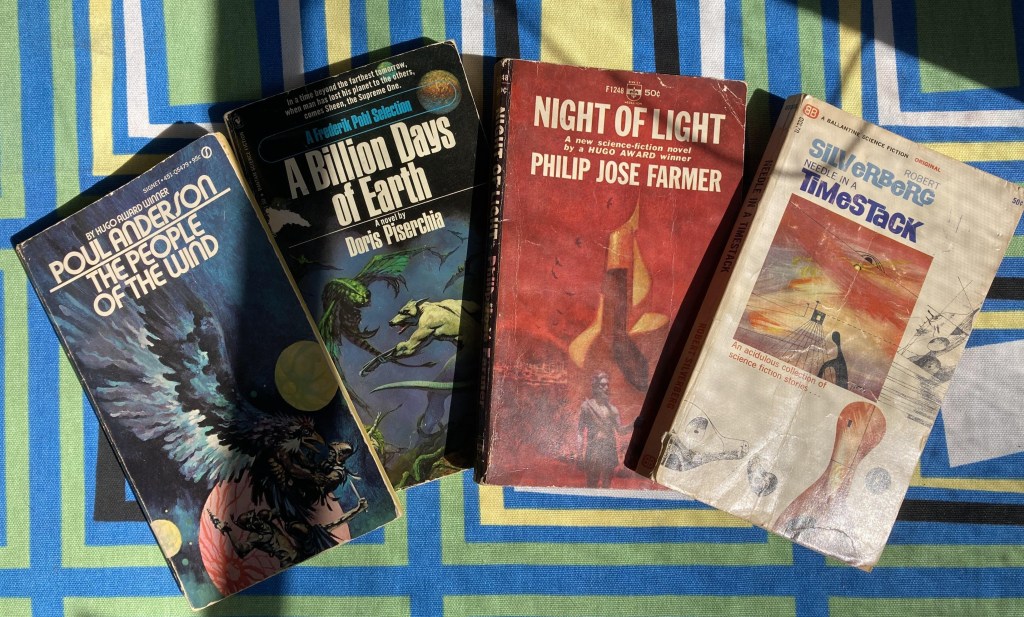
What pre-1985 science fiction are you reading or planning to read next month? Here’s the July installment of this column.
One of my favorite forms of SF scholarship is careful identification of a intellectual genealogy–tracing what an author read and engaged in dialogue with. Authors are readers. They also can’t escape references and textual traces of what they’ve consumed (or, of course, engagement with the world in which they lived).
I’ve read two interesting examples recently. The first, Carol McGuirk’s “J. G. Ballard and American Science Fiction” in Science Fiction Studies, vol. 49 (2022), is the perfect example of this type of scholarship. She traces Ballard’s engagement with SF, his earliest stories, and the various parallels an interactions between his work and American SF that he read (Galaxy Magazine, Theodore Sturgeon, Fritz Leiber, Robert Heinlein, Frederik Pohl, C. M. Kornbluth, Ray Bradbury, Judith Merril, Federic Brown, Henry Kuttner, C. L. Moore, etc.). She argues that Ballard engaged in “retelling with a twist” (476). She writes that “early Ballard stories rework prior sf in moods ranging from measured homage to barbed repose to parodic photo-bomb” (483).
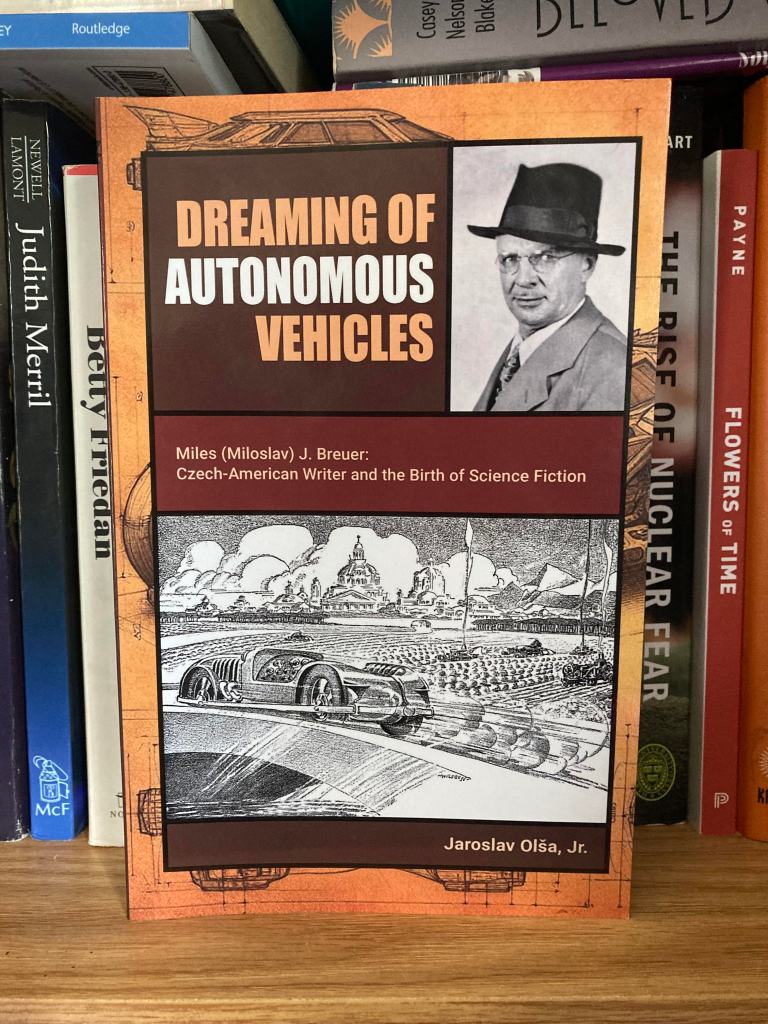
Over the last few years, I have incorporated a smattering of the vast range of spectacular scholarship on science fiction into my reviews and highlighted works with my Exploration Log series that intrigue me.1 Today I have an interview with Jaroslav Olša, Jr. about his brand-new book, Dreaming of Autonomous Vehicles: Miles (Miroslav) J. Breuer: Czech-American Writer and the Birth of Science Fiction (2025). In the book, he covers the life and career of Miles (Miroslav) J. Breuer (1889-1945), the first SF author to regularly write original stories for Hugo Gernsback’s Amazing. Breuer’s career also provides a fascinating window into the literary and cultural world of immigrants in late 19th and early 20th century America.
You can buy an inexpensive physical copy ($15.80 at last look) directly from Space Cowboy Books here (preferred) and on Amazon.
Thank you so much for agreeing to this interview. First, can you introduce yourself and your interests in science fiction?
Since childhood, I have loved reading science fiction, but — except for a short time — I have not been professionally attached to it. After studying Asian and African Studies and social sciences in Prague, Tunis and Amsterdam, I joined the Czech diplomatic three decades ago, and have served in various positions including Director of the African Dept. and the Head of the Policy Planning Dept. at the Czech Ministry of Foreign Affairs. I also served as a Czech Ambassador three times: to Zimbabwe for six years, to South Korea for another six years, and to the Philippines for four years. Since December 2020, I have served as Czech Consul General in Los Angeles in charge of the US West.
In the early 1980s, I became a part of a small but very active fandom when—in the then communist Czechoslovakia—the first science fiction club emerged. I started the SF fanzine Ikarie XB, which in 1990 turned into the first Czech-language professional SF magazine Ikarie, with monthly editions until 2024.
I have also translated many short stories and edited numerous SF anthologies, but never wrote fiction. But since the very beginning, the center of my interest in SF was to write about science fiction. I co-edited and authored entries in the only Czech SF encyclopedia, published in 1995. Thus my book about Miles (aka Miloslav) J. Breuer is somewhat of a culmination of my work on science fiction.
What drew you to the science fiction of Miles (Miloslav) J. Breuer (1889-1945)?
In the past few years, I’ve put together a series on the first three published short fictions by female authors who are completely new to me or whose most famous SF novels fall mostly outside the post-WWII to mid-1980s focus of my reading adventures. To be clear, I do not expect transformative or brilliant things from first stories. Rather, it’s a way to get a sense of subject matter and concerns that first motivated authors to put pen to paper.
Today I’ve selected the first three science fiction short stories by New Zealander author Cherry Wilder (1930-2002). Here’s her bibliography. In the past I’ve picked up her best-known novel Second Nature (1982) and gazed at the evocative Tony Roberts cover! But never managed to get past the first few pages… According to SF Encyclopedia, Wilder’s work is “notable for its narrative skill, evocative style and rounded characterization, should have long since given her a higher reputation.” My general sense from her first three stories is that they’re relatively well-told, traditional, and a bit on the slight side of things. I still look forward to reading Second Nature (1982).
Back in July 2024, I posted six interviews with Clifford D. Simak (1904-1988). Since then I’ve tracked down three more. As in that post, I’ll provide a rundown of each interview and provide quotes of interesting passages. In the interviews, Simak comes across as an author deeply suspicious of rigorous generic distinctions, passionate about all life, and open to science fiction as an ever-changing and evolving entity.
Enjoy! And if you know of more interviews (or are able to update the Internet Speculative Fiction Database entry as it only includes five of the nine interviews I’ve covered) let me know.
Sherwood Anderson (1876-1941) confides in the introduction to his travel memoir Puzzled America (1935) that the Great Depression was inescapable: “I was a writer of tales. It might be that I should have remained just that, but there is difficulty. There are, everywhere in America, these people now out of work. There are women and children hungry and others without enough clothes.”1 Edgar Albion Lyons, in the author’s note to his science fiction novel The Chosen Race: A Novel Based on the Depression and Machine Age (1936), echoes this sentiment: “The following chapters were written during the months of 1932 when the words ‘Depression’ and ‘Unemployment’ were on everyone’s lips.”2 Magazine science fiction, with its eye towards the marvelous technological future, likewise could not escape contemporary economic, political, and societal convulsions.3 Science, “in the form of a hypothesized device or theory,” enabled exciting adventures but also the exploration of “diverse and dire social implications.”4
On May 9th, 1934, a massive two-day dust storm caused by severe drought and human-made factors, removed massive amounts of Great Plains topsoil. The Dust Bowl unleashed its fury. The dust clouds reached Chicago and cities in the east, blotted out the Statue of Liberty and the United States Capitol. Red snow fell in New England.5 In the September 1934 issue of Astounding, a twenty-year-old Frank K. Kelly published “Famine on Mars” (1934) about a desperate attempt to assist Martians dying of thirst and starvation after a drought. In Kelly’s vision, The Combine, Earth’s government, deliberately caused the genocide and refuses to provide assistance.6
M. Marchioni’s interior art for “Famine on Mars” (1934)
What pre-1985 science fiction are you reading or planning to read this month? Here’s the January installment of this column (sorry I missed a month).
Before John W. Campbell, Jr. (1910-1971) attempted to raise the “standards and thinking in magazine SF,” David Lasser (1902-1996) attempted his own brief (1929-1933) program to improve science fiction as managing editor of Hugo Gernsback’s Science Wonder Stories, Wonder Stories, and Wonder Stories Quarterly. According to Mike Ashley’s The Time Machine: The Story of the Science-Fiction Pulp Magazine from the Beginning to 1950 (2000), Lasser is a “much neglected revolutionary in science fiction” and through his efforts the genre “started to mature” (66).
Ashley highlights Lasser’s letter of instruction mailed to his regular contributors on the 11th of May, 1931, in which he “exhorted them to bring some realism to their fiction” (72). He also outlawed common tropes like the giant insect story and space opera (73). He emphasized the need to focus on characters that “should really be human” — not everything needs to be a “world-sweeping epic” (73). Stories in this vein, according to Ashley, include Clifford D. Simak’s religiously themed “The Voice in the Void” (1932), P. Schuyler Miller and Walter Dennis’ “The Red Spot on Jupiter” (1931) and “The Duel on the Asteroid” (1934), which featured a grim realism and character development (74).
In the past few years, I’ve put together a series on the first three published short fictions by female authors who are completely new to me or whose most famous SF novels fall mostly outside the post-WWII to mid-1980s focus of my reading adventures.
Today I’ve selected the first four stories by an author I’ve only recently started to read–Leigh Kennedy (1951-). I’d previously reviewed “Helen, Whose Face Launched Twenty-Eight Conestoga Hovercraft” (1982) and placed her on the list for this series. According to SF Encyclopedia, Kennedy’s “writing is succinct, polished, lucent, and her stories are emotionally penetrating; it is unfortunate that she has fallen from the world of novel publishing, though continuing to work as a professional indexer.” And I can’t agree more! Her first four stories show great promise and moments of refined vision. I can’t help but think the backlash to her Nebula-nominated (and best-known work) “Her Furry Face” (1983) might have had some effect on her trajectory.
Which books/covers/authors in the post intrigue you? Which have you read? Disliked? Enjoyed?
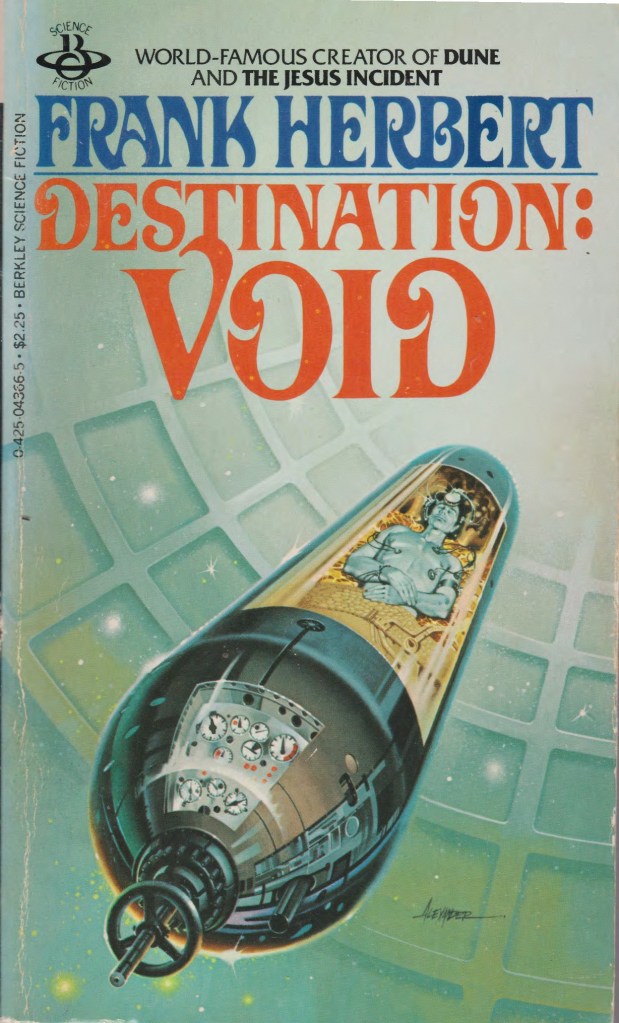
1. Frank Herbert’s Destination: Void (1966, rev. 1978)
Paul Alexander’s cover for the 1978 edition
From the back cover: “DESTINATION: VOID
THE COMPLETELY REVISED AUTHOR’S EDITION OF THE CLASSIC DEEP-SPACE ADVENTURE!
‘When the publishers announced that they were going to bring out a new edition of DESTINATION: VOID, they offered me the opportunity to make any changes I felt were necessary. Because of the tightly interwoven scientific premises behind this story and rapid development in the fields related to these premises, it would be extraordinary if discoveries across thirteen years did not dictate certain revisions.
I’ve finally completed my article for Journey Planet on depictions of organized labor in the 40s and 50s science fiction of Clifford D. Simak. I plan on adding to it over the next few months as I read more. After it appears for Journey, I’ll post it on my site in whatever version is current. The project lead me to read a vast range of Simak short fictions, a small slice of which I’ve reviewed on my site, including the first two stories revised for his iconic masterpiece City (1952). I’ll cover “Huddling Place” (1944) soon as well.
Enjoy!
William Timmins’ cover for Astounding Science Fiction, ed. John Campbell, Jr. (May 1944)
4.25/5 (Very Good)
“City” first appeared in Astounding Science Fiction, ed. John Campbell, Jr. (May 1944). You can read it online here.
This is a good one! I read the 1952 novelized version of the City stories in my late teens. At the time, logically, I was fascinated by the sentient dogs and the slow apocalypse of humanity that unfolds across the generations. For whatever reason, the earliest stories without dogs, for example “City” (1944) and “Huddling Place” (1944), faded from the culminative aura the novel generated all these years later. This project compelled me to break my deep-seated compulsion to read what I haven’t read before.