Guest Post: A Little Knowledge, Michael Bishop (1977)

(Dean Ellis’ cover for the 1978 edition)

The sixth installment of my The Science Fiction of Michael Bishop guest post series was graciously provided by Heloise over at Heloise Merlin’s Weblog.  She is a long time fan of Michael Bishop’s work and we have engaged in numerous (fruitful) discussions of his work—including whether or not the first version of A Funeral for the Eyes of Fire (1975) is superior to his complete rewrite Eyes of Fire (1980).

Heloise purposefully chose one of Bishop’s lesser known novels.  But, from the review, A Little Knowledge (1977) has been wrongly ignored: “even though [A Little Knowledge] never leaves this single place on Earth, in the end Bishop’s novel manages to give more of a sense of what it means for humans to live in a vast, largely unexplored universe than most novels that are filled with large spaceships and far-future technologies.”

I plan acquiring a copy ASAP.

Visit Heloise’s site! Enjoy!  Comment!

michael bishop,header,02

A Little Knowledge (1977)—Michael Bishop

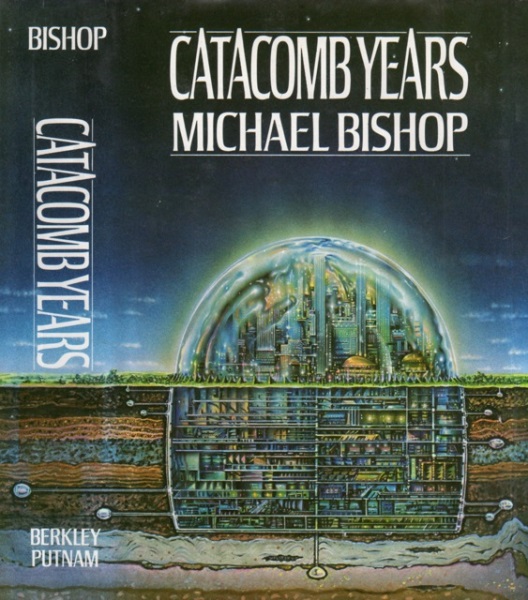
Michael Bishop’s Urban Nucleus sequence (consisting of the novel A Little Knowledge and the stories collected in Catacomb Years) is unusual among his early works in that it is not an anthropological Science Fiction novel; unlike books like A Funeral for the Eyes of Fire or And Strange at Ecteban the Trees, while reading A Little Knowledge, one is not so much reminded of Ursula K. LeGuin but it rather seems influenced by Philip K. Dick – and not by his largely consensual novels like Ubik or The Man in the High Castle, but his Continue reading

Guest Post: Brighten to Incandescence (selections), Michael Bishop (2003)

(Jamie Bishop’s cover for the 2003 edition)

The fourth installment of my The Science Fiction of Michael Bishop guest post series was written by MPorcius (twitter: @hankbukowsi) at MPorcius Fiction Log—a valued and longtime commentator on my site.  I have procured quite a few books due to his quality reviews which I highly recommend perusing.  Check out his site (especially if you like classic SF)!

Over the course of this series we moved from Michael Bishop’s most well known novella (“Death and Designation Among the Asadi“) to his novels (Brittle Innings, No Enemy but Time) and now to an intriguing collection of lesser known short SF and non-genre stories.

MPorcius decided to only focus on the SF in Brighten to Incandescence but points out that all the stories in the collection are worth reading!

Enjoy!

~~~

michael bishop,header,02

Brighten to Incandescence (2003) — Michael Bishop

Brighten to Incandescence, published by Golden Gryphon Press in 2003, is Michael Bishop’s seventh collection of stories. In the final chapter of the book, a series of notes on the stories, Bishop explains that he and the people at Golden Gryphon initially were thinking of putting out a Best Of volume, then decided to publish a collection of previously uncollected pieces instead. What we have in Brighten to Incandescence, then, are 17 stories, many of which were passed over for inclusion in previous collections for years or even decades; these stories probably do not represent Bishop’s best or most salable work.

Happily, the stories are all worth Continue reading

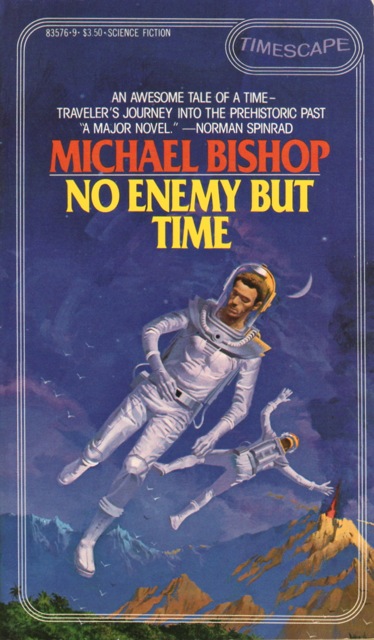
Guest Post: No Enemy But Time, Michael Bishop (1982)

NENMYTM1983

(Vincent Di Fate’s cover for the 1983 edition)

The third installment of my Guest Post Series on Michael Bishop’s SF was written by Megan (twitter: @couchtomoon) over at the relatively new but completely worthwhile SF review site From Couch to the Moon.  She’s already put together a substantial list of delightful reviews.  Megan selected Bishop’s single most famous and Nebula award-winning novel, No Enemy But Time (1982)—and sadly, one of few books of his still in print.  Along with Transfigurations (1979), it was republished and selected for the Gollancz Masterwork [list].

michael bishop,header,02

No Enemy But Time (1982) — Michael Bishop

Coming out of Bishop’s 1982 Nebula award winning novel, No Enemy But Time, is like coming out of a time travel trance: the experience is jarring, hazy, and unwelcome. Bishop sweeps the reader into his world—humanity’s distant past—and paints a primitive African landscape dappled with hippos, hyenas, and volcanoes, but lush Continue reading

Guest Post: “Death and Designation Among the Asadi,” Michael Bishop (1973)

michael bishop,header,02

The first installment in my Guest Post Series on The Science Fiction of Michael Bishop was written by Jesse over at the remarkable SF review site Speculiction… Not only is he incredibly prolific (and has a large back catalog of reviews to browse) but his reviews are also a joy to read.  If you are interested in both classic and contemporary SF, and the occasional post on Chinese poetry, make sure to check out his site.

Jesse has previously posted on his site about Bishop’s  “The Samurai in the Willows” (1976) and “Cri de Coeur” (1994).  Both reviews are worth reading.  

“Death and Designation Among the Asadi” (1973) is one of Michael Bishop’s more well known novellas that was nominated for both the Hugo and Nebula in 1974.  It was first published in the magazine Worlds of If January-February 1973, ed. Ejler Jakobsson.  If you are interested in finding a copy the story can be found in multiple later collections and forms the first part of his novel Transfigurations (1979) [listing here].

Enjoy!

~

“Death and Designation Among the Asadi,” Michael Bishop (1973)

The alien is perhaps the most recognized, if not the most used trope of Continue reading

Update: Guest Post Series Announcement, The Science Fiction of Michael Bishop

michael bishop,header,02

Collage of Bishop’s SF covers created by my father

“[Michael Bishop’s] early stories and novels display considerable intellectual complexity, and do not shirk the downbeat implications of their anthropological treatment of aliens and alienating milieux” — John Clute, SF Encyclopedia

Michael Bishop (b. 1945) [official website] is no stranger to critical success for both his novels and short SF: he has won the Nebula Award twice (“The Quickening” and No Enemy But Time) and picked up nine Hugo nominations and an additional thirteen Nebula Nominations.  Two of his more famous novels, No Enemy But Time (1982) and Transfigurations (1979), were selected for inclusion and republication in the Gollancz Masterwork List. Although Bishop has not published a novel since the Hugo-nominated Brittle Innings in 1994, he received a Nebula nomination for his novelette “Vinegar Peace, or, The Wrong-Way Used-Adult Orphanage” (2008) as recently as 2010!

With this in mind it is surprising that his extraordinary talent is not better known within the SF community.  John Clute in his article for SF Encyclopedia argues that “the earnest ardour and rigorousness of Bishop’s fiction has made Continue reading

Book Review: The Dream Master, Roger Zelazny (1966)

THDRMMSTR1966

(Kelly Freas’ cover for the 1966 edition)

4/5 (Good)

Roger Zelazny’s The Dream Master (1966)—expanded from the Nebula Award winning novella “He Who Shapes” (1965)—revolves around the Freudian notion of the centrality of dreams and importance of decoding dreams for psychoanalytical treatment.  Susan Parman, in Dream and Culture (1990), points out that Freud was initially focused on “treating ‘abnormal’ patients” but soon “expanded his theory of psychoanalysis to explain puzzling events in ‘normal’ behavior” including dreams.  Freud’s influential work The Interpretation of Dreams (1899) argued that the “dream expresses the secret wishes of the soul” where the dreamscape is the “arena” in which good and bad forces are engaged in a struggle.  Thus, the dream is a message that must be deciphered by an “allegorical Continue reading

Updates: Recent Acquisitions No. CI (Clarke + Bishop + Varley + Maclennan)

A nice range of SF authors/works!  A Michael Bishop collection containing many of his most famous 70s short stories for my upcoming guest post series….  And a SF juvenile written by Phyllis Maclennan with an intriguing premise (although, as always, I’m very dubious about juveniles in general).  John Varley’s famous novel Titan (1979) seems like a fascinating take on the Big Dumb Object trope. And finally a 50s adventure by the indomitable Arthur C. Clarke.

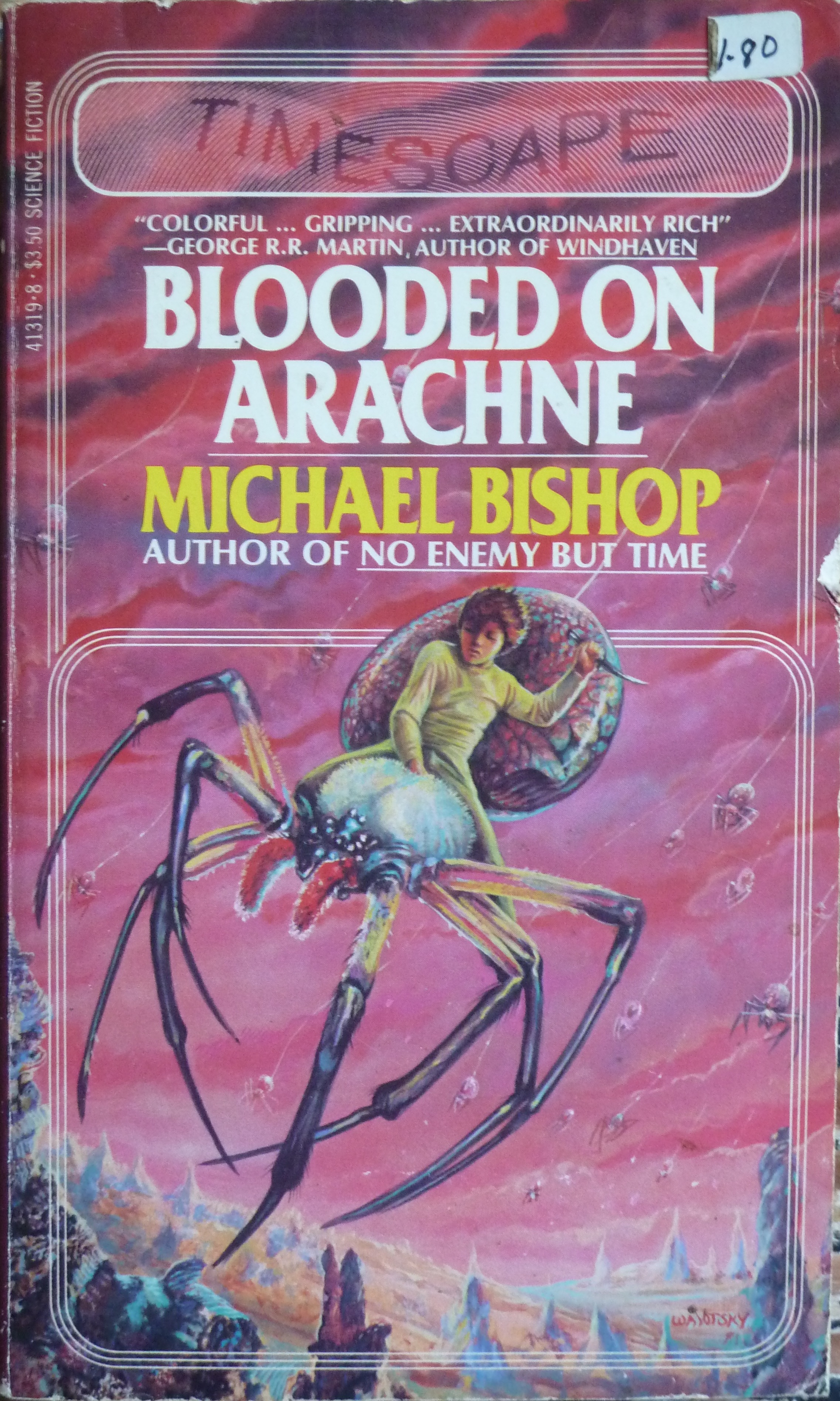
I am most intrigued by the Varley’s Titan and Bishop’s Blooded on Arachne.

Some of the covers are cringe inducing.

Thoughts?

1. Titan, John Varley (1979)

TTNRPPCRKF1979

(Ron Waltosky’s cover for the 1979 edition) Continue reading

Book Review: Juniper Time, Kate Wilhelm (1979)

(Bob Aulicino’s cover for the hideous 1979 edition)

3.5/5 (Good)

Nominated for the 1980 Nebula Award

“Everything that is, Robert had said, must be.  Every cycle must be completed, must lead to the next cycle.  He had talked about times when the desert had been drier than it now was, times when it had been lush and wet, and there had been no questions in his mind that this too must be” (170-171).

At the heart of Kate Wilhelm’s Nebula-nominated novel Juniper Time (1979) is the notion of historical cyclicality at both the macro- (earth cycles) and the micro- (human historical time) levels.  Wilhelm’s near-future mysteriously drought-stricken world is at an important juncture of two such cycles.  The macrocycle concerns devastating world-wide desertification, which is most likely caused by a natural cycle but the precise nature of which is unknown.  The microcycle concerns a shift in human populations in the drought stricken countries: mass migrations towards coasts as the springs and rivers of the hinterlands turn to mud.  In this world the farmer, in the past linked tightly to his fields, abandons his traditional position in American society and moves to a cluttered and violent state Continue reading

Book Review: The Crystal Ship (three novellas by Vonda N. McIntyre + Marta Randall + Joan D. Vinge), ed. Robert Silverberg (1976)

MLO4230

(Norman Adams’ cover for the 1977 edition)

3.25/5 (collated rating: Good)

According to a list compiled by Ian Sales [here] only a handful of SF anthologies have hit print solely featuring women authors—none were published before 1972 and, surprisingly, few after 1980 (there seems to be a resurgence in the last few years).  The Crystal Ship (1976) ed. Robert Silverberg, is one of these.  It contains the three novellas by three important SF authors who got their start in the 70s: Marta Randall, Joan D. Vinge, Vondra McIntyre.  The latter two achieved critical success: Joan D. Vinge won the Hugo for her novel The Snow Queen (1980) and Vonda N. McIntyre won the Hugo for her novel Dreamsnake (1978).  Marta Randall, on the other hand, despite her Nebula nomination for the intriguing Islands (1976) remains to this day lesser known.

All three of the novellas feature impressive female protagonists and narratives that subvert many of SF’s traditional Continue reading