Book Review: The Dream Master, Roger Zelazny (1966)

THDRMMSTR1966

(Kelly Freas’ cover for the 1966 edition)

4/5 (Good)

Roger Zelazny’s The Dream Master (1966)—expanded from the Nebula Award winning novella “He Who Shapes” (1965)—revolves around the Freudian notion of the centrality of dreams and importance of decoding dreams for psychoanalytical treatment.  Susan Parman, in Dream and Culture (1990), points out that Freud was initially focused on “treating ‘abnormal’ patients” but soon “expanded his theory of psychoanalysis to explain puzzling events in ‘normal’ behavior” including dreams.  Freud’s influential work The Interpretation of Dreams (1899) argued that the “dream expresses the secret wishes of the soul” where the dreamscape is the “arena” in which good and bad forces are engaged in a struggle.  Thus, the dream is a message that must be deciphered by an “allegorical Continue reading
Updates: Recent Acquisitions No. CI (Clarke + Bishop + Varley + Maclennan)

A nice range of SF authors/works!  A Michael Bishop collection containing many of his most famous 70s short stories for my upcoming guest post series….  And a SF juvenile written by Phyllis Maclennan with an intriguing premise (although, as always, I’m very dubious about juveniles in general).  John Varley’s famous novel Titan (1979) seems like a fascinating take on the Big Dumb Object trope. And finally a 50s adventure by the indomitable Arthur C. Clarke.

I am most intrigued by the Varley’s Titan and Bishop’s Blooded on Arachne.

Some of the covers are cringe inducing.

Thoughts?

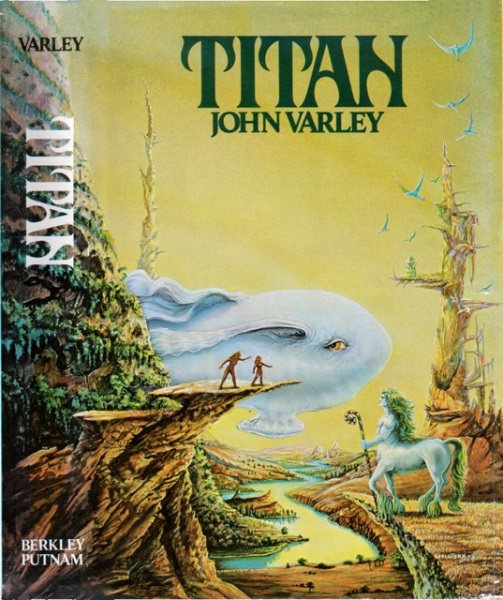
1. Titan, John Varley (1979)

TTNRPPCRKF1979

(Ron Waltosky’s cover for the 1979 edition) Continue reading

Book Review: Juniper Time, Kate Wilhelm (1979)

(Bob Aulicino’s cover for the hideous 1979 edition)

3.5/5 (Good)

Nominated for the 1980 Nebula Award

“Everything that is, Robert had said, must be.  Every cycle must be completed, must lead to the next cycle.  He had talked about times when the desert had been drier than it now was, times when it had been lush and wet, and there had been no questions in his mind that this too must be” (170-171).

At the heart of Kate Wilhelm’s Nebula-nominated novel Juniper Time (1979) is the notion of historical cyclicality at both the macro- (earth cycles) and the micro- (human historical time) levels.  Wilhelm’s near-future mysteriously drought-stricken world is at an important juncture of two such cycles.  The macrocycle concerns devastating world-wide desertification, which is most likely caused by a natural cycle but the precise nature of which is unknown.  The microcycle concerns a shift in human populations in the drought stricken countries: mass migrations towards coasts as the springs and rivers of the hinterlands turn to mud.  In this world the farmer, in the past linked tightly to his fields, abandons his traditional position in American society and moves to a cluttered and violent state Continue reading

Book Review: The Crystal Ship (three novellas by Vonda N. McIntyre + Marta Randall + Joan D. Vinge), ed. Robert Silverberg (1976)

MLO4230

(Norman Adams’ cover for the 1977 edition)

3.25/5 (collated rating: Good)

According to a list compiled by Ian Sales [here] only a handful of SF anthologies have hit print solely featuring women authors—none were published before 1972 and, surprisingly, few after 1980 (there seems to be a resurgence in the last few years).  The Crystal Ship (1976) ed. Robert Silverberg, is one of these.  It contains the three novellas by three important SF authors who got their start in the 70s: Marta Randall, Joan D. Vinge, Vondra McIntyre.  The latter two achieved critical success: Joan D. Vinge won the Hugo for her novel The Snow Queen (1980) and Vonda N. McIntyre won the Hugo for her novel Dreamsnake (1978).  Marta Randall, on the other hand, despite her Nebula nomination for the intriguing Islands (1976) remains to this day lesser known.

All three of the novellas feature impressive female protagonists and narratives that subvert many of SF’s traditional Continue reading

Updates: Recent Science Fiction Acquisitions No. C (Bishop + A. E. Van Vogt + Pangborn + Pratt)

Another Michael Bishop novel for my upcoming guest post series (announcement coming soon)!  Irresistible after the brilliant Stolen Faces (1977) and his masterpiece A Funeral for the Eyes of Fire (1975)….

The rest are fun but not high on my list of must reads.  I’ve never been a fan of A. E. Van Vogt (could not tolerate the inarticulate labyrinth of a novel The World of Null-A) but the Powers cover on The War Against the Rull (1959) was fun.

I’ve heard good things about Edgar Pangborn, although people seldom discuss West of Eden (1953), perhaps with good reason.

Fletcher Pratt’s Invaders from Rigel (1932) is one of those AMAZING covers but incredibly dubious reads.  Even the back cover is rather non-sensical.

Thoughts?

1. Transfigurations, Michael Bishop (1979) (MY REVIEW)

TRNSFGRTND1980

(Mike Hinge’s cover for the 1979 edition) Continue reading

Uncollected short story reviews: Joe Haldeman’s “Two Men and a Rock” (1973), A. G. Moran’s “Close Your Eyes and Stare at Your Memories” (1973)

My first in a new series of reviews that aim to bring to your attention short stories that appeared in magazines (I have substantially more due to Chris’ generosity—go visit him at Battered, Tattered, Yellowed & Creased) but where never collected in later English language volumes.  I’ve decided to pair a known author (in this case Joe Haldeman) with a lesser known author (in this case A. G. Moran) published in Amazing Science Fiction.

amazing_science_fiction_197303

(Mike Hinge’s cover for the March 1973 issue of Amazing Science Fiction, ed. Ted White)

“Two Men and a Rock” by Joe Haldeman (1973) 3/5 (Vaguely Average):  Joe Haldeman, of The Forever War (1975) fame, tells a straight-laced Hard SF tale of two “fools who would rather die breathing space then never see the stars” (87).  The place in space is a station in an asteroid rich region.  Four prospectors, sixteen sappers, seven pilots, and a variety of secretaries live on the station—the job, ride out to an asteroid on a rickety sled, carrying a pile of nukes, without its own Continue reading

Updates: Recent Science Fiction Acquisitions No. XCIX (Vinge + Randall + McIntyre + Wylie + Brunner + Sohl)

A nice mix with some gorgeous Powers’ covers—some 30s + 50s pulp, three novellas in one of only a handful of female SF author anthologies ever published, and another John Brunner novel for my extensive collections (it’s an expanded novel from one of his earlier pulp works, hopefully he improved the original version).

Enjoy!

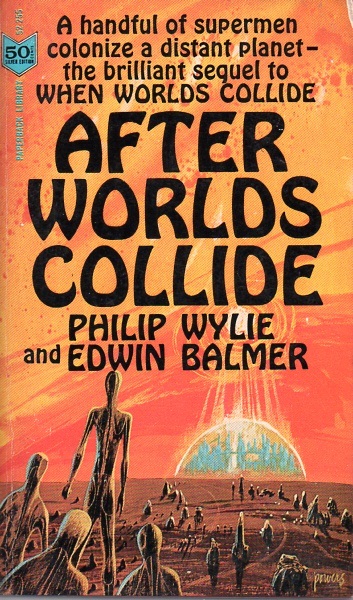
1. After Worlds Collide, Philip Wylie and Edwin Balmer (1933)

FTRWRLDSCL1968

(Richard Powers’ cover for the 1963 edition)

From the back cover: “When the group of survivors from Earth landed on Bronson Beta, they expected absolute desolation.  This Earth-like planet from another universe had been hurtling through space, cold and utter darkness for countless millennia.  All life should have perished millions of years ago.  But the Earth-people found a breathtakingly beautiful city, encased in a huge, transparent metal bubble; magnificent apartments filled with every luxury; food for a lifetime in the vast, empty kitchens; but with no trace either of life—or death.  Then the humans learned they were not alone on Bronson Beta…” Continue reading

Adventures in Science Fiction Cover Art: Existential Crisis

PRTNTRRRRM1968

(Uncredited cover for the 1968 edition of Operation Terror (1962), Murray Leinster)

Barry N. Malzberg’s depressed/depraved astronauts have inspired me to make a post! (unfortunately, the covers for his books do not really fit the bill).

Guy Billot’s cover for the 1975 edition of Brian Stableford’s Man in a Cage (1975) perfectly embodies the feel of existential crisis—man, hemmed in by a single red line, raises his arms against the star-studded sky in anguish.  The nature of the crisis is left oblique.  I have selected a variety of covers that convey—with varying degrees of success/precision—this same mental state.

I admit that some might not fit the bill exactly—for example, in the uncredited Continue reading