After Frederik Pohl (1919-2013) left his editorial position at Galaxy and If in 1969, he set his pen towards a productive vein of form in the 70s that would culminate in his Hugo and Nebula-winning Gateway (1977). The Gold at the Starbow’s End contains five short stories–including the first of his Heechee sequence–from this period. Two of the best stories, the titular “The Gold at the Starbow’s End” (1972) and “The Merchant of Venus” (1972), demonstrate Pohl’s characteristic blend of hyperbolic satire and delirious energy. There are no duds in this collection.
What pre-1985 science fiction are you reading this week?
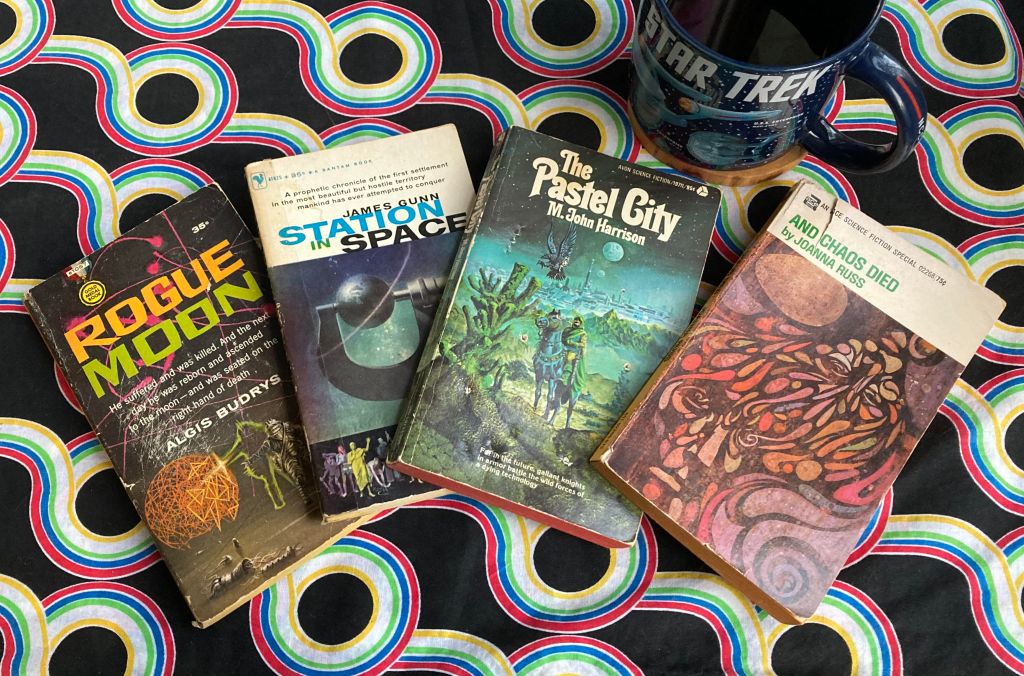
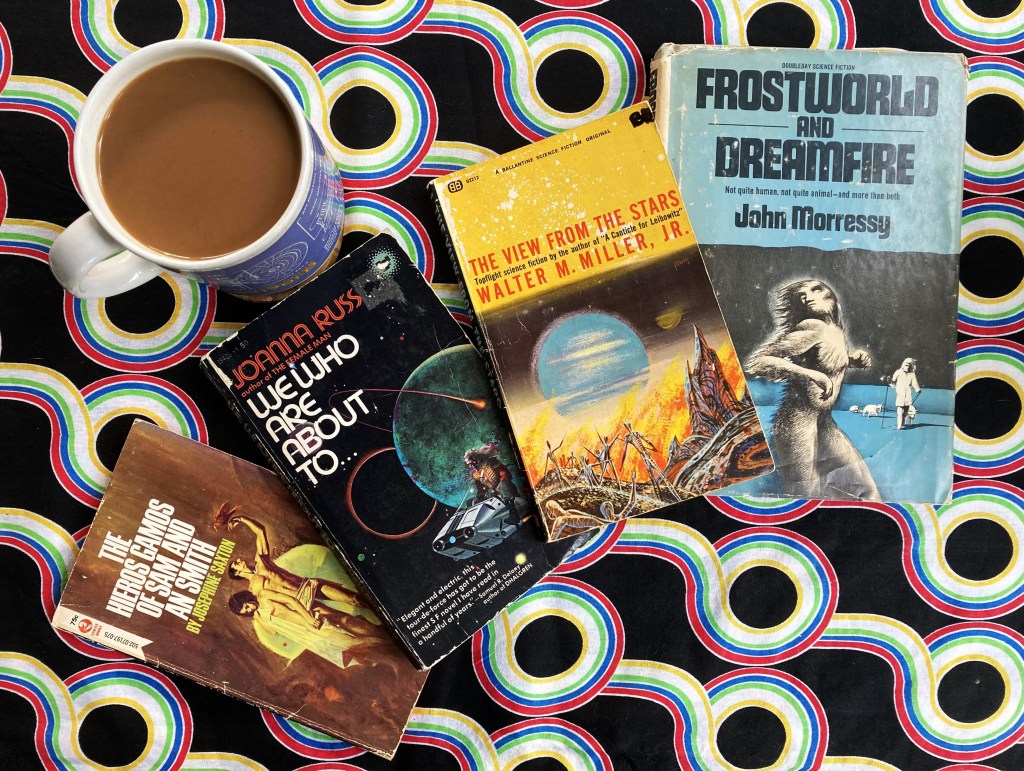
I’ve thoroughly enjoyed the conversations and connections you all have made in the comments over the last two months of this column. Make sure to check out the previous installment if you haven’t already. As before, I’ve included a bit about the books in the photograph, birthdays from the last two weeks, and brief ruminations on what I’ve been reading and writing.
What pre-1985 science fiction are you reading this weekend?
Thank you all for making this fanzine column a success! I’ve thoroughly enjoyed the conversations and connections you all have made in the comments. Make sure to check out the previous installment if you haven’t already. As before, I’ve included a bit about the books in the photograph, birthdays from the last two weeks, and brief ruminations on what I’ve been reading and writing.
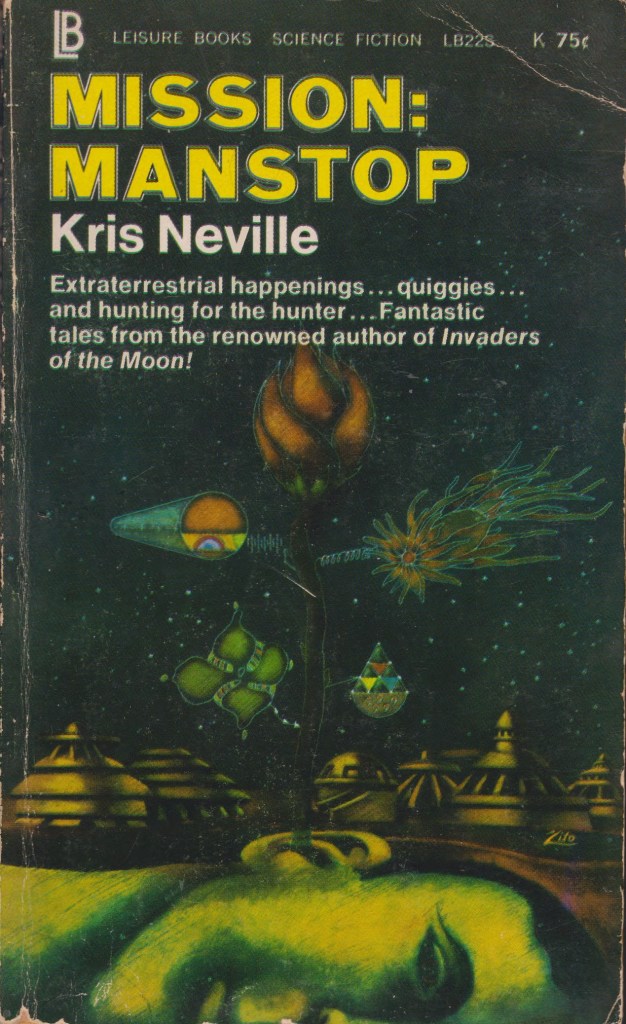
The career of Kris Neville (1925-1980) can be divided broadly into two parts. In his most productive period (1949-1957), Neville’s SF appeared in all the major magazines of the day, The Magazine of Fantasy and Science Fiction in particular. Afterwards, while he continued to publish short stories at a far reduced clip until his death, he wrote a handful of fix-up novels between 1964-1970. This trajectory neatly maps onto the restriction of magazine markets in the late 50s and the growing importance of the SF novel.
The following reviews are the 23rd and 24th installments of my series searching for SF short stories that are critical in some capacity of space agencies, astronauts, and the culture which produced them. Some stories I’ll review in this series might not fit. Many are far from the best. And that is okay. I relish the act of literary archaeology.
I’ve paired two 1950s stories, by Philip K. Dick and the far lesser-known James Causey, that explore the inability to understand the universe outside our Earth. Explorers find themselves at each others throats caught up in paranoid delusions of grandeur.
Allen Andersons’ cover for Planet Stories, ed. Jack O’Sullivan (May 1953)
3.5/5 (Good)
Philip K. Dick’s “The Infinites” first appeared in Planet Stories, ed. Jack O’Sullivan (May 1953). You can read it online here.
A preliminary note: I dislike writing about Philip K. Dick. As I mentioned in my 2021 review of “A Little Something for Us Tempunauts” (1974) for this series, “I find it far more enjoyable and liberating to write about lesser-known authors.” Or at least those whose works and lives are less encyclopedically covered by fans and academics alike. There are and will be far superior takes on this story. I don’t have the will or focus. And that’s okay. I rather focus my obsessive eye on others. To be clear, I love Philip K. Dick. Along with C. J. Cherryh, Frank Herbert, and Stanislaw Lem, he was one of the authors of my early twenties–right before I started this website.
In the past year or so I’ve put together an informal series on the first three published short fictions by female authors who are new(ish) to me and/or whose most famous SF novels fall mostly outside the post-WWII to mid-1980s focus of my reading adventures. So far I’ve featured Josephine Saxton (1935-), Carol Emshwiller (1921-2019), Wilmar H. Shiras (1908-1990), Nancy Kress (1948-), Melisa Michaels (1946-2019), Lee Killough (1942-), and Eleanor Arnason (1942-).
I do not expect transformative or brilliant things from first stories. This is particularly relevant to keep in mind for today’s post. Rather, it’s a way to get a sense of subject matter and concerns that first motivated authors to put pen to paper and to further map the territories that fascinate me.
Today I’ve selected the first three professional science fiction stories published by Betsy Curtis (1917-2002). She is “best” known for her Hugo-nominated short story “The Steiger Effect” that appeared in Analog Science Fiction, ed. John W. Campbell, Jr. (October 1968). It lost to Harlan Ellison’s “The Beast That Shouted Love at the Heart of the World” (1968). Her short biographical blurb by Eric Leif Davin in Partners In Wonder: Women and the Birth of Science Fiction 1926-1965 (2006) indicates that she received an M.A. in English (1941) from Oberlin College, in 1966 another M.A. in Education from Allegheny College, and was active in the Society for Creative Anachronism (375). Her work is not discussed in much detail by Davin. She published 13 stories in professional magazines and two in fanzines between 1950-1973. For a bit more about her fannish activities, check out the following forum posts.
Have you read any of her work? If so, what were your thoughts?
George Salter’s cover for The Magazine of Fantasy and Science Fiction, ed. Anthony Boucher and J. Francis McComas (Summer 1950)
2.75/5 (Below Average)
Betsy Curtis’ “Divine Right” first appeared in The Magazine of Fantasy and Science Fiction, ed. Anthony Boucher and J. Francis McComas (Summer 1950). You can read it online here.
Sometime in the future a family of telepathic monarchs rule. Until the death of King Almar the Eighth, Curtis suggests the monarchy was more on the benevolent side of things–collecting a small tithe and encouraging the indoctrination of children to its glories through song and rhyme. But everything changes with the controversial ascension of King Glann. Unlike his predecessors, he squeezes the people dry for new palatial constructions. The story’s protagonist, the young Tod Winster bubbles with the capitalistic credo: “But Dad [..] When you’ve worked hard and earned something, shouldn’t it be yours to keep?” (98). He wants a bicycle. And in a confusing sequence of events his life savings are handed over as a tithe to King Glann in a ceremony to inaugurate the completion of the Winter Palace… but something is amiss. The king doesn’t seem to be a telepath at all. And Tod’s confused actions create the spark of rebellion!
The following review is the 17th, 18th, and 19th installment of my series searching for “SF short stories that are critical in some capacity of space agencies, astronauts, and the culture which produced them.” Some stories I’ll review in this series might not fit. Many are far from the best. And that is okay. I relish the act of literary archaeology.
Reinvigorated by the positive response to my last post in my series, I turn now to an author, Alfred Coppel (1921-2004), whom I’ve only infrequently explored. Track down his post-apocalyptic masterpiece, of the “realistic” variety, Dark December (1960) if you haven’t already. As I was in the Coppel reading mood, I included an extra tale on a different theme.
As always, feel free to join the conversation and read along with me on the search for the depressed astronaut.
Ed Emshwiller’s cover art for Fantastic Story Magazine, ed. Samuel Mines (Fall 1952)
3.5/5 (Good)
Alfred Coppel’s “The Hunters” first appeared in Fantastic Story Magazine, ed. Samuel Mines (Fall 1952). You can read it online here.
“The Hunters” imagines a world after humanity has voyaged to the stars. Or rather, after humanity figured out that they were not suitable for the stars–a simulacrum of the human was required instead. Felti hides from the hunters–Grancor and Corday–on a “twisted, tortured world that had not died with dignity” (107). An archaeologist by trade who studied the culture that started the exploration of the cosmos, Felti felt the pull of this shattered place despite its “acrid tang of radiation” (107). But he was on the run! The “Psychoanalyzer” required Felti’s reconditioning (107).
The following review is the 16th installment of my series searching for “SF short stories that are critical in some capacity of space agencies, astronauts, and the culture which produced them.” Some stories I’ll review in this series might not fit. And that is okay. I relish the act of literary archaeology.
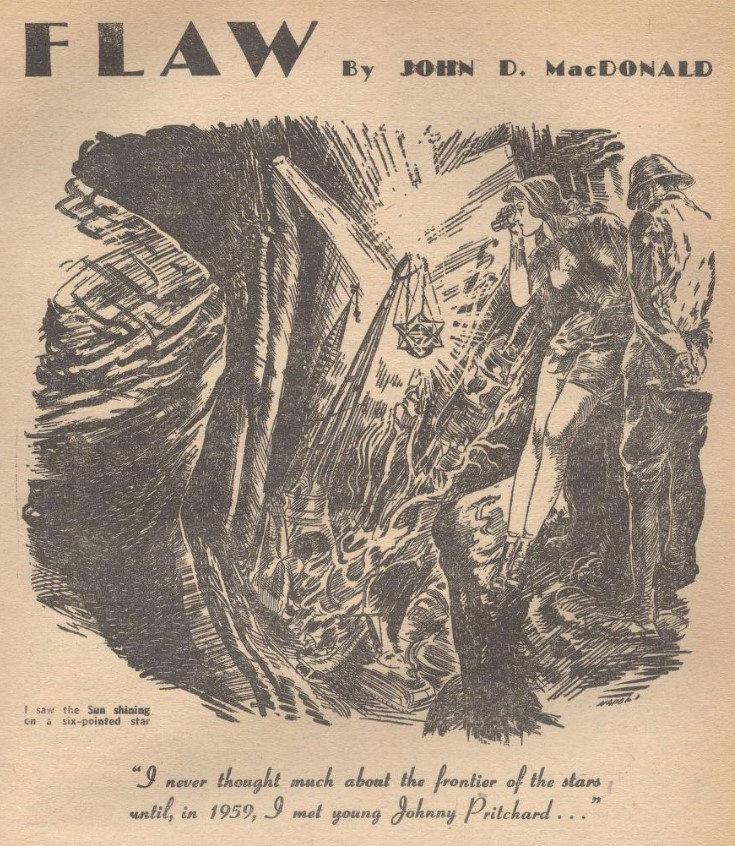
I decided to return to this all-but-defunct series after I was inspired by a conversation in the comment section of my recent review of John D. MacDonald’s “Spectator Sport” (1950). A friend of the site listed a fascinating range of MacDonald’s short stories and multiple appeared to fit my series on subversive accounts of astronauts and space travel. MacDonald’s “Flaw” (1949) charts the end of the dream of the conquest of space.
As always, feel free to join the conversation and read along with me on the search for the depressed astronaut.
Previously: Walter M. Miller, Jr.’s “The Hoofer” (1955)
Vincent Napoli’s interior art for John D. MacDonald’s “The Flaw” in Startling Stories, ed. Sam Merwin, Jr. (January 1949)
3.75/5 (Good)
John D. MacDonald’s “The Flaw” first appeared in the January 1949 issue of Startling Stories, ed. Sam Merwin, Jr. You can read it online here.
The Dream Sold to the Legions
Carol Adlar, a government clerk at a rocket station in Arizona, falls in love with both the young astronaut Johnny Pritchard and his dream. Johnny believes the moment that humanity can travel to the stars will be the opportunity to create a new “world with no wars, no disease, no starvation” (84). The scars of the ruined Earth offer lessons to create a better future where the sinful will be able to transcend their timeless tendencies. Carol recounts, after Johnny’s tragic death, that “within a week I had caught his fervor, his sense of dedication” (84). They share the dream. They imagine that they will become “one of the first couples to become colonists for the new world” (84). And against her better judgement, she gives her “heart to a man who soars up at the top of a comet plume” (84).
Which books/covers/authors intrigue you? Which have you read? Disliked? Enjoyed?
1. Strange Ports of Call, ed. August Derleth (1948)
Uncredited cover for the 1958 edition
From the back cover: “‘Begotten of Imagination, on the body of Technology, there springs forth the wild child Science Fiction.’ –Clifton Fadiman
The above is one of the many attempts that have been made to describe a department of fiction which, in spite of some sniping critics, continues to increase its followers. Recently Bertrand Russell observed that science fiction consists of ‘intelligent anticipation–much more intelligent than the expectations of statesmen.’




 Science Fiction and Other Suspect Ruminations