Which books/covers/authors intrigue you? Which have you read? Disliked? Enjoyed?
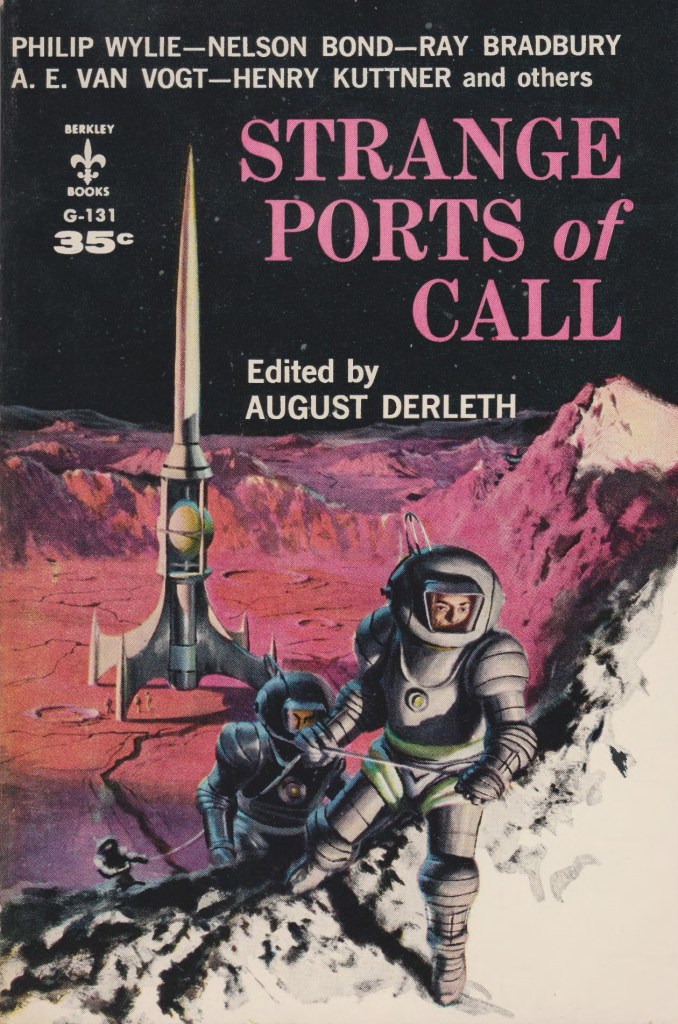
1. Strange Ports of Call, ed. August Derleth (1948)
Uncredited cover for the 1958 edition
From the back cover: “‘Begotten of Imagination, on the body of Technology, there springs forth the wild child Science Fiction.’ –Clifton Fadiman
The above is one of the many attempts that have been made to describe a department of fiction which, in spite of some sniping critics, continues to increase its followers. Recently Bertrand Russell observed that science fiction consists of ‘intelligent anticipation–much more intelligent than the expectations of statesmen.’
This is the 15th post in my series of vintage generation ship short fiction reviews. Today I have an unusual take on the subgenre–a young scavenger couple encounter a mysterious blip on their radar!
As a reminder for anyone stopping by, all of the stories I’ll review in the series are available online via the link below in the review.
You are welcome to read and discuss along with me as I explore humanity’s visions of generational voyage. And thanks go out to all who have joined already. I also have compiled an extensive index of generation ship SF if you wish to track down my earlier reviews on the topic and any that you might want to read on your own.
Paul E. Wenzel’s cover for Galaxy Magazine, ed. H. L. Gold (June 1961)
3/5 (Average)
Fred Saberhagen’s “The Long Way Home” first appeared in the June 1961 issue of Galaxy Magazine, ed. H. L. Gold. You can read it online here.
Among the Asteroids out Near Pluto
Marty and Laura–recently married and very much in love–form the crew of the Clementine, a robotic mining, ore refining, and hauling vessel. They spend their isolated existence identifying prospective asteroids out near Pluto. Laura, on her very first space voyage, remains his liaison in the control room when Marty scoots off in his space bike to investigate a blip on the radar. If it’s a wrecked hull of “a ship dead for decade, or a century, or a thousand years” if theirs by right of salvage if they could tow it into a port (181). The robotic librarian indicates that no such vessel has ever existed! Marty’s investigation reveals that the thirty-mile long hull is part of a two-thousand-year-old larger vessel that has suffered a possibly cataclysmic disaster.
Wallace Wood’s interior art for Frederik Pohl’s “The Wizards of Pung’s Corners” in Galaxy Magazine, ed. H. L. Gold (October 1958).
Today I’ve reviewed the twentieth story in my series on the science fictional media landscape of the future. Frederik Pohl satirizes a post-apocalyptic world where advertising gets right to work after the bomb!
Dember’s cover for Galaxy Magazine, ed. H. L. Gold (October 1958)
3/5 (Average)
Frederik Pohl’s “The Wizards of Pung’s Corners” first appeared in Galaxy Magazine, ed. H. L. Gold (October 1958). You can read it online here.
The year 1957 flashed subliminal messaging directly into the popular imagination. Vance Packard published The Hidden Persuaders (1957), that quickly became a best seller, and articlesincluding “The Growing Power of Admen” in the Atlantic [1]. In addition, research findings were released and publicized demonstrations occurred over the course of the year appeared to substantiate Packard’s primary claims. In September 1957 James Vicary, a pioneer in subliminal advertising, conducted his infamous “breakthrough media event” to gathered reporters [2]–he intermixed a nature documentary with the subliminal message “Drink Coca-Cola” 169 times! –that built on his earlier studies [3].
Today I’ve reviewed the fourteenth story in my series on the science fictional media landscape of the future. Walter F. Moudy relays the coverage of the 2050 Olympic War Games between the United States and Russia with harrowing effect.
Previously: Barry N. Malzberg’s “The Idea” (1971) (as K. M. O’Donnell).
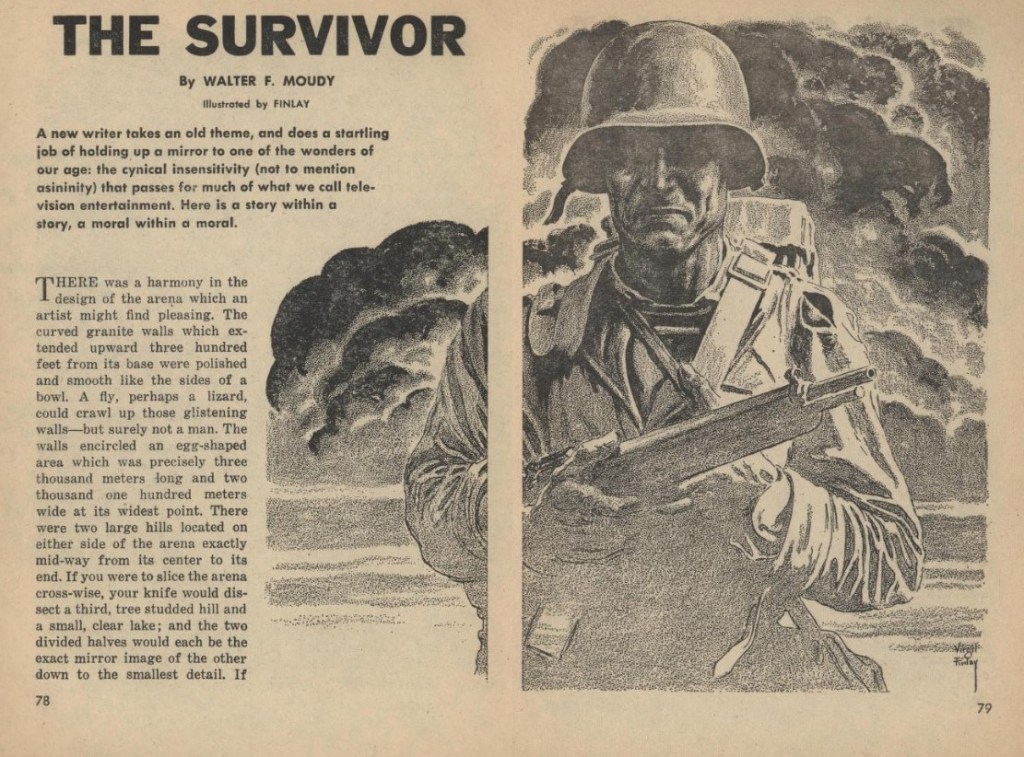
Virgil Finlay’s interior art for Moudy’s “The Survivor” in the May 1965 issue of Amazing Stories
3.5/5 (Good)
Walter F. Moudy’s “The Survivor” first appeared in the May 1965 issue of Amazing Stories, ed. Cele Lalli (Goldsmith). You can read it online here.
Recently James Harris highlighted the truncated writing career of Walter F. Moudy (1929-1973) with a focus on No Man on Earth (1964), his only science fiction novel. Inspired by his comments on “The Survivor” (1965) and relentlessly intrigued by authors who have fallen from contemporary memory, I placed the slick future televised Cold War conflict tale at the top of my media landscapes of the future review list. For those expecting a masterful Henry Kuttner tale, stay tuned! In the meantime, let’s plunge into Moudy’s coverage of the 2050 Olympic War Games between the US and Russia.
Which books/covers/authors intrigue you? Which have you read? Disliked? Enjoyed?
Preliminary Note: As I’m currently on vacation, the images in this post are photographs of my volumes rather than my normal hi-res scans. I’ll replace them when I get home.
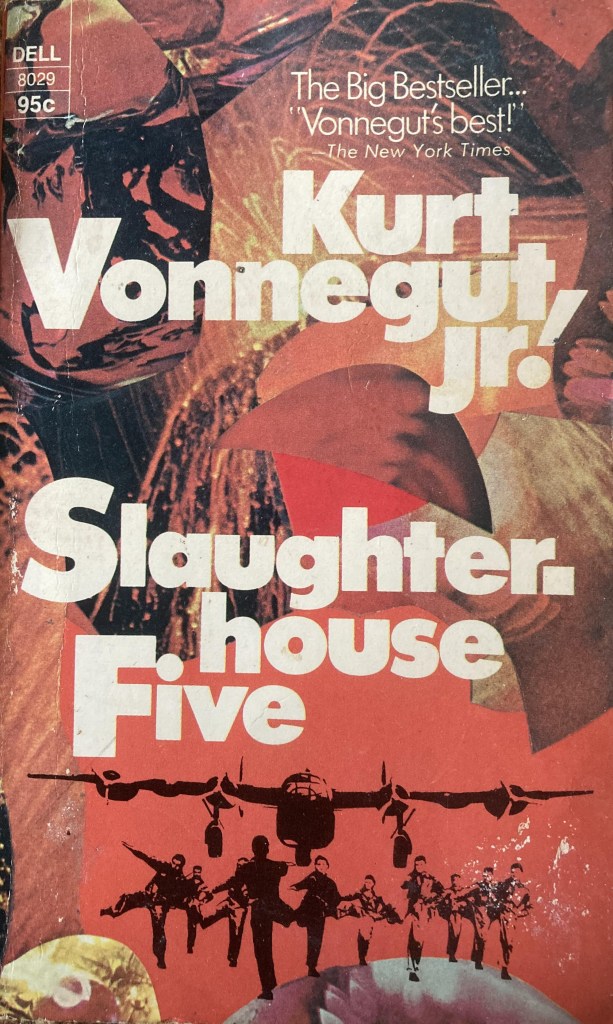
1. Slaughterhouse-Five or The Children’s Crusade: A Duty-Dance with Death, Kurt Vonnegut, Jr. (1969)
Uncredited cover for the 1971 edition
From the inside page: “TAKE A TRIP WITH BILLY PILGRIM
-To the cellar of a slaughterhouse in Dresden, a city about to be destroyed by the greatest man-made catastrophe of all time.
-To happy marriage and mating with the sweet and willing daughter of one of the finest citizens of Illium, New York.
-To a luxurious zoo on the planet Tralfamadore for the public exhibition of lovemaking with the famous Earthling blue-moviestar, Montana Wildhack.
All in an amazing novel that could only have been written by Kurt Vonnegut, Jr., a writer whose wildest flights take you straight to the hear and now.“
Today I’ve reviewed the thirteenth story in my series on the science fictional media landscape of the future. Here, I finally return to the nightmarish embrace of Barry N. Malzberg.
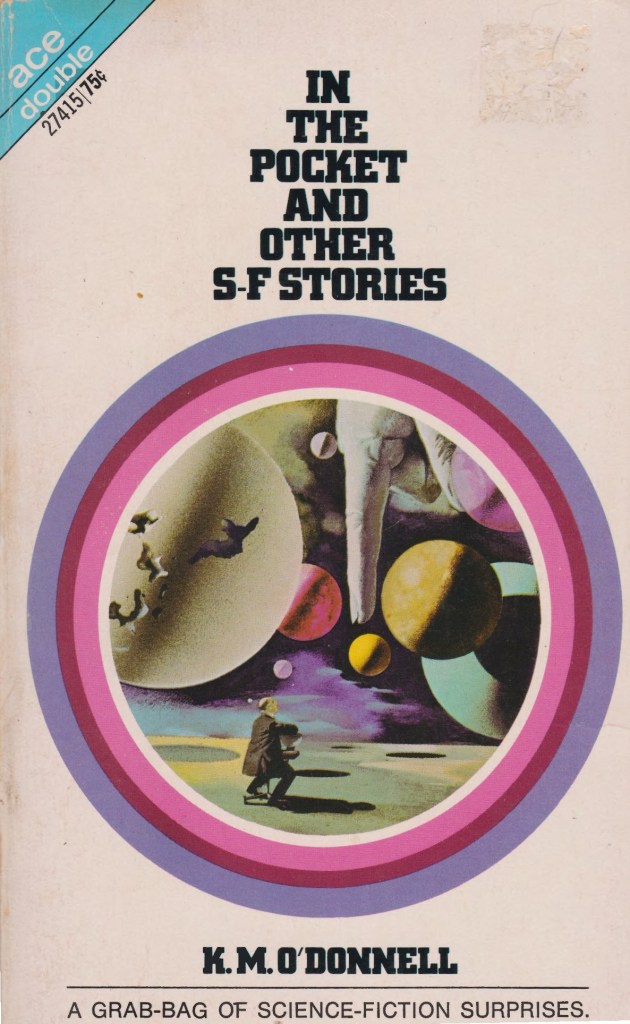
Karel Thole’s cover for the 1st edition of K. M. O’Donnell’s In the Pocket and Other S-F Stories (1971)
3.5/5 (Good)
Barry N. Malzberg’s “The Idea” first appeared in In the Pocket and Other S-F Stories (1971) (as K. M. O’Donnell). I cannot find the story online. Please contact me if you do not own a copy and want a PDF of the story. I recommend you procure the fantastic anthology TV: 2000, ed. Isaac Asimov, Martin H. Greenberg, Charles G. Waugh (1982) which “The Idea” also appears in. I’ll be returning to this volume in coming weeks for this series.
Reading a Barry N. Malzberg story is like returning to a familiar embrace–an embrace of the blackest satire conveyed via terrifying existential traps. Ever since I read his masterpiece Beyond Apollo(1972), a metafictional destruction of America’s obsession with space exploration, Malzberg joined the pantheon of my favorite authors.
2021 was the best year in the history of my site for visits and unique viewers! I suspect this increasingly has to do with my twitter account where I actively promote my site vs. a growing interest in vintage SF. I also hit my 1000th post–on Melisa Michaels’ first three published SF short stories–in December.
As I mention year after year, I find reading and writing for the site—and participating in all the SF discussions it’s generated over the year—a necessary and greatly appreciated salve. Thank you everyone!
I read very few novels this year. Instead, I devoted my attention to various science short story reviews series and anthologies. Without further ado, here are my favorite novels and short stories I read in 2021 (with bonus categories).
Tempted to track any of them down?
And feel free to list your favorite vintage (or non-vintage) SF reads of the year. I look forward to reading your comments.
My Top 7 Science Fiction Novels of 2021 (click titles for my review)
Uncredited cover for the 1988 edition
1. Where Time Winds Blow (1981), Robert Holdstock, 5/5 (Masterpiece): Holdstock’s vision is a well-wrought cavalcade of my favorite SF themes–the shifting sands of time, the pernicious maw of trauma that threatens to bite down, unreliable narrators trying to trek their own paths, a profoundly alien planet that compels humanity to construct an entirely distinct society… It’s a slow novel that initially masquerades as something entirely different. Just like the planet itself.
Note: My read but “waiting to be reviewed pile” is growing. Short rumination/tangents are a way to get through the stack before my memory and will fades. Stay tuned for more detailed and analytical reviews.
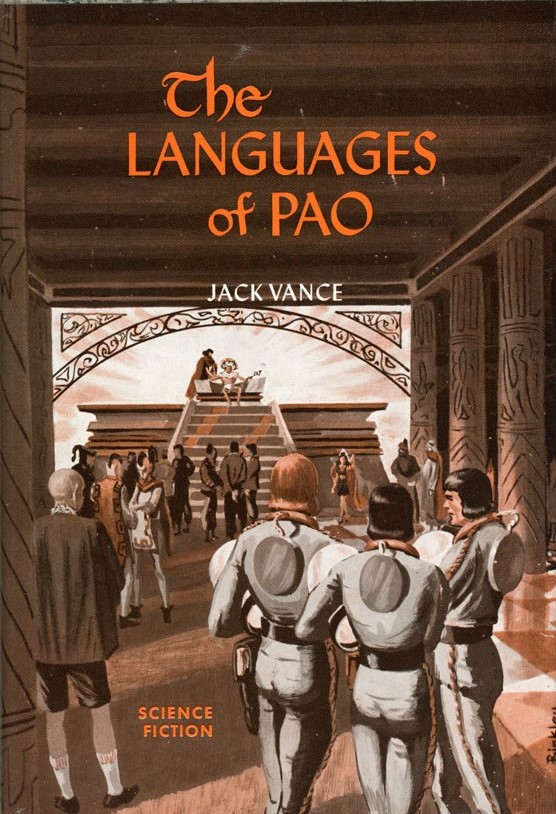
1. The Languages of Pao, Jack Vance (1958)
Ric Binkley’s cover for the 1958 1st edition
3.25/5 (Vaguely Good)
Since I started my site in 2011, I’ve soured a bit on Jack Vance’s brand of planetary adventure in richly realized and exotic worlds. I doubt I’d currently rate novels like Showboat World(1975) or The Blue World (1966) as highly as I did back then. One of more appealing elements of having a single project for so long is my ability to track my evolving views on genre. That said, I’d classify Wyst: Alastor 1716(1978) and The Languages of Pao (1958) amongst his most conceptually ambitious novels I’ve read so far and worth tracking down. For a full list consult my index. Note: I read but never reviewed Dying Earth (1950).
Every morning for the last few years, I post on Twitter the birthdays (pre-1955) of artists, authors, and editors involved in some way with science fiction. In the last year, a singular compulsion has hit and I’ve started to include even more obscure figures like Gabriel Jan (1946-) and Daniel Drode (1932-1984). On May 31st, while perusing the indispensable list on The Internet Speculative Fiction Database, I came across an author unknown to me–Melisa Michaels (1946-2019) (bibliography). She’s best known for the five-volume Skyrider sequence (1985-1988) of space operas “depicting the growth into maturity of its eponymous female Starship-pilot protagonist” (SF Encyclopedia).
As I’m always willing to explore the work of authors new to me, I decided to review the first three of her six published SF short stories. Two of the three stories deal with my favorite SF topics–trauma and memory.
Karl Kofoed’s interior art illustrating Melisa Michaels’ “In the Country of Blind, No One Can See” in Isaac Asimov’s Science Fiction Magazine (January 1979)
“In the Country of the Blind, No One Can See” (1979), 3.5/5 (Good): First appeared in Isaac Asimov’s Marvels of Science Fiction (1979). It was reprinted in Isaac Asimov’s Science Fiction Magazine (January 1979). You can read it online here.
On a terraformed Mars, Allyson Hunter and her two clone sisters, Rebecca and Kim, are societal outcasts. They spent their lives trying to be “real people” yet were “reminded, every day in a dozen little ways, that they weren’t real people” (87). Clones retain their first usage as replacement body parts. Permitted to live only due to indications of telepathic potential (needed to guide spaceships), the sisters attempt to live meaningful lives and develop useful skills. The sisters charter two identical twins, Frank and Todd, to convey them across the Martian landscape. A horrific crash kills Kim and forces the survivors to work together and move past the deep resentment and hatred the brothers hold.