Short Book Reviews: Fredric Brown’s The Lights in the Sky Are Stars (variant title: Project Jupiter) (1953), M. A. Foster’s Waves (1980), Eric Frank Russell’s The Great Explosion (1962)

My “to review” pile is growing and my memory of them is fading… hence short—far less analytical—reviews.

1. The Lights in the Sky Are Stars, Fredric Brown (1953)

(Mitchell Hooks’ cover for the 1955 edition)

3/5 (Average)

Frederic Brown’s The Lights in the Sky are Stars (1953)  is a slick 1950s vision of the fanatical men and women who take America by the scruff of the neck and yank it, without letting the law get in the way, towards space and the deep beyond. As a rumination on radicalism,  The Lights in the Sky are Stars succeeds—I’m not entirely sure if it was entirely intentional as Continue reading

Updates: Recent Science Fiction Acquisitions No. CCXXXVII (Rex Gordon, Craig Strete, Graham Dunstan Martin, and an Anthology of European SF)

Clifford D. Simak, Tanith Lee, and M. A. Foster reviews are incoming. The first few weeks of every semester hit with a vengeance—teaching is an exhausting profession.

In the meantime get inspired to read vintage SF by ogling these gems!

1. In my youth I was obsessed with Victorian/Belle Epoque survivalist novels–Jules Verne’s The Mysterious Island (1874), Perseverance Island Or the Robinson Crusoe Of The Nineteenth Century(1885), et al. I judged them on their “realistic” portrayals of how man (and yes, the characters were always men) moved up the technological tree—from fire to steam engines—in a hostile world. Although I’ve utterly disavowed SF that adheres to such  naive technological triumphalism, occasionally nostalgia calls…. Here’s a SF Robinsonade along similar lines.

2. I adore Craig’s Strete unique brand of SF story. I reviewed, in abbreviated form, his spectacular collection If All Else Fails…. (1980). I’ll read this one soon! The Bleeding Man and Other Science Fiction Stories is also a well-designed volume as elements of the cover art are used at the beginning of each short story.

3. Another unknown commodity—seems to combine SF and fantasy tropes.

4. Back in November I acquired the second in the Terra SF series of anthologies edited by Richard D. Nolane of Western European SF in translation. I pointed out that the first volume online was prohibitively expensive. A follower on twitter discovered that a seller on Amazon incorrectly listed the collection under another title—at a radically reduced price. Now it’s a happy member of my collection.

Let me know what you think of the books and covers in the comments!

~

1. First on Mars (variant title: No Man Friday), Rex Gordon (1956)

(Kelly Freas’ cover for the 1976 edition) Continue reading

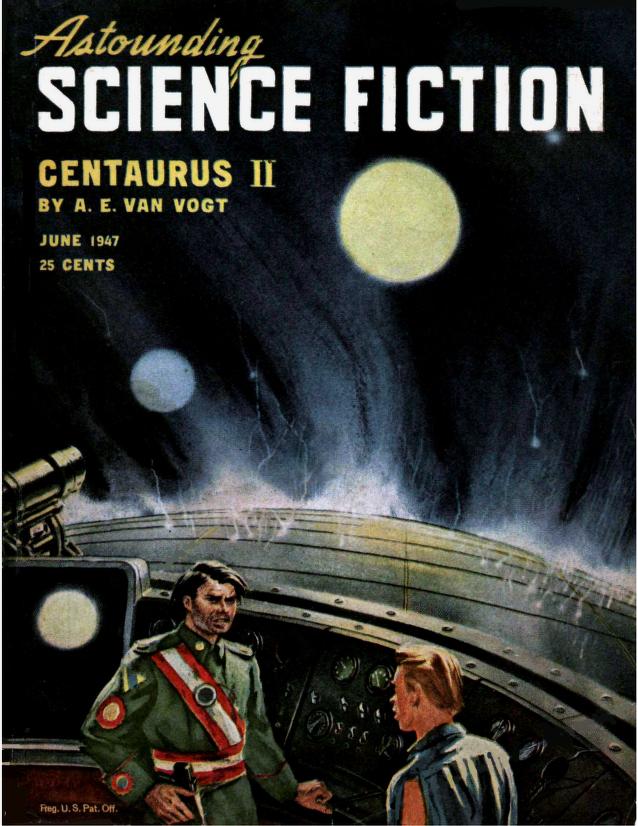
Generation Ship Short Story Review: A. E. van Vogt’s “Centaurus II” (1947)

Preliminary note: This is the sixth post in a series of vintage generation ship short fiction reviews. All of the stories I’ll review are available online (see links below). You are welcome to read and discuss along with me as I explore humanity’s visions of generational voyage. And thanks go out to all who have joined already.

Previously: J. G. Ballard’s “Thirteen to Centaurus” (1962)

Next up: Chad Oliver’s “Stardust” (1952)

I’ve compiled a helpful list on the theme with links to all my reviews.

(Charles Schneeman’s cover for the June 1947 issue of Astounding Science Fiction, ed. John W. Campbell, Jr.)

4/5 (Good)

A. E. van Vogt’s “Centaurus II” (1947)* (story link) first appeared in the June 1947 issue of Astounding Science Fiction edited by John W. Campbell, Jr. Together with two later stories—“Rogue Ship” Continue reading

Updates: Recent Science Fiction Acquisitions No. CCXXXIV (Anne McCaffrey, Lester del Rey, Poul Anderson, and Philip Wylie)

1. In my youth Anne McCaffrey’s Pern novels received a privileged place on my shelf. I have yet to explore her other SF in any great detail. The Ship Who Sang (1969) is a fix-up novel of six earlier short fictions from the 60s. I’ve put this one near the top of my to-read list!

2. Another epic series of tales of space exploration from Poul Anderson! I hope it’s better than Tau Zero (1970).

3. A post-apocalyptical novel from Philip Wylie—14 survivors in the bomb shelter of a millionaire. Thoughts on this one?

4. I’ve never cared for Lester del Rey, The only work of his I’ve somewhat enjoyed was The Eleventh Commandment (1962, rev. 1970) as I’m a sucker for overpopulation-themed SF.

Let me know what you think of the books and covers in the comments!

~

1. The Ship Who Sang, Anne McCaffrey (1969) (MY REVIEW)

(Greg and Tim Hildebrandt’s cover for the 1976 edition) Continue reading

Book Review: The Space-Born, E. C. Tubb (1955)

(Ed Valigursky’s cover for the 1956 edition)

2.5/5 (Bad)

Almost the surprise of the year! E. C. Tubb’s The Space-Born (variant title: Star Ship) (1955) first appeared as a serial in New Worlds (April, May, and June 1955 issues). For American audiences, Tubb’s novel was paired with Philip K. Dick’s The Man Who Japed (1956) as an Ace Double. My only previous exposure to the prolific British author’s SF was “The Seekers” (1965), a paranoid vision of spacemen possessed by delusions of grandeur after their captain’s death. The Space-Born is a fascinating generation ship novel with a catastrophic Continue reading

Generation Ship Short Story Review: John Brunner’s “Lungfish” (1957)

Preliminary note: This is the fourth post in a series of vintage generation ship short fiction reviews. All of the stories I’ll review are available online. You are welcome to read and discuss along with me as I explore humanity’s visions of generational voyage. And thanks go out to all who have joined already!

Previously: Judith Merril’s “Wish Upon a Star” (1958).

Next up: J. G. Ballard’s “Thirteen to Centaurus” (1962).

I’ve compiled a helpful list on the theme.

(Brian Lewis’ cover for the December 1957 issue of Science Fantasy, ed. John Cornell)

4.75/5 (Near Masterpiece)

Our generation ship short story series continues with a gem! John Brunner’s “Lungfish” (1957) appeared in the December 1957 issue of Science Fantasy, ed. John Cornell. You can read it online here.  It also appeared in the 1972 collection Entry to Elsewhen which I reviewed back in 2010. “Lungfish” was the only worthwhile story in the collection and I was eager to give it a reread!

John Brunner wrote thought-provoking Continue reading

Updates: Recent Science Fiction Acquisitions No. CCXXXI (Sheri S. Tepper + Paul H. Cook + Robert Merle + Anthology)

1. I bought this themeless hodgepodge anthology for two reasons–the UK 1980 edition has a cool spaceship! And second, it contains Chad Oliver’s generation ship short story “The Wind Blows Free” (1957). MPorcius calls it one of Oliver’s best. As I’ve not been enamored with his brand of SF, I’m eager to try a short story on a favorite theme far outside of his normal anthropological-focused oeuvre.

I’ve previously reviewed Oliver’s The Shores of Another Sea (1971).

2. Sheri S. Tepper is a glaring hole in my SF knowledge. I often explore the back catalog before plunging into the best known novels of an author—The Revenants, her first published novel, is “a long, complex work of SF” according to SF Encyclopedia. I wish it would be a tad more descriptive…. the novel has a fun map which I’ll feature in a Monday Maps and Diagrams post.

3. French post-apocalyptic SF in translation! With an awful cover…

4. Paul Cook is another unknown author to me. His first novel, Tintangel (1981) has a bizarre premise (see blurb below). This might be my next SF read.

Let me know what books/covers intrigue you. Which have you read? Disliked? Enjoyed?

~

1. A Sea of Space, ed. William F. Nolan (1970)

(Bob Layzell’s cover for the 1980 edition) Continue reading

Book Review: Frontera, Lewis Shiner (1984)

(Vincent Di Fate’s cover for the 1st edition)

3.75/5 (Good)

Lewis Shiner’s Frontera (1984), a paranoid romp across post-democratic landscapes (both Earth and Mars) of decay and corporate takeover, contains a hypnotic premise and a not entirely convincing plot. Be prepared for a maelstrom of ideas and images: Subliminal messages. An abandoned Martian colony. Implanted Biological RAM. A dangerous voyage to Mars in old NASA shuttles. Corporate mercenaries. Hyper-violence. Mutant children. Transcendent mathematics.

Recommended for fans of gritty Continue reading

Updates: Recent Science Fiction Acquisitions No. CCXXI (Nancy Kress + Norman Spinrad + Charles Sheffield + Graham Dunstan Martin)

1. A lesser-known novel by Nancy Kress… She remains a complete unknown author to me. I’ve heard high praise for her best-known novel–the Hugo and Nebula-nominated Beggars in Space (1990).

2. In the mid-80s Bluejay Books released a series of illustrated editions of previously published novels and novellas from the likes of Vernor Vinge, Rosel George Brown, and Theodore Sturgeon. As I’ve long respected the work of Norman Spinrad, I tracked down a Bluejay Books edition of his Hugo-nominated novella “Riding the Torch” (1974) with illustrations by Tom Kidd. At first glance the illustrations are not my cup of tea…. but the Spinrad novella has a wonderful premise.

I’ve previously reviewed Spinrad’s meta-fictional masterpiece The Iron Dream (1972) and his worthwhile short story collection The Last Hurrah of the Golden Horde (1970).

3. I recent reviewed Charles Sheffield’s novel Sight of Proteus (1978) and was impressed enough to track down a short story collection. Unfortunately my copy is rather battered, obfuscating my absolute favorite Attila Hejja SPACE SCENE cover!

4. Post-apocalyptic nightmares where survivors are forced to live inside radiation suits? Yes! Raving preacher promising deliverance if survivors leave their radiation suits? Yes! Probability of novel being a “lost” masterpiece? Close to zero.

Let me know what books/covers intrigue you. Which have you read? Enjoyed? Hated?

~

1. An Alien Light, Nancy Kress (1988)

(Ron Walotsky’s cover for the 1st edition) Continue reading