Today I’ve paired two post-apocalyptic tales that attempt–with varying degrees of success–to chart the awesome transformation that nuclear war might bring. Ray Bradbury’s “The Highway” (1950) situates the realization that the end is neigh in an unusual location–the rural Mexican countryside. Leslie A. Croutch’s “The Day the Bomb Fell” (1950) charts the obliteration of the timeless rituals of life through the eyes of a young boy (and his cat).

John Richards’ cover for the 1955 edition of Ray Bradbury’s The Illustrated Man (1951)
3.75/5 (Good)
Ray Bradbury’s “The Highway” first appeared in Copy Magazine (Spring 1950) [as by Leonard Spalding]. It appeared as a section of The Illustrated Man (1951). You can read it online here.
Bradbury was one of my earliest exposures to science fiction. My dad selected cassette audiobooks of The Martian Chronicles (1951) and The Illustrated Man (1951) for family car trips. Other than a select few stories–“The Veldt” (1951) and “All Summer in a Day” (1954) come to mind, the specifics of those collections have faded from my memory. My various short story review series provide a wonderful opportunity to reorient myself with his fiction. See my earlier posts on “Almost the End of the World” (1957) and “The Pedestrian” (1951) for my media landscapes of the future series. And I have another lined up for my subversive accounts of space travel series.
Like many of Bradbury’s fictions, “The Highway” is a quiet speculation, in this instance on the terror of nuclear apocalypse from an unusual perspective. Hernando and his wife eke out a living on a small plot of land alongside a concrete highway in Mexico somewhere near (I assume) the American border. Most of the time he indulges (for a coin), with minor irritation, the tourists who travel back home who want a photo of a Mexican farmer with wooden plow and hat. The highway, with its car accidents, brings other forms of bounty. A tire from a wreck became the material for his shoes, he transforms a hubcap into a large water basin…
But one day the highway seems strangely different: “something big has happened. Something big to make the road so empty this way.” And then the cars come: “hundreds of them, miles of them, rushing and rushing as he stood […] heading north toward the United States, roaring, taking the curves at too great a speed.” As the main convoy passes, a straggler car and its five occupants (one man and four women) in need of assistance pause at his home. “Haven’t you heard?” the young man asks Hernando. With the women crying, the man shouts: “It’s come, the atom war, the end of the world!”
The highway serves as an effective multi-faceted metaphor. It represents modernity and change infringing on a way of life that has always existed. Simultaneously, the highway brings limited financial benefit to supplement the meager bounty of his hard labor. For Hernando, cut off from the happenings of the external world, the highway serves as a link to the expanse of the external world and the chaos bubbling far beyond what he can see. I enjoyed this elegant story. Bradbury’s use of an unusual perspective (for science fiction at least) is a heartfelt attempt to chart existential dread of the end of the world. That said, I’m not sure it has the staying power of his best visions.
Recommended for fans of Ray Bradbury and stories that ruminate on the nature of the end.
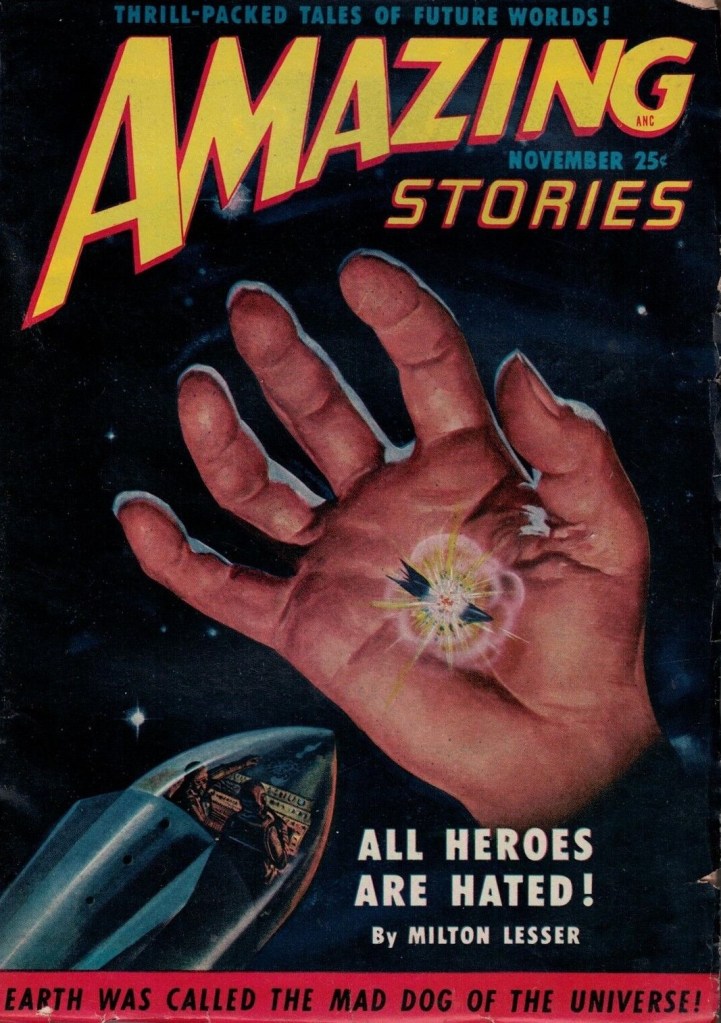
Arnold Kohn’s cover for Amazing Stories, ed. Howard Browne (November 1950)
1/5 (Egregious)
Leslie A. Croutch’s “The Day the Bomb Fell” first appeared in Amazing Stories, ed. Howard Browne (November 1950). You can read it online here.
According to Fancyclopedia, Leslie A. Croutch (1915-1969) was a Canadian fan–who produced at least 175 fanzines–primarily active in the 1940s. Most of his “at least 100 stories” appeared in his own fanzines or those of his friends. Between 1941 and 1951, a handful of stories appeared in professional SF venues. I’ve selected one of his two post-apocalyptic tales from the latter category–the other, “Eemanu Grows Up” (1948) appeared in Mary Gnaedinger’s Famous Fantastic Mysteries. I can’t say I’m inspired to pick that one up anytime soon!
“The Day the Bomb Fell” is a bog standard boy who miraculously survives a nuclear attack on nearby factories and cities and must face new world story. With Johnny’s rituals of school and home disrupted by the blasts, he sets off to find food and shelter. He finds a cat amidst the wreckage. He realizes most of his family is probably dead. He watches horses with radiation burns writhe in pain. He meets a young girl named Marianne. They hold hands.
“The Day the Bomb Fell” goes through the motions to convey trauma and exact sympathy in the most amateur manner possible. I am remind of Basil Wells’ superior, if also far too plain, “Sole Survivor” (1957) in which a young girl emerges from her hiding place and sets off through the wreckage of her earlier life not entirely understanding the devastating transformation that has inspired. Of course, Basil Wells wrote in the era of hydrogen bomb when fallout–conveyed as an alien manifestation replete with pseudopods–added a terrifying new dimension. Croutch struggles to convey physical or interior devastation in anything but the most cringeworthy manner. For example, after Johnny encounters a young girl who watched her parents die and soldiers desecrate her dead body, takes her hand and says “maybe vacation has come a little early this year” (107). What?
I struggle to write more about this one. Yes, I have another footnote or paragraph in a half-conceived article about nuclear bombs and rituals… but that’s about all.
Avoid unless you are an obsessive connoisseur of the nuclear gloom landscape like myself!
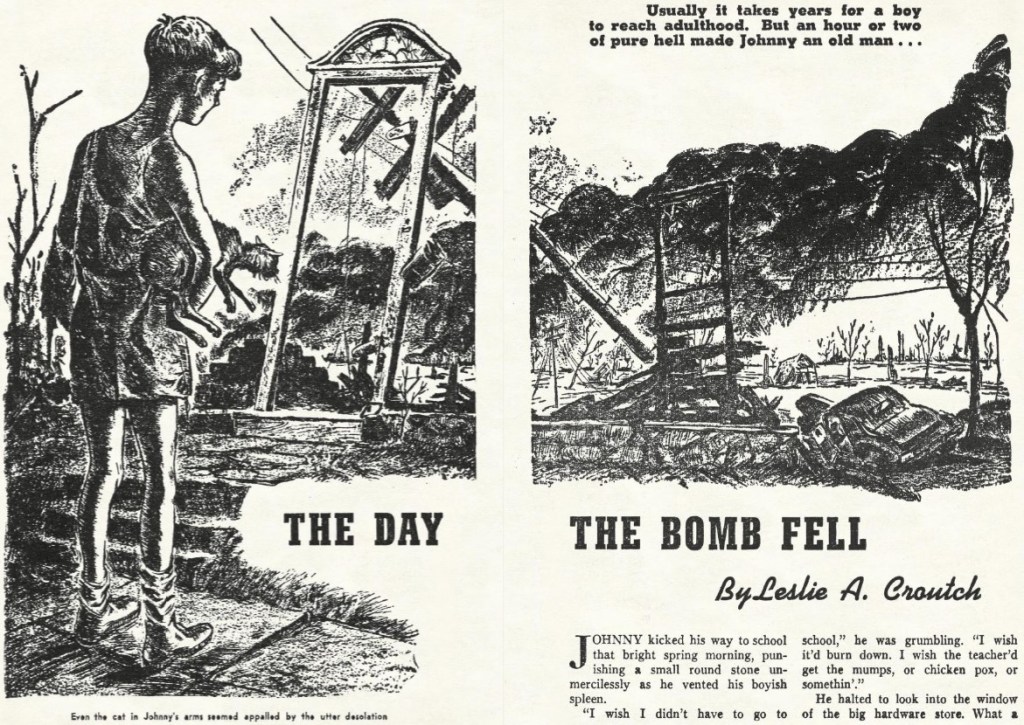
Leo Summers’ interior art for Leslie A. Croutch’s “The Day the Bomb Fell” in Amazing Stories, ed. Howard Browne (November 1950)
For book reviews consult the INDEX
For cover art posts consult the INDEX
For TV and film reviews consult the INDEX
 Science Fiction and Other Suspect Ruminations
Am looking at that Day the Bomb Fell art across one of my 2 cats tucked in between me and the PC keyboard while the other one does his “paint me like your French girls” attention requesting pose on the carpet. That gives a unique feel to the situation depicted in the art.
Unfortunately my two wonderful cats are home across an ocean at this moment. Too bad the story is complete crud. It struggles to convey any real connection that humans might have with animals… yet alone anything else!
And if you want a moment that gets at the heart of what an pet might mean in the apocalypse… check out Matheson’s I Am Legend (1954) if you haven’t already. https://sciencefictionruminations.com/2022/07/06/book-review-i-am-legend-richard-matheson-1954/
Well, that vacation is certainly doing wonders for you writing! Three new posts in rapid succession!
I have surely read “The Highway” as I read THE ILLUSTRATED MAN long ago, but I don’t remember it. I’ll dig out my copy and reread it.
And I’ll skip the Croutch story!
It can’t be more than four pages or so. I read it online at the link I provided as I am away from my physical copy–if I even have a copy anymore of The Illustrated Man! I should procure one.
Does he have any other nuclear war stories?
Yes … “There Will Come Soft Rains” is probably one of the most famous nuclear war stories of all time. I think at least one other story in THE MARTIAN CHRONICLES mentions nuclear war — maybe “Way in the Middle of the Air”? (Though that’s kind of more a civil rights story.)
Thank you for the reminder. I listened as a teenager on car trips to more of his stories than I read so my memories of them have long since faded. There’s a reason Fahrenheit 451 is so firmly in my mind — I owned a paper copy and read that one.
Oh, and the Bradbury story I mentioned in the post that I have lined up for my astronaut series is one you suggested years back.
I’m not sure the Bradbury rains story was about nuclear war; the houses were intact but there just weren’t people in them, and there were recorded voices speaking.
Do you know of any others that might fit better?
No, I’ve not seen any postatomic shorts.
Pretty sure it’s about nuclear war. Here’s a quote: “The house stood alone in a city of rubble and ashes. This was the one house left standing. At night the ruined city gave off a radioactive glow which could be seen for miles.”
Sometimes I prefer implied or indirectly indicated connections to nuclear gloom. The Matheson I reviewed recently comes to mind.
There are a couple of other Martian Chronicles stories that reference nuclear war on Earth. One is “The Million Year Picnic”, the last in the book (and one of the best) in which a family that fled to Mars to escape the war learns that the war has gone nuclear and Earth is uninhabitable. The other is “The Watchers”, one of the little one or two page vignettes that Bradbury added for the book publication, in which a group of Martian colonists hear of nuclear war on Earth and are urged to return (which seems silly!)
I’ll put both on my list. Thank you again.
But yes, after four emotionally/physically gassed days at the end of the semester (not a good year) in which I did nothing, I started writing compulsively in the days before we headed to Spain.
Dave C
Joachim–
I haven’t read “The Day the Bomb Fell” but I remember “The Highway” from elementary school–I had a cool 6th grade teacher who read the stories from “The Illustrated Man” to his class, one every day. (That kept everybody’s attention focused for half an hour or so.) “The Highway” gave me the feeling that it’s possible to be so far away from everything in what we call “civilization” that it doesn’t really touch you, even though you can see it. The highway is the visible monument to civilization but Hernando and his family have very little to do with it except dealing with the tourists etc. Their life isn’t defined by scavenging for debris off the road or posing for amateur photographers, though–they’re self-sufficient. Hernando’s last remark shows how little he thinks about (or cares about) everything he can’t see: “What do they mean, the world?” You could say it’s not really a science fiction story, but it has a great finish there.
I remember a post-apocalyptic story called “Fermi and Frost” (I think this was by Frederik Pohl, but I’m not sure) in a graphic novel story collection I got in the late 1980s. Nuclear war was the linking theme between the stories. This story was about a NASA scientist stuck in a crowded airport when the bombs start to fall; everyone’s trying to get a flight home, to their loved ones, to a safe place out of the reach of WWIII. He ends up adopting a boy who’s been orphaned or abandoned in the mob, and he manages to get his son to a very remote part of the world. But is anywhere safe from nuclear war and all the changes that will follow? I don’t think anything actually science-fictional happens here, as with “The Highway.” “Fermi and Frost” isn’t what I’d call a cheerful story, but you see some very decent people in it; for all our bad behavior, humanity is capable of surprisingly good behavior. I don’t know if this was Pohl’s intended message (if he had one), but that’s what I took away from it.
Hello Dave, thanks for stopping by!
I remember little from my first exposure to The Illustrated Man. Probably because I was listening to the stories in a car (most likely with intermixed naps) on a trip to go hiking with my family!
I’d suggest that Hernando has a symbiotic relationship with the road. He gains real benefits from its presence — new shoes and pots and money. But yes, the implication is that his way of life is so different from the “civilization” that caused nuclear war. I’d still suggest that it’s science fiction as the travelers imply that bombs have been dropped (I assume in Mexico’s main cities to the south of Hernando). And the last line is not so much Hernando not caring but rather struggling with understanding how his way of life could possibly end. It’s a good one!
What are your favorite Bradbury stories?
I’ve read quite a bit of Pohl over the years but not “Fermi and Frost” (1985). It’s right at my site cutoff point of 1985. Onto the list it goes. Can’t promise I’ll get to it soon.
Joachim–
Thanks for the reply! I’ve never really had a chance to discuss Ray Bradbury with any other of his fans, but he’s been one of my favorite science fiction authors as long as I can remember, and I got a copy of The Martian Chronicles through one of those elementary school book clubs when I was in the 4th or 5th grade. I didn’t read (or understand) all of those stories at the time, but I loved most of them. My favorite Bradbury stories? Just off the top of my head
“Ylla”
“And the Moon be Still as Bright”
“Usher II”
“Way Up in the Middle of the Air”–I was 8 or 9 years old when I read it, about the age of Silly, and as the child of an interracial marriage–well, WTF? That’s what I would have said to Bradbury if I had had the chance, at the time. I read it over again a decade or so later, and I thought–having got a better handle on racism and racial politics–this was very brave of Bradbury to write this story. I wonder if he ever got it published separately, or if he wrote it for the book? Samuel Teece is a real monster, with absolutely no conception that anything he says or does might be wrong or even questionable; he really is the hero of his own story, and nothing will ever convince him otherwise. I’m sure lots of hardcore racists would love this story and not have any idea that Ray was trying to depict them as evil. This is a great story. “The Million-Year Picnic.”
Those are my favorite Bradbury stories from The Martian Chronicles. I’ve got many more, from his other collections. I’d say from “The Illustrated Man”
“All Summer in a Day”
“The Long Rain”
“A Sound of Thunder”
“The City”? (Not sure of the title of this one–an interstellar rocket from Earth comes to a world with a city controlled by genocidal androids etc? Some really horrific imagery in this. I wonder if Ray Bradbury had anything to do with writing or inspiring the original Westworld or The Stepford Wives movies?)
Well, that’s all I can come up with right at the moment.
No problem.
Your memory of Bradbury is clearer than mine. I remember a few — but their general shape and sense (other than Fahrenheit 451 which I remember super clearly). Again, as I mentioned, due to listening vs. reading them as audiobooks on trips when I might have been zoning out… hah.
I have “Way Up in the Middle of the Air” on a list I’ve been compiling for a long long time on race and SF. I assume I’ll cover it when I decided to start that series. Thank you for the reminder.
Have you read the newish David Seed Bradbury volume in the Illinois U. Masters of Science Fiction series? I have a copy on my shelf but haven’t gotten to it yet. It’s on the docket for the summer. Seed is one of my favorite SF scholars due to his analysis of SF and nuclear war.