The following reviews are the 25th and 26th installments of my series searching for SF short stories that are critical in some capacity of space agencies, astronauts, and the culture which produced them. Some stories I’ll review in this series might not fit. Many are far from the best. And that is okay. I relish the act of literary archaeology.
I’ve paired two stories, one by Philip K. Dick (1928-1982) and another by prolific but forgotten Henry Slesar (1927-2007), that puncture the grandiose illusion of humanity’s progress.
Thank you Richard Fahey, “Friend of the Site,” for the PKD recommendation.
Previously: Philip K. Dick’s “The Infinites” (1953) and James Causey’s “Competition” (1955)
Up Next: Kate Wilhelm’s “Planet Story” (1975) and Clark Ashton Smith’s “Master of the Asteroid” (1932)
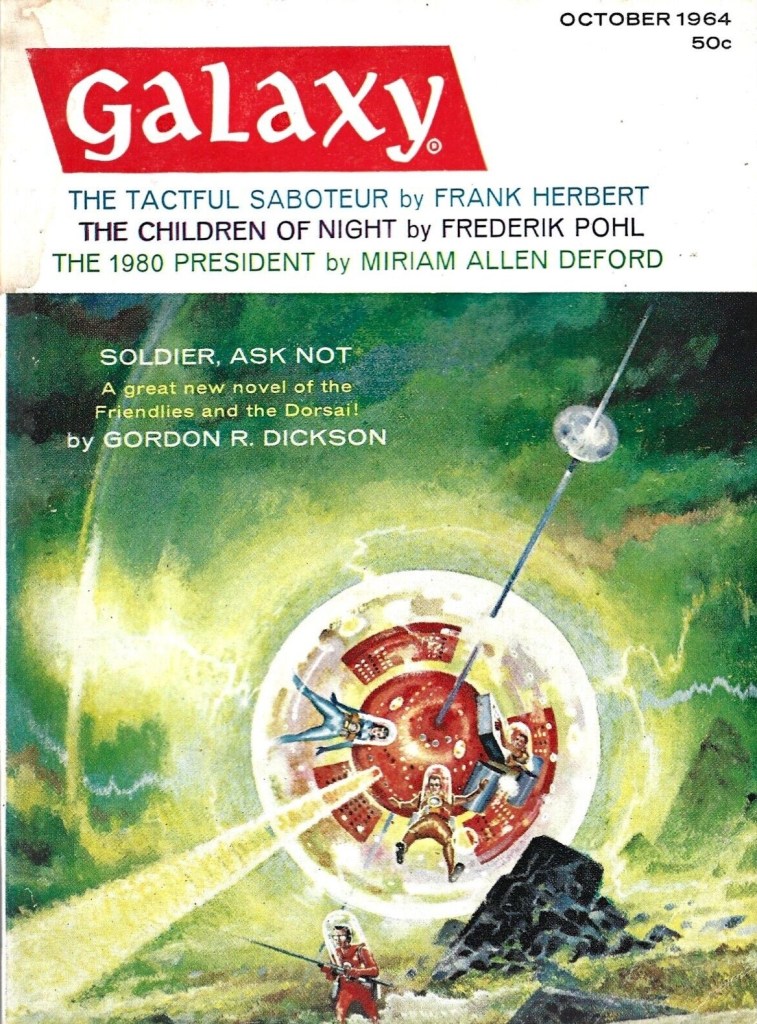
George Schelling’s cover for Galaxy, ed. Frederik Pohl (October 1964)
4/5 (Good)
Philip K. Dick’s “Precious Artifact” first appeared in Galaxy, ed. Frederik Pohl (October 1964). You can read it online here.
A vast array of scholarship charts the continuing allure Mars holds in the popular imagination [1]. David Seed writes that “since the late nineteenth century Mars has tantalized the literary imagination with the possibility that life might exist on that planet” [2]. The visions of Edgar Rice Burroughs, Leigh Brackett, Ray Bradbury, and countless others created a seductive and sometimes complex vista of longing and conquest. Brackett, for example, evocated a Mars that was “more complex and varied” than Burrough’s “imperial triumphalism” [3]. In Brackett’s “The Beast-Jewel of Mars” (1948) (scheduled for this series), Mars becomes the location for the revenge perpetrated by the colonized [4].
Bradbury’s Mars is often a strange conjured simulacrum of the American West–a location where memories of home are pasted on the landscape, combined with a jarring “nostalgia for the closure of the frontier,” and the nuclear fears of the 50s [4]. In more traditionalist strokes, Langdon Jones’ “The Empathy Machine” (1965) a tame yet exotic Mars becomes the location for mysterious alien technology that repairs human relationships.
Philip K. Dick takes his unique brand of paranoia and obsessive ruminations on identity to Mars’ multi-variant surface. Martian Time-Slip (1964), amongst my top Dick novels, follows the inhabitants of a colony on Mars that hides its deepest secrets to maintain support from Earth. Douglas Quail, in one of Dick’s best-known stories “We Can Remember It for You Wholesale” (1966), dreams of escaping to Mars before discovering that most likely he’s already been. Note: If you haven’t read Raymond F. Jones’ more straight-laced paranoid vision of a vacation to the Red Planet, “The Memory of Mars” (1961), check it out.
“Precious Artifact” (1964) declares its subversive intentions in the first paragraph. Milt Biskle works as a reconstruction engineer, transforming Mars’ “ancient water network” back into a “verdant” landscape (142). The reason? A devastating Prox-Terra conflict that bombed the once thriving surface. Soon the first Terran emigrants would return to Mars and stake their claims, perhaps Milt could “bring his own family here, receive priority of land acquisition” (142). First, Milt wants to meet with a psychiatrist — he suspects that something is profoundly wrong with the state of things. Maybe the Proxmen actually won the war. The psychiatrist adjusts his wig and dentures–all humans lost their hair and teeth from the “fallout during the war” (143)–and Milt agrees not to make his suspicions public in exchange for a trip to Earth.
On Earth Milt discovers a young woman, Mary, who has been assigned to guide him around NYC — and climb into his bed: “I’ll be with you constantly, night and day” (145). Earth is not like he remembers. No more parks exist–“we’re so damn overpopulated” Mary exclaims (145). But the evidence doesn’t add up. In distinctly Dickian touches, Milt notices small details that suggest he’s interacting within a simulacrum reality. When he confronts Mary, she gives in. Yes, they’re Proxmen. Yes, they will show him reality. But they need Milt and the reality can only be so real with just enough truth sprinkled in to keep him alive.
“Precious Artifact” fits the remit of this series on multiple levels. First, Dick demystifies the power that Mars holds. Mars might be a new frontier but Milt wants above all else to return to Earth. And, in the final calculation, the idea that something of Earth (a pseudo-cat that he imagines is real) might continue to exist keeps Milt from committing suicide. On a more obvious level, Dick imagines a future where humanity will not triumph in a Cold War-esque struggle with aliens. Humans are on their way out. Milt, and his simulacrum cat, will work to preserve the future of the enemy. And, like so many of Dick’s stories, there’s the disturbing undercurrent that the human mind cannot grapple with reality.
Recommended.
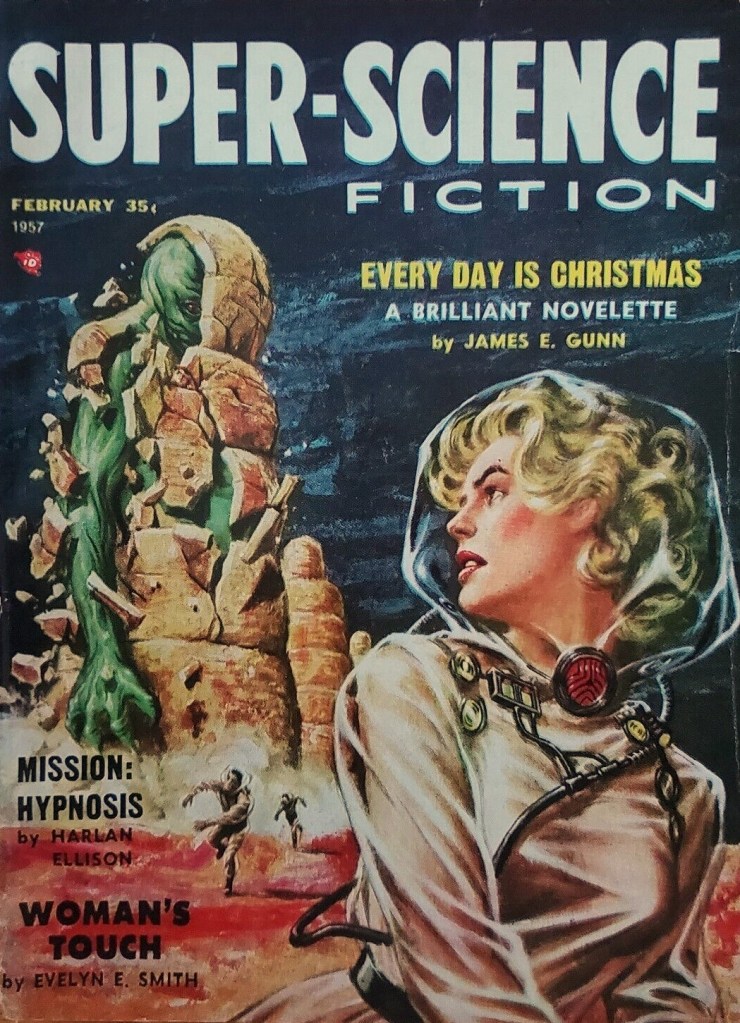
Ed Emshwiller’s cover for Super Science-Fiction, ed. W. W. Scott (February 1957)
3/5 (Average)
Henry Slesar’s “Mr. Loneliness” first appeared in Super Science-Fiction, ed. W. W. Scott (February 1957). You can read it online here.
Henry Slesar (1927-2002) is not a name I know well as he’s rarely mentioned in the scholarship I read [6]. According to SF Encyclopedia, Slesar began his career in advertising and coined the phrase “coffee break.” Of his several hundred short stories, around a third were science fiction or fantasy. His name is best known in the mystery field in which he won an Edgar Award for The Gray Flannel Shroud (1958). What are your favorite Slesar science fiction stories?
After a year in isolation on a deep space outpost, Pace believes he feels the “freak currents of space” infiltrate his dreams (40). While connected to other outposts by radio, the morose spaceman does not feel comfort in their business talk. He yearns for the company of his Earth-bound love. Three psychiatrists make their rounds of the outposts by hologram. His love does not join as planned. The psychiatrists ignore his problems and give him canned advice: “Keep those hands busy. Keep your mind off space” (43). Pace reaches a boiling point and the psychiatrists needle him on.
“Mr. Loneliness,” like many others in this series, tackles the psychological profile of the astronaut alone or isolated with only a few companions in deep space. In Frederik Pohl’s “The Hated” (1958), psychological conditioning prepares men for the cramped interior of a spaceship. In “Plague on Kryder II” (1964), Murray Leinster speculates that interstellar travel might create a “psychosis of solitude.” Prevention techniques include small random noises (conversation, faint music, rain, and wind) piped through the spaceship. Of course, the tormal aliens that accompany Leinster’s med ship crews also serve as needed companionship.
Slesar suggests that exposure to deep space isolation will also create an array of psychoses. Pace needs a kind face, sympathetic conversation, empathy. The technology exists to assist in maintaining comforting connection but its incapacitated by professionals who refuse to understand their patients. As with Tom Godwin’s “The Nothing Equation” (1957), there’s a cold lack of care for the men who risk their lives and sanity for the sake of progress.
This story is solid but unremarkable. I found it an intriguing piece of evidence in a tapestry of stories that confronted the dark psychological landscape that exploration of the cosmos will create. I can’t imagine it’s worth tracking down unless you’re obsessed with stories on this theme and exploring lesser-known authors of the 50s. I have two more of Slesar’s stories lined up for my media landscapes of the future series. Stay tuned!
Notes
[1] Robert Crossley’s Imagining Mars: A Literary History (2011) is a good place to start. See also the substantial scholarship on Ray Bradbury — for example, David Seed’s Ray Bradbury (2015).
[2] Seed, 45.
[3] Seed, 47.
[4] Seed, 48.
[5] Seed, 51.
[6] Mike Ashley mentions two of his short stories in Transformations: The Story of the Science Fiction Magazines From 1950-1970 (2005), 168 and 174: “Who Am I?” (1956) in his discussion of Super-Science Fiction and “The Brat” (1955). The former seems like it could fit this series as well. Ashley indicates that Harlan Ellison introduced Slesar to various New York editors of the day.
For book reviews consult the INDEX
For cover art posts consult the INDEX
For TV and film reviews consult the INDEX
 Science Fiction and Other Suspect Ruminations
I know I first came upon the name of Slesar in connection with Harlan Ellison due to the two collaborating on a story titled “Survivor #1”(1951), which was included in Ellison’s Partners in Wonder collection. It’s been a long time and I don’t remember the story.
I seem to recall Ellison being a fan of Slesar’s fiction which made me take note of the name when it would appear in random anthologies.
I believe his most famous work is “Examination Day” (1958), which takes place in a dystopian future whose plot would most likely show one why Ellison would praise Slesar. I would recommend finding a copy of that story, it is a quick read.
The work that I most associate with Slesar today is the Twilight Zone episode “The Old Man in the Cave”, based on a Slesar short story. I have not come across the fiction the episode was based on though.
I did enjoy that episode of TZ. It takes place in a post-nuclear war future and is quite grim. It has a positive, almost quasi-religious based on the allegory, view of technology.
Hello Chris,
Thank you for the Slesar comments. The brief asides about him in Mike Ashley’s monographs on 50s SF magazines, suggest, as you stated, that Ellison was a fan of Slesar and introduced him the editors of the day — the dismal W.W. Scott of Super Science-Fiction, whom Ellison wrote prodigiously for in the 50s, included.
I am unabashedly a fan of post-nuclear war stories and would like to track down the original Slesar story that inspired the episode. it seems to be “The Old Man” (1962): https://www.isfdb.org/cgi-bin/title.cgi?93638
“Examination Day” also sounds interesting. Will put it on the list. I have “Repeat Broadcast” (1956) and “The Movie-Makers” (1956) on my master list for the media series. I’ll squeeze them in later this year.
I just read “The Old Man” a few weeks back in “Microcosmic Tales” (a collection edited by Asimov) – somewhat different than the TZ episode, but easily recognized as related.
Cool! Did you enjoy it?
Yes. There’s more information about the organization of the village, and the army isn’t in the story (replaced by a rebellion of the younger men in the village), but it’s still a good story.
Sounds cool. I’ll check it out! I haven’t seen the TV adaptation so I’ll be going in blind.
I have not read nearly enough of Philip K. Dick’s work. Definitely need to remedy that.
Hello Tonya,
What are your favorites so far? This is a pretty approachable PKD 60s short story with many of his hallmarks.
As in novels such as “Martian Time-Slip” and “The Three Stigmata of Palmer Eldritch”, the dream of the Martian frontier has turned sour. The real focus is not on the disenchantment with Mars as a new age colony here though, which is really only really being turned into a sort of amusement park. The problem is more existential: would it be better to accept the truth and adjust to the situation, or is an illusion better than the angst that plain knowledge will entail? As in much of his SF, reality and illusion are entwined and there isn’t any simple answers.
I think there’s also a problem with empathy. Milt Biskle seems to accept the fact that the Proxer race are the same species as himself, but does that mean they care about him and what they did to his people? Will he get on with them and his superficial family? They have really committed genocide and are probably only human in appearance.
This is very well written, one of the best pieces of his shorter SF, with probably only “Faith of Our Fathers” being better. In fact, I think it’s better than some or several of his novels, which is really saying something.
While I enjoyed the story, I do not think it is close to his best short fiction work.
You bring up some good points about Milt’s confused “empathy.” Dick signals in the beginning of the story that Milt is sympathetic to the Proxmen. But his sympathy doesn’t seem to waver much when he discovers the extreme atrocities perpetrated by them on his people. Also… I am unclear how Milt wouldn’t eventually learn of the extent of the destruction if he is to reconstruct Earth in the future.
I think our preferences differ then. Dick wrote so many short pieces, so it’s not surprising he wrote a substantial number of bad or average ones. Unlike them, it’s very well written as I said, in a simple but elegant prose, and is quaint, poignant and focused on human feeling and angst, qualities not often found in his shorter fiction. Still, we can both like different things, I’m just saying why I like it so much.
Yes, while Dick was concerned with empathy as a defining human factor, I think it’s tinged with moral uncertainty in his SF, as it is here. I remember liking the mechanical cat the first time I read it, that fuzzy line between real and artificial things being partly what made it so attractive to me and has left a lasting impression. It even seemed to respond to his attempted suicide!
“Still, we can both like different things.” — Of course, but in this instance we both liked the same story!
I know there’s a ton about mechanical animals in Do Androids Dream of Electric Sheep? (1968). Are there other pre-Androids examples of mechanical animals in his fiction besides “Precious Artifact”? I can’t remember.
Of course we did, sorry, I meant that I thought it should score more points. It was one of the earliest of his short SF I read, and the impression it made on me at the time, has lasted, as I said. We can have different views on the standard of individual pieces though.
Yes, it reminds me of the theme of ornamental but realistic fake animals in “Do Androids Dream of Electric Sheep”, where it poses the more existential query of if “humanity” can still cherish things of pseudo-life, even if they know they’re artificial. The closest I can come to other mechanical animals in his SF, are artificial insects in “The Simulacra” and the later “A Maze of Death”, that also has artificial snakes. “Do Androids Dream of Electric Sheep” also has artificial flies, which I assume you know.
Considering my deep love of cats, I feel his need for a pet — a memory of a past world that no longer exists and a wonderful companion.