Which books/covers/authors intrigue you? Which have you read? Disliked? Enjoyed?
1. The Saliva Tree and Other Strange Growths, Brian W. Aldiss (1966)

Les Edwards’ cover for the 1979 edition
Contents: “The Saliva Tree” (1965), “Danger: Religion!” (1962), “The Source” (1965), “The Lonely Habit” (1962), “One Role with Relish” (1966), “Legends of Smith’s Burst” (1959), “Day of the Doomed King” (1965), “Paternal Care” (1966), “Girl and Robot with Flowers” (1965)
Initial Thoughts: I love Aldiss as most of you probably know. I’ve reviewed around 45 of his short stories and 5 novels. Hothouse (1962) was one of last year’s reading highlights!
2. Science Fiction from China, ed. and trans. by Dingbo Wu and Patrick D. Murphy (1989)

Jennifer A. Damsky’s cover for the 1st edition
From the inside flap: “This anthology of stories by six major Chinese science fiction writers is the firstsuch collection to be published in English. The stories are enriched by CHina’s ancient trdition of fantastic literature as well as that nation’s fascination with futuristic science and technology, and they provide illuminating glimpses of Chiense attitudes, values, and daily life.
Like most Chinese science fiction writers, the authors represented in this volume are themselves engaged in scientific research or the popularization of science. Their work reflects the critical dictum that scientific fiction must be factual or based on reasonable extrapolations of known fact.
Among the themes treated in these stories are people’s use of and relationship to robots and clones; peaceful versus military applications of technology; futuristic detection and intelligence operations; space exploration and warfare; and personal heroism, patriotism, and responsibility. The stories typically incorporate an optimistic view of science’s contribution to the future of humankind.
Wu provides a comprehensive introduction to the history of Chinese science fiction together with a chronological bibliography of stories, novels, and related critical works.
This collection offers a unique perspective on modern China and a welcome opportunity to explore the Chinese contribution to one of the most popular forms of contemporary fiction.”
Contents [For the original titles here’s the bibliographic listing]: Tony Enzheng’s “The Death of the World’s First Robot” (1982), Wei Yahua’s “Conjugal Happiness in the Arms of Morpheus” (1982), Ye Yonglie’s “Reap As You Have Sown” (1981), Xang Xiaoda’s “The Mysterious Wave” (1979), Tony Enzheng’s “Death Ray on a Coral Island” (1978), Zheng Wenguang’s “The Mirror Image of the Earth” (1980), Ye Yonglie’s “Corrosion” (1981), Jiang Yunsheng’s “Boundless Love” (1987)
Initial Thoughts: A few months ago I voted for the first time in the Hugo Awards. And, considering the awards will be held in China (to great controversy concerning the choice of Russian author Sergei Lukyanenko as a Guest of Honor), I wanted to read-up a bit on earlier Chinese SF in the late 1970s and early 1980s. I will feel like a fish out of water writing about this one! Wu Dingbo, who received a PhD in English on “Utopias by American Women” in the United States, contributes what’s bound to be a deeply illuminative introduction to Chinese Science Fiction.
3. Ibis: Witch Queen of the Hive World, Linda Steele (1985)
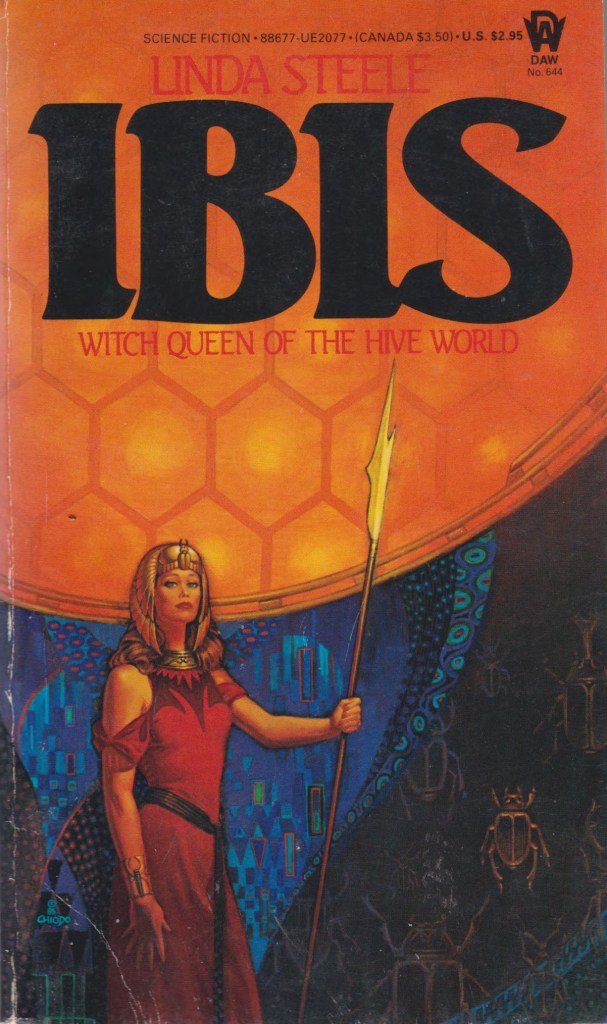
J. Chiodo’s cover for the 1st edition
From the back cover: “When Padrec Morrissey and the crew of his Planetary Exploration ship crashlanded on Ibis 2, they realized quickly that they weren’t the first human ship to have landed there. The native Ibisians were not only sentient, but strangely human. However, unlike most of the early colonies, the denizens of Ibis deviated widely from the mammalian norm.
The natives displayed a highly organized societal behavior like that of certain Terran insects. And their behavior was a mirror of their physiological changes. Like a beehive, 95% of Ibsians were neuter–workers or warriors. Very few were truly male or female, and of these only the true females, the Queens, were intelligent.
Padrec faced a triple problem. How to explain to his queen captor that he was an individual; how to escape a future of mindless hive servitude; how to save his crewmen’s lives…”
Initial Thoughts: A DAW Collectors volume I’d never heard of by an equally unknown author. Here’s all that SF Encyclopedia states: “(1953- ) US author (not the Linda Steele married to Michael Moorcock) whose Ibis: Witch Queen of the Hive World (1985) examines human sexual politics (see Feminism; Gender) through the perspective of an affair between a human male and a female of an Alien hive-like species.” Doesn’t have the most compelling premise…
4. City of Masques, Alan Brennert (1978)

Dennis Luzak’s cover for the 1st edition
From the back cover: “A BONE-CHILLER ABOUT A HOLLYWOOD STUDIO THAT WOULD MAKE ANYONE A STAR FOR A TERRIFYING PRICE.
Dalmatton Studios was building an empire on the fading dreams of Hollywood hopefuls. Struggling actors and actresses were turning up in starring roles in the most lavish, most expensive productions in town. Even the critics were amazed. No one had ever seen a sexier Marilyn. Or a more brutal Manson.
L.A. Times reporter Marnie Eilers sensed a scoop when she heard about the revolutionary technique. Jim DeKalb, the actor she lived with, wanted to investigate too. He wanted to try Dalmatton’s amazing “method.” It was very simple: electronically replace your thought patterns with those of the person you want to become: Farrah Fawcett-Majors or Robert Redford, for example.
THE RESULTS WERE SPECTACULAR: OVERNIGHT FAME OVERNIGHT TERROR.”
Initial Thoughts: Back in 2021 I read my first Alan Brennert short story “In This Image” (1974) and swore that I’d read down more of his fiction… I haven’t, yet.
For book reviews consult the INDEX
For cover art posts consult the INDEX
For TV and film reviews consult the INDEX
 Science Fiction and Other Suspect Ruminations
Despite my admiration for Brennert’s short fiction, I have not read CITY OF MASQUES and if I’m honest the theme doesn’t thrill me. Of the Aldiss collection, I’ve only read the title story. And I’m ignorant of those other two books.
You know me and media-themed SF! I love a good movie about movies, I’ve had less success with SF about movies… Although there must be some exceptions that I could conjure up.
Yeah, I forgot I had that Aldiss volume in the stack of books waiting for a post! I look forward to it.
I am surprised that there was an anthology featuring Chinese science fiction which fits the criteria of your site. I have not heard of this book. I have been trying to keep up with Chinese science fiction releases in English, of which there are a plethora compared to just a decade ago. To say the least.
I recently finished the Sinopticon anthology (published by Titan Books). The oldest story included was published in 1991. Most of the stories are much more recent though.
The only story from your find which I have read is Zheng Wenguang’s “The Mirror Image of the Earth”. I’m sure I would remember it if I read a synopsis of the story, but I’m drawing a blank as to whether I enjoyed that one or not.
I was surprised as well! Are you going to try to track down a copy? The going price seems to be around $20 online with shipping (at least in the US).
If I could find it for around that price, I would be tempted. That’s not too exorbitant. I was thinking it might be rarer today. Darko Suvin’s Science Fiction from Socialist Countries anthology, from 1972, seems to be nearly impossible to find, for example. I guess the Science Fiction from China book is more recent.
Here’s the Abebooks listing. I can’t promise someone won’t snatch it before you if I link it (haha): https://www.abebooks.com/servlet/SearchResults?sts=t&cm_sp=SearchF-_-home-_-Results&tn=%20Science%20Fiction%20from%20China&an=Patrick%20D.%20Murphy
I own Suvin’s Other Worlds, Other Seas: Science-Fiction Stories from Socialist Countries (1970) but I acquired it a few years ago so I don’t remember exactly how much I paid… Abebooks says $16 with shipping currently.
On a related topic, do you follow Rachel Cordasco’s wonderful site SF in Translation? She has a vast index of translated SF.
Oh. Maybe the price has come down in recent years, or maybe I didn’t do a good job of looking. heh
I do own a copy of Path into the Unknown: The Best of Soviet Science Fiction and View from Another Shore, edited by Franz Rottensteiner (which covers some of the same territory as Suvin’s book).
I have visited the SF in Translation site when I am interested in trying to discover genre literature from a specific country.
I own both Path into the Unknown: The Best of Soviet Science Fiction and View from Another Shore as well!
I reviewed a story from the latter to inaugurate my media landscapes of the future series — Lino Aldani’s wonderful Good Night, Sophie” (1963, trans. 1973) https://sciencefictionruminations.com/2022/01/22/the-media-landscape-in-science-fiction-short-stories-lino-aldanis-good-night-sophie-1963-trans-1973/
You remind me I really need to go back to Aldiss!!
Yes! Please!
I’ve read Ibis, but have zero memory of the plot.
You didn’t review it anywhere? Alas!
I had it lined up to review on SF Mistressworks, but then things happened.
Maybe put it in the review queue again. You’ll probably get to it long before me.
Brennert’s book is a solid first novel – although I may be biased because I’m such a big fan of his work in general (and I thoroughly enjoyed all of his more recent historical novels).
His next novel, Kindred Spirits (1984), is also interesting: it’s a romance novel but with a sort of speculative – or perhaps better stated, supernatural – hook.
His first great novel, though, is Time and Chance (again with a sort of SF but really more magical plot device), but it falls outside of your framework since it was published in 1990.
Any favorite Brennert short stories?
There’s not a single one collected in the book Her Pilgrim Soul that I didn’t like; I’d say my two absolute favorites are the title story and “Sea Change.”