Which books/covers/authors intrigue you? Which have you read? Disliked? Enjoyed?
1. Under Compulsion (variant title: Fun with Your New Head), Thomas M. Disch (1968)
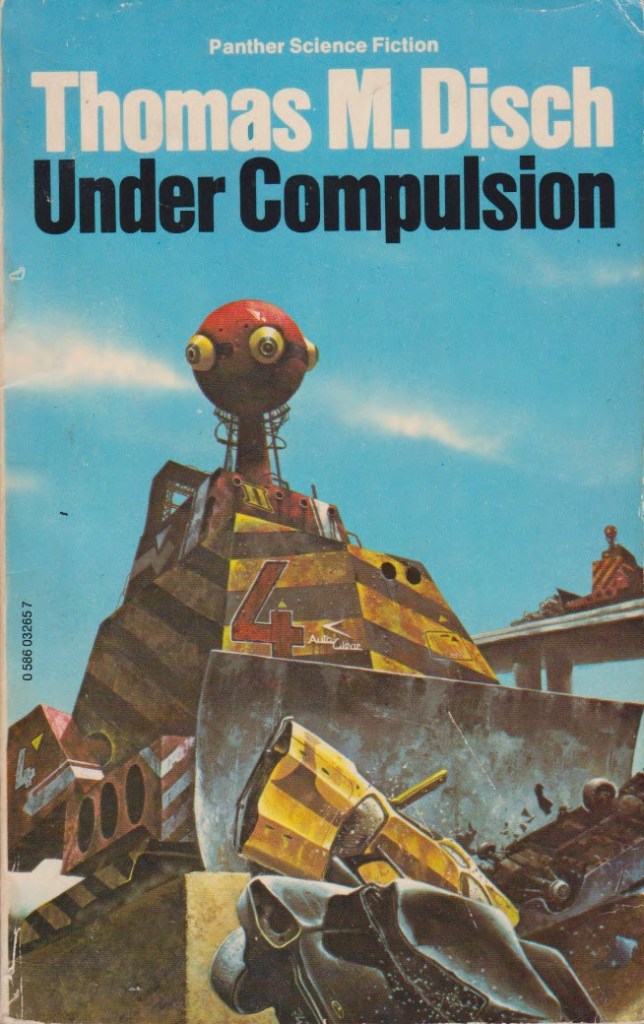
Tony Roberts’ cover for the 1978 edition
From the back cover: “A BLACK BANQUET OF PURE DISCH
A part-human, part-electronic brain going slowly mad in the Venus jungle.
The last man on earth rejecting the last woman.
A Russian astronaut looking for a good reason to die on the moon.
A chilling glimpse of a 21st century America where war is peace, freedom is slavery and ignorance is strength–and they like it like that.
These and thirteen more dark delights by the brilliant author of THE GENOCIDES and CAMP CONCENTRATION await you in this outstanding collection. Read them. Eat them. But be sure and get them into your head somehow.”
Contents: “The Roaches” (1965), “Comes to Venus Melancholy” (1965), “Linda and Daniel and Spike” (1967), “Flight Useless, Inexorable the Pursuit” (1968), “Descending” (1964), “Nada” (1964), “Now is Forever” (1964), “The Contest” (1967), “The Empty Room” (1967), “The Squirrel Cage” (1966), “The Number You Have Reached” (1967), “1-A” (1968), “Fun with Your New Head” (1966), “The City of Penetrating Light” (1968), “Moondust, the Smell of Hay, and Dialectical Materialism” (1967), “Thesis on Social Forms and Social Controls in the U.S.A.” (1964), “Casablanca” (1967).
Initial Thoughts: I’ve enjoyed the Disch short fictions I’ve read so far. He’s a unique and fascinating voice that I’ve been meaning to explore more widely this year since I read, and adored, The Genocides (1965) in January.
2. Earth in Twilight, Doris Piserchia (1981)
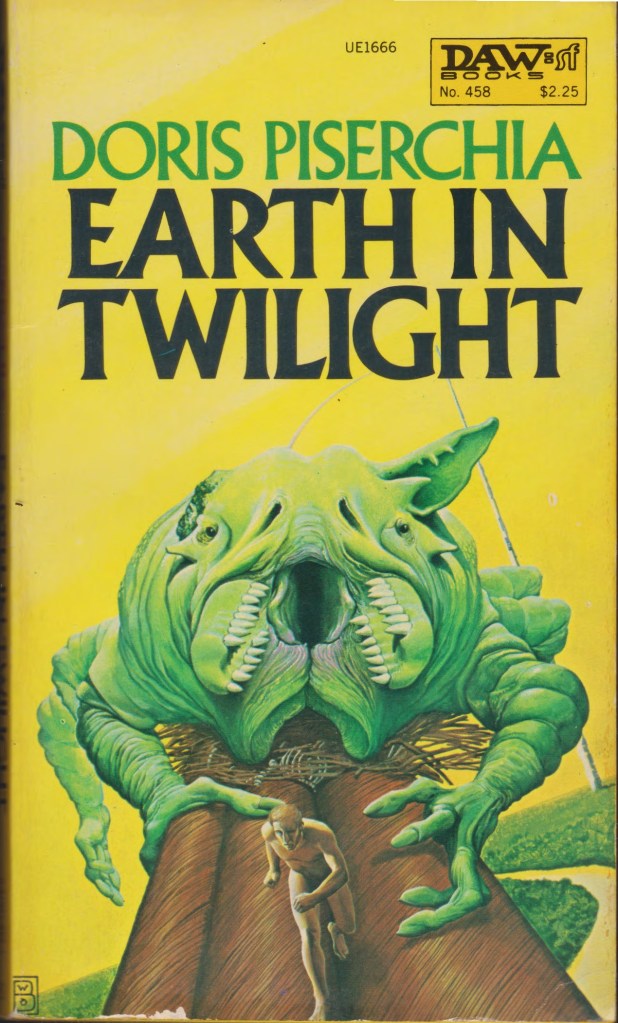
Wayne D. Barlowe’s cover for the 1st edition
From the back cover: “EARTH IN TWILIGHT
Laredo Space Base hadn’t sent a ship in Earth for hundreds of years before the Project Deep Green survey craft was launched. Only one thing was known: the planet humankind had so long ago vacated was a wasteland with nothing on it but poisonous flora and small, murderous denizens.
that’s what they taught astronaut Ferrer Burgoyne and as a result he was totally unprepared for the teeming jungle stretching farther than his eyes could see. He was even more unprepared for the slightly green humanoids who greeted him. Obviously the scientists of Old Earth had done more in their labs than just mess around mixing human and plant cells. As sure as Ferrer Burgoyne was an astronaut the new men of Earth were the descendants of those hidden, forbidden experiments.
How then could Burgoyne continue his mission: to defoliate Earth with the deadly chemical Deep Green and Prepare Earth for the return of his species?”
Initial Thoughts: Similar to Disch above, reading Piserchia’s “Pale Hands” (1974) earlier this year inspired me to track down more of her work. I’d previously read — and mostly enjoyed — A Billion Days of Earth (1976) and Doomtime (1981).
3. The New Tomorrows, ed. Norman Spinrad (1971)

Uncredited cover for the 1st edition
From the inside page: “WHAT IS NEW WAVE SCIENCE FICTION?
WHAT IS THE NEW TOMORROWS?
THE NEW TOMORROWS is a predestined collision of fifteen first-rate stories of somewhat scientific speculative fiction, collection and commented on by Norman Spinrad, himself the author of the controversial novel BUG JACK BARRON.
‘I submit them as proof positive that something has indeed been going on in the past decade. Leaving the labels an ideological epithets to the mandarins, I hope to give some feel for what has been going on, and let waves break where they may.’ –Norman Spinrad”
Contents: Michael Moorcock’s “The Pleasure Garden of Felipe Sagittarius” (1965), Samuel R. Delany’s “Driftglass” (1967), Edward Bryant’s “Sending the Very Best” (1970), Robert Silverberg’s “Going Down Smooth” (1968). Langdon Jones’ “The Garden of Delights” (1969), Terry Champagne’s “Surface If You Can” (1969), Damon Knight’s “Masks” (1968), Harlan Ellison’s “Pennies, Off a Dead Man’s Eyes” (1969), John Sladek’s “198-, a Tale of ‘Tomorrow'” (1970), Thomas M. Disch’s “Flight Useless, Inexorable the Pursuit” (1968), Norman Spinrad’s “The Last Hurrah of the Golden Horde” (1969), Brian W. Aldiss’ “Down the Up Escalation” (1967), Michael Butterwoth’s “Circularization of Condensed Conventional Straight-Line Word-Image Structures” (1969), Bob Marsden’s “The Definition” (1968), Philip José Farmer’s “The Jungle Rot Kid on the Nod” (1970)
Initial Thoughts: I tracked down this battered copy of Spinrad’s New Wave (in his words) anthology as it contains some of my favorite authors of the era (Disch, Spinrad, Silverberg, Sladek, Aldiss, Farmer, etc). I’ve previously read Delany’s “Driftglass” (1967) long before I started my site and thought I might return to it. I’ve linked above the other short stories I’ve previously covered on the site.
I wish I knew the cover artist! It screams 70s and New Wave.
4. The Martian Inca, Ian Watson (1977)

Stephen Hickman’s cover for the 1978 edition
From the back cover: “THE MARS PROBE HAS CRASHED
A triumph of Soviet technology, the first two-way interplanetary probe performed brilliantly until the final stage of its return. Then something went wrong: rather than following its programmed course to a soft landing in its country of origin, the probe crashed in the Peruvian Andes.
Now a weird infection beyond the understanding of medical science has wiped out an entire village–except for one man, who, alone and undiscovered by the medics, survives. He has awakened to find himself become his own ancestor, and a god. Suddenly the flames of an Indian revolution are spreading in South America; he is the MARTIAN INCA.”
Initial Thoughts: I struggle to write about Watson’s visions. I never managed to review The Embedding (1973) or The Jonah Kit (1975) despite my manifest enjoyment. As a result, I’ve avoided his fiction for the past few years as I gravitate towards authors that I can write about. I need to remedy that. Watson is fantastic. Sounds like a good resolution for 2024!
For book reviews consult the INDEX
For cover art posts consult the INDEX
For TV and film reviews consult the INDEX
 Science Fiction and Other Suspect Ruminations
The Disch collection can be read straight through with pleasure if you are in a suitably sardonic frame of mind. The classic of the book is “Casablanca.” THE NEW SF is quite a mixed bag. PJ Farmer’s “The Jungle Rot Kid on the Nod”–Tarzan as if by WS Burroughs rather than ER Burroughs–is not to be missed. I read THE MARTIAN INCA when it came out and found it pretty turgid going. If you want to read more Watson, I’d suggest skipping directly to the exuberantly nutty MIRACLE VISITORS.
Hello John, I have a copy of Miracle Visitors which I bought a few years ago.
The four stories I’ve read from The New SF were mostly solid. I look forward to reading the rest — and the Farmer, and his treatment of Tarzan, intrigues!
I have an idea for a series surrounding “Casablanca” — the main reason I acquired the collection actually!
The only Watson I’ve managed to review are some of his short stories. Do you have a favorite short work of his?
No. I’ve read several of his collections, and just reviewed their TOCs, but nothing leaps out from his short fiction. His metier is clearly novels, even if he gets in his own way all too frequently in them.
Oh, I thought the stories in The Very Slow Time Machine (1979) were quite memorable.
I remember some of them too. Watson has a knack for striking ideas. He’s not always so good at turning them into captivating fiction.
“Pennies Off a Dead Man’s Eyes” isn’t science fiction, although I had the idea it was post apocalyptic. It’s more like a mainstream piece about uncertain morality, which wasn’t bad, but it was far from his best.
If it’s post-apocalyptic (I call that SF) than I’m all the more interested in it!
There wasn’t much background to it. I read “The Pleasure Garden of Felipe Sagittarius” very many years ago, and is a weird and whimsical piece as I remember, but I don’t think it’s all that good. I didn’t like the Delany one, as I don’t of any of his short fiction. The one by P.J. Farmer is very good, although I haven’t read E. R. Burroughs.
I’ve read “The Martian Inca”, it probably has some good ideas, but the way it was written was rather bland. “The Alien Embassy” is much better. I couldn’t finish “The Jonah Kit”.
Yeah, I read and linked my thoughts on “The Pleasure Garden of Felipe Sagittarius.” I said:
“4.25/5 (Very Good): In some alternate world, Minos Aquilinas, “top Metatemporal Investigator of Europe” is called to a ruined Berlin (with Bismarks and Hitlers who don’t act like their namesakes) to investigate the murder of a man with paper lungs. His body lays in Police Chief Bismark’s garden, a vegetative locus in a ruined cityscape… Moorcock’s adept use of names with historical connotations in a ruined world where those connotations do not connect, creates the uncanny and decadent setting. Although the mystery does not surprise, Moorcock does conjure the “languorous scents” (104) of a vividly hinted at alternate Europe.”
I thoroughly enjoyed “Driftglass” (1967) when I read it before I started my site. It was one of the first SF short stories I read. My memories of it are hazy though.
I think Moorcock’s piece was strange and intriguing, but my memories of it are rather vague now.
…but yes, what I’ve read about the story does suggest that the speculative elements are minimal to non-existent.
That Disch collection is fantastic, among his best. Personal favorite is “Now is Forever”. I liked it so much my band cribbed the title: https://youtu.be/eH5NCE6Dk1c?si=O8fFJQ3WI3ZyEwge
Ah, cool! I’ll give it a listen.
I agree with John that “Casablanca” is the classic in the Disch collection — and overall it’s an excellent book.
I haven’t seen that Spinrad anthology, but I’ve read most of the contents. I do like Delany’s “Driftglass” (as I like most of his short fiction!) It’s not very New Wave though — and Delany always denies being part of the “New Wave”. The cover resembles Ron Walotsky just a bit, but I don’t think it’s him.
I like Watson’s THE EMBEDDING a great deal, but I haven’t read THE MARTIAN INCA.
To be honest, I place little on whether someone says if they’re a part of a movement or not. They certainly were publishing at a time in which New Wave ideas had traction and one can’t help but be inspired or influenced by the moment. A lot of people want to seem like they are independent of the trends — and that’s how I read a lot of those statements.
As for the story itself, it’s been too long since I read it to place it firmly in the movement or not. But a lot of his other works smack of the New Wave.
I agree that writers often avoid placing themselves in movements. And I would definitely put Delany stories like “Time Considered as a Helix of Semi-Precious Stones” and “Aye, and Gomorrah” in at least the “New Wave-adjacent” category. But I think “Driftglass” is not what I’d call New Wave at all, except that it’s quite well-written.
Definitely a challenging movement to pin down — I like Spinrad’s comments in the intro. He essentially suggests that the New Wave was more a new wave of creativity in which there aren’t single defining characteristics.
I found Earth in Twilight very enjoyable (as I’ve done with all Piserchia I’ve read), even though it’s not among my favorites of her books. It’s probabaly slightly more accessible for those that find her style too weird, messy or incoherent, as there’s a bit more overall plot, and the world makes somewhat more sense. It shares some elements with especially Doomtime and Earthchild (and to a lesser degree A Billion Days of Earth), certain tropes pop up again and again in her writing. Personally I enjoy her stuff more the weirder it gets.
I would like to explore more Watson, the only ones I’ve read so far are Deathcather and The Very Slow Time Machine. I suppose The Embedding would be a good one to track down.
I’ve read Doomtime and A Billion Days — as you know. I too am very tolerant of “weird.”
I thoroughly enjoyed The Embedding. I wish I managed to write a review as I’d have clearer memories of what precisely I enjoyed.
Earth in Twilight is a Piserchia banger. It feels like her take on Aldiss’ Hothouse, and where Aldiss was cynical Piserchia is downright nihilistic – but always with that uplifting Piserchia tone, that mix of Ballard-esque distance and normal pulpy SF.
I look forward to it. I’m not sure when but maybe in the coming year.