Which books/covers/authors in the post intrigue you? Which have you read? Disliked? Enjoyed?
1. It’s A Mad, Mad, Mad Galaxy, Keith Laumer (1968)

Richard Powers’ cover for the 1st edition
Back cover: “This frenetic collection of science fiction stories–often disturbing, always entertaining–comes from outstanding and unpredictable SF author Keith Laumer.
Tingle your imagination: In ‘The Planet Wreckers,’ Jack Waverly goes to bed an ordinary mortal and wakes up a movie star. But the trouble is, his life is the price.
Tired of being a 97-pound weakling? “The Body Builders” has the answer for you: Just buy yourself the Body Beautiful.
Exorcise your hostility! A Certain Powers plans to obliterate “the greatest menace in the world today”–coast-to-coast television, better known as ‘The Big Show.'” [I think the last description is not for a story in the collection. Laumer always had a story title “The Big Show” that appeared in 1968. Maybe they were planning on including it in this collection but substitute something else at the last minute?]
Contents: “The Body Builders” (1966), “The Planet Wreckers” (1967), “The Star-Sent Knaves” (1963), “The War Against the Yukks” (1965), and “Goobereality” (1968)
Initial Thoughts: Other than a few of Laumer’s Retief stories, I remain ignorant of his work.
2. Threats… and Other Promises, Vernor Vinge (1988)
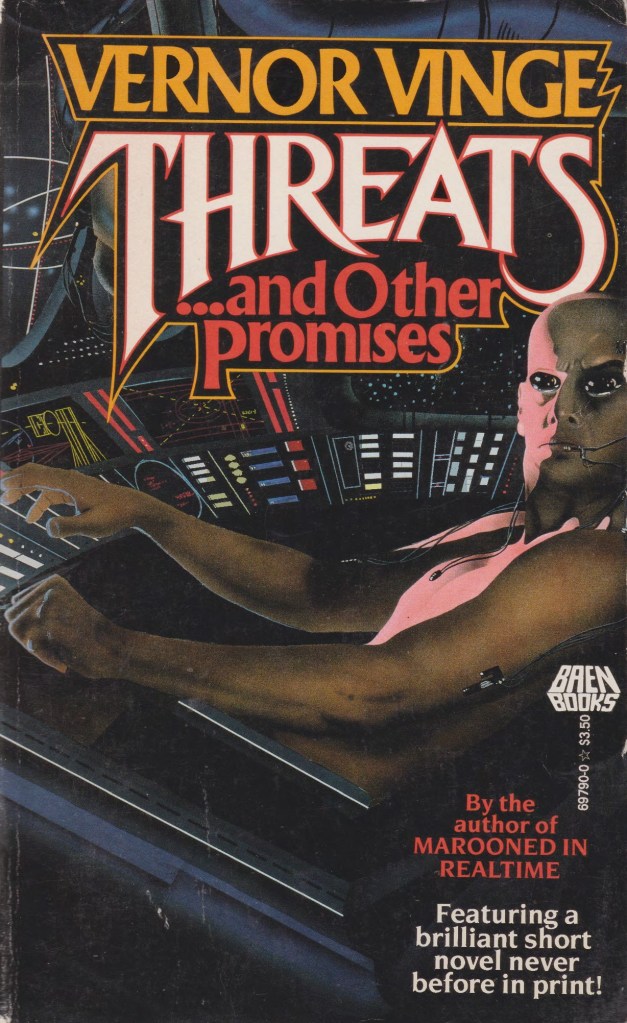
E. M. Gooch’s cover for the 1st edition
From the back cover: “Threats and Promises: HOW DO YOU TELL THE DIFFERENCE?
Take for example the ‘promises’ inherent in computers: super-human intelligence to do your every bidding and make our every wish come true; mind links with those mechanical intelligences to give us the gift of instant knowledge-on-demand of anything that has ever been recorded or can be calculated. Computer realities that aren’t just as good as everyday life—but much, much better.
But once we have such servants civilization will no longer be recognizable, or even comprehensible to such as us [sic]. Once you mind link with that super-intelligence you will no longer be human–you might not even be you. And the world that ‘you’ inhabit may be nothing more than a dream in the mind of a computer.
What was once a threat will have been a promise, and what once a promise will be some kind of… joke.”
Contents: “Apartness” (1965), “Conquest by Default” (1968), “The Whirligig of Time” (1974), “Gemstone” (1983), “Just Peace” (1971), “Original Sin” (1972), “The Blabber” (1988)
Initial Thoughts: In my obsessive Vernor Vinge binge in my late teens, I never got to his short fiction. I need to rectify that.
3. Rule Britannia, Daphne du Maurier (1972)
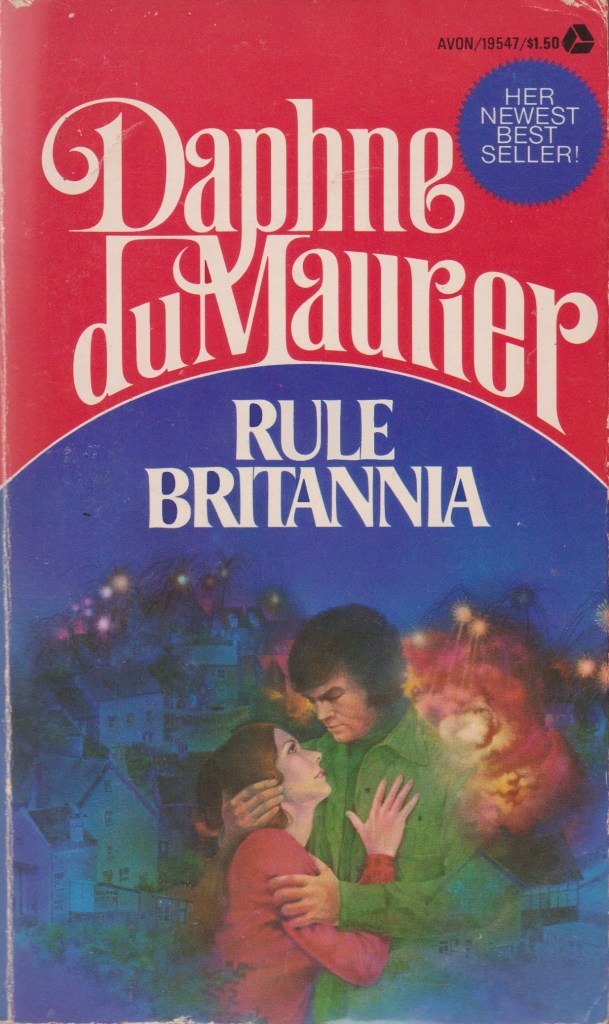
Gene Szafran’s cover for the 1974 edition
From the back cover: “Set in the not-too-distant future on the raw, blustery English seacoast of Cornwall, RULE BRITANNIA is the rousing saga of an indomitable woman who takes on the combined might of the British and American armed forces.
Known to all as Madam, she had retired after a brilliant theatrical career. Then she took in Emma–left motherless as a child–and the six boys, orphans whom nobody wanted. Suddenly one day their lives are transformed, as England and America join forces in an economic and strategic alliance, and American airplanes and troops swarm over the little town to ‘protect’ England from retaliatory invasion. But they hadn’t asked Madam! She leads the local protest forces, including irate villagers, her own brood of boys, and–she hopes–Emma, and pulls off a spectacular maneuver that carries the day. RULE BRITANNIA is a provocative new addition to the great du Maurier tradition–a tradition that includes such treasured bestsellers as REBECCA and DON’T LOOK NOW.”
Initial Thoughts: To be honest, the only thing I know about Daphne du Maurier is that she wrote the source material for Hitchcock’s The Birds (1963) and Rebecca (1940). Rule Britannia (1972) was her last novel.
4. Commune 2000 A.D., Mack Reynolds (1974)
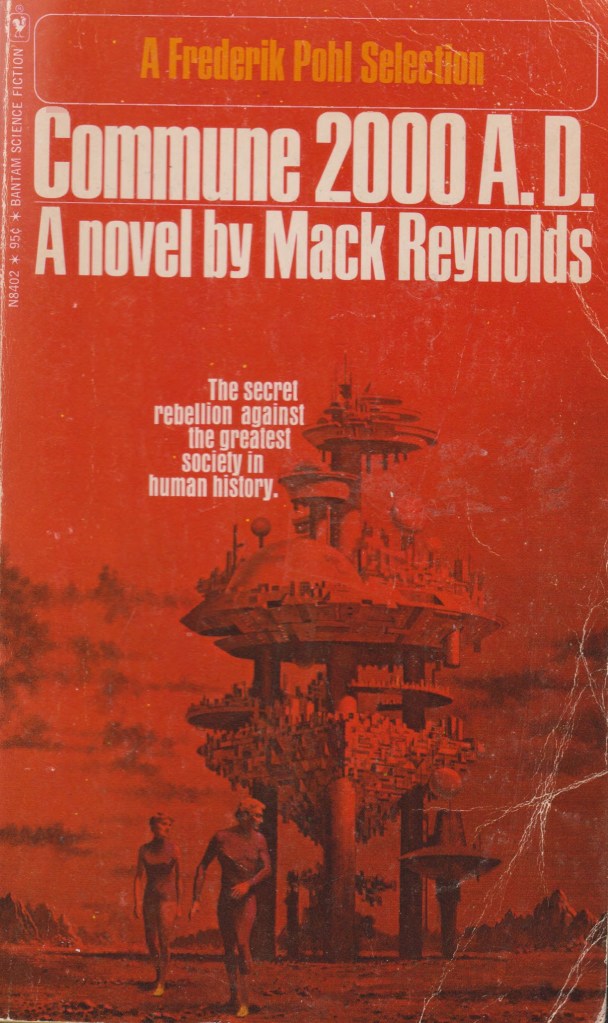
Dean Ellis’ cover for the 1st edition
From the back cover: “It was the future perfect, the greatest society in human history, with peace and plenty, and total sexual freedom. Utopia paid you the Universal Guaranteed Income, whether you worked or not. Yet something was wrong, it was a….
Fractured Utopia
By the thousands, the disenchanted fled the cities to join tiny, mobile towns that sprang up wildly. It was called the Commune Phenomenon. Super leaders of the super future challenged Swain to locate the worm of discontent. Strange, because Swain himself felt gnawed by corruption, distracted by lust, troubled by danger…
Commune 2000 A.D.”
Initial Thoughts: As I age, I find myself more and more interested in the counterculture or flight from urban life. Reynolds’ idea-driven and “unashamedly didactic” SF remains something I have not explored in much detail. In the first years of the site, I read the third volume in the Bat Hardin sequence — Rolltown (1976). I did not care for it at the time although I highlighted the transfixing premise. I did not realize that Rolltown was the final volume in the trilogy. I finally own the first!
For book reviews consult the INDEX
For cover art posts consult the INDEX
For TV and film reviews consult the INDEX
 Science Fiction and Other Suspect Ruminations
I’ve never been much of a fan of Laumer. I enjoyed his Timetracks themed collection well enough. Some “big idea” sci-fi involving the theme of time. Actually, I see that “The Star Sent Knaves” was included in Timetracks under a different title (“The Time Thieves”). His isn’t the type of science fiction I tend to seek out.
—————————————
”Apartness” may be the best fiction Vinge ever wrote. It was originally published in (Moorcock’s) New Worlds, which seems to be a very unlikely place to see Vinge’s name with hindsight. A Fire Upon the Deep was good for the type of fiction Vinge was writing, but I can’t say I’ve been too interested in seeking out more of his work.
The back cover on that book is…something. I’d have absolutely no idea how to even parse those sentences into any coherent information as to the contents.
——————————————-
You should read DuMaurier’s “The Birds”. It’s quite different than the movie (which is also quite good). It’s very much a work of existentialist fiction. I was surprised by how affecting a short story it was after expecting something along the lines of the movie.
I had never even heard of this novel by her. It sounds like an engaging read.
————————————————-
I love Mack Reynolds. However, Reynolds idea of the counterculture has always come across as a square’s version of the counterculture. Still, there is something to be said for Commune 2000 AD, which I did read. Even if I find myself reacting to Reynolds’ writing of sex scenes with humour.
Hello Chris,
Re-Vinge’s “Apartness” — my friend Brian Collins (an occasional commenter on my site) recently reviewed that one on his site: https://sffremembrance.com/2024/01/13/short-story-review-apartness-by-vernor-vinge/
Re-Reynolds — what are you favorite works of his? Yeah, that was also the vibe I got in Rolltown (1976), the third in the sequence and the only novel of his I’ve read.
Daphne du Maurier — while I am intrigued by her SF, I am not sure I’ll get to non-SF works. I have tracked down another one of her stories for my media landscapes of the future series. I think this novel is generally considered her worst… but it’s SF so I had to find a copy!
I would say my top Reynolds’ novels include:
1.)The Day After Tomorrow-It has a corporate CEO crucified like the Christ on the cover. You know it’s going to be great by the cover alone. It was Reynolds at his scathing best.
2.)Trample an Empire Down-It deals with similar themes as Commune 2000 AD but without Reynolds’ attempts at being hip.
3.)Time Gladiator-Ignore the stupid title. There is a lot of political commentary hidden behind the pulpy exterior. Although, your enjoyment will vary based on how interested you are in reading Reynolds’ political views disguised as science fiction. It’s the main draw of Reynolds for me.
4.)The Black Man’s Burden trilogy-In some ways, it is very dated. However, in other ways, I would say it is still (sadly) relevant.
I also know that China Mieville enjoyed The Rival Rigelians. I only came across a copy recently (it was only published as an Ace double), and I had trouble getting immersed in the book. The writing style read as quite “pulpy” (which, I know, some people would scoff that I am making that complaint about Reynolds specifically for this one novel). I stopped reading it and picked up another book. I am ashamed to admit I found the other Reynolds’ novel included in the set to be more fun…Planetary Agent X, which is mostly a typical space opera story. I wouldn’t recommend Planetary Agent X to anyone, but it was a quick read.
It’s actually the political discussions that I am most interested in. I know his plots tend to be ramshackle and repetitive.
If you happen to remember ANY of Reynolds’ work that discusses or mentions unions… I would be particularly fascinated (even if the story is trash). I am fascinated by the tension between his Marxist views and attempts at reform of capitalism that unions represent (yet simultaneously were part of).
Well, the Rival Rigelians actually does have some comments about unions towards the beginning. It’s a Cold War-era novel. The plot is about the USSR and the US establishing colonies on other planets. There was something about a rebel faction on one of the USSR dominated planets wanting legalized unions. The State government responds that under Communism everyone is a member of the union. The rebels retort that they want real, independent unions not tools of the Stalinist bureaucracy.
As I said though, I didn’t get much further into the novel, so I’m not sure if unions were an aspect of the wider plot or just mentioned in passing.
I’ll try to look through my Reynolds collection and see if any memories come to me on the subject.
Thank you! That sounds like a fascinating dialogue about unions and the radical left! Perfect.
@JB —
You might try Dawnman Planet, first published in two parts as ‘Beehive’ in ANALOG Dec. 1965-Jan.1966.
https://www.isfdb.org/cgi-bin/title.cgi?5943
It was one of Reynolds’s ‘United Planets’ series about Section G: an interstellar secret agency, essentially, with the usual Reynolds cardboard characterization and plotting, and porridge-y prose
No unions. But the central concept is a strong one, and new at that time, I think.
Unfortunately for Reynolds, Bruce Sterling’s ‘Swarm,’ the first of his Shaper-Mechanist stories in 1982, dealt with the same idea far more strongly, at 30,000-40,000 less words. Still, I’ve wondered whether Sterling read the Reynolds as a kid and thought later, ‘good idea, now I’ll do it right.’
Overall, given that Reynolds was about the only writer back then who went in the particular politico-economic directions he did, I do feel very slightly guilty that I find the prospect of actually re-reading something like Reynolds’s The Five Way Secret Agent or Mercenary from Tomorrow so unattractive.
But there we are.
Re-Mark: I agree with you there. The prospect of reading a Reynolds novel does not excite me… but I want to have a better grasp of some of his future political extrapolations.
Fun trivia note: “The Day After Tomorrow” must of been influential because the cover ended up as the cover to the album “Resurrection” by Sacred Rite. See
https://www.metal-archives.com/reviews/Sacred_Rite/Resurrection/173459/
I didn’t know Daphne du Maurier wrote sci-fi. I only read Jamaica Inn by her, which I highly recommend. The premise of Rule Britannia sounds interesting.
I read a bit of Commune 2000 A.D. not too long ago. I’m not sure what the rest of the books in the Bat Hardin sequence are like, but you can tell Commune was a product of the free love era since the book begins with some graphic sex stuff and the lead character then sleeps with every campus girl he comes across. I found it severely lacking in plot, so I dropped it halfway through.
Unfortunately, Rule Britannia is supposed to be one of her weakest/worst novels. That said, it’s SF and within my decades so I had to find a copy!
As for Reynolds, that was precisely the response I had to Rolltown (1976), the third volume in the same series. Although, I did not abandon it as I wanted to write a scathing review. I am a bit more interested now in the theme and frequently read bad examples of SF as long as it is evidence of a larger claims I want to make… that logic gets me through a lot of terrible reads! hah.
I read Commune 2000 AD during the 70s when I was an adolescent. My reactions to Reynolds’ sex scenes were negative – surprising for an hormonal teenage lad. I found the book tedious and preachy and no amount of soft porn was going to alleviate it.
Hello Neil,
My response to Rolltown (1976), the third volume in the sequence, was remarkably similar!
Fantastic set of reviews! Made me go out and look for short story collections by Vernor Vinge and now I’ve got one now in my bucket list.
Hello Christopher,
Reviews? These are new purchases. I haven’t read them yet. That said, I review tons of science fiction on my site and you might find some other stuff worth tracking down: https://sciencefictionruminations.com/science-fiction-book-reviews-by-author/
The best place to start is probably my 2023 in review as it gives a more recent survey of my various reviewing series and projects: https://sciencefictionruminations.com/2024/01/01/my-2023-in-review-best-sf-novels-best-sf-short-fiction-and-bonus-categories/
Big fan of Laumer. The Retief stories are amusing but it’s his harder scifi which I appreciate much more.
Given opportunity, read “End a Hero”, “Dinosaur Beach” or “A Plague of Demons”. The last is a personal favorite.
I’m happy you continue to post, keep up the good work.
Thank you for the kind words.
I’m struck by the Vinge cover, mainly because I’m unused to topless pilot depictions. 🙂
I haven’t read any of these, but I’ll read Collins’ review of the Vinge to which you kindly linked.
I can’t imagine that there aren’t other “topless” pilot depictions! I’ll have to think about it.
Yeah, “Apartness” has been on my list to read for an unrealized review series (lips sealed). I’ll see if the project comes about.
The Vinges (Joan D. and Vernor) were quite a power couple in the early seventies in the pages of “Analog” before both went off to write novels. I liked both in my teens. “Grimm’s World” (Vernor) was fun, and “Tin Solder” and “The Outcasts of Heaven Belt” (Joan). But, then I graduated and went out into the real world and started working fourteen hour days, and get a social life, and I lost track of their stuff.
Never really liked the Retief stories (Laumer), but I liked his other stuff, but it’s been so long…and I was a different person back then.
Never read much of Reynolds, but it’s telling that during the sixties his regular markets were to the magazines of John Campbell and Fred Pohl, both heavy into social commentary fictions.
Covers: The best is Dean Ellis’, Gooch’s was ugly (looking like it was ripped from a bad video game), Szafran’s was saccharine, and the Power’s cover was one of his more pedestrian works.