Book Review: Those Who Watch, Robert Silverberg (1967)

3.25/5 (Above Average)

A preliminary note: I’m something of a Robert Silverberg completionist, especially work from his glory years of 1967-1975. I’ve reviewed forty-seven of Silverberg’s short stories and thirteen of his novels–I’ve also read but never reviewed A Time of Changes (1971), The Masks of Time (1968), Tower of Glass (1970), and the stories in Capricorn Games (1976).

While a middling Silverberg novel at best, Those Who Watch (1967) almost succeeds as a revisionist take on UFO panic. The aliens do not seek to experiment on, exterminate, or manipulate humans. Instead, this is a book about the lost and lonely, and how their love and care for the injured interstellar visitors that appear on their doorsteps transform their lives. It’s a problematic work that simultaneously pulses with kindness.

Continue reading
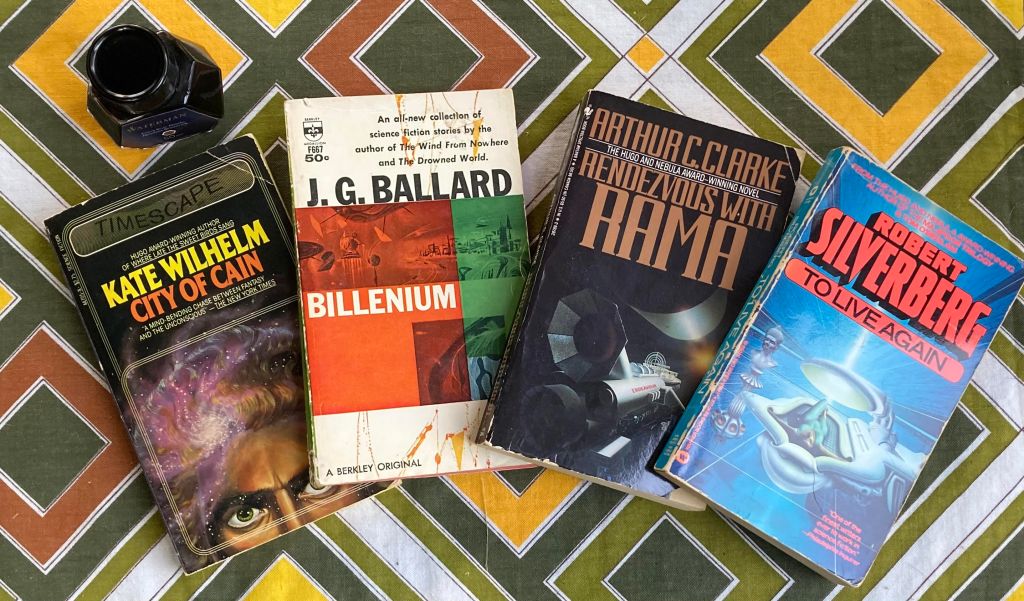
What pre-1985 science fiction are you reading? + Update No. XIII

What pre-1985 science fiction are you reading or planning to read this month?

Here’s May’s installment of this column.

As I am currently exploring the north-of-the-Arctic Circle reaches of Norway, why not segue way into this post by re-ruminating on the only Norwegian SF novel I’ve read: Knut Faldbakken’s spectacular Twilight Country (1974, trans. Joan Tate, 1993). I wish I’d thought to bring the sequel — Sweetwater (1976, trans. Joan Tate, 1994). Twilight Country, my second favorite SF novel read of 2021, contains one of the great depictions of a decaying metropolis. It is a densely metaphoric story of survival within its crumbling edifices. The masterstroke of Faldbakken’s novel is the portrayal of the Dump, a border zone containing the cast off fragments of human existence, as a place of recreation. Our characters run to the Dump to escape, to make their lives anew. They’re deeply flawed figures. There’s a tangible sense of organic transformation within the transients who inhabit this liminal zone. Sweetwater and The Dump act as a closed system. One decays into the other. One creates the other. Not recommended unless you like your SF dark and moody like me!

Continue reading

Short Story Review: Robert Abernathy’s “Single Combat” (1955)

In January, I inaugurated a new review series on the urban landscape in science fiction. I finally present the second post! And it’s a good one. I am joined by Anthony Hayes, a frequent contributor and creator of wonderful conversations over the last few years on the site (as antyphayes). I recommend you check out his website The Sinister Science. In addition to ruminations on science fiction–often through the lens of his academic PhD research in the Situationist International, “as well as other related left-communist and post-situationist writings,” he creates fascinating collages that interweave comic books, textual play, and historical images.

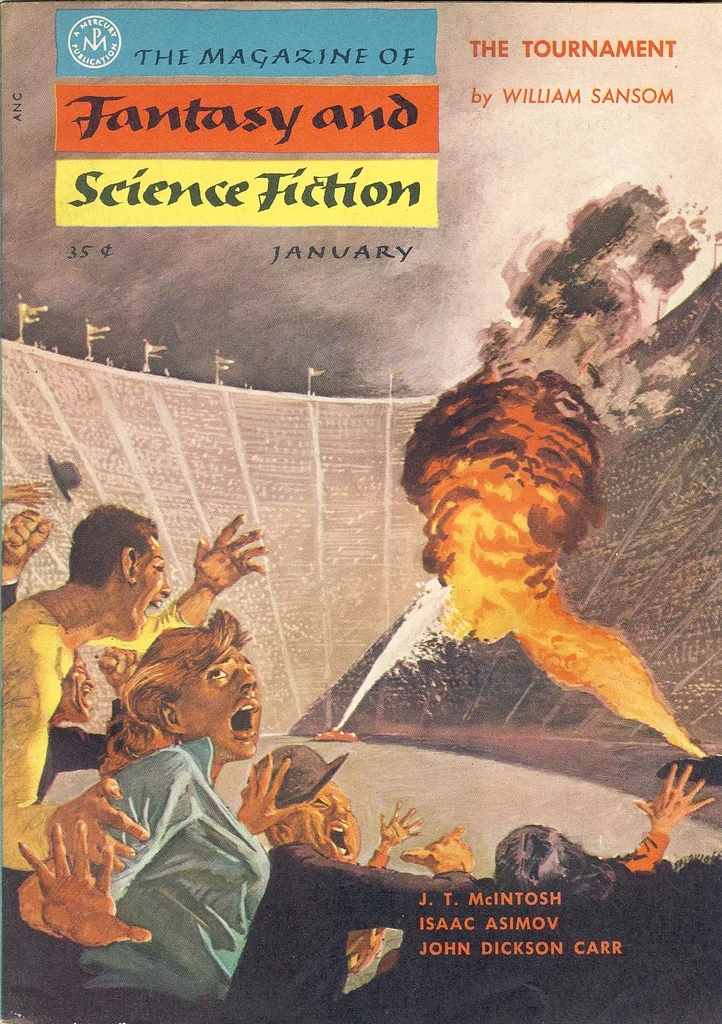
We chose Robert Abernathy’s deceptively complex parable of urban alienation “Single Combat” (1955) as our inaugural story. It first appeared in The Magazine of Fantasy and Science Fiction, ed. Anthony Boucher (January 1955). You can read it online here.

Previously: Michael Bishop’s “The Windows in Dante’s Hell” (1973), Barrington J. Bayley’s “Exit from City 5” (1971), and A. J. Deutsch’s “A Subway Named Mobius” (1950).

Up Next: TBD


Anthony Paul Hayes’ Rumination

Urban alienation writ large: Robert Abernathy’s “Single Combat”’ (1955)

Having planted an explosive device in a forgotten corner of an unnamed, North American city, the similarly unnamed protagonist flees. However, in fleeing the protagonist comes to realise what they had hitherto only suspected: that the city has become a living, conscious thing, and like all such things is willing to fight for its survival.my

Continue reading