Back from Norway! Time to acquire more science fiction.
Which books/covers/authors in the post intrigue you? Which have you read? Disliked? Enjoyed?
1. The Dreaming Dragons, Damien Broderick (1980)

Carl Lundgren’s cover for the 1st US edition
From the back cover: “TO THE PLACE WHERE SECRETS LIE SLEEPING. Alf Dean, an aborigine trained as an anthropologist, knew that his tribesmen, for centuries beyond memory, had warned of a dreadful secret in the mountains of Australia.
His ‘slow-witted’ nephew led him to the secret spot–the same spot where men were claimed by deaths that were secret to the world.
As secret as the knowledge the scientists now share which compels them to press deep under the mountain.. deep where the aborigines never go… through the nuclear shield, through the collective unconscious, deeper and deeper toward the center of the earth, closer to exploding the myths of time and space, closer to rousing… THE DREAMING DRAGONS.”
Initial Thoughts: I recently read Brian Attebery’s fascinating article “Aboriginality in Science Fiction” in Science Fiction Studies, vol. 32 (Nov., 2005) and decided to track down a few examples of SF that included Aboriginal characters. Damien Broderick’s The Dreaming Dragons (1980) features prominently in the article as an archetypal example of a “scientist or professional of Aboriginal ancestry” who serves as a “cultural bridge between Western science and traditional myth” (394). Count me intrigued! You can read the full article online here.
2. The Zilov Bombs, D. G. Barron (1962)

Uncredited cover for the 1965 edition
From the back cover: “BRITAIN.. A SOVIET SATELLITE.
From his East Anglian home–not far from Norwich where hostages await execution–Elliot, one of the pacifists responsible for Britain’s subjection, is drawn against his will into the British Union for Survival, a Resistance movement with ambitious and ruthless plans of diabolical violence…”
Initial Thoughts: I fell victim to the allure of esoterica, and a spectacular cover. I don’t know anything about this one. SF Encyclopedia writes that D. G. Barron was an UK architect and author. John Clute describes but does not assess The Zilov Bombs (1962). The back cover suggests an attempt to critique the extremes of Cold War action/inaction.
3. Darkchild, Sydney Van Scyoc (1982)
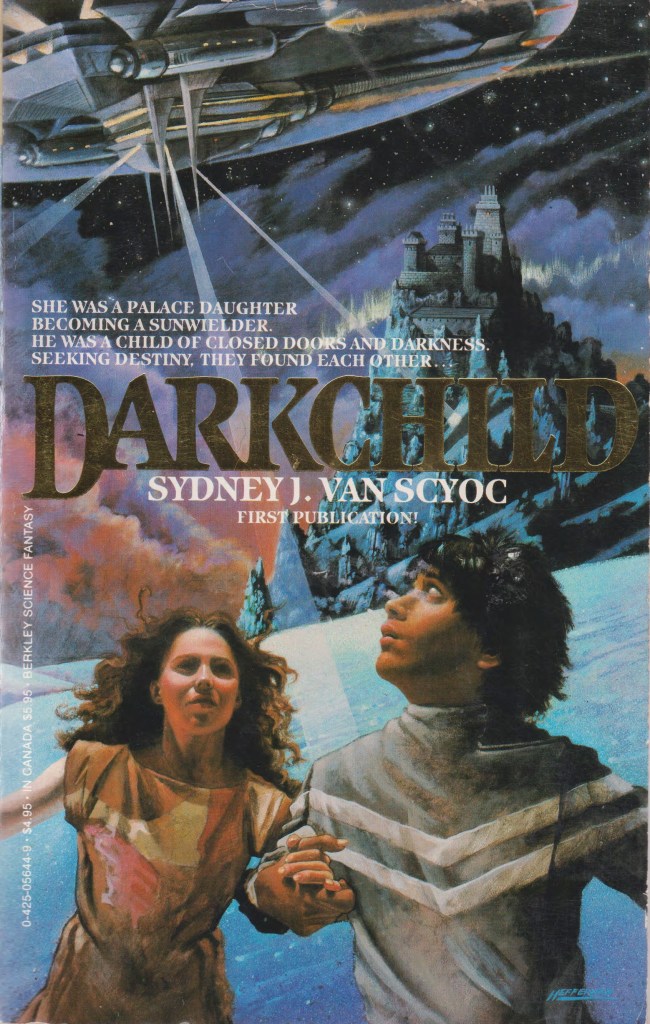
David Heffernan’s cover for the 1st edition
From the back cover: “For these hundred centuries, women of wisdom and strength have mastered the sunstones to bring warmth and wealth to their people.
But when the Brakrathi tended their stonehalls and valleys, others have traversed the spaces between the stars with less gentle motives. Like the arrogant Arnimi, who study and measure everything but understand nothing of the human soul. Or the Benderzic, who ruthlessly harvest information from their army of child informants and auction it to the highest bidder.
Until the coming of Darkchild. Until the end of the beginning of things.”
Initial Thoughts: I can’t say the blurb gives me much hope. Ian Sales, back in May, mentioned that the Daughters of the Sunstone sequence was Van Scyoc’s best novel work. I covered Van Scyoc’s first three published SF short stories last year.
4. Cryptozoic! (variant title: An Age), Brian W. Aldiss (1967)

Ron Walotsky’s cover for the 1968 edition
From the inside flap: “Near the end of the twenty-first century man made his final assault on the barriers of the fourth dimension–time–and they came tumbling down around him…
Edward Bush is an artist, an expert mind-traveler, moving through time like a phantom, and haunted by an equally phantasmal Dark Woman. Is she a guardian from the future or the anima of a disturbed mind?
And Professor Silverstone? Beatnik or charlatan? Or is his theory that time runs backward most terribly true?
And Ann–what part does she play among rival factions that threaten Bush’s existence?
This splendid piece of psychological science fiction represents a sustained act of imagination. It operates on several different levels, from the opening scenes on a prehistoric shore, to Queen Victoria’s Buckingham Palace, to the alien perspective of uncreated time. A godlike vision or an infantile fantasy; whichever Bush underwent, the reader must decide for himself.”
Initial Thoughts: Trying to complete my Brian W. Aldiss collection. He’s a favorite of mine.
For book reviews consult the INDEX
For cover art posts consult the INDEX
For TV and film reviews consult the INDEX
 Science Fiction and Other Suspect Ruminations
Fascinating choices as always. Love Aldiss as well, and have had an interest in van Scyoc for years, though I’ve seen little enough discussion of her work outside of your blog to get a fair assessment of where to start with her novels. Perhaps I should try the throw-a-dart approach and see what comes up.
Do it!
Yeah, and I too have only covered a tad bit of her work. I’ve reviewed three of her short stories recently and one of her novels, Assignment Nor’Dyren (1973) way back in 2011 — which I didn’t entirely understand at the time as interrogates some topics that I didn’t appreciate at the time (my memory is vague). I imagine I might have a far different take on it now.
‘The Dreaming Dragons’ does, indeed, seem like an intriguing title. I’ve never encountered it prior to your posting. If you give it a good rating, I might seek it out.
It could be years before I get to it! You might as well acquire your own copy. I have quite a few anthologies of Australian SF that I haven’t featured yet in these purchase posts as well. Anyway, we don’t always look eye-to-eye on SF (which is fine, of course!) so you might as well make your own assessment.
I hit comment too soon!
I bet you could find the clothes on the cover of Darkchild in a thrift store. (I agree with you that the novel doesn’t sound very promising.) The jacket looks just like a ski jacket from the early to mid ’80’s. One of the things I find so interesting about science fiction cover art and science fiction movies and tv is that the people are always dressed in futuristic versions of the current style. It’s particularly striking in post-apocalyptic science fiction from the ’80’s. There’s not enough food, people’s clothes are made from used clothes that have been sewn together, but somehow there are home perms and enough aquanet around for everyone to have metal hair. I’ve always found it kind of funny that science fiction from the ’50’s assumes that women will be wearing girdles in space.
Someday when I have the time, I want to write about the clothing in science fiction because it’s pretty interesting. As far as I can tell, the pointy shoulders and capes look of the future was heavily influenced by the 1936 version of Things to Come. It’s a visually stunning movie with beautiful (and expensive) costumes, so it makes sense that it was so influential. I would love to track down where the bulky cording at the knees and elbows of spacesuits from the Cold War era originated.
Fashion and textile history is currently big in my area of training — medieval history. I wonder if there are any articles in science fiction that address it. Go for it! I can’t say I have paid too much attention to it on covers but I often pay attention to depictions of food and waste in science fiction (Waste studies is actually a thing). I always find it fascinating how future food is depicted in such an anti-septic way (packets, drinks, pills, etc.) and of course, how they always complain that the fake meat they’re eating is nothing like what they remember as kids.
In re fashion in SF, you may wish to take note of J. T. McIntosh’s “Unit” (NEW WORLDS #55), which posits a planet where a great schism has developed between one hemisphere, which has decided to exalt all things of Earth, and the other, which eschews Earth and everything associated with it, including clothing styles:
“A child of five, sex unknown, went past wearing what looked like a model spaceship. A girl hobbled past in a dress shaped like a water-pipe. A man wore a box-shaped garment about his hips and a shirt in the shape of a sphere. The sphere idea was quite common. Apparently the perfect sphere was passed as non-Terran. The next man we saw wore what looked like a big cannon-ball about his middle and smaller cannon-balls everywhere else. A girl came along in the first skin-tight outfit we’d seen, with holes cut for her naked breasts to stick through.”
Well, you can’t say he wasn’t original. (Sometimes.)
And Barrington J. Bayley’s utterly bizarre novel The Garments of Caean (1976). It explores ” the power that external ornament–in this case clothes–plays in manipulating, controlling, and forming body image + self. Imagine a society where the garment maker “supplants the functions of psychiatrist, priest, and molder of public opinion […]” (31)!”
Full review: https://sciencefictionruminations.com/2012/11/23/book-review-the-garments-of-caean-barrington-j-bayley-1976/
I am going to add those to my list!
I love the idea behind The Garments of Caean. It sounds like this is not the focus of the novel, but an atelier could become quite powerful in that society.
And the clothing in McIntosh’s story sounds like a runway show gone off the deep end. Or perhaps the costumes in a Bjork video. I’d love to visit that world, though as a tourist who can wear normal clothes
I purchased a copy of the Broderick novel for the same reason. I found myself disappointed by the novel. I think I found the style to be dry.
Cryptozoic was a book I loved. It is dark and depressing, which is something I greatly enjoy in science fiction. It is also what I feel is Aldiss at his best.
How do you think Cryptozoic! compares to his other fiction? I love so much of his work — from Greybeard to Hothouse.
I’d rank it in the middle of his oeuvre. If I had to choose, I’d pick Barefoot in the Head as my personal selection for his best novel.
As far as Buddy’s: In that same review, he goes on to state that he think it’s good that Aldiss is “leaving the field”, so it sounded like Buddy’s had an axe to grind with Aldiss.
That use of “Buddy’s” should be read as Budrys
I should check Kincaid’s monograph I read last year on Aldiss if he had anything against Budrys. Here’s a fun but too short Q&A with Kincaid on his book: https://www.press.uillinois.edu/wordpress/qa-with-paul-kincaid-author-of-brian-w-aldiss/
“Cryptozoic” isn’t even close to his best [“Greybeard”]. “Algis Budrys called it “a useless book”. I think he’s right.
That might be the case. That said, as someone who enjoys lots of his work (Greybeard, Non-Stop, Hothouse, etc.), I don’t see the problem reading some of his lesser stuff. Even Aldiss’ worst often contain contain fascinating ideas. And, as you know, I’m not interested in reading only “the best” — especially as I have, in Aldiss’ case, read them already.
Yes, I can understand what you mean Joachim, I don’t think that “Non-Stop” or “Hothouse” are his best. If you’re really keen on any authors though, you’ll probably want to read all their books, as I have [not mentioning any names], whether they’re going to be good or not. It’s worth it to find their best or the ones you really like. “Cryptozoic” does contain some fascinating ideas as I remember, to do with the concept of time, but didn’t like the actual writing of it. Since I’ve read it, I had to make a comment and say what I thought about it, I didn’t mean to offend.
Or topics that one is fixated on — which is what motivates most of my reading nowadays rather than any particular author.
Richard, nothing you said offended me! And even if you did (which you didn’t), I’m a teacher. I have thick skin. Just imagine the crazy stuff I hear bloody every day… hahaha.
Good.
The only one of these I know is Cryptozoic, which I was never able to finish but nonetheless sat on my shelf for quite awhile. The premise seemed like an extended riff on Moorcock’s Guild of Temporal Adventurers’ prehistoric Time Centre (although naturally it’s possible the influence was going in the other direction, New Worlds encouraged that kind of cross-pollination of ideas/concepts) and the prose felt inert. After reading Barefoot in the Head, Greybeard, and Report on Probability A, Cryptozoic seemed like a letdown, not quite worth the effort. Your mileage may vary, obviously.
The dystopia angle is the most interesting. I’m rarely a fan of time travel. I say that but immediately tons of great time travel novels come to mind… including Holdstock’s criminally underrated Where Time Winds Blow (1981)