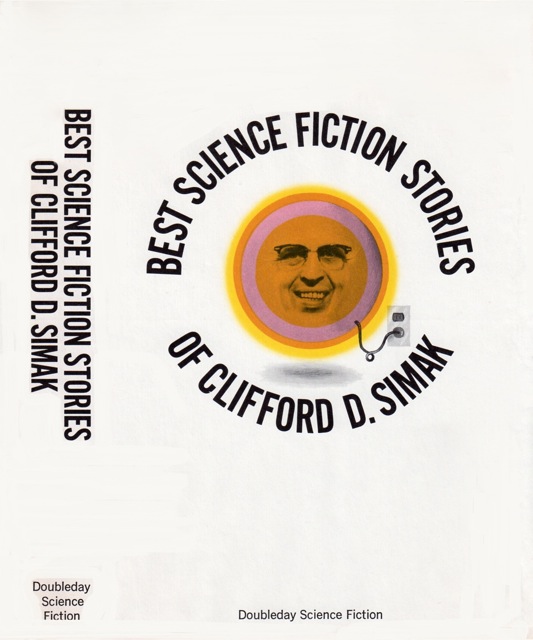
Lawrence Ratzkin’s cover for the 1st edition
3.5/5 (collated rating: Good)
I can’t get off my Clifford D. Simak (1904-1988) kick–the author that’s defined, directly and indirectly, my 2024 reading and writing adventure. Rather than hunt for more stories on the theme of organized labor, I fished out a collection languishing in a dusty corner of my shelves instead. Best Science of Science Fiction Stories of Clifford D. Simak (1967), not to be mixed up with the later collection The Best of Clifford Simak (1975), contains seven short stories published between 1954-1963. Of the bunch, “Founding Father” (1957) ranks amongst the best of Simak I’ve read. Only one, “Lulu” (1957), should be avoided.
While I still recommend City (novelized 1952) for readers new to Simak, this collection contains a nice representative group of stories from those nine years.
Short Summaries/Analysis
“Founding Father” (1957), 4.75/5 (Very Good). First appeared in Galaxy Magazine, H. L. Gold (May 1957). You can read it online here.
The collection starts off with the best of the bunch! As with Simak’s later “Conditions of Employment” (1960), “Founding Father” operates on the premise that space travel will be psychologically damaging to humans without technological assistance that can, in turn, generate its own trauma. In this story, Winston-Kirby, the sole human overseer (of robots and embryos) on a space colonization vessel, must struggle to cast off the deliberately constructed delusion (via a dimensino) that kept him sane throughout the voyage. In the delusion, he was one of six immortals who escaped earth for a peaceful planet. They spend their time in conversation, reading, hanging out near a fireplace in some archaic manor house. Even in the delusion he wonders “it was not often that six persons could live intimately for a hundred years without a single spat, without a touch of cabin fever” (11).
Without the delusion, Winston-Kirby feels adrift, despair sets in. The robot explains: “we let you keep them as long as we could [..] But we needed the equipment for the incubators” (13). In the isolated loneliness of his room, he comes “face to face” with the “sick sense of loss” (15). He knows that in order to survive a century in space, “there must be a delusion and companionship to provide security and purpose day to day” (15), And, perhaps the most disturbing element of it all, the companionship must be “more than human” (15), a manufactured peace, a utopian dream. And as a mutant immortal, he had a part to play in the bleak reality of Earth’s desperate desire for empire. He would serve as “father, proctor, judge, sage and administrator, a sort of glorified Old Man of a brand-new tribe” (17). Even with this knowledge, fragments of the his far more peaceful and content delusion keep on creeping in.
As with Simak’s later take, humanity’s drive to act, exploit, and expand proves psychologically damaging for the workers tasked with bringing it all about. They are the discarded chaff of humanity’s omnipresent desire to expand no matter the cost.
Recommended.
This fits my ongoing review series on “SF short stories that are critical in some capacity of space agencies, astronauts, and the culture which produced them.”
Previously: Clifford D. Simak’s “Conditions of Employment” (1960).
Up Next: Philip K. Dick’s “Explorers We” (1959) and James Tiptree, Jr.’s “Painwise” (1972).
“Immigrant” (1954), 3/5 (Average). First appeared in Astounding Science Fiction ed. John W. Campbell, Jr. (March 1954). You can read it online here.
Selden Bishop, against all odds, wins the right to head to the El Dorado-esque planet of Kimon. What the inhabitants and life is like on Kimon, no one is entirely clear as no one returns to Earth. Instead, across the vast distance, letters appear on Earth vaguely explaining Kimon’s perfection in addition to large quantities of cash and rare materials. Before he arrives, Bishop is beset by various wealthy passengers promising huge profit if he manages a way in to the Kimon’s market: “the man who cracks this Kimon situation is the one who’ll have it big” (21). Everyone wants to know how the technology on the planet could bring more profit to Earth. And so the legend grows… and the desire to exploit.
When Sheldon arrives, he encounters a range of other humans who won the right to visit the planet. They are stuck in various stages of denial about what they see and what they know. And soon the reason for the lack of real information about the planet sent to Earth becomes clear, a deep, humbling, and mortifying shame.
“Immigrant” contains the desperate searching for an source of social change that characterizes so much of Simak’s work. And again, the change rarely comes from within humans but by means of an external, alien, agent. Enlightened humans that can identify problems within society and acknowledge that others might know more than us, can take the first steps to learn to better the world. This story suffers from a bit of bloat. There is not enough here for the substantial length (54 book pages). I am glad I read it as it further substantiates my earlier analysis of Simak’s views on the American business ethic and post-WWII search for a better tomorrow.
Recommended only for completists.
“New Folks’ Home” (1963), 4.25/5 (Good). First appeared in Analog, ed. John W. Campbell, Jr. (1963). You can read it online here. Nominated for the 1964 Hugo for Best Short Fiction.
My second favorite story in the collection ruminates on age and memory and the possibility of a new path as death approaches. Frederick Gray, a retired professor, heads off on a fishing trip he used to take with his good friend Ben Lovell. Lovell lays in a hospital bed with little chances of heading home. Frederick knows the trip might be his last as well. Near where he spent countless hours fishing with Ben, a new home appears with few of the signs that would indicate a new construction. Frustrated, “for when a man is near the end […] his past is somehow precious” (76), Frederick decides to continue fishing. An accident occurs and Frederick must crawl back the way he came. As he cannot make it back to the car, he decides to knock on the mysterious house’s door. It opens. No one appears to be home but it smells like freshly cooked food. And when he awakes, he’s healed of his ailment… And instructions appear.
One of the reasons I keep on coming back to Simak is his willingness to incorporate non-traditional narrators–from an old professor on his final trip to a place rich in memory (“New Folks’ Home”) to a drunk sanitarium janitor (“Crying Jag”). This is a powerful piece on the importance of place in our memory. As a deeply nostalgic person myself, I found the longing for the sense of how it used to be palpable.
Recommended.
“Crying Jag” (1960), 3/5 (Average). First appeared in Galaxy Magazine, ed. H. L. Gold (February 1960). You can read it online here.
In the town of Millville on a Saturday evening our narrator, a sanatorium janitor who spends his weekends drinking, encounters an alien with a robot. The alien has an unusual request: “tell me about the troubles and tribulations” (100). The narrator, somewhat surprised, can only say: “I haven’t got no troubles. I am sitting pretty” (100). But there are many others in the town with troubles and, like the narrator with his jug, they seem to have a inebriating effect on the alien. Soon it becomes apparent that the alien is on the run from his kind who want to stop his illegal activities. Our narrator sees an opportunity for a business proposition as everyone wants an ear to divulge their troubles.
A slight story that reads as a gentle satire of the societal forces that encourage normality.1 The aliens proclaim that they all adjusted to life, yet, in reality, legions of maladjusted seek to lap of the misfortunes of others. And, in classic Simak, fashion, the story also reads as a light-hearted critique of the American business ethic, our drunken narrator can’t help but make a quick buck from the ridiculous scenario. This story reminded me of Silverberg’s far superior “Warm Man” (1957).
“All the Traps of Earth” (1960), 4/5 (Good). First appeared in The Magazine of Fantasy and Science Fiction, ed. Robert P. Mills (March 1960). You can read it online here.
The robot Richard Daniel worked for the Barrington family for six hundred years. The law states a robot cannot keep its memories for more than a hundred years (121). Richard knows that “human vanity” prevents a robot from living longer than a human (123). After the last Barrington dies, Richard must give up his double name (not often given to robots), his personal servant cubby, and the life he’s lived in service to a family that genuinely cared for him.
Impulsively, Richard decides to make a run for it with a pile of cash he’s hidden away for a day like this — he attaches himself to the exterior of a rocket bound for distant planets. On the voyage, something happens to his circuits as he experiences hyperspace unshielded. Richard’s story takes him across an uneasy futuristic capitalist landscape of robotic labor colonies on dangerous planets that “cried for exploitation” (136) and as a lowly crewman on a human merchant ship. He develops contempt for the humans around him, and yearns for his years serving the Barringtons. With his strange hyperspace-created powers, Richard wonders about his place in a world formed by man.
Despite my qualms with Simak’s robot stories that can at moments feel like revisionist takes on historical human servitude, “All the Traps of Earth” is well-told story with an appealing main character.2 Recommended for fans of his work.
“Lulu” (1957), 2.5/5 (Bad). First appeared in Galaxy Magazine, H. L. Gold (June 1957). You can read it online here.
My least-favorite story in the collection is a humorous trifle about a sentient “female” robotic spaceship falling in love with her three human male crewmen and setting off on her own grand romance. Riffing off of the tradition of naming airplanes and ships after women, Simak imagines that a Planet Exploration Robot–“a combination spaceship/base of operations/synthesizer/analyzer/communicator” (161)–would be programmed with a female persona in order to keep the crewmen company on a long voyage (as Simak is rarely more than G rated other implications are not discussed). In retrospect, the narrator suggests that Jimmy Robins’ bad romantic poetry caused Lulu to connect with them far more than intended. The three crew attempt–never picking up after themselves, refusing to move for days at a time, etc.–to make her fall out of love. Eventually she lands on a planet and finds a long lost alien robot. But there’s a hitch. Lulu’s new “man” means that she abandons the three crewmen outside on an alien planet. They need to get her to fall back in love if they’re ever to return to Earth.
It’s Simak at his least ruminative and moody–a strange inclusion for a best of collection. The concept of the robot programmed with a particular character to keep the crew sane on a long voyage is only touched upon. The rest is straight, often sexist in a 50s manner, sap. Forgettable.
“Neighbor” (1954), 3/5 (Average). First appeared in Astounding Science Fiction, ed. John W. Campbell, Jr. (June 1954). You can read it online here.
The inhabitants of Coon Valley, a ubiquitous rural farming community of the “kind of people you meet all over these United States” (203), barely survives on farming the bottomlands and pasturing the hillsides.3 The story follows an “old-timer” who would feel strange living anywhere else and the arrivl of an unusual neighbor. Unlike many who buy up an old farm and leave as the work gets hard, Reginald Heath transforms an abandoned farm into a veritable rural utopia–highly productive crops, repaired fences, a gorgeous garden filled with unusual vegetables, etc. The narrator slowly realizes that not is all that it seems.
While I’m not convinced of the merits of the actual story, “Neighbor” posits a utopian possibility that I’d suggest helps us formulate the world the Simak yearned for after the devastation of WWII and the emergence of a strong capitalist state. Here a small number of families, with the assistance of a humanoid alien that represents what humans could be if technology was not controlled by “our commercial-industrial society,” radically improve their own lives. As in many of Simak’s stories of corporate nightmare, farmers are not forced from their lands.4 Decentralization of technology prevents profit from becoming the sole objective. As Simak retrospectively spells out in various interviews, the problem is with technology’s implementation and control: “[it] should be used for the betterment of mankind and to make life more meaningful.”
There’s a mournful sadness in Simak’s stories as humanity rarely seems to change, without outside assistance, its own destructive urges.5
Somewhat recommended.
Notes
- Anna G. Creadick’s Perfectly Average: The Pursuit of Normality in Postwar America (2010) is a wonderful analysis of “normality” in the post-WWII world. ↩︎
- Simak’s strident anti-capitalist takes and general pro-brotherhood of all races (alien and humans) often clash with his stories of happy robot servants to kindly masters. ↩︎
- Simak includes one of his few direct references to the political parties of his day: “I imagine you’d call us [the valley old-timers] conservative, for most of us vote Republican without even wondering why and there’s none of us who has much time for all this government interference in the farming business” (203). ↩︎
- As in “City” (1944), revised as the first installment of the 1952 fix-up. In this iconic Simak story, farmers are forced to flee their lands for the abandoned urban centers due to the growth of the hydroponics industry and cheap transportation. In “Full Cycle” (1954), check page 38 of my article rather than my review as I dived into far more detail with helpful context, characters ruminate on the impact of more sophisticated farm equipment that forced farmers sell land to monolithic corporate holdings. ↩︎
- This tendency makes “Full Cycle” (1955) an unusual anomaly as humans, via roving unions, are able to discover their own innate potential. We don’t learn from aliens. We don’t encounter robots transformed by hyperspace. We change from realizing the importance of community, the land, and standing up against oppressive societal forces. ↩︎
For book reviews consult the INDEX
For cover art posts consult the INDEX
For TV and film reviews consult the INDEX
 Science Fiction and Other Suspect Ruminations
It’s worth noting in passing that two of these stories, “Neighbor” and “Immigrant,’ appeared in ASTOUNDING and are part of the still, small minority report that Campbell allowed, begging leave to differ with his human chauvinism. In “Immigrant,” the Earth humans go into space and find themselves starting at the bottom, not outgunned, but outclassed. In “Neighbor,” an alien sets up shop on Earth and proves invulnerable to official human interference (an aspect of the story you don’t emphasize, but I remember well). It took a fine writer to get away with that sort of thing in ASTOUNDING.
I wonder if you’ve ever read Simak’s story “Limiting Factor” (STARTLING STORIES 1949; well anthologized but not in a Simak collection until last year), which takes a slyly different angle on some of his familiar themes.
Hello John,
Thank you for the suggestion — I have not read “Limiting Factor” yet. I plan on continuing my read through of his pre-70s work next few years. I’d love for you to tell me more about the story. What’s the different angle?
Let’s avoid a definitive spoiler and just say it’s a different perspective on civilization and complexity.
Thank you for being considerate of people who might stop by — as for me, I do not care about spoilers. I, more often than not, already know what’s going to happen in the story. I end up spoiling most stories in my reviews.
So I relented in my opposition to spoilers, at least for you (the rest of you lot? Don’t peek!), but just now had a little time actually to do a precis, as follows:
Intrepid space explorers arrive at a system with two planets gutted of resources, one with a single beautiful city, deserted but with no signs of violence or flight, and one planet surfaced in burnished metal. So WTF? As one character says, “This system . . . is like a pulp whodunit.”
So they blow their way into the metal planet and find a vast array of machinery. “And machinery that was the same, repeating over and over again the senseless array of shafts and spools and disks and the banks of shining crystal cubes.” There is a more usual planetary surface, but it’s twenty miles down. And on it . . . The ruined cities of “[a] primitive culture . . . a culture not much better than twentieth-century Earth.”
So our boys (of course, it’s 1949) continue exploring and speculating about what it all means. They find some things that might be something like file cabinets, but they’re all empty, except one, which has something rattling around in it, which proves to be a card punched with holes in irregular patterns—“a computation card.” The crew’s philosophical speculations reach a fever pitch, but they pack up, acknowledging that their job is done.
“Ten miles up, Taylor leaned over the guard rail of the ramp to look down into the maze of machinery below him.
“A spoon slid out of his carelessly packed knapsack and went spinning down.
“They listened to it for a long time, tinkling as it fell.
“Even after they could hear it no longer, they imagined that they could.”
I should add that this seems to me one of Simak’s most capably crafted stories, with his tendency towards plain short words and short sentences and paragraphs at its most consistent, in contrast with the cosmically baffling subject matter.
It is also interesting that this story appeared in STARTLING STORIES, and not in ASTOUNDING, by which it was almost certainly rejected, though most of his SF work of the ‘40s had appeared there, and both the plot and the level of discourse are the sort of thing that were absolutely characteristic of Campbell’s magazine. I think he didn’t much care for the conclusion—or lack thereof. From this point on, Simak mostly parted company with ASTOUNDING, appearing only four times in the ‘50s (once in 1951, twice in 1954, once in 1958). His most consistent market was GALAXY (26 items), and almost everything else went to middle- or bottom-market magazines.
Sounds fascinating, and something that could have added to my discussion of his views on capitalism and technology in my recent Simak article. I’ll put it on my list of next Simak stories I’ll cover.
On the stories I’ve read, you and I are in complete agreement. “All the Traps of Earth” and “New Folks’ Home” are great Simak.
Thanks for stopping by. Yeah, Simak’s robot stories still give me odd vibes — his reimaging of the manor with perfect servants… a bit creeps. That said, the story is about Richard’s realization of the cruelty of man. Although, he never really thinks back on how his own 600 years of servitude was cruel. As Simak does tends not to acknowledge robots as “programmed” (I know of a few exceptions), they come off simply as entirely sentient and thus not constrained at all by their humans creators. With that in mind, I guess the sort of fit his general argument that capitalism creates an ever-evolving tableau of oppressive relationships.
I am on board for your Simak journey! I havent read much of his short fiction, apart from an early volume of his complete collected stories (which I dont think had any of the ones in your review). i know you post online links woth everything but I hate digital longform reading and prefer book so will see if the local library or shop has some of the later volumes.
The numbers suggest readers are getting a little bored with the series (happens!) — so I think I’ll space it out a bit more. But yes, I end up printing out the magazines versions I read online so I can easily annotate. You should purchase this collection — it’s around $7 with shipping on Abebooks.
In regards to “spoilers”, it depends on what the spoilers are. When I was writing reviews for Amazon I was always accused as spoiling the story, when all I was doing was describing the story and giving pertinent plot points. Telling the readers that Doc Savage, Tarzan or Perry Mason aren’t killed by the story’s end is not a spoiler, we know that these characters will survive/win in the end. A spoiler is telling how these characters resolve their dilema. Still, if spoilers were that important, would most of your readers not reread their favorite fictions, or rewatch their favorite movies, or, relisten to their favorite music?
As I am not a plot reader, I care little about spoilers — especially as I am analyzing themes that might come up in the final moments of a story. But to each their own, I’m not going to tell people how to read. But just know that I litter my reviews with “spoilers” of all forms.