Which books/covers/authors intrigue you? Which have you read? Disliked? Enjoyed?
1. Subi: The Volcano, Burt Cole (1957)

Peter Rudland’s cover for the 1958 edition
From the inside flap: “This is a forceful war story with a different. There is the Far Eastern background, the convincing solders’ talk, the military politics, the sex, disablement, disease, death, violence, stoicism, sadism, and so on, which combine to stress once again war’s futility and stupidity and man’s inhumanity to man: but there are also deeper implications which make this novel so strikingly unusual.
Judson, a persistent deserter from an army camp, has made a rough shelter for his native girl in the nearby ramshackle, bombed city, when he hears of a guerrilla attack on the camp. He goes to the base of the volcano (where the mob has gathered) to persuade them that if they kill Americans they will only die of disease for want of medical treatment. For his pains he is set upon and torn to pieces.
This is only one episode in a book of several themes, but it one that symbolizes the larger issues. In fact, it is because the novel focuses sympathetic attention on this internal innocent who forfeits his life for his naivety in thinking that all men are brothers that it differs from the unusual so-called war epic.
The author’s descriptive powers are quite remarkable, and the story he tells works up to an almost excruciating exciting climax. He is a young writer of whom great hopes are entertained, and we commend this novel to the attention of the discerning reader.”
Initial Thoughts: According to SF Encyclopedia, Burt Cole is the pseudonym of American author Thomas Dixon (1930-). I acquired Subi: The Volcano due to the encyclopedia’s description: “a savage New Future tale set in an Asia dominated by a Future War much like that in Vietnam a decade later.” I’ve also acquired a copy of Cole’s Blood Knot (1980) which I’ll post about later.
I’m all for esoterica. Especially examples that I hope to put a few eyes on if it indeed hits the buttons I think it might. Check out my recent review of Margot Bennett’s The Long Way Back (1954) if you haven’t already.
2. The Last Hope of Earth, Lan Wright (1965)
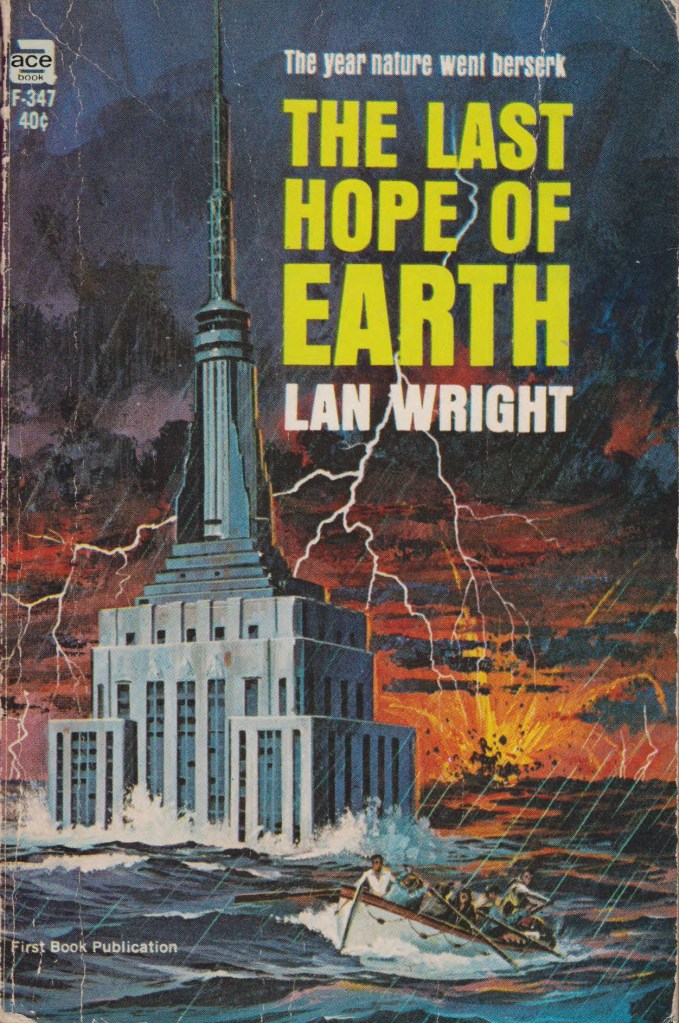
Uncredited cover for the 1st edition
From the back cover: “Was the answer to the blight that was destroying the world’s waterways… MARS?
Was the solution to the deadly smog blanketing out the world’s sky… MARS?
Was the road back to civilization amid the chaos of worldwide anarchy… MARS?
But if THE LAST HOPE OF EARTH was on the Red Planet, why was all news from Mars desperately kept the darkest of secrets?
Lan Wright has written a different science-fiction novel, packed with suspense and the unexpected!”
Initial Thoughts: A few months ago a reader of the site mentioned the presence of generation ships in Wright’s novel — you know me and my plan to read all pre-1985 accounts of generation ships even if they’re awful! My most recent post in the series: Poul Anderson’s “The Troublemakers” (1953).
3. Watchstar, Pamela Sargent (1980)
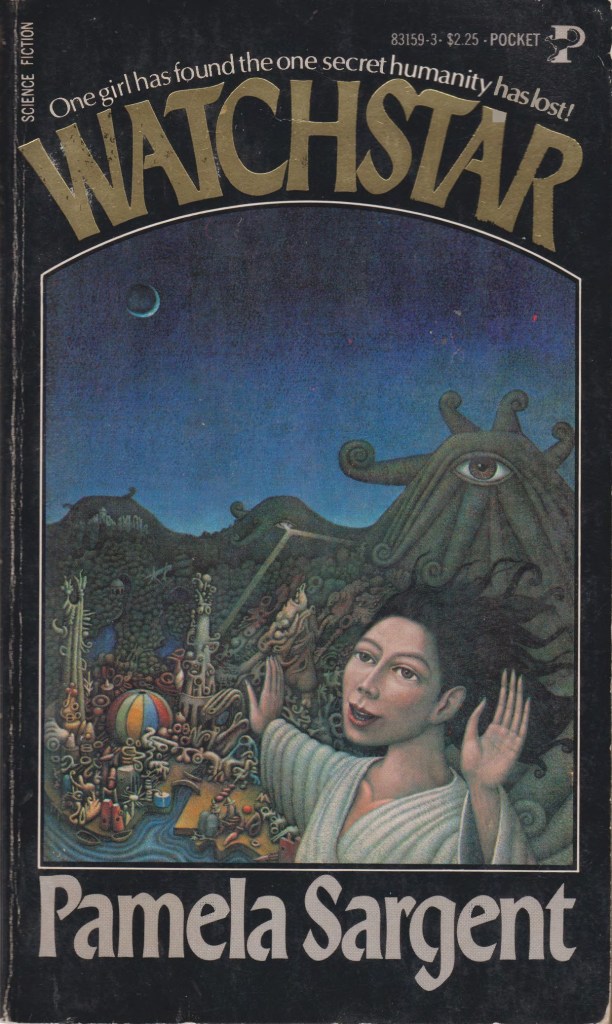
Terrance Lindall’s cover for the 1st edition
From the back cover: “Rite of Passage…
In the desert, Daiya had to face her ordeal. Alone. If successful, she could join the Net of her village. If she failed, she would join the Merged Ones and die. But the mountains spoke to her in their jewel tongue, the discovery of a starship and an alien presence told her of worlds beyond worlds–leaving her unfit for her own life, unable to know another, and in possession of a dread secret her people needed as much as they shunned.”
Initial Thoughts: I’ve slowly been acquiring all of Sargent’s pre-1985 catalog. Now I need to read them!
4. Afterwar, ed. Janet Morris (1985)
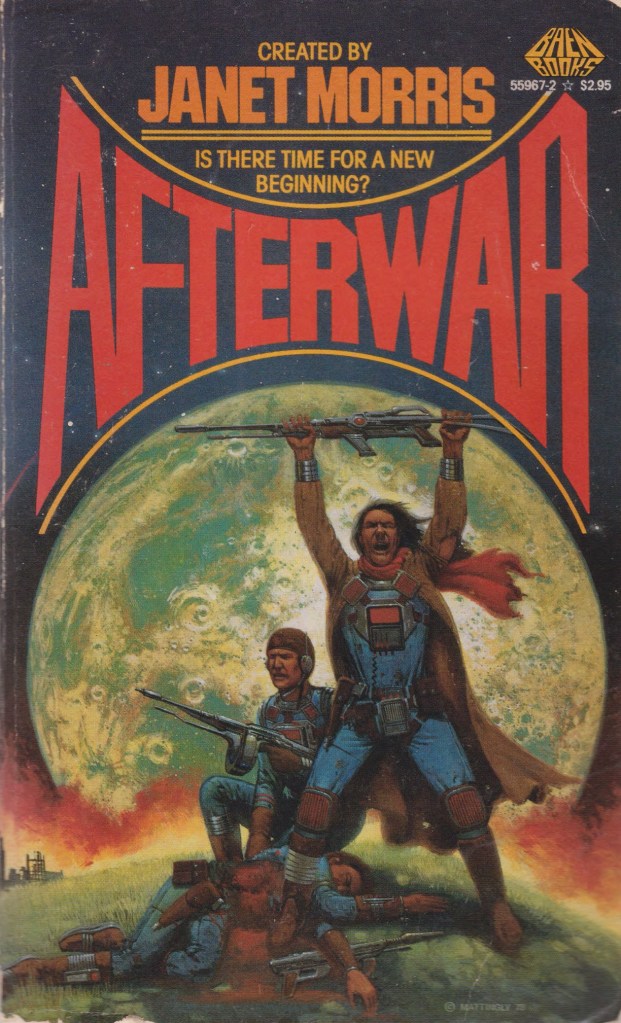
David Mattingly’s cover for the 1st edition
From the back cover: “C J. CHERRYH
Many, many years from now will rise a new religion, founded in the Last War and surrounded by mystery. And it will have its heretics…
GREGORY BENFORD
A group of survivors sets forth to determine whether they are truly alone…
DAVID DRAKE
Gour men guarding a precious secret face a band of well-armed marauders. But a few true professionals can sometimes equal an army…
JANET MORRIS
The stranger wasn’t welcome in Chilmark, but he was given one good meal and pointed to the right road…”
Contents: Janet Morris’ “Hero’s Welcome” (1985), Michael Armstrong’s “Going After Arviq” (1985), Gregory Benford’s “To the Storming Gulf” (1985), Stephen Leigh’s “Flamestones” (1985), Diana L. Paxson’s “The Phoenix Garden” (1985), Esther M. Friesner’s “Primary” (1985), Ian Watson’s “When Idaho Dived” (1985), C. J. Cherryh’s “Pots” (1985), Craig Shaw Gardner’s “Bar and Grill” (1985), David Langford’s “Notes for a Newer Testament” (1985), David Drake’s “The Guardroom” (1985)
Initial Thoughts: I love the theme of this anthology and the idea of finally reading authors I’ve avoided for whatever reason (David Drake, Janet Morris, et et.). I have a lot of great anthologies lined up this year — I hope to maybe squeeze this one in too.
For book reviews consult the INDEX
For cover art posts consult the INDEX
For TV and film reviews consult the INDEX
 Science Fiction and Other Suspect Ruminations
I haven’t read the Lan Wright book in your pile, but I have read plenty of his work in the old UK magazines, and it doesn’t much impress–to put it euphemistically. Here’s an example of his thinking, from a guest editorial in NEW WORLDS #125: “[STARSHIP TROOPERS] is an entertainment, and a rattling good adventure story. It is not, cannot be (and was probably never intended to carry) any sort of philosophical message. Any message has been grafted on by a semi-intellectual hysteria emanating from pseudo-intellectual morons who batten on the ideas of others under the grossly misused heading of ‘criticism.’”
Yeah, I 100% assume the novel will be pretty awful. And wow, that is one misguided/ignorant take on Starship Troopers for sure.
I like how Wright hedges his bet (?) or simply contradicts himself. “The novel cannot be read this way, and oh wait, it probably was never intended to carry a message.” OK…? Well, if it may have once been intended to carry a message, it doesn’t seem to make sense that it now definitely cannot be read in this manner.
There’s probably good reason you’ve avoided reading David Drake. I’ve never read anything by Drake I’ve truly enjoyed. “Than Curse the Darkness” is the one story by Drake I’d recommend, if I were to be forced. It’s a Lovecraftian horror story set in the Congo Free State. I wouldn’t call it a great story, but Drake tried something different for the time.
I’ve also never read anything by Janet Morris. The Ian Watson story would appeal to me.
The comment certainly doesn’t make sense. It reminds me of the “science fiction shouldn’t be political” crowd. Maybe they were just ignorant of the message intended by the author… or how it’s impossible to separate the creative work from the context of the day. Or how even deliberately “unpolitical” works are in themselves making a statement that is, obviously, political.
As for Drake, I always like exploring new authors, even if I end up not enjoying their fiction. Exploring is part of the fun. I, too, want to return to Watson. I’ve thoroughly enjoyed what I’ve read of his (The Jonah Kit, The Embedding, and the stories in The Very Slow Time Machine).
The pejorative use of “pseudo-intellectual” and “semi-intellectual” in the same sentence (by an editor, no less!) is some egregiously bad writing, shameless gaslighting re: Heinlein’s bluntly obvious politics aside.
’tis illogical in every way for sure. Any books from the post interest you?
Sargent’s the only one I’m familiar with so I’d probably start there, although any anthology of the era is bound to have something of interest.
I should have a review of a wonderful anthology up today! But yes, I adore anthologies… especially when they include authors that I haven’t read in a long while and can’t convince myself to read an entire collection by them.
The only Lan Wright novels I’ve read are The Pictures of Pavanne and Who Speaks of Conquest?, and based on them, I endorse John Boston’s views.
As for the rest of the books — I haven’t read any of them either, and I suspect the only story I’ve read is Cherryh’s “Pots”.
Hello Rich, glad the comment feature is working again for you! I’m convinced that WordPress installs some random update and then spends the subsequent week trying to fix their mistakes…
Yeah, the only reason I acquired the Wright is due to the supposed presence of a generation spaceship. I imagine it’s a pile of crud.
Cherryh’s “Pots” sounds like my cup of tea. I’ve been meaning to return to her work for far too long. She was very much an author I was obsessed with in my childhood that I’ve only infrequently returned to.
Ah, memories. I once described WHO SPEAKS OF CONQUEST? as “another of Wright’s exercises in mechanical cleverness, scaled up from yard goods to light-year goods,” featuring “a sequence of space battles which seems to owe equally to C.S. Forester and to a particularly elaborate pinball machine.”
Always interesting! I’ve only read The Last Hope of Earth. And I admit I bought it for the striking cover. I sought and read Wright’s other novels and rated this book his best, but that’s not saying much since I rated the cover much better than the content. As for the other books: I’ve been burned enough times so I’m leery of cover blurb lies re: Cole; I’ve no interest whatsoever in Sargent; and I’ll keep an eye out for Afterwar, since it contains Drake’s The Guard Room that I’ve never read before.
For me, part of the fun is exploration — even if a cover blurb might overstate that qualities of a particular work. The theme, on the other hand, is one in which I have an encyclopedic interest (50s/60s/70s takes on America’s expansion of Cold War intervention).
I agree that we have different reasons and definitions of fun. After 60+ years of reading I’ve been engaged in early SF from 1805-1920 (including utopias, dystopias & lost worlds), SF magazines of the 1950s and novels/collections/anthologies from the 50s & 60s that I never read before.
I’m most surprised at the early SF: I finally read Shelley’s Frankenstein for the first time, discovering how different it was from the movie starring Boris Karloff; the insight of HG Wells, other than The Time Machine and The War of the Worlds; and the other early women writers I’d never heard of before: Anna Bowman Dodd, Elizabeth B. Corbett, Mary E. Bradley Lane and Anna Adolph to name a few. Luminist.org, archive.org and gutenberg.org are great sources for exploring!
Lastly, I always find your exploration of the what I call the esoteric eddies of SF intriguing that very often leads me to explore where I’ve never been before!
You certainly have an admirable higher tolerance for the earlier stuff! If I had a historical question I was desperate to answer, I would read more pre-WWII SF. I dabble only when I have some topic I’m obsessively exploring at that moment. And thank you for the list of authors down below — I am perversely fascinated by Anna Bowman Dodd’s anti-socialist tract. If any of those early works touch on unions or organized labor, let me know!
And thank you for the kind words.
I posted earlier today a review of the Cole novel!