Which books/covers/authors intrigue you? Which have you read? Disliked? Enjoyed?
1. Tom O’Bedlam, Robert Silverberg (1985)
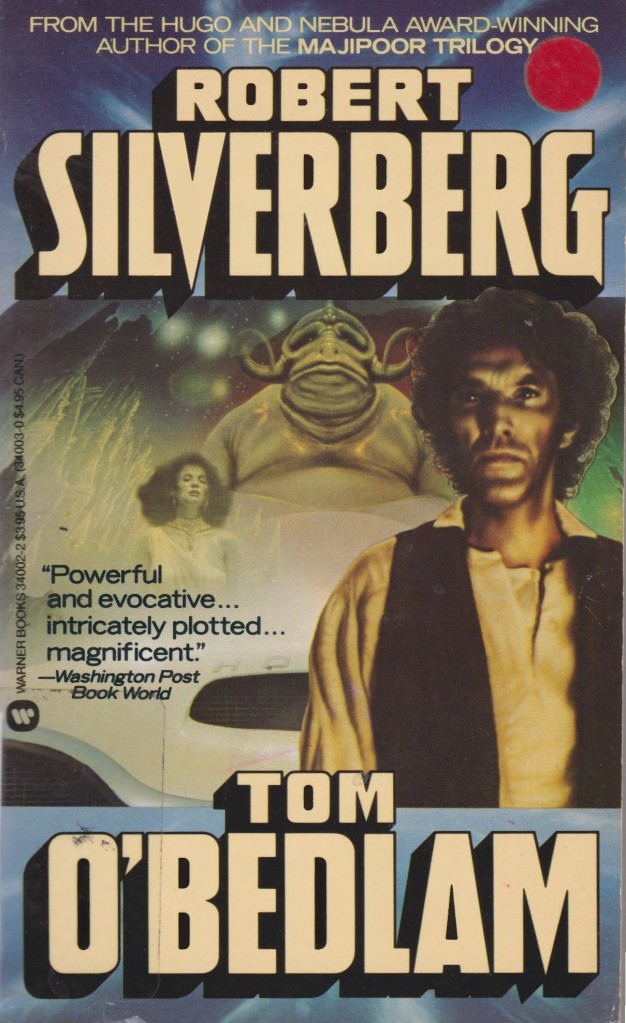
Jim Burns’ cover for the 1986 edition
From the back cover: “MESSIAH OR MADMAN? It is 2103 and Tom O’Bedlam, madman, prophet, and visionary, wanders through California, dwelling place of the last humans on a continent decimated by radioactive dust. Tom, caught up in a living vision of distant worlds ruled by godlike beings, is the herald of a new age, a herald no one wants to hear until others too begin to dream of salvation beyond the stars. Yet while many dream, only tom has the power to make the wondrous visions real, to give people the ultimate escape they desire. Across the universe they must go… if Tom is humanity’s last hope–and not its final destroyer.”
Initial Thoughts: Just rounding out my pre-1985 Silverberg collection as he’s a favorite of mine!
2. Line to Tomorrow, C. L. Moore and Henry Kuttner (as Lewis Padgett) (1954)

Mitchell Hooks’ cover for the 1st edition
Inside description: “The world of Lewis Padgett-a world where anything can happen and usually does–where the unreal is made real–the improbably made possible.
Where ordinary people do extraordinary things–where a man can own a radio that washes dishes, father a superman, or eavesdrop on a telephone conversation between people who haven’t been born.
It’s a weird, wild, but strangely real world. Once you enter it, you won’t want to leave.”
Contents: “Line to Tomorrow” (1945), “A Gnome There Was” (1950), “What You Need” (1945), “Private Eye” (1949), “The Twonky” (1942), “Compliments of the Author” (1942), “When the Bough Breaks” (1944).
Initial Thoughts: Ever since I read their collection Clash by Night and Other Stories (1980) (and the joys of the 1946 shocker “Vintage Season”) I’ve been eager to track down more of their co-written fiction. Despite my dislike of “When the Bough Breaks” (1944)…
3. How Are the Mighty Fallen, Thomas Burnett Swann (1974)

George Barr’s cover for the 1974 edition
Back Cover: “Cyclops and sirens, halfmen and godlings… That of which myths are made and that from which worship arises–these are the materials Thomas Burnett Swann weaves together in the fantasy-historical tapestry of this new novel, which he considers to be his most important work to date.
For the author of Green Phoenix and The Forest of Forever now tells of a queen of ancient Judea who was more than human, of her son who became legend, of their cyclopean nemesis whose name became synonymous with colossus, and of loves and loyalties and combats fixed forever in the foundations of human society.
The ever-growing audience that Thomas Burnett Swann has gathered for his unique novels will find How Are the Mighty Fallen a new fantasy fiction experience.”
Initial Thoughts: I still have yet to read any of his work. I saw reference to his brand of fantasy crop up in a few articles about sexuality in SF — he seemed very open to integrating gay characters.
4. The Thinking Seat, Peter Tate (magazine 1966, novelized 1967)
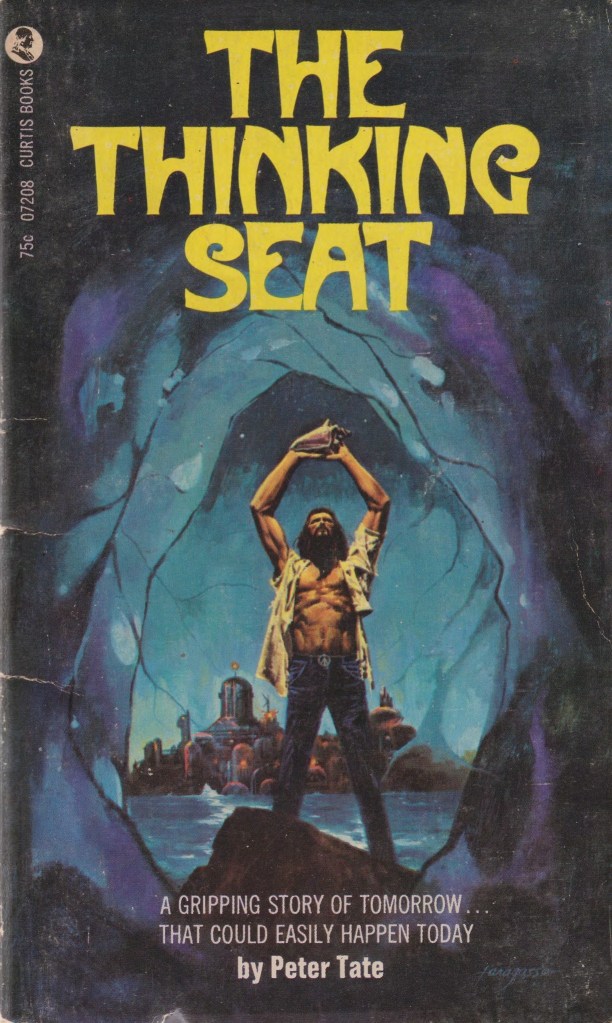
John Faragasso’s cover for the 1969 edition
From the back cover: “It is only 1973. Yet the beautiful California coast has undergone a tragic metamorphosis. Progress has arrived in the form of a large desalinization plant transforming the majestic tides into fresh water units, the rugged coastline into lush, green Edens. Most people accept the change as a necessity for survival.
Then a man named Simeon and a devoted girl disciple arrived in the coastal town of Playa 9. Simeon begins to preach against man’s subjugation of nature. Soon he becomes the prophet of a counter-culture group called the Budkins. Most of the other citizens regard him as a harmless nut… except the powerful group of men who all themselves Co-Ordinated Interest Association. For them Simeon represents an encroching [sic] menace that must be stopped.”
Initial Thoughts: Tate is a New Wave author whom I have only recently had my eyes on. I am all for SF that engages (in positive or negative ways) with the Counterculture so I hope to get to this one this year. For the Galactic Journey‘s take–here.
For book reviews consult the INDEX
For cover art posts consult the INDEX
For TV and film reviews consult the INDEX
 Science Fiction and Other Suspect Ruminations
Henry Kuttner and C.L. Moore are always fun to read, especially in their shorter works. “A Gnome There Was”, if I am remembering correctly, starts off as a light-hearted romp and ends terrifyingly dark. It is often held up as a perfect example of an author loosing control of his/her story.
Thomas Burnett Swann was the center of controversy in his day because of his attitude about sex. The baby on the cover (a beautiful piece by George Barr) is named Johnathon. His relationship with his good buddy* David, figures later in the book.
*Friends are friends and pals are pals but buddies sleep together.
Hello,
Apparently “A Gnome There Was” contains a positive take on unions!
But yes, I acquired the Swann due to that content. I’m always interested in SF from that era that pushed various boundaries when it came to sex and sexuality.
The Peter Tate novel sounds interesting. I have read some of Tate’s short fiction in anthologies. I’ll be looking for this novel.
On the subject of hippies and the counter-culture in fiction (we have a shared interest), have you read Sacred Locomotive Flies by Richard A. Lupoff yet? I read it in December. It was an amazing read, and I’m not usually interested in Lupoff as a writer. If you find a copy and start reading it, give it until the third chapter before judging the novel. Lupoff started out writing the novel as a satire short story of the New Wave, especially Moorcock’s Jerry Cornelius stories, and it’s not exactly good. However, somewhere along the way, Lupoff decided to expand it into a novel, and somehow Lupoff ended up writing a New Wave science fiction book instead of an attempt to satirize the New Wave.
Thank you for the Lupoff recommendation. I don’t think I’ve read any of his work.
I think I’ve read all the Padgett stories – but I don’t quite remember the details. I bet if I started Gnome or Line to Tomorrow I’d remember them instantly (I haven’t been able to forget Bough – a prototypical example of the post-war response to the Baby Boom).
I can’t say I adored “Bough” but I’ve enjoyed quite a few of their other co-written works — and of course work written individually by both.
“Private Eye” might be the best of the Padgett stories, with “The Twonky” not far behind. Both “A Gnome There Was” and “Compliments of the Author” are good examples of capable writers being sloppy; they both should have been considerably shorter.
Thomas Burnett Swann is a very fine writer but far from your announced preoccupations. I haven’t read this one.
Re-the Swann — I am seduced by great review articles. https://seanguynes.com/2025/03/22/reading-the-tournament-of-thorns-by-thomas-burnett-swann/
He covers a different work but when I found this in a bargain bin at a local book store I couldn’t resist.
I’ve been looking for their collection named A Gnome There Was, which was old when I read it in the 70s. I loved it. The inspiration for the movie The Last Mimsy—titled “Mimsy were the Borogoves—was in it, and it made a big impression on me. Never forgot it. But on eBay, the book is crazy expensive.
Yikes, definitely not cheap! At least the stories in that collection appeared in others.
That’s a nice haul! It’s been a few decades since I read any Swann, but as I recall his books would fit right in with the current cozy fiction trend. Margaret St. Clair’s novel The Dancers of Noyo is my favorite counterculture SF.
Hello Jim,
Thanks for visiting!
I actually have a copy of the St. Clair — it’s in my massive, unwieldy, bound to collapse and trap my cat in a book fort, pile of unposted for this series books. I’ve enjoyed some of the St. Clair I’ve read — her bizarre short story “Stawdust” comes to mind although I never managed to review it. What would you say is her take on the Counterculture? I have an interest in the theme as the topic is given short shrift in most academic works as, perhaps due to the topicality of when they appeared, they were rarely reprinted. Stuff like William K. Carlson’s anti-commune story Sunrise West comes to mind, etc. Works that rarely appear in monographs on SF.
Dancers leans into the hallucinatory, mystical aspect, while remaining firmly grounded in human nature. The original hippies have turned into the Mandarins, sending their children on vision quests whether they want to go or not. From there on it gets weird.
Cool!
Also, if you are new to the site then I highly recommend my 2024 in review to get a glimpse at the range of stuff I like to investigate and current projects 🙂 ! https://sciencefictionruminations.com/2025/01/05/my-2024-in-review-best-science-fiction-novels-and-short-fiction-articles-podcasts-reading-initiatives-and-bonus-categories/
We have similar tastes in Silverbob, I’d be curious to hear your thoughts on how that one measures up to his New Wave period if you ever get around to reviewing it. Typically I tend to avoid his post-70s works (read Majipoor books as a teen and feel no compulsion to revisit) but judging from the blurb it seems more of a piece with his pre-Majipoor era in terms of its themes/concerns.
I plowed through a complete collection of Kuttner/Moore’s stories awhile back and was not disappointed, although yes they could occasionally get overly cutesy or goofy. I do recall “The Twonky” being good, sort of a proto-PKD machines-come-to-life riff.
Very curious about the Richard Lupoff referenced above, never heard of that one before.