
Jack Gaughan’s interior art for Arkady and Boris Strugatsky’s “Wanderers and Travellers” in International Science Fiction, ed. Frederik Pohl (November 1967).
Today I’m joined again by Rachel S. Cordasco, the creator of the indispensable website and resource Speculative Fiction in Translation, for the fifth installment of our series exploring non-English language SF worlds. Last time we covered Kathinka Lannoy’s strange (and unsuccessful) Dutch language story “Drugs’ll Do You” (1978, trans. 1981).
Please note that Rachel and I are interested in learning about a large range of authors and works vs. only tracking down the best. That means we’ll encounter some stinkers! Unlike our last entry, this one isn’t a stinker.
The first translated edition of Boris and Arkady Strugatsky’s “Wanderers and Travellers” appeared in Path Into the Unknown, ed. uncredited (1966). Unfortunately, the translator and editor (I assume Judith Merril as she wrote the intro) is unknown. You can read it online here. You can also read it in International Science Fiction, ed. Frederik Pohl (November 1967) online here.
Enjoy!

Richard Powers’ cover for the 1968 edition of Path Into the Unknown, ed. uncredited (1966)
Rachel S. Cordasco’s Review
Arkady and Boris Strugatsky, two of the greatest science fiction authors of the twentieth century, really should be read more widely in the Anglophone world. Thankfully, the Chicago Review Press has been trying to make this happen, reissuing many classics like Roadside Picnic (1972), Hard to be a God (1964), The Inhabited Island (1971), and more. Together, the Strugatsky brothers wrote an astonishing number of novels, short stories, essays, plays, and film scripts, stretching from the 1950s through the 1980s, many of which have been translated into English.
“Wanderers and Travellers,” credited to Arkady in the November 1967 issue of International Science Fiction but written by both brothers, features a scientist trying to study the changing habits of septopods. He and his daughter live in isolation, following the creatures and marking them in order to understand their movements. A stranger appears one day and begins philosophizing about the existence of “reason” in the universe. An astro-archaeologist (a job that the scientist thinks to himself is rightly criticized), Gorbovsky explains to Stanislav Ivanovich that his “task is to find some traces of Reason in the universe, and I am still not clear myself as to what Reason is….For instance, I find a termite mound. How am I to know whether it has been constructed by an intelligent mind or not?” (11-12). Gorbovsky invites the pair, and us readers, to consider a radical shift in perspective, reminiscent of Stanislaw Lem’s Solaris (1961), in which an entire planet forces a change in perspective on the part of a human scientific crew attempting to understand it.
According to Gorbovsky, humans don’t even know where to look for “reason,” and would likely not recognize it if they found it. He then goes on to list some phenomena that humans can’t explain, like the“ Voice of Empty Space” that broadcasts to lonely explorers and can’t be deciphered, and the fact that Gorbovsky and his two former shipmates are somehow “signalling” across the universe without understanding why.
Stanislav Ivanovich quietly tries on the astro-archaeologist’s perspective for himself, wondering “if I were to be marked the way I mark the septopods…” (16). Like Lem, writing around the same time as the Strugatsky brothers, this story offers readers a chance to think more humbly about humanity’s place in the universe by considering how little we know, in fact, about the creatures that share the planet with us.
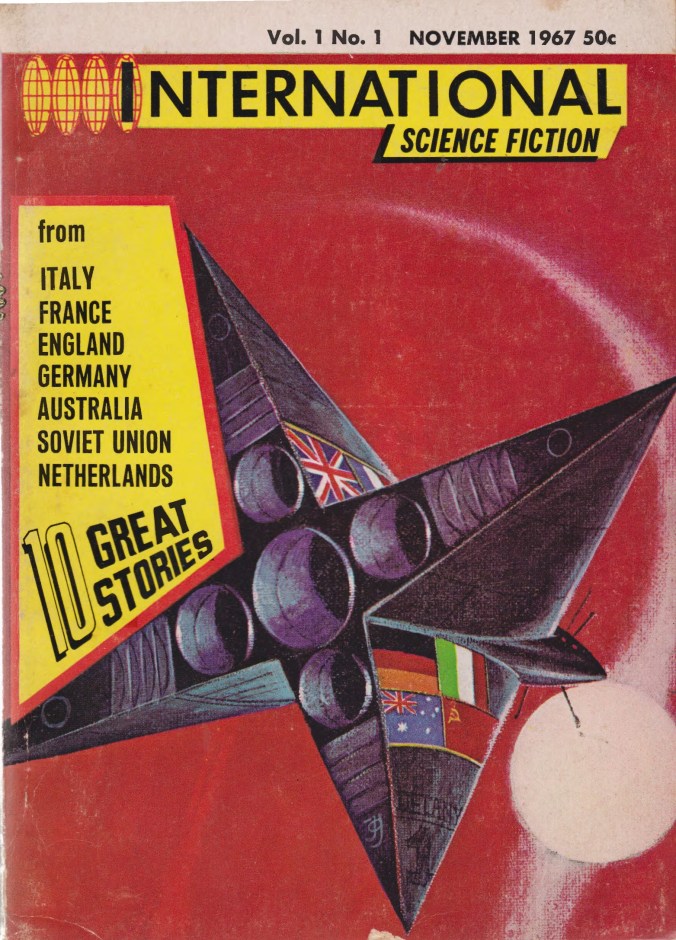
Jack Gaughan’s cover for International Science Fiction, ed. Frederik Pohl (November 1967).
Joachim Boaz’s Review
4/5 (Good)
I must confess that the work of the Strugatsky Brothers is an embarrassing absence in my knowledge. I’ve read, enjoyed, but never reviewed The Ugly Swans (1972, trans. 1979). I’ve consumed with meditative glee Andrei Tarkovsky’s Stalker (1979) (and rank it amongst my top five cinematic marvels) but never managed to track down a copy of the Strugatsky source material: Roadside Picnic (1972, trans. 1979). In an effort to encourage myself to tackle more of their work, I suggested to Rachel that we should cover “Wanderers and Travellers” (1963, trans. 1966). Unfortunately, Rachel sent me her review more than a year ago. I’ve dragged my feet. Why? I don’t have an easy answer. There are authors that feel daunting to write about. And as someone possessed by whim with a vast library, it’s often easier to pick something else in the few moments I have to write… I’ve finally escaped the gravimetric pull of other projects. And, unsurprisingly, I’m glad I did!
“You, Me, Septopods?“
Stanisław Ivanovich spends his days submerged in lakes and rivers tagging septopods, a new octopus-like species discovered on Earth. He describes as “very much like the tattered ends of an old gray rag,” with a “lusterless eye, half-covered by the eyelid” that shines “wanly in the dim light” (9). His daughter, Marsha, assists from above. When he emerges from a lake, Marsha is deep in conversation with Leonid Andreevich Gorbovsky, an astroarchaeologist implied to be on leave from an expedition. The two scientists–IIvanovich, with his eyes on earthly mystery, and Gorbovsky, untangling the traces of potential intelligences across the cosmos–and Marsha engage in a series of discussions about the nature of the universe.
Ivanovich explains how the septopods seem driven by some unknown force to crawl across the land and enter freshwater abandoning females and young in saltier waters (14). Gorbovsky ruminates: “for centuries they used to sit in the depths and now they come out into the unknown and hostile world. What urges them on? An ancient dark instinct, you say? Or a method of handling information that has reached the stage of extreme curiosity?” (14). Astroarcheaologists encounter similar mysteries but on the cosmic scale. Gorbovsky explains his task: “find some traces of reason in the universe” (12). The problem? How can one identify what an alien remnant might be? “How am I to know whether it has been constructed by an intelligent mind or not?” (12). In one of a series of fascinating conjuration of the alien, Gorbovsky ponders a planet devoid of an atmosphere: “suppose their sole aim in life is to destroy atmosphere whenever they encounter it” or “hybridize life” or “create new life” (12). Can we identify when these processes are the remnants of the alien?
In the final weaving of the ruminative net, Gorbovsky reveals two further mysteries: the unknown origins of a voice in a foreign language broadcast across space and his own radio resonance. The voice cannot be decoded. The origin of the resonance within him cannot be identified. The parallels are clear. Like the septopod journeying headlong into new lands, we trek the cosmos unable to entirely comprehend the world we encounter. There must be signs of the alien out there but… what are they? And like the Ivanovich’s tagged septopods, we too radiate–tagged by something somewhere else–in the dark dark night.
Final Fragmentary Thoughts
This is a ruminative story, a dialogue between three people curious, confused, and fascinated by the world in which they dwell. Stories from the Soviet sphere–from Stanislaw Lem’s Solaris (1961) to Vladimir Colin’s “The Contact” (1966, trans. 1970)–are adept at problematizing the nature of the alien. Ultimately, I found “Wanderers and Travellers” a tantalizing, if perhaps lacking in full impact and expansion of the ideas dangled before us, window into their fiction. Recommended. I’ll be reading more stories from the Strugatsky brothers!
For book reviews consult the INDEX
For cover art posts consult the INDEX
For TV and film reviews consult the INDEX
 Science Fiction and Other Suspect Ruminations
Hi Jochen (common german contraction for Joachim),
LinuxLea from Bluesky here!
Hello Hello, thanks for stopping by! If you end up reading the story, let me know. Do you have any favorite Strugatsky tales?
A few general notes
Thank you. I saw that it was in that sequence but as I have not read enough stories to entirely understand the connective tissues across the novels and stories I did not mention it. What were your thoughts about the story itself?
Bearing in mind that I’ve read the whole sequence fairly recently and initially I wasn’t able to recall the story – it hasn’t impressed me. Upon reading your review I recalled it, it was one of the stories that I like when I am reading it, but which doesn’t stay in my memory (which is my memory’s fault)
I read ‘Wanderers and Travellers’ (translated as ‘Pligrims and Wayfarers’ in the collection ‘Noon: 22nd Century’ (1978)) more than a decade ago. I recall it being more meditative than some of the other stories, but that this quality worked well alongside the other stories in the collection.
In that read through I also read most of the associated Noon Universe novels as well (Escape Attempt, Far Rainbow, Hard to Be a God, The Final Circle of Paradise, Prisoners of Power, Space Mowgli, The Kid from Hell, Beetle in the Anthill, The Time Wanderers). One of the things that is striking about doing that–at least from the Hard to be a God and on (though perhaps also from Far Rainbow and on)–is that one can track the growing disillusionment of the Strugatsky’s in the Soviet system. What begins as a relatively straightforward representation of a communist utopia (definitely on display in Noon: 22nd Century) begins to unravel.
I can’t help but feel that Ian Banks was profoundly influenced by them in writing his Culture novels.
Hello Anthony,
It was delightfully meditative. I am far behind in my Strugatsky reading adventure — as I said, only this story and The Ugly Swans (which isn’t in the sequence to the best of my knowledge). I have thought about reading Hard to be a God but, I dunno, I bounce off a lot of explicit “medieval” SF analogies. I need to get into my “medievalism as a topic” mentality vs. a more realistic take on the “medieval.”
Thanks for stopping by. I always appreciate your comments.
I haven’t read The Ugly Swans, though I own a lovely first edition of the English translation.
I hope you do finally read Hard to be a God. It’s really very good. If it helps any, the Strugatsky’s set it on a “feudal” planet (parallel evolution and social development!) mostly so they can have a go at the Soviet version of Marxist orthodoxy and the latter’s vision of “necessary” historical development. For a Marxist nerd like me it’s a great take down.
But if it’s still off putting try Far Rainbow or Prisoners of Power. Or, why not just crack the entire Noon: 22nd Century collection of short stories?
Otherwise, if the Noon stories aren’t enticing just read Roadside Picnic (and make sure it’s the 2012 translation by Olena Bormashenko and not the censored, earlier translation from the 1970s).
Yes, I’d say Hard to be a God isn’t so much about a “medieval” society as it’s about our tendency to see a particular society as necessarily fitting an established box like “medieval”. A criticism of historical materialist orthodoxy, but it could arguably also be seen as a criticism of medeivalism in SF.
I like the idea that one can read Hard to be a God as a critique of the rampant faux-medievalism in SFF–though I don’t think this is actually the intention of the authors (but it is an interesting idea nonetheless).
What more startling about the work is that you could read the society of Arkanar as an analogue for the USSR, which was supposedly on its way to “realizing” communism (just as the Arkanar society is being pushed toward a more complex, industrial society by the agents from Earth). Of course, this goes horribly wrong–just as it did in the USSR–though long before the 1960s!
I really should read it!
To me the Strugatskys short stories always seemed more ordinary that the novels – but maybe that’s just because they were relatively early works. This certainly sounds interesting. I have a copy of Path into the Unknown – the only one of my Soviet SF-collections that I haven’t read yet – so I’ll be looking forward to it.
Let me know your thoughts when you get to it. I found it a quiet ruminative little story with some nice observations. I obviously haven’t read enough to make any sort of distinction between the short and longer works.
Pingback: The Strugatskys at SF Ruminations – Speculative Fiction in Translation