Which books/covers/authors intrigue you? Which have you read? Disliked? Enjoyed?
I apologize for the photos of my copies instead of my normal hi-res scans. My scanner died suddenly. Goodbye Dutiful and Dedicated Recorder of the SF Volumes.
1. Always Coming Home, Ursula K. Le Guin (1985)

Chris Hopkins’ cover for the 1986 edition
From the back cover: “Ursula K. Le Guin’s Always Coming Home is a major work of the imagination from one of America’s most respected writers of science fiction. More than five years in creation, it is a novel unlike any ever written. A rich and complex interweaving of story and fable, poem, artwork and music, it totally immerses the reader in the culture of the Kes, a peaceful people of the far future who inhabit a place called the Valley on the Northern Pacific coast.”
Initial Thoughts: Always Coming Home was the only Le Guin novel published in 1985 or earlier that I had yet to acquire. It’s a daunting, massive (563 pages), and immersive book. Not sure what will convince me to put gather the willpower to pick it up! (I know I’ll be transfixed).
2. Red Shift, Alan Garner (1973)
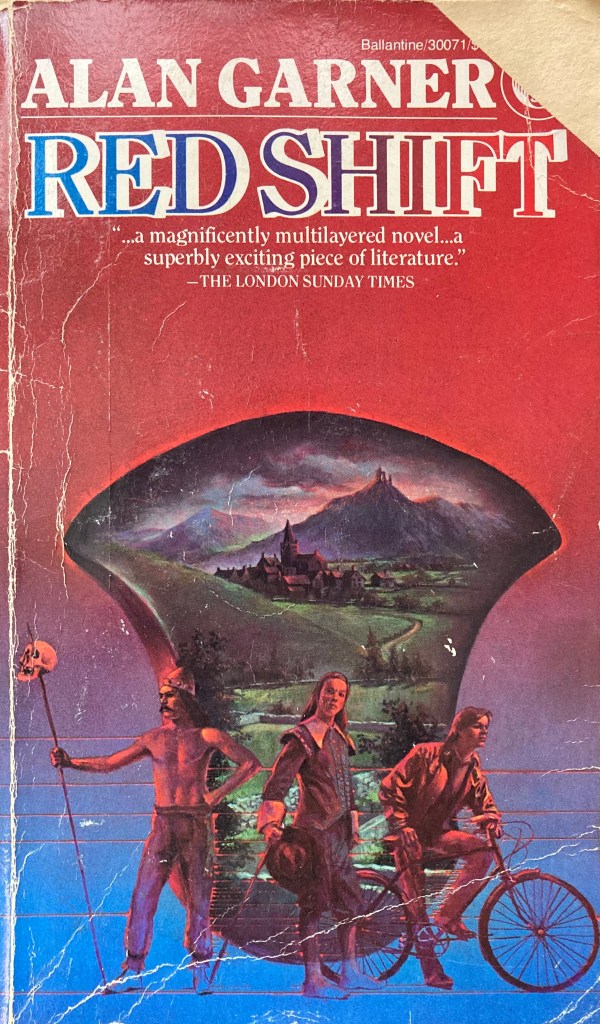
Laurence Schwinger’s cover for the 1981 edition
From the back cover: “In a superb fusion of fantasy and reality, this compelling novel moves back and forth among three young men, separated by time but bound together by a neolithic stone axe-head that each possesses for a brief time.
Tom comes from the twentieth-century world of trailer parks and high-speed motorways; Mace inhabits the second-century Britain of warring tribes and Roman legions; and Thomas is caught up in the seventeenth-century war raging between the King and Parliament. Each faces a critical moment of choice, when fundamental decisions must be made about love, responsibility, and faith. Each influences the destiny of the others as the carriers of time dissolve.”
Initial Thoughts: I’d read a few reviews and when I saw a copy for a buck (albeit the beat up edition shown above) I couldn’t resist. Not sure what to expect.
3. Mirrorshades: The Cyberpunk Anthology, edition. Bruce Sterling (1986)
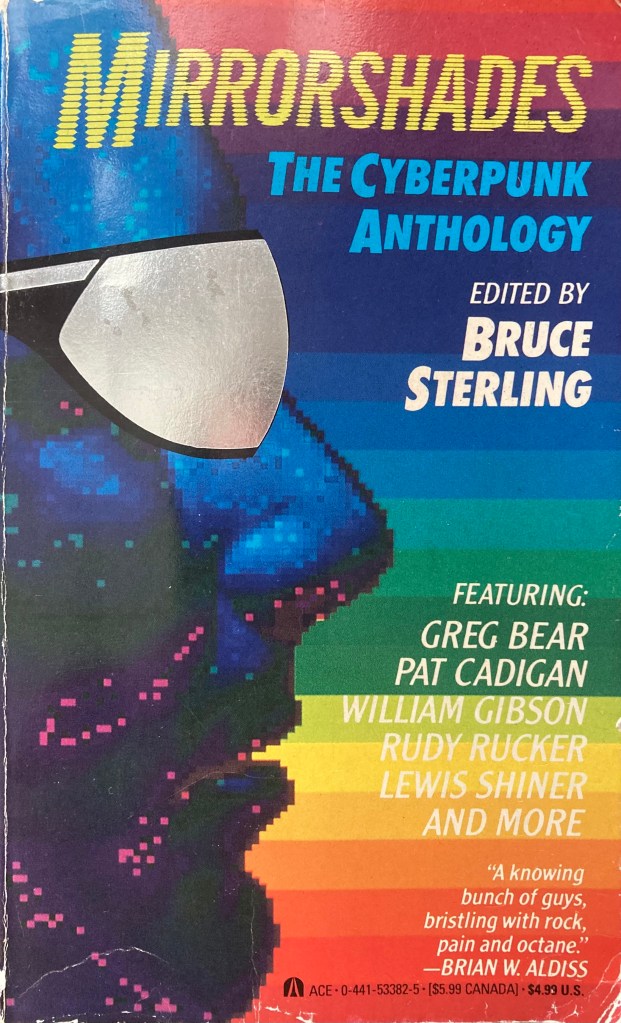
Uncredited cover for the 1988 edition
From the back cover: “They explored on the scene in a white-hot flash of pure talent. With their hard-edged, street-wise prose they created frighteningly probably futures of high-tech societies and low-life hustlers. Fans and critics called their work cyberpunk. And their surreal, decadent futures made science fiction history. Here in one volume is the definitive cyberpunk short fiction collection, including twelve stories and collaborations by the most startling talents in the field. also included, an original essay on the cyberpunk movement by ward-winning author Bruce Sterling.”
Contents: William Gibson’s “The Gernsback Continuum” (1981), Tom Maddox’s “Snake-Eyes” (1986), Pat Cadigan’s “Rock On” (1984), Rudy Rucker’s “Tales of Houdini” (1981), Marc Laidlaw’s “400 Boys” (1983), James Patrick Kelly’s “Solstice” (1985), Greg Bear’s “Petra” (1982), Lewis Shiner’s “Till Human Voices Wake Us” (1984), John Shirley’s “Freezone” (1986), Paul Di Filippo’s “Stone Lives” (1985), William Gibson and Bruce Sterling’s “Red Star, Winter Orbit” (1983), Lewis Shiner and Bruce Sterling’s “Mozart in Mirrorshades” (1985).
Initial Thoughts: As readers know, most of my cyberpunk reading happened before my website. That said, I needed a copy of this historically important anthology!
4. Blood Knot: A Novel, Burt Cole (1980)
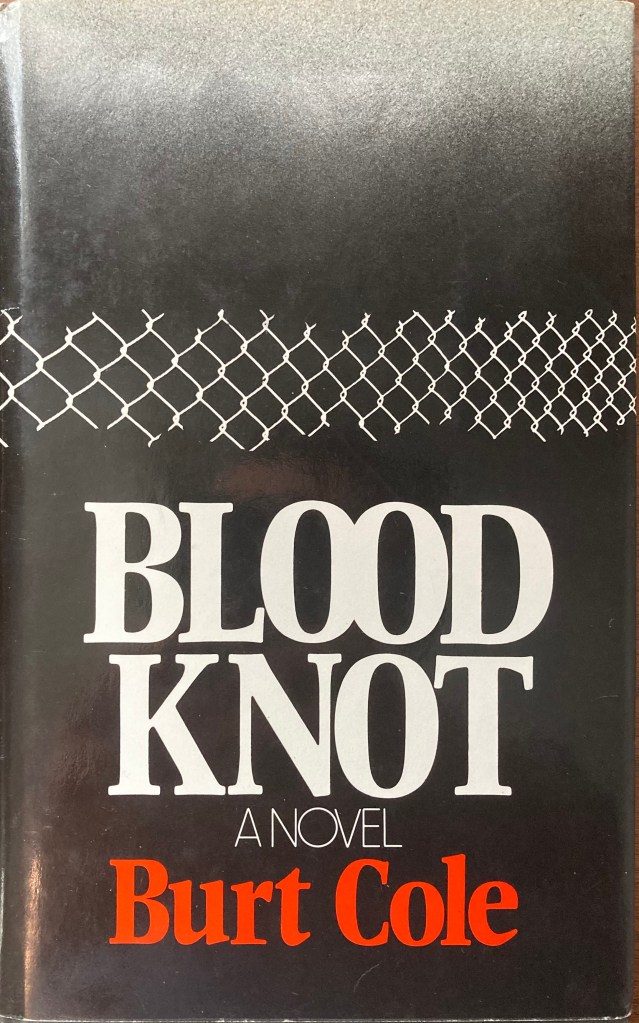
Uncredited cover for the 1st edition
From the inside flap: “The next America Civil War is coming.
The Chaos had begun the breakdown of the system.
The Famine had made the people angry.
The Terror had unified the freedom fighters into the People’s Freedom Army, which had held its own against the combined might of the U.S. Army, the National Guard, and the state law-enforcement agencies. Now, at the end of the two years of armed conflict, the PFA dominates the forests and countryside, the U.S. Government the urban centers. It is a stalemate.
With a war both highly surreal and utterly credible as its scenario, BLOOD KNOT defines two men’s private conflict. One is Kindred, a soldier of fortune and practice guerrilla, whose task is to train the recruits in the art of efficient and dispassionate killing. His message: ‘We will not be concerned with moral considerations, religious couples, personal convictions, or political justifications. Not why to achieve the end, but how. The kill.’ His credo: ‘Painstaking thoroughness is the hallmark of the professional.’
The other is Mano, reduced to noncombatant status by a wound received in the raid on Trenton. In Kindred’s unfailing calm, Mano senses an evil which oppresses him, unnerves him, and finally obsesses him. And in the end he revolts with a force that astounds him no less than his victim.
Extraordinarily compelling, BLOOD KNOT confronts the moral issues of our violent past and uncertain future, themes present in Burt Cole’s highly acclaimed first novel, SUBI: The VOLCANO. Unrelentingly suspenseful, BLOOD KNOT succeeds both as first-rate fiction and as chilling chronicle of our times.”
Initial Thoughts: I never grow tired of dystopia imaginings of a future America. Even if it feels like we’ve already slid into one… I reviewed Burt Cole’s first SF novel Subi: The Volcano (1957) recently.
For book reviews consult the INDEX
For cover art posts consult the INDEX
For TV and film reviews consult the INDEX
 Science Fiction and Other Suspect Ruminations
I think “Always Coming Home” is one of LeGuin’s great masterpieces.
What did you enjoy about it?
When I was in college (forty years ago!) this was published and I grabbed it as soon as I could because I loved the anthropology courses I took and to have her doing an ethnography style novel seemed exciting and different. I think this is a more impressive example of world building than “Dune” (yes, I know what I am saying). I have the originally published edition with the cassette of Kesh music and songs, and I have the Library of America expanded edition but haven’t read it yet.
I have faint memories of seeing a copy of the book as a teen at my local used book store with a cassette — now I know why!
But yes, from what I’ve heard it’s an utterly immersive reading experience.
I have odd taste in SF, and have found a lot of the old classics to be of slight quality or worse. For me, this is a classic and a notable work of post-modernism. It was a finalist for the National Book Award for fiction but was beaten out by Don DeLillo’s “White Noise” (which I also consider SF).
I’ve gotten to the point where if a work of science fiction doesn’t help answer a historical question I want to answer I probably won’t read it — regardless of the quality. The historical context gets me humming. Anthologies, collections, and entire magazine issues (my brief, but perhaps ongoing, series on Galaxy for example) are the exception. They force me to branch out a bit.
I acquired one of DeLillo’s novels recently — End Zone (1972). While not SF (to the best of my knowledge), it definitely is a bit on the apocalyptic (-ly violent) side of things (in the words of one review, the novel is an extended sequence of “hilarious riffs on the parallels between football and nuclear war”)… and I attended high school in a rural Texas school district where football was king so I couldn’t resist.
DeLillo is a favorite of mine and I have read all of his work (even his pseudonymous novel and his plays). An early novel, “Ratner’s Star” is long and awfully difficult, but it works as a first contact story. Late in his career he has worked in SF themes almost exclusively. “Zero K” involves cryopreservation and immortality and “The Silence” addresses a sudden and total technology failure. Sadly, it is very underwritten and I do not recommend it.
No worries on the later novels — all after 1985 so I am not at all tempted. But yes, I’ve heard of but not read Ratner’s Star.
And there is a short story from the 80’s titled “Human Moments in WWIII” in which two astronauts orbiting the earth in a space station (like Skylab) watch the third world war unfold below them.
That one I have not heard of. I do love a nuclear war story!
I apologize for going on at length. I hope that you enjoy the LeGuin when you get to it.
Don’t apologize. I love discussion.
And you can read “Human Moments” here: https://granta.com/human-moments-in-world-war-iii/
Thank you.
the LeGuin and Mirrorshades are total classics, albeit things I read um ~30 years apart. I remember reading Mirrorshades when it first came out, but no longer own a copy.
Always Coming Home I read during the pandemic and while I ultimately glossed over some of the ethnographic ephemera (annotated music etc.) I did find it very absorbing once I got into its rhythms. Knowing the locale the story is set in well also leant it some personal weight, easy for me to envision the places and geography she was writing about. You’ll love it.
I’ve read two stories from Mirrorshades — the Cadigan story that I linked (a few years ago) and William Gibson’s “The Gernsback Continuum” in his collection Burning Chrome before my site (albeit, I do not remember it and probably did not entirely appreciate it at the time). Marc Laidlaw’s 1st novel Dad’s Nuke (1986) (acquired a copy a year or so ago) has been on my radar for a bit so I might read his early story in Mirrorshades soonish. I am terrible at making plans. I might just go back to one of my reviews series instead…
But yes, I’ve mostly heard great things about the Le Guin and her world building.
ALWAYS COMING HOME is an uplifting book, and not a shred of sarcasm there. It’s one of the great spirits of the field having a relaxed good time, and herself acknowledging some of the problems with her utopia of choice as she spins it out. And of course the world- (society-) building is splendid. Not really world-building, since the world is the California of her childhood and youth.
I look forward to it. As you know, could be a bit before I open it though…
Can’t say “uplifting” is a word I use much in my SF reading adventures. Hahahaha. I have a perverse desire for the depressive visions.
Well, the two are not necessarily incompatible. Consider EARTH ABIDES, the definitional uplifting book with a depressive vision.
100%. I couldn’t help but be a bit jokey about my own tastes. A depressive book can absolutely uplift in its craft and brilliance. I have not yet read Earth Abides!
I haven’t read ‘Red Shift’ but I have been a fan of Alan Garner for a long time. I read ‘The Weirdstone of Brisingamen’ and ‘The Moon of Gomrath’ at the age of 19 and loved them. The adults I talked to did not like them. I read ‘The Owl Service’ at 30 and hated it. Then, I reread it at 60 and loved it. My theory is that you need to read Garner while you are still young enough that your sense of wonder hasn’t been dulled by adulthood, or when you are old enough that it is starting to come back. I can’t speak for ‘Red Shift’. It may not have that problem but your age is something you might want to keep in mind while reading it.
I am completely new to his work. No worries, I understand. I tend to think of the SFF I read as historical sources of an era — all useful to answer a historical question that I’m burning to answer. I don’t know how Garner fits into a historical question so I probably won’t pick it up yet. Of course, I find some good stuff along the way. All of this is to say, I do not read to only encounter the good stuff or to return to how I felt as a kid (I haven’t returned to any of the nostalgic works from my teenage years — i.e. bloated fantasy sequences like Tad Williams and Robert Jordan). I have thought about removing ratings altogether from my reviews.
Red Shift is more along the lines of The Owl Service and Boneland, an emotionally brutal tale whose current day protagonist is clearly psychologically challenged in dealing with reality, even disregarding the supernatural aspects of the story. It’s very well written but painful.
I think I learned about the book as there is a BBC adaptation for the series Play for Today that someone I followed reviewed. https://www.imdb.com/title/tt0331614/?ref_=ttep_ep_13